


Table of Contents
A garage can hold more moving work than you expect. Tools, shelves and bulky gear need their own plan.
Start early, sort honestly and tell your removalist what needs special attention. This guide gives Sydney households a clear eight-week run-up.

Phase 1: 8 to 6 Weeks Out – Inventory & The Three-Pile Rule
Start eight weeks out when possible. A stitch in time saves nine, especially in a crowded garage.
Empty every surface
Clear benches, shelves, cupboards and floor corners. Work one wall at a time, not the whole garage at once.
Place items in a clear sorting area. Check tubs, drawers and overhead storage before you count anything.
Use a simple garage clean-out checklist. Mark each space as empty, sorted or still needing attention.
Count bulky gear
List large items before you request a removalist quote. Include workbenches, tool cabinets, ladders, compressors and storage racks.
Record each item’s width, height and depth. Add an approximate weight from its label or manual when available.
Photograph unusual shapes and tight exits. The inventory is a map for the crew, not just a memory aid.
Apply the Three-Pile Rule
Use three piles: keep, pass on and dispose. Keep only gear you use or need at the new property.
Why pay to move gear you no longer use? Sell working duplicates, donate useful items and arrange suitable disposal.
Separate broken tools from working tools. Never place batteries, paint or unknown chemicals in ordinary rubbish.
For a more detailed first pass, use this garage clear-out checklist.
A good sort now can reduce carton count, loading time and avoidable quote changes.

Phase 2: 6 to 4 Weeks Out – Hazardous Goods & Sydney Council Clean-Ups
Sort restricted items before packing begins. Better safe than sorry, and council services need time to book.
Check local council rules
Sydney spans many local government areas. Collection dates, item limits and booking rules can differ by council.
Check the waste page for your exact suburb. Parramatta, Blacktown, Penrith and the Inner West may use different services.
Ask whether your clean-up accepts bulky household items. Do not assume it accepts workshop waste, trade waste or chemicals.
Book eligible council collection early. Keep collection items clear of footpaths until your council says they may be placed out.
Separate hazardous and restricted items
Set aside paints, solvents, oils, fuels, gas cylinders and batteries. Do not pack them with household cartons.
Never mix unknown products or move them into unlabelled bottles. Ask your council or an approved waste service for advice.
The NSW EPA lists free household Chemical CleanOut events and Community Recycling Centres. Check accepted items and local event details first.
Use the NSW EPA recycling and CleanOut finder before arranging disposal.
Household collection services do not cover business or trade quantities. A working home workshop may need a commercial waste provider.
Note
Tell your removalist which items are excluded or still awaiting disposal. Ask for the company’s written restricted-items list.
Do not leave questionable items beside the truck on moving day. Arrange their approved disposal before the crew arrives.
Did you know?
NSW EPA Household Chemical CleanOut events are free for household quantities. Business-related and commercial quantities are not accepted.
Phase 3: 2 to 4 Weeks Out – Packing & Zone Staging
Pack by task and destination zone. A place for everything keeps the last fortnight calmer.
Group by workshop function
Keep related items together. Group hand tools, garden tools, bike gear, painting supplies and spare parts separately.
Use labels that name the shelf, project or machine. This helps you find matching parts after arrival.
Keep daily-use items apart from long-term storage. Mark each carton with its room and priority.
Drain fuels and oils
Ask your removalist about fuel, oil and battery exclusions before packing powered equipment.
Do not attempt draining or decanting unless a qualified person and manufacturer instructions make it appropriate. Arrange approved disposal for unwanted products.
Keep restricted goods out of the moving load unless the carrier confirms acceptance in writing. Never assume a mower or generator can travel as-is.
Measure large machinery
Measure the full footprint and highest point. Include handles, guards, wheels and attachments that remain fitted.
Check the machine plate or manual for its weight. Do not guess by trying to lift it.
Send clear photos and measurements to the removalist. Mention steps, narrow doors and any fixed connections.
Phase 4: 1 Week Out – Kerb & Access Clearance
Clear the route before moving day. Many hands make light work when everyone knows the plan.
Clear the escape paths
Keep garage doors, side gates and walkways free from cartons. Leave enough room for safe access and normal household movement.
Move cars, bins, garden hoses and loose items away from the loading route. Tell neighbours about shared access needs early.
Photograph tight corners, steps and steep driveways. Share these images with the crew before the job.
Final garage sweep
Check cupboards, ceiling racks, behind doors and under benches. Confirm every item is marked keep, pass on or dispose.
Keep keys, remotes and the final cleaning kit separate. Take photos after the garage is empty and clean.
A clear final sweep also supports the property handover. Do not block fire exits or shared paths with unwanted goods.
Comparative Preparation: Standard Items vs. Workshop Assets
Prepare household goods and workshop assets differently. Compare apples with apples when you build the inventory.
Standard items are usually easier to count by carton or room. Workshop assets need extra details about shape, weight and handling.
| Item group | Standard household items | Workshop assets |
| Quantity | Count boxes, chairs and loose goods. | Count machines, benches and tool cabinets. |
| Size and weight | Estimate cartons and furniture dimensions. | Record machine dimensions and maker weight. |
| Preparation | Pack, label and protect surfaces. | Confirm restrictions, movable parts and specialist needs. |
| Access | Note stairs, lifts and carry distance. | Check doors, turns, thresholds and loading route. |
| Quote details | List rooms and large furniture. | Add photos, weights, power needs and dismantling scope. |
The same removalist can handle both groups only when the service scope fits. Ask before you assume.
This guide covers local Sydney moves. Interstate removalists, interstate furniture removalists and international removalists may need separate route checks.
Some providers also advertise removalists Melbourne or removalists Brisbane. Check the actual pickup team and Sydney access plan.
How to Pack Hand Tools, Power Tools and Precision Equipment
Pack tools by type and protect each item from knocks. Measure twice, cut once, even when you are only sorting.
Keep spanners, socket sets and screwdrivers in fitted cases when available. Close latches and label each case clearly.
Use suitable padding around delicate measuring tools. Keep callipers, levels and gauges in firm cases with their maker instructions.
Pack cordless tools in their cases where possible. Ask the removalist about battery rules and damaged battery exclusions.
Remove loose accessories only when the maker allows it. Keep matching chargers and attachments with their tool number.
List expensive items separately. Piano removalists and machinery specialists handle different loads, so confirm the crew’s relevant experience.
Ask about Packing Removals and confirm which workshop items they can pack.
How to Organise Small Parts, Fasteners and Workshop Accessories
Sort small parts into sealed, labelled groups. Keep your ducks in a row before the first carton closes.
Separate screws, bolts, nuts, washers and brackets by size or the machine they belong to. Avoid mixing different projects.
Use lidded organisers or small bags inside a sturdy carton. Keep heavy metal parts in manageable containers.
What good is a sealed parts box if nobody can identify it? Label each pack with its shelf or equipment name.
Use names such as “Workbench A fixings” or “Drill press accessories”. Avoid labels such as “garage bits”.
Keep a short list of box IDs and contents. This makes it easier to match fasteners after reassembly.
Preparing Workbenches, Shelving and Wall-Mounted Storage for Moving
Check what can legally and safely move before dismantling anything. The devil is in the detail.
Identify fixed installations
Check the sale contract, lease or strata rules first. Some wall rails, cabinets and benches may belong to the property.
Do not remove fixtures without the owner or manager’s approval. Photograph their current position for the handover record.
Remove detachable shelving
Empty shelves and freestanding racks before removal. Ask the removalist whether dismantling is included in the quote.
Do not attempt to take down heavy or fixed units alone. Use a suitably qualified person where the work needs one.
Label dismantled components
Keep matching brackets, bolts and supports together. Give each shelf or bench a short ID.
Photograph the original layout before approved dismantling. Keep the pictures with the parts list.
Protect bench surfaces
Clean and dry timber or metal surfaces first. Use protective covers suited to the finish.
Protect corners and edges from impact. Tell the crew about loose drawers, glass panels or fragile worktops.
Heavy Workshop Machinery: Lifting, Protection and Transport Planning
Heavy machinery needs a planned move and accurate details. Don’t bite off more than you can chew.
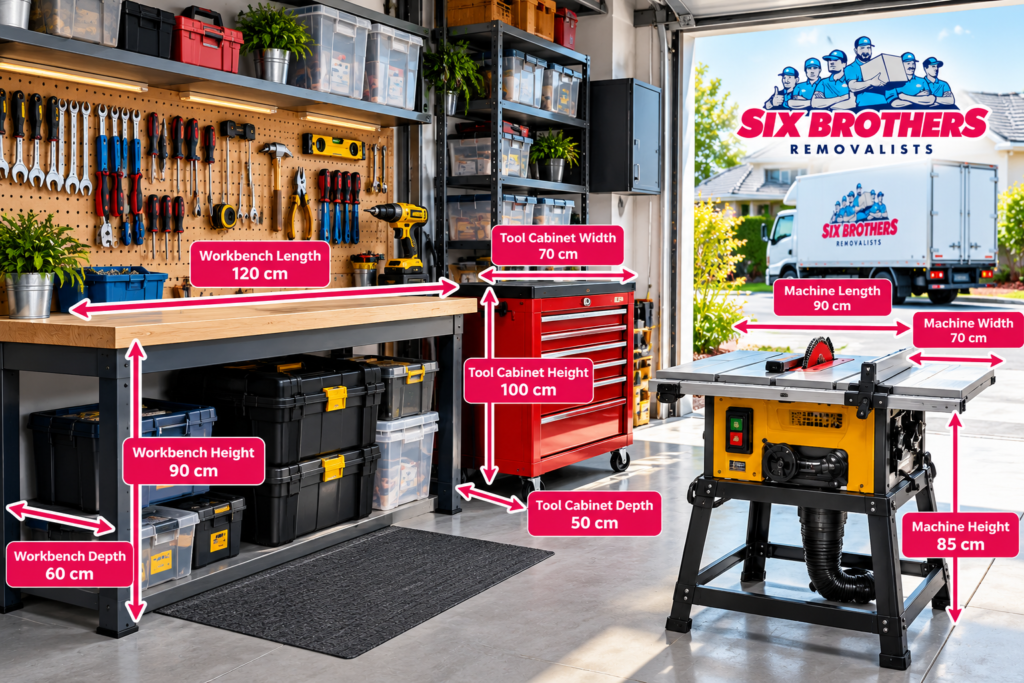
Check machinery weight
Use the manufacturer plate or manual for the listed weight. Share the model, dimensions and any uncertainty with the mover.
Do not estimate weight by lifting or tilting the machine. Ask a qualified specialist to assess difficult equipment.
Secure movable components
List loose guards, trays, handles and attachments. Ask the manufacturer or specialist how each part should be prepared.
Do not improvise restraints or remove safety parts. The person responsible for the machine should approve its transport preparation.
Protect sensitive mechanisms
Tell the crew about exposed rails, delicate controls and precision surfaces. Keep manuals and service notes available.
Ask whether the item needs a dedicated crate or specialist carrier. Ordinary cartons may not suit valuable mechanisms.
Confirm specialist handling needs
Send photos, weight, dimensions and access details before booking. Ask who supplies the handling equipment and who completes disconnection.
A general furniture removalist may not suit every machine. Specialist equipment and training should match the item.
List the work clearly in writing. Confirm any excluded machinery before you accept the quote.
Garage Moving-Day Access Requirements for Sydney Removalists
Give the crew access details before moving day. Forewarned is forearmed, especially on narrow Sydney streets.
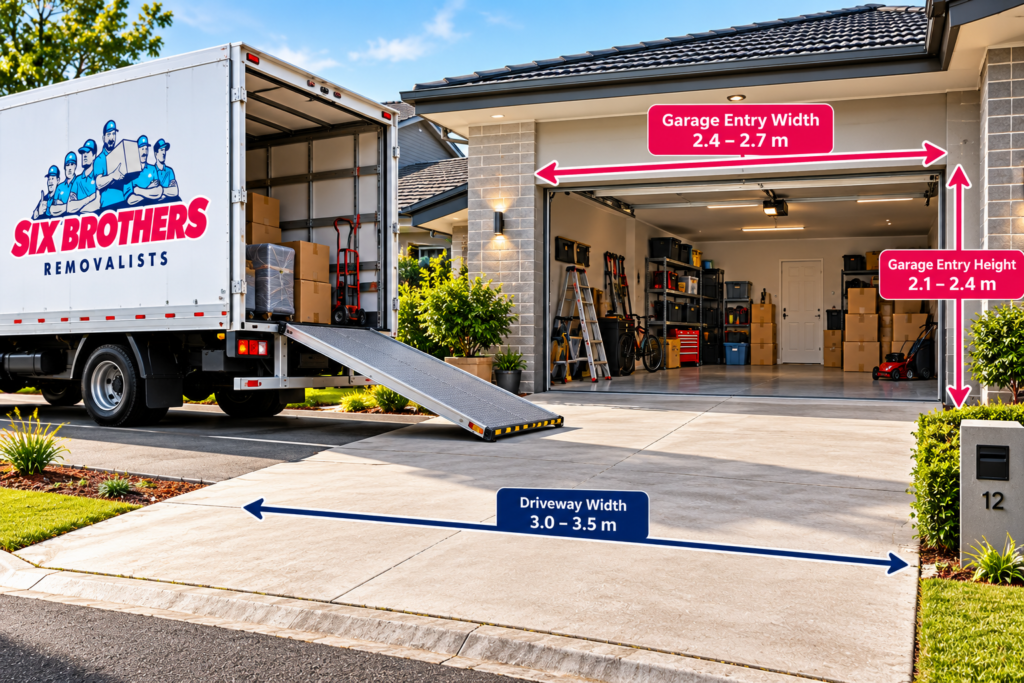
Check driveway clearance
Measure the narrowest part of the driveway and garage opening. Include low branches, overhead structures and sharp turns.
Share photos of steep slopes, steps and low clearance. Do not rely on a quick verbal description alone.
Confirm vehicle access
Tell the removalist whether a truck can reach the driveway. Mention height limits, weight limits and gated entries.
If access is restricted, ask about a smaller vehicle or a different loading point. Confirm any extra carry distance.
Identify loading obstacles
List parked cars, bins, garden beds and narrow paths. Move loose items before the crew arrives.
Mention basement ramps, shared entrances and security gates. The team needs the full route from garage to truck.
Reserve suitable parking
Check current parking rules with the relevant council or building manager. Do not assume a kerb space can be reserved.
Arrange any required permission early. Share the confirmed loading plan with neighbours where access is shared.
Sydney Strata, Shared Driveways and Garage Moving Restrictions
Check building rules before you book. Good fences make good neighbours, and clear notice helps everyone.
Check strata moving rules
Ask the strata manager about booking windows, lift rules and loading access. Some buildings require advance notice or a bond.
Check whether garage storage or wall fixtures form part of common property. Get written approval before removal.
Confirm loading permissions
Ask where the truck may stand and how long loading can take. Confirm gate codes, access cards and security arrangements.
Tell the removalist about basement height limits and tight ramp turns. Send photos and measurements where possible.
Coordinate shared access
Speak with neighbours who use the same driveway. Agree on a clear access window and keep emergency paths open.
Do not block another resident’s garage or shared path. Move cars and bins before the agreed time.
Verify council disposal options
Council clean-ups may have separate rules for strata properties. Check who can book and where accepted items may be placed.
Confirm whether the building manager controls bulky waste areas. Keep household waste separate from restricted workshop items.
What Affects the Cost of Moving Garage and Workshop Equipment?
The cost depends on the items, access and service scope. You get what you pay for when the quote explains each part.
The main price factors usually include:
- Volume and number of cartons, cabinets, benches and machines.
- Weight, dimensions and any item that needs specialist handling.
- Stairs, driveway slope, tight turns and the distance to the truck.
- Packing, dismantling, reassembly and protective materials.
- Parking limits, travel time and any extra loading distance.
- Items excluded from the move or requiring separate disposal.
A quote is only as clear as the inventory behind it. Give each company the same list and photos.
Compare itemised quotes, not just the headline price. Cheap removalists may quote a smaller job if workshop assets are missing.
Ask whether labour, truck size, travel, packing and specialist handling are included. Get exclusions and possible extra charges in writing.
A removalist truck hire option may not include the crew or equipment needed. Check the full cost before choosing DIY.
For home moves, house removalists and furniture removalists need the same garage list. Add office removalists only when the workshop belongs to a business.
Your removalist furniture list should separate household pieces from workshop assets. That helps the team plan space and handling.
For a removalists near me search, share the same inventory with each provider.
Do the same when checking a removalist near me.
Ask any removalists Sydney households are considering to confirm workshop handling in writing.
Removalist companies should explain what they will move and what they will not. Ask for clear answers before paying a deposit.
Some local households also compare interstate removalists or an interstate removalist when moving away from Sydney. Route quotes need a separate destination plan.
A Sydney move is different from long-distance work. Confirm the actual pickup team, even when a provider advertises several cities.
The same check applies to searches for removalists Melbourne and removalists Brisbane. A city listing alone does not confirm local workshop handling.
International removalists also work to different paperwork and destination rules. This checklist covers local Sydney household moves.
Ask whether the provider handles piano removalists’ style of specialist lifting only when relevant. A piano and a workshop machine need different plans.
The NSW Government explains that removalists are not legally required to insure goods during a move. Review the NSW Government removalist guidance and ask about cover in writing.
Send your item list to Six Brothers Removalists for a clear quote discussion.
Common Garage and Workshop Moving Mistakes to Avoid
Most moving-day problems start with missing details. Haste makes waste, so check these points early.
Leaving packing too late
Do not leave the garage until the final weekend. Sort restricted goods, bulky assets and small parts weeks ahead.
Create a short daily target. One shelf or one machine group is easier to manage than the whole room.
Mixing loose components
Do not pour mixed fixings into one carton. Keep each set sealed, labelled and linked to its machine or shelf.
Check every pouch before closing the carton. Keep a contents list with the box number.
Underestimating equipment weight
Do not guess the weight of steel cabinets or workshop machinery. Read maker information and ask for specialist advice.
Tell the mover about wheels, fixed bases and access limits. Never assume an item can be carried by a standard crew.
Overlooking removalist exclusions
Ask for the restricted-items list before moving day. Confirm batteries, chemicals, fuels and oversized machinery separately.
Write down every item that will not travel on the truck. Arrange a safe alternative before the final week.
Check how garage items in your removalist quote can affect the job scope.
Setting Up Your Garage and Workshop at the New Property
Set up the new space in stages. Rome wasn’t built in a day, and a safe layout is worth the extra check.
Plan equipment placement
Choose machine locations before unpacking heavy assets. Leave clear routes to doors, switches and storage areas.
Check power points, ventilation and floor suitability with a qualified person where needed. Do not guess about electrical requirements.
Reassemble labelled components
Use your before-move photos and parts list. Match each labelled pouch to its bench, shelf or machine.
Follow the maker’s instructions for reassembly. Use a qualified technician when setup affects safety or machine operation.
Check equipment stability
Inspect machines and cabinets before use. Look for movement, missing parts or visible damage after transport.
Do not operate equipment until the owner or a qualified technician confirms it is safe. Report transport damage promptly.
Restore safe working access
Keep exits and walkways clear. Store tools so heavy items do not sit above shoulder height or block doors.
Place frequently used gear within easy reach. Keep chemical and waste storage separate from ordinary household goods.
Keep the wider plan beside your Sydney moving house checklist.
That stops the garage becoming your last unfinished room.
For help planning the move, request a free quote from Six Brothers Removalists. Call 1300 764 372 or email info@sixbrothersremovalist.com.au.
Share your inventory, measurements and access photos. A clear brief helps the team assess the right crew and service scope.
FAQs
How to Prepare for Removalists?
Sort the garage, label cartons and list bulky gear. Share photos, dimensions and access details before confirming the booking.
Do Removalists Have Insurance?
Not automatically. NSW law does not require removalists to insure your goods. Ask about transit cover, exclusions and excess in writing.
Can removalists transport petrol, paint or gas bottles?
Do not assume they can. Check the provider’s restricted-items policy and arrange approved disposal for excluded goods.
What garage items should I include in a removalist quote?
List tool cabinets, benches, shelving, ladders, compressors, bikes and machinery. Include dimensions, weights and clear photos for unusual items.
Should garage shelving be dismantled before removalists arrive?
Empty it first and check whether it belongs to the property. Ask whether dismantling is required and included in the written quote.
How should I organise screws and bolts before moving?
Separate them by machine, shelf or project. Use sealed labelled bags or compartment boxes, then record each carton ID.
When should I start organising a garage before relocation?
Start around eight weeks out when possible. Sort early, book council services, prepare equipment and leave the final week for access checks.