


Table of Contents
Moving interstate in Australia is absolutely worth it for the right reasons but only when you go in with clear eyes about what it actually costs, how long it takes, and what can go wrong without proper planning. For most people relocating from Parramatta or Greater Western Sydney, the decision comes down to one thing: preparation.
Whether you’re chasing a job opportunity in Melbourne, downsizing to Queensland, or relocating your business to Canberra, the logistics are the same. The move itself is manageable. What trips people up is underestimating the complexity, the cost, and the time involved.
This guide covers everything: real interstate moving costs, backloading options, transit timelines, packing requirements, storage solutions, and how to choose a removalist you can actually trust.
What Does Moving Interstate in Australia Actually Involve?
An interstate move is fundamentally different from shifting suburbs. You’re not just loading a truck and driving across town. You’re coordinating logistics across state lines, managing transit times measured in days rather than hours, and trusting a removalist with everything you own for an extended period.
Understanding what’s actually involved before you book anything is the single most important step you can take.
The Difference Between Local and Interstate Removals
A local move in Parramatta might take a few hours. An interstate move from Sydney to Brisbane takes one to three days in transit alone, depending on the route, the truck load, and whether you’re using a dedicated vehicle or a backloading service.
Local removals are typically charged by the hour. Interstate moves are priced by volume (cubic metres), weight, or a flat rate based on distance and load size. The pricing model changes completely, which is why comparing quotes without understanding what’s included leads to nasty surprises.
Interstate removalists also carry different insurance obligations, operate under different regulatory frameworks, and require more detailed pre-move planning. You’re not just hiring a truck and a couple of strong arms. You’re engaging a logistics operation.
What to Expect From the Moving Process End to End
A well-managed interstate move follows a clear sequence. It starts with a volume assessment, either in-person or via a video survey, where the removalist calculates how much space your belongings will occupy. From there, you receive a quote, confirm a pickup date, and begin preparing your home.
On moving day, the crew arrives, loads your belongings carefully, and the truck departs. Depending on the service type, your goods may travel directly to your new address or be consolidated at a depot before dispatch. Delivery is scheduled based on your destination and the removalist’s route.
At the other end, the crew unloads, places furniture in designated rooms, and you sign off on delivery. The whole process, from booking to delivery, typically spans two to six weeks when you factor in lead times, transit, and settling in.
Is Moving Interstate Worth It? The Real Costs Broken Down
Cost is the first thing people want to know, and it’s also the area where most people get caught off guard. Interstate moving costs in Australia vary significantly based on volume, distance, service type, and timing. Getting a realistic picture upfront prevents budget blowouts later.
Average Interstate Moving Costs From NSW to Other States
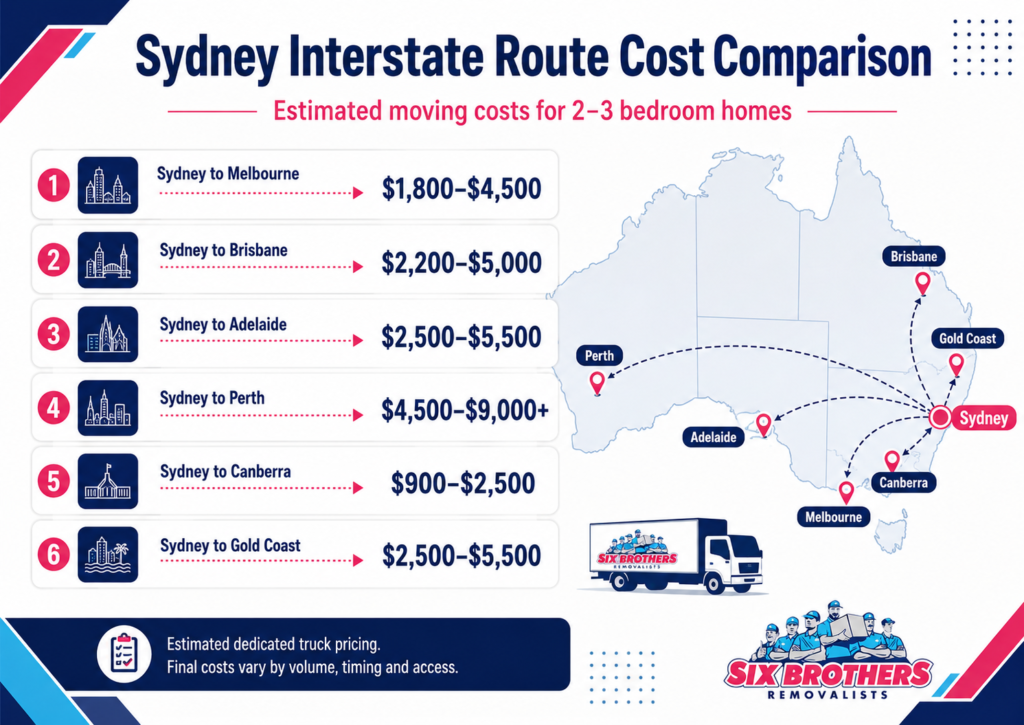
For a standard two to three-bedroom home moving from Sydney or Parramatta, you can expect to pay roughly the following:
| Route | Estimated Cost (2BR–3BR Home) | Transit Time |
| Sydney to Melbourne | $1,800 – $4,500 | 1–2 days |
| Sydney to Brisbane | $2,200 – $5,000 | 2–3 days |
| Sydney to Adelaide | $2,500 – $5,500 | 2–3 days |
| Sydney to Perth | $4,500 – $9,000+ | 5–7 days |
| Sydney to Canberra | $900 – $2,500 | Same day–1 day |
| Sydney to Gold Coast | $2,500 – $5,500 | 2–3 days |
These figures reflect dedicated truck services. Backloading options can reduce costs by 30 to 50 percent, but come with less scheduling flexibility. Prices shift based on the time of year, with peak periods around Christmas, Easter, and end-of-financial-year pushing rates higher.
For a one-bedroom apartment or studio, costs are proportionally lower. For a four-plus bedroom home with a full garage, expect to sit at the upper end or beyond these ranges.
Hidden Costs Most People Don’t Budget For
The quoted price is rarely the final price when people don’t ask the right questions upfront. Common additional costs include:
Stair and lift fees. If your current home or destination has stairs, most removalists charge a stair levy per flight. Lifts that require booking or have restricted access also attract fees.
Long carry charges. If the truck can’t park close to your front door, the crew charges for the extra distance they carry items.
Packing materials. Boxes, bubble wrap, packing paper, mattress covers, and furniture blankets are often quoted separately. A full pack for a three-bedroom home can add $300 to $800 to your bill.
Storage fees. If your new home isn’t ready when your goods arrive, you’ll need short-term storage. Costs vary by volume and duration.
Fuel levies and tolls. Some removalists add these as line items. Always ask.
Disassembly and reassembly. Flat-pack furniture, bed frames, and large wardrobes often require disassembly for transport. Not all removalists include this in their base rate.
Insurance upgrades. Basic transit insurance covers limited liability. Full replacement value coverage costs more but protects you properly.
How to Compare Removalist Quotes Without Getting Burned
Getting three quotes is standard advice. Getting three comparable quotes is what actually matters. When quotes vary by $1,000 or more, it’s rarely because one company is simply cheaper. It’s usually because they’re quoting different things.
Ask every removalist to quote on the same scope: same volume, same service inclusions, same insurance level, same access conditions. Request an itemised breakdown rather than a single lump sum. This makes comparison meaningful.
Check whether the quote is binding or subject to change. Some removalists provide estimates that can increase on the day if the volume is larger than expected. A fixed-price quote based on an accurate volume assessment protects you.
Verify that the company is a member of the Australian Furniture Removers Association (AFRA), which sets industry standards for training, equipment, and insurance. AFRA membership isn’t a guarantee of quality, but it’s a meaningful baseline.
What Is Backloading and Is It a Smart Option for Interstate Moves?
Backloading is one of the most cost-effective ways to move interstate in Australia, but it’s widely misunderstood. Many people either don’t know it exists or assume it’s a second-rate option. Neither is accurate.
How Interstate Backloading Works
When a removalist truck completes a delivery interstate, it needs to return to its home base. Rather than driving back empty, the company fills available space with other customers’ goods heading in the same direction. That’s backloading.
Because the truck is already making the trip, the cost per cubic metre is significantly lower than booking a dedicated vehicle. You’re essentially sharing the truck’s return journey with other customers’ loads.
The trade-off is flexibility. With backloading, you work around the truck’s existing schedule rather than setting your own. Pickup and delivery windows are broader, sometimes spanning a day or two rather than a specific time. If your timeline is flexible, this is a minor inconvenience for a major cost saving.
Backloading vs. Dedicated Truck: Which Is Right for You?
| Factor | Backloading | Dedicated Truck |
| Cost | 30–50% cheaper | Full rate |
| Flexibility | Lower (schedule-dependent) | High (you set the date) |
| Transit time | Slightly longer | Direct route |
| Best for | Flexible movers, smaller loads | Fixed settlement dates, large homes |
| Availability | Route and date dependent | Bookable in advance |
If you have a fixed settlement date or a lease start date that can’t move, a dedicated truck is the safer choice. If you have a two-week window and want to reduce costs significantly, backloading is worth serious consideration.
Best Interstate Backloading Routes From NSW
Backloading is most readily available on high-traffic routes where trucks are moving regularly. From Parramatta and Greater Western Sydney, the strongest backloading availability exists on:
- Sydney to Melbourne (one of Australia’s busiest freight corridors)
- Sydney to Brisbane and Gold Coast
- Sydney to Adelaide
- Sydney to Canberra
Perth routes have backloading options but less frequency, which means longer wait times and less scheduling certainty. For Perth moves, booking well in advance is essential regardless of service type.
How Long Does an Interstate Move Take From NSW?
Transit time is one of the most common sources of confusion for people planning their first interstate move. The truck doesn’t always leave on day one and arrive on day two. Understanding realistic timelines prevents scheduling conflicts at both ends.
Transit Times for Major Interstate Routes

| Route | Driving Distance | Typical Transit Time |
| Sydney to Melbourne | ~880 km | 1–2 days |
| Sydney to Brisbane | ~920 km | 2–3 days |
| Sydney to Canberra | ~280 km | Same day–1 day |
| Sydney to Adelaide | ~1,400 km | 2–4 days |
| Sydney to Gold Coast | ~840 km | 2–3 days |
| Sydney to Perth | ~4,000 km | 5–10 days |
These are transit times once the truck departs, not total time from booking to delivery. Factor in loading day, any depot consolidation for backloads, and unloading at the destination.
Factors That Affect Delivery Timelines
Several variables can extend or compress these windows. Road conditions and weather events, particularly flooding on inland routes or bushfire-related closures, can add days to transit. Driver rest requirements under Australian heavy vehicle laws also affect how far a truck can travel per day.
For backloading specifically, your goods may be held at a depot briefly while the truck consolidates a full load. This is normal and should be disclosed upfront. Ask your removalist for a realistic delivery window, not just a best-case scenario.
If you’re moving into a property with a specific settlement date, build in a buffer. Arriving at your new home before your goods is far less stressful than the reverse.
How to Choose the Right Interstate Removalist in Australia
The removalist industry in Australia is largely unregulated at the entry level. Anyone with a truck and an ABN can call themselves a removalist. This makes due diligence non-negotiable, particularly for interstate moves where your belongings are out of your hands for days.
What Licences and Insurance Should Your Removalist Have?
At minimum, your interstate removalist should carry:
Public liability insurance. This covers damage to your property (floors, walls, doorframes) during the move. Ask for the certificate of currency, not just a verbal confirmation.
Transit insurance. This covers your goods while in transit. Understand the difference between basic carrier liability (which pays out very little) and full replacement value coverage.
Workers’ compensation insurance. Protects the crew and protects you from liability if a worker is injured on your property.
AFRA membership requires removalists to meet minimum standards for insurance, equipment, and staff training. It’s a useful filter when shortlisting companies.
Red Flags to Watch for When Hiring Interstate Movers
Certain warning signs consistently appear in bad interstate moving experiences. Watch for:
Unusually low quotes. If a quote is 40 percent below every other company, something is missing. Either the scope is incomplete, the insurance is inadequate, or the company plans to add charges on the day.
No physical address or ABN. Legitimate removalists have a verifiable business address and a registered ABN. Check both.
Cash-only payment requirements. Reputable companies accept card or bank transfer and provide receipts.
No written contract. Every interstate move should be confirmed in writing with a clear scope of work, pricing, and terms.
Vague answers about insurance. If a removalist can’t clearly explain what their insurance covers, assume it covers very little.
No volume assessment. Quoting without assessing your actual load volume is a recipe for price changes on moving day.
What Are Red Flags With Moving Companies?……..Read more
Questions to Ask Before Booking an Interstate Removalist
Before committing to any company, get clear answers to these:
- Is your quote fixed or subject to change based on actual volume?
- What insurance do you carry, and what does it cover per item?
- Do you subcontract any part of this move, or is it your own crew and truck?
- What is your process if goods are damaged in transit?
- What is the realistic delivery window, not just the best case?
- Are packing materials, disassembly, and stair fees included or additional?
- Are you AFRA accredited?
A removalist who answers these questions clearly and without hesitation is a removalist worth trusting.
Packing for an Interstate Move: What You Need to Know
Packing for an interstate move is not the same as packing for a local one. Your belongings will be in transit for days, loaded and unloaded multiple times, and stacked in a truck that travels hundreds or thousands of kilometres. Packing quality directly determines whether your belongings arrive intact.
Packing Materials That Actually Protect Your Belongings
The materials you use matter as much as the technique. For an interstate move, invest in:
Double-walled cardboard boxes. Standard single-wall boxes compress under weight during long transit. Double-wall boxes maintain their structure.
Packing paper and bubble wrap. Packing paper wraps individual items and fills void space. Bubble wrap provides cushioning for fragile items. Use both, not one or the other.
Furniture blankets and moving pads. These protect timber surfaces, glass panels, and upholstery from scratches and impact during loading and transit. Professional removalists carry these as standard.
Mattress covers. Mattresses are expensive to replace and difficult to clean. Plastic mattress covers cost a few dollars and prevent staining and damage.
Stretch wrap. Wraps around drawers, doors, and upholstered furniture to keep them closed and protected during transit.
Wardrobe boxes. Tall boxes with a hanging rail allow clothes to travel on hangers without creasing. Worth the investment for a long-distance move.
How to Pack Fragile Items for Long-Distance Transport
Fragile items require a specific approach for interstate transport. The key principle is immobilisation: items that can’t move can’t break.
Wrap each fragile item individually in packing paper, then in bubble wrap. Place heavier items at the bottom of the box, lighter items on top. Fill every void with crumpled packing paper so nothing shifts. The box should feel solid when you shake it, not hollow.
Label every fragile box clearly on all four sides and the top. Mark which way is up. Communicate to your removalist which boxes require careful handling and where they should be positioned in the truck (typically on top, away from heavy items).
Plates travel better on their edge than flat. Glasses should be individually wrapped and packed upright. Electronics should be packed in their original boxes where possible, or in appropriately sized boxes with substantial padding.
Should You Pack Yourself or Use Professional Packing Services?
Self-packing saves money but takes significant time and carries risk. If items are damaged in transit and you packed them yourself, most transit insurance policies won’t cover the damage. This is a critical point that many people miss.
Professional packing services cost more, but they transfer responsibility. When a removalist packs your goods, they’re accountable for how those items are protected. Damage claims are far more straightforward.
A practical middle ground: pack non-fragile items yourself (books, linen, clothing, pantry items) and have the removalist pack fragile and high-value items. This reduces cost while protecting the things most likely to break.
Storage Solutions for Interstate Moves: When You Need a Buffer
Not every interstate move goes door to door on a single timeline. Settlement dates shift. Leases end before new ones begin. Renovations run over. Storage bridges the gap between where you are and where you’re going.
Short-Term vs. Long-Term Storage During a Move
Short-term storage, typically one to four weeks, is the most common need during interstate moves. It covers the gap between vacating your current home and gaining access to your new one. Most removalists offer this as part of their service, storing your goods at a depot until delivery is possible.
Long-term storage, spanning months rather than weeks, suits people who are relocating temporarily, downsizing significantly, or moving into a property that isn’t ready for full occupancy. Dedicated storage facilities offer climate-controlled units for sensitive items like artwork, antiques, wine, and electronics.
When comparing storage options, ask about:
- Security (24-hour monitoring, individual unit locks)
- Climate control (essential for timber furniture, electronics, and artwork)
- Access hours (can you retrieve items if needed?)
- Insurance coverage while in storage
- Minimum contract periods and exit terms
How Storage Works With Your Interstate Moving Timeline
The cleanest approach is to book storage through your removalist rather than separately. This means your goods are loaded once, stored at the removalist’s depot, and delivered when you’re ready. Handling your belongings multiple times increases the risk of damage and adds cost.
If you need long-term storage beyond what a removalist depot offers, coordinate the handover carefully. Ensure there’s a clear inventory of everything in storage, and confirm insurance coverage applies throughout the storage period, not just during transit.
Moving Interstate With Special Items: Vehicles, Cars, Pets, and Valuables
Standard removalist services cover household furniture and boxes. Special items require separate arrangements, and leaving these to the last minute creates significant stress.
How to Transport Your Car During an Interstate Move
Driving your car interstate is the simplest option if the distance is manageable and you have time. Sydney to Melbourne or Sydney to Canberra is a reasonable drive. Sydney to Perth is not.
For long-distance vehicle transport, enclosed car carriers provide the highest level of protection. Open carriers are more common and less expensive but expose your vehicle to road debris and weather. Both options require booking well in advance, particularly during peak moving periods.
Costs for interstate car transport from Sydney range from approximately $600 to $900 for Melbourne, $700 to $1,100 for Brisbane, and $1,500 to $2,500 for Perth, depending on the carrier type and current demand.
Before handing over your vehicle, document its condition thoroughly with dated photographs. Check that the transport company carries adequate insurance and provides a condition report at pickup and delivery.
Moving Fragile, High-Value, or Oversized Items Interstate
Antiques, artwork, pianos, pool tables, and large gym equipment require specialist handling. Standard removalists may not have the equipment, training, or insurance to move these items safely.
For high-value items, consider specialist art and antique movers who use custom crating and climate-controlled transport. For pianos and pool tables, confirm that your removalist has specific experience with these items. A piano moved incorrectly can sustain thousands of dollars in damage.
Jewellery, important documents, and irreplaceable personal items should travel with you, not in the truck. No insurance policy fully compensates for items with sentimental value.
Interstate Moving Checklist: What to Do Before, During, and After
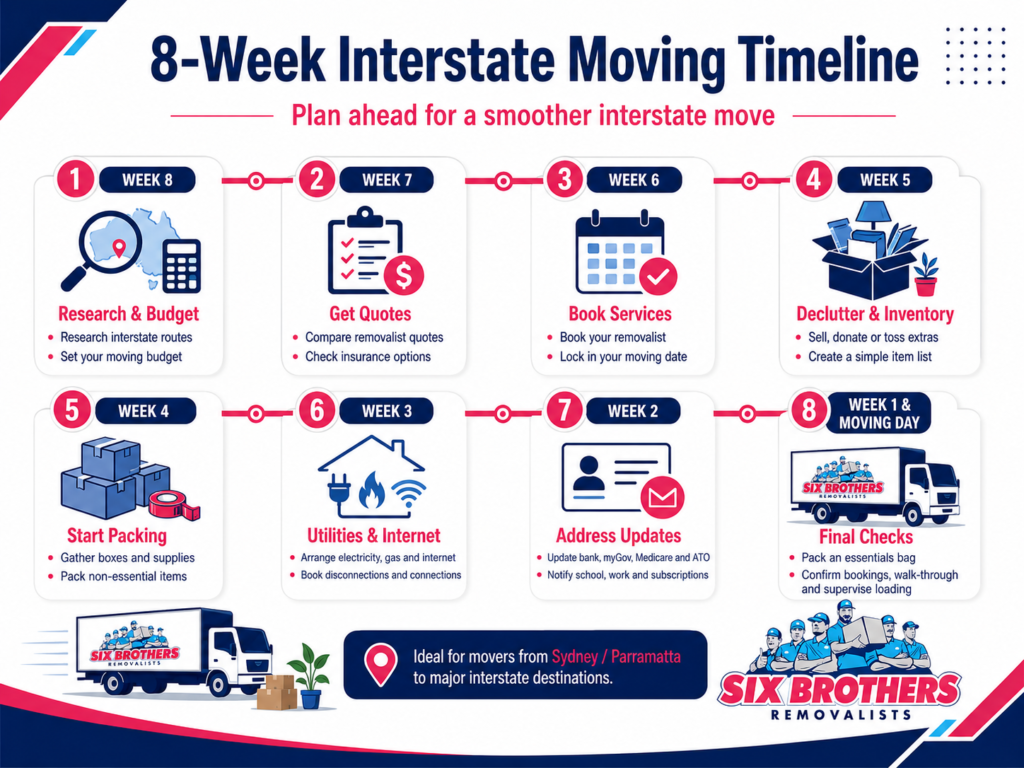
A structured timeline prevents the last-minute scramble that turns a manageable move into a stressful one. Start earlier than you think you need to.
8 Weeks Before Your Move
- Research and shortlist at least three interstate removalists
- Request volume assessments and written quotes
- Confirm your moving date and book your preferred removalist
- Notify your employer, bank, Medicare, ATO, and electoral roll of your address change
- Begin decluttering: sell, donate, or dispose of items you won’t take
- Order packing materials if self-packing
- Arrange vehicle transport if needed
- Notify your children’s schools and arrange enrolment at new schools
- Contact your insurance providers about coverage during transit and at the new address
2–4 Weeks Before Your Move
- Begin packing non-essential items: books, seasonal clothing, decorative items
- Confirm all bookings in writing: removalist, storage, vehicle transport
- Arrange disconnection of utilities at your current address
- Set up utilities at your new address: electricity, gas, internet
- Notify your body corporate or landlord of your moving date
- Arrange pet transport or accommodation if needed
- Pack a “first night” box with essentials: toiletries, phone chargers, a change of clothes, basic kitchen items, important documents
Moving Day and After Arrival
On moving day, be present for the entire loading process. Walk through every room before the truck leaves to confirm nothing has been left behind. Take photographs of your empty home for bond or settlement purposes.
At the destination, direct the crew on furniture placement before they start unloading. It’s far easier to position a couch correctly the first time than to move it again after the crew has left.
After arrival, check every item against your inventory list. Report any damage to the removalist in writing within the timeframe specified in your contract, typically 24 to 72 hours. Update your address with remaining services and register your vehicle in the new state within the required timeframe.
Is Moving Interstate From Parramatta Worth It in 2025?
For most people asking this question, the answer is yes, with conditions. The financial and lifestyle reasons that drive interstate moves lower property prices, better job opportunities, proximity to family, lifestyle change are real and significant. The cost of moving, while substantial, is a one-time expense against years of benefit.
What makes an interstate move not worth it is poor planning. Choosing the wrong removalist, underestimating costs, missing key deadlines, or failing to account for the full scope of the move turns a positive life decision into a prolonged ordeal.
From Parramatta specifically, the interstate moving market is well-served. Regular truck movements to Melbourne, Brisbane, Adelaide, and Canberra mean competitive pricing and good backloading availability. The infrastructure exists to make your move efficient and cost-effective.
The question isn’t really whether moving interstate is worth it. It’s whether you’re approaching it with the preparation it deserves.
Conclusion
Moving interstate in Australia involves real costs, genuine logistics, and decisions that compound quickly if you get them wrong. Understanding backloading, transit timelines, packing requirements, and what to look for in a removalist transforms a daunting process into a manageable one.
Six Brothers Removalists has handled interstate moves from Parramatta and Greater Western Sydney for years, covering routes to Melbourne, Brisbane, Adelaide, Canberra, and beyond. Our team knows these routes, these timelines, and exactly what it takes to get your belongings there safely.
If you’re planning an interstate move and want a straight answer on costs, timelines, and what’s involved, contact Six Brothers Removalists today for an obligation-free quote and honest advice from a team that’s done this thousands of times.
Frequently Asked Questions About Moving Interstate in Australia
How much does it cost to move interstate in Australia?
Interstate moving costs in Australia depend on volume, distance, and service type. A two to three-bedroom home moving from Sydney to Melbourne typically costs between $1,800 and $4,500 for a dedicated truck service. Backloading options can reduce this by 30 to 50 percent for flexible movers.
Is backloading cheaper than a dedicated truck for interstate moves?
Yes, backloading is generally 30 to 50 percent cheaper than booking a dedicated truck. The trade-off is scheduling flexibility, as your move works around the truck’s existing route rather than a date you choose. For movers with a flexible two-week window, backloading offers significant savings.
How far in advance should I book an interstate removalist?
Book your interstate removalist at least six to eight weeks before your moving date, particularly during peak periods like Christmas, Easter, and end of financial year. Popular routes like Sydney to Melbourne fill quickly, and last-minute bookings often cost more and offer fewer options.
What is the cheapest way to move interstate in Australia?
Backloading is the most cost-effective option for most interstate moves. Combining backloading with self-packing for non-fragile items reduces costs further. Moving during off-peak periods, mid-week and outside school holidays, also lowers rates compared to weekend or peak-season moves.
Do interstate removalists disassemble and reassemble furniture?
Most professional interstate removalists offer disassembly and reassembly as part of their service, though it may be quoted separately rather than included in the base rate. Always confirm this upfront and get it in writing. Bed frames, large wardrobes, and flat-pack furniture are the most common items requiring disassembly.
How do I protect my belongings during an interstate move?
Use double-walled boxes, wrap fragile items individually in packing paper and bubble wrap, and fill all void space so nothing shifts in transit. Furniture blankets protect surfaces during loading. For maximum protection, use professional packing services for fragile and high-value items, which also strengthens your insurance position if damage occurs.
Can I move interstate without a removalist?
Yes, you can hire a self-drive truck or use a pod-style container service for a DIY interstate move. This reduces cost but increases physical effort, risk of damage, and logistical complexity. For moves involving significant furniture, fragile items, or long distances, professional removalists typically deliver better outcomes and comparable total cost when damage risk is factored in.
What happens if my belongings are damaged during an interstate move?
Report damage to your removalist in writing within the timeframe specified in your contract, usually 24 to 72 hours after delivery. Photograph all damage immediately. Your claim outcome depends on the insurance coverage in place. Basic carrier liability pays out very little per item. Full replacement value coverage provides proper protection and is worth the additional premium for interstate moves.
How long does it take to move from Sydney to Melbourne?
Transit time from Sydney to Melbourne is typically one to two days once the truck departs. Factor in loading day, any depot consolidation for backloads, and unloading at the destination. Total time from pickup to delivery is usually two to four days. Build in a buffer if you have a fixed settlement or lease start date.
Does Six Brothers Removalists offer interstate moving from Parramatta?
Yes, Six Brothers Removalists provides interstate moving services from Parramatta and Greater Western Sydney to Melbourne, Brisbane, Adelaide, Canberra, and other destinations across Australia. We offer dedicated truck services, interstate backloading, professional packing, and storage solutions. Contact us for a free, itemised quote based on your actual volume and requirements.