


Table of Contents
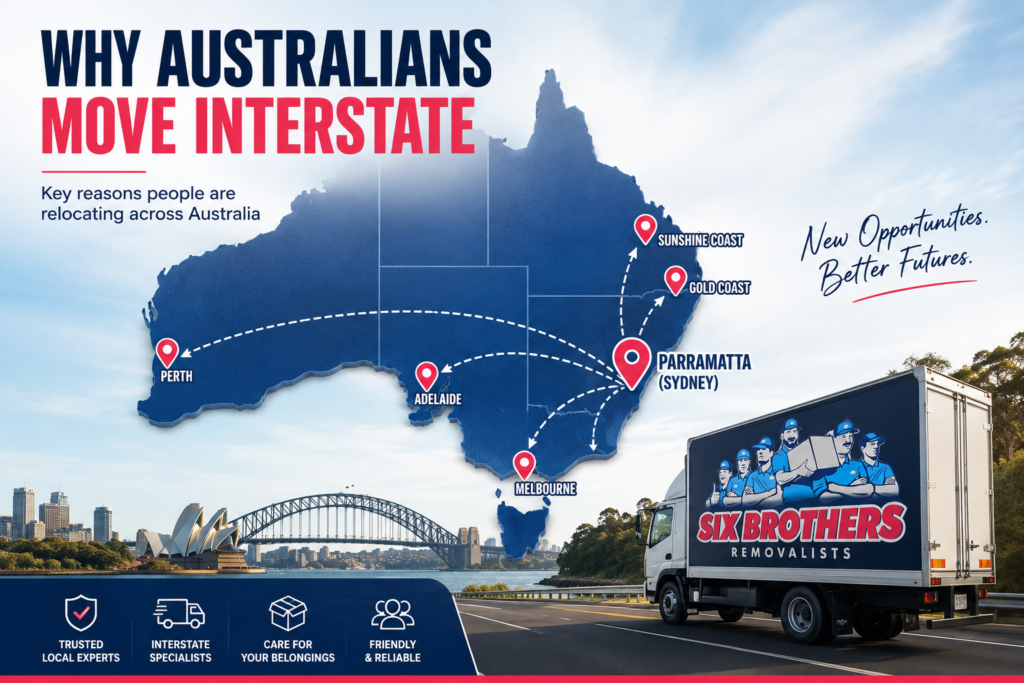
Every year, hundreds of thousands of Australians pack up their lives and cross a state border. The reasons are as varied as the people making the move better jobs, cheaper homes, family, retirement, or simply a fresh start somewhere new.
If you’re weighing up an interstate relocation from Parramatta or Greater Western Sydney, understanding what’s driving these moves helps you make a more confident decision. It also helps you plan earlier, budget more accurately, and avoid the surprises that catch most people off guard.
This guide covers the seven biggest reasons Australians move interstate, what each type of move actually involves, and what you need to know before booking a removalist for the journey ahead.
Career Opportunities and Job Relocations
Work is the single most common reason Australians move interstate. Whether it’s a promotion, a new employer, a contract role, or a sector that simply doesn’t exist in your current state, job-driven relocations account for a significant share of all interstate moves each year.
Australia’s economy is not evenly distributed. Mining and resources dominate Western Australia and Queensland. Technology, finance, and professional services are concentrated in Sydney and Melbourne. Healthcare, education, and government roles are spread more broadly, but the best-paying positions often require you to go where the work is.
For many people in Greater Western Sydney, the calculation is straightforward: a role in Brisbane, Melbourne, or Perth might offer a salary increase that more than covers the cost of moving. When that’s the case, the move stops being a disruption and starts being an investment.

Which Australian cities are attracting the most workers?
Brisbane and South East Queensland are currently drawing the largest share of interstate workers, driven by infrastructure investment, the 2032 Olympic Games pipeline, and a construction and development boom that has created sustained demand across trades, engineering, and project management.
Melbourne continues to attract workers in finance, technology, healthcare, and the arts. Perth has seen renewed interest from mining and resources professionals as commodity prices have remained strong. Adelaide is growing its defence and technology sectors, offering competitive salaries with a noticeably lower cost of living than Sydney.
For workers leaving NSW, Brisbane is the most common destination, followed by Melbourne and Perth.
How does a job relocation affect your moving timeline and costs?
Job relocations tend to move fast. Most employers give between two and six weeks’ notice, which compresses your planning window considerably. That means booking a removalist early is critical, particularly if you’re moving during peak periods like January, June, or December.
Some employers offer relocation packages that cover part or all of your moving costs. If yours does, get the details in writing before you commit to a removalist. Packages vary widely, and some only cover a fixed dollar amount rather than the full cost of a managed move.
If your employer doesn’t offer a relocation allowance, interstate moving costs from Sydney or Parramatta typically range from $3,000 to $8,000 or more depending on volume, distance, and whether you choose a dedicated truck or a backloading service.
Affordable Housing and Lower Cost of Living
Sydney is one of the most expensive cities in the world to buy or rent a home. That’s not a new problem, but it has intensified significantly over the past decade. For many families and individuals in Parramatta and Western Sydney, the financial pressure of housing costs has become the primary driver behind an interstate move.
The maths can be stark. A three-bedroom house that costs $1.2 million in Western Sydney might sell for $550,000 in regional Queensland or $650,000 in Adelaide. For renters, the gap is equally significant. Moving interstate doesn’t just reduce your housing costs it can fundamentally change your financial position.

Where are Australians moving to find cheaper housing?
Queensland remains the top destination for housing-driven interstate migration from NSW. Cities like Brisbane, the Gold Coast, the Sunshine Coast, and regional centres like Toowoomba offer substantially lower property prices alongside a strong lifestyle offering.
South Australia, particularly Adelaide, has attracted significant attention from Sydney buyers priced out of the NSW market. Adelaide’s median house price sits well below Sydney’s, and the city offers good schools, healthcare, and employment options.
Regional Victoria, Tasmania, and parts of Western Australia are also drawing buyers looking for space, affordability, and a slower pace of life. The shift to remote and hybrid work has made these moves more viable than they were five years ago.
How much can you save by relocating interstate for housing?
According to the Australian Bureau of Statistics, NSW consistently records net interstate migration losses, meaning more people leave NSW for other states than arrive. Housing affordability is cited as a primary driver in most demographic analyses of this trend.
The savings vary by destination and property type, but families moving from Western Sydney to South East Queensland commonly report reducing their mortgage by $300,000 to $600,000 for a comparable property. Over a 30-year loan, that difference is transformative.
Beyond the purchase price, day-to-day living costs including groceries, utilities, and transport are also lower in most interstate destinations compared to Greater Sydney.
Family Reasons and Lifestyle Changes
Not every interstate move is driven by money or work. A significant number of relocations happen because of family ageing parents who need support, a partner who has been offered a role elsewhere, children who have settled in another state, or a relationship that has ended and made staying in the same city feel impossible.
These moves are often the most emotionally complex. They involve leaving behind established networks, familiar neighbourhoods, and the routines that make a place feel like home. But they’re also among the most purposeful moves people make, because the reason is deeply personal.
How do family circumstances drive interstate moves?
The most common family-driven scenarios include moving to be closer to elderly parents, following a partner who has relocated for work, reuniting with adult children who have settled interstate, and separating from a partner and choosing a fresh start in a new city.
Blended families, custody arrangements, and changing household compositions also play a role. When a family’s centre of gravity shifts, the home base often shifts with it.
What lifestyle factors make people leave their home state?
Beyond family, lifestyle is a powerful motivator. People leave NSW for a slower pace, more outdoor space, a warmer or cooler climate, access to nature, or simply the desire to live somewhere that feels different from where they grew up.
The concept of a “sea change” or “tree change” moving to a coastal or rural area for a fundamentally different way of living has been part of Australian culture for decades. The pandemic accelerated this trend significantly, and many of those who moved have stayed.
For people in Parramatta and Western Sydney, the appeal of more space, a bigger backyard, and a quieter environment is real. When that space is available interstate at a fraction of the cost, the decision becomes easier to justify.
Retirement and Sea Change or Tree Change Moves
Retirement is one of the most significant life transitions a person makes, and for many Australians, it comes with a serious question: do I want to stay where I’ve always lived, or is this the moment to finally make the move I’ve been thinking about for years?
For retirees in Greater Sydney, the answer is increasingly: move. The combination of high property values (which can be unlocked by selling and buying interstate), lower ongoing costs, and access to lifestyle destinations makes interstate relocation an attractive option at retirement age.
Which regions are most popular for retirees relocating interstate?
Queensland’s Sunshine Coast and Gold Coast remain the most popular retirement destinations for NSW retirees. The climate, lifestyle infrastructure, and proximity to major hospitals and services make them practical as well as appealing.
Northern NSW and South East Queensland’s hinterland regions attract retirees looking for a tree change. Tasmania has grown in popularity among retirees seeking cooler weather, natural beauty, and a strong arts and food culture. South Australia’s Barossa Valley and Fleurieu Peninsula also draw retirees from the eastern states.
What should retirees consider before making an interstate move?
Healthcare access is the most critical practical consideration. Before committing to a destination, retirees should research the availability of specialists, hospitals, and aged care facilities in the area they’re considering.
Social connection matters too. Moving away from established friendships and community networks is a real cost of interstate relocation, and it’s one that’s easy to underestimate when you’re focused on the financial and lifestyle benefits.
From a moving logistics perspective, retirees often have decades of accumulated belongings to sort through. A professional removalist who offers packing services, storage solutions, and careful handling of antiques and valuables makes the process significantly less stressful.
Education and University Relocations
Australia’s university system is concentrated in major cities, and the best programs in specific fields are often only available in one or two states. For students and their families, this creates a clear reason to move interstate: go where the course is.
This type of move is often a first interstate relocation for young Australians. It’s also frequently a move that becomes permanent students who study interstate often build their careers and lives in the city where they studied.
Which states attract the most interstate students?
Victoria and New South Wales attract the largest number of interstate students due to the concentration of Group of Eight universities in Melbourne and Sydney. Queensland is growing its student population, particularly in Brisbane, which has invested heavily in university infrastructure.
Specific programs draw students to specific states. Medicine and law at the University of Melbourne, engineering at the University of Queensland, and mining engineering at the University of Western Australia are examples of programs that regularly attract students from across the country.
What do students need to plan for an interstate move?
Students moving interstate for the first time often underestimate how much they’re taking with them. A bedroom’s worth of furniture, a car, kitchen equipment, and personal belongings adds up quickly.
Timing is important. University move-in periods in late January and early February are among the busiest times for removalists. Booking early ideally two to three months in advance secures better availability and pricing.
Students and their families should also consider whether a full removal service or a partial service makes more sense. If the student is moving into furnished accommodation, a smaller load with careful packing may be all that’s needed.
Business Expansion and Commercial Relocations
Businesses move interstate for many of the same reasons individuals do: better markets, lower costs, access to talent, and strategic growth. Commercial relocations are often more complex than residential moves, involving office equipment, IT infrastructure, sensitive documents, and the need to minimise downtime.
For businesses in Parramatta and Greater Western Sydney, interstate expansion is a natural step as companies grow beyond the NSW market.
Why do businesses relocate interstate in Australia?
The most common business reasons for interstate relocation include expanding into a new market, reducing operating costs by moving to a state with lower commercial rents, following a major client or contract, accessing a larger or more specialised talent pool, and taking advantage of state government incentives for specific industries.
Queensland and South Australia have actively courted businesses from NSW and Victoria with competitive commercial property rates and industry-specific incentives. Some businesses relocate their headquarters while maintaining a presence in Sydney, effectively splitting operations across states.
What does an interstate office or business move involve?
A commercial interstate relocation requires significantly more planning than a residential move. IT systems, server infrastructure, and telecommunications need to be coordinated carefully to avoid extended downtime. Furniture, filing systems, and specialised equipment all need to be inventoried, packed, and transported with care.
The best commercial removalists work outside business hours to minimise disruption. They provide detailed move plans, assign dedicated project managers, and coordinate with building management at both the origin and destination.
For businesses in Parramatta considering an interstate move, working with a removalist who has experience in commercial relocations not just residential moves makes a significant difference to how smoothly the transition goes.
Climate, Environment, and Quality of Life
Australia’s geography means that moving interstate can mean moving to an entirely different climate. For people who have spent their lives in Sydney’s temperate but humid summers, the idea of Queensland’s warmth or Tasmania’s cool air can be genuinely motivating.
Climate-driven moves have increased in recent years, partly because remote work has made them more feasible and partly because extreme weather events have made some areas feel less liveable than they once did.
How does climate influence interstate relocation decisions?
Warmer climates draw people from Victoria and NSW to Queensland, particularly retirees and families with young children who want more outdoor time year-round. Conversely, people who struggle with heat are increasingly looking at Tasmania and parts of Victoria as alternatives to Sydney’s increasingly hot summers.
Environmental factors beyond temperature also play a role. Air quality, bushfire risk, flood exposure, and access to natural environments all influence where people choose to live. Some families have relocated specifically to reduce their exposure to bushfire-prone areas.
Which states offer the best quality of life for relocating families?
Quality of life is subjective, but consistently high-ranking states for family liveability include Queensland (for outdoor lifestyle and affordability), South Australia (for culture, food, and cost of living), and Western Australia (for space, natural beauty, and strong wages in resource-sector employment).
Victoria, particularly regional Victoria, scores well for education, healthcare, and cultural amenity. Tasmania has developed a strong reputation for food, arts, and natural environment, though its job market is more limited than the mainland states.
For families leaving Greater Western Sydney, the most common quality-of-life destinations are South East Queensland and regional NSW, followed by Adelaide and Melbourne.
What Do You Need to Know Before Making an Interstate Move from NSW?
Understanding why people move interstate is one thing. Actually planning and executing the move is another. If you’re based in Parramatta or Greater Western Sydney and you’re seriously considering an interstate relocation, there are several practical realities you need to understand before you start getting quotes.
The distance, the volume of your belongings, your timeline, and whether you need storage all affect the cost and complexity of your move. The sections below cover the key practical questions that come up most often for people planning an interstate move from NSW.
How Much Does an Interstate Move from Parramatta or Sydney Cost?
Interstate moving costs vary considerably depending on where you’re going, how much you’re moving, and what type of service you choose. There’s no single price that applies to every move, but understanding the main cost drivers helps you budget accurately and compare quotes fairly.
As a general guide, a full household move from Sydney or Parramatta to Brisbane typically costs between $3,500 and $7,000. A move to Melbourne might range from $2,500 to $5,500. Perth is significantly more expensive due to the distance, with costs commonly ranging from $6,000 to $12,000 or more for a full household.
These figures assume a standard three-bedroom home. Larger homes, specialist items like pianos or antiques, and additional services like packing and unpacking will increase the total.
What factors affect interstate removalist pricing?
The main factors that affect interstate removalist pricing are volume (how much you’re moving), distance (how far the truck travels), access conditions at both properties, the time of year, and whether you choose a dedicated truck or a shared load service.
Additional services like professional packing, furniture disassembly and reassembly, transit insurance, and storage also add to the total. Getting a detailed, itemised quote from your removalist rather than a rough estimate is the best way to avoid surprises on moving day.
Is backloading a cheaper option for interstate moves?
Backloading is a cost-effective alternative to booking a dedicated truck for your interstate move. It works by sharing truck space with other customers whose loads are travelling in the same direction. Because the truck is already making the journey, you pay only for the space your belongings occupy rather than the full cost of the vehicle.
Backloading can reduce interstate moving costs by 30 to 50 percent compared to a dedicated truck. The trade-off is flexibility you work around the truck’s schedule rather than setting your own dates. For people with a flexible timeline, it’s an excellent option.
Six Brothers Removalists offers interstate backloading services from Parramatta and Sydney to Brisbane, Melbourne, Adelaide, and other major destinations. If your dates are flexible and your budget is a priority, it’s worth asking about backloading availability when you get your quote.
How Do You Choose the Right Interstate Removalist?
Choosing an interstate removalist is a more significant decision than choosing a local mover. Your belongings will be on a truck for one to five days depending on the destination, and the quality of the company you choose directly affects whether they arrive safely and on time.
The removalist industry in Australia is largely unregulated, which means the quality gap between operators is wide. Doing your research before you book protects you from the most common problems: damaged goods, hidden charges, and unreliable delivery windows.
What should you look for in an interstate moving company?
Look for a removalist with verifiable experience in interstate moves specifically not just local moves. Ask whether they own their trucks or subcontract to third parties, as subcontracting introduces variables you can’t control.
Check for public liability insurance and transit insurance options. Read recent reviews on Google and other platforms, paying attention to how the company handles complaints and whether their responses are professional. Ask for a written quote that itemises all costs, and be cautious of any company that provides only a verbal estimate.
Membership in the Australian Furniture Removers Association (AFRA) is a useful indicator of professional standards, though it’s not the only measure of quality.
Why choose a Parramatta-based removalist for your interstate move?
Working with a Parramatta-based removalist means you’re dealing with a team that knows Greater Western Sydney’s streets, building access conditions, and traffic patterns. That local knowledge reduces delays and complications on the day your move begins.
Six Brothers Removalists is based in Parramatta and has completed interstate moves to every major Australian city. Our team handles the full process packing, loading, transport, and delivery so you’re not coordinating between multiple providers. We’re a single point of contact from the moment you book to the moment your last box is placed in your new home.
How Far in Advance Should You Book an Interstate Move?
For interstate moves, earlier is always better. The general recommendation is to book your removalist at least four to eight weeks before your move date. During peak periods, six to twelve weeks is more realistic if you want your preferred dates.
Leaving your booking too late limits your options and often means paying more. The best removalists fill their interstate schedules quickly, particularly for popular routes like Sydney to Brisbane and Sydney to Melbourne.
What is the best time of year to move interstate in Australia?
The busiest periods for interstate moves are January (post-Christmas, start of school year), June and July (end of financial year, lease changeovers), and December (pre-Christmas). These periods see higher demand, higher prices, and reduced availability.
The quietest and therefore most cost-effective times to move interstate are typically March to May and August to October. If your timeline is flexible, scheduling your move during these shoulder periods can reduce costs and give you more choice of dates.
What Packing and Storage Options Are Available for Interstate Moves?
Packing and storage are two services that make a significant difference to the outcome of an interstate move, but they’re often treated as afterthoughts. Getting them right from the start reduces the risk of damage and gives you flexibility if your move-in date changes.
Do you need professional packing for an interstate relocation?
Professional packing is worth considering for any interstate move, but it’s particularly valuable when you have fragile items, antiques, artwork, or a large volume of belongings. Interstate moves involve more handling than local moves your boxes will be loaded, transported over long distances, and unloaded at the other end. Professionally packed items are significantly less likely to be damaged in transit.
Six Brothers Removalists offers full and partial packing services. Full packing means our team handles everything from wrapping individual items to sealing and labelling boxes. Partial packing is useful if you want to pack personal or sensitive items yourself but need help with the bulk of your household.
We also supply quality packing materials boxes, tape, bubble wrap, and protective covers so you’re not sourcing them from multiple places.
When does storage make sense during an interstate move?
Storage becomes relevant when there’s a gap between your move-out date and your move-in date. This is more common in interstate moves than local ones, because settlement dates, lease start dates, and travel logistics don’t always align perfectly.
Rather than rushing your move-in or leaving belongings in a truck, a short-term storage solution keeps your items secure and accessible until your new home is ready. Six Brothers Removalists offers storage solutions that integrate directly with your interstate move your belongings go from the truck into secure storage and then directly to your new address when you’re ready.
Conclusion
Australians move interstate for a wide range of reasons career growth, housing affordability, family circumstances, retirement, education, business expansion, and the pursuit of a better quality of life. Each of these motivations comes with its own planning requirements, timelines, and logistical challenges. Understanding the full picture helps you make a more informed decision and approach your move with realistic expectations.
Whatever your reason for relocating, the practical side of an interstate move deserves the same careful thought as the decision itself. Costs, timing, packing, storage, and choosing the right removalist all affect how smoothly your transition goes and how quickly you settle into your new home or business premises.
At Six Brothers Removalists, we’ve helped families, individuals, and businesses across Parramatta and Greater Western Sydney make interstate moves to every major Australian city. If you’re planning a relocation and want straightforward advice, an honest quote, and a team that handles the details so you don’t have to, contact us today to get started.
Frequently Asked Questions
What is the most common reason Australians move interstate?
Employment and career opportunities are consistently the most common reason Australians move interstate. Job relocations, promotions, and moves to states with stronger job markets in specific industries account for the largest share of interstate migration each year.
How long does an interstate move from Sydney or Parramatta take?
Transit times depend on the destination. A move from Sydney to Brisbane typically takes one to two days. Sydney to Melbourne is usually one day. Sydney to Perth can take five to seven days by road. Your removalist will give you a specific delivery window when you book.
Is it cheaper to move interstate yourself or hire a removalist?
Hiring a professional removalist is often more cost-effective than a DIY move once you factor in truck hire, fuel, accommodation, time off work, and the risk of damage to your belongings. For interstate distances, the cost difference between DIY and professional is smaller than most people expect.
What is backloading and how does it work for interstate moves?
Backloading means your belongings share space on a truck that is already travelling to your destination. You pay only for the space your load occupies rather than the full cost of a dedicated truck. It’s a cost-effective option for people with flexible move dates, typically saving 30 to 50 percent compared to a dedicated service.
Do I need transit insurance for an interstate move?
Transit insurance is strongly recommended for interstate moves. Your belongings are on the road for longer and handled more times than in a local move, which increases the risk of damage. Most professional removalists offer transit insurance as an add-on, and the cost is modest relative to the value of your household contents.
How early should I start planning an interstate move?
Start planning at least eight to twelve weeks before your intended move date. This gives you time to sort and declutter, get multiple quotes, book your preferred removalist, arrange packing materials or services, and coordinate your move-out and move-in dates without pressure.
What should I do with items I don’t want to take interstate?
Decluttering before an interstate move reduces your volume and your costs. Items in good condition can be sold through Facebook Marketplace or Gumtree, donated to local charities, or given to friends and family. Items that can’t be rehomed can be disposed of through your local council’s bulk waste collection. The less you move, the less you pay.