


So you pull in $3,000 a month. Rent’s biting. Coles keeps creeping up. And somewhere in the back of your head a voice keeps asking, am I saving enough?
Honest answer? Probably not as much as the finance bros on TikTok want you to believe. But also more than you think is possible.
Here’s the thing. A $3,000 monthly income in Sydney isn’t a fortune. It’s also not a sentence. You can save real money on it. You just need a plan that fits your actual life, not a spreadsheet built for someone earning double. There’s an old Aussie saying. You can’t fatten the pig on market day. Meaning, you can’t fix your money on the day rent’s due. The fix happens earlier. Quietly. In the small choices you make every week.
Let’s break down exactly how much you should save if you make $3,000 a month. We’ll cover the 50/30/20 rule, weekly targets, Sydney’s brutal cost of living, and the moving-house savings trap most people fall into.
What Percentage of a $3,000 Monthly Income Should You Save?
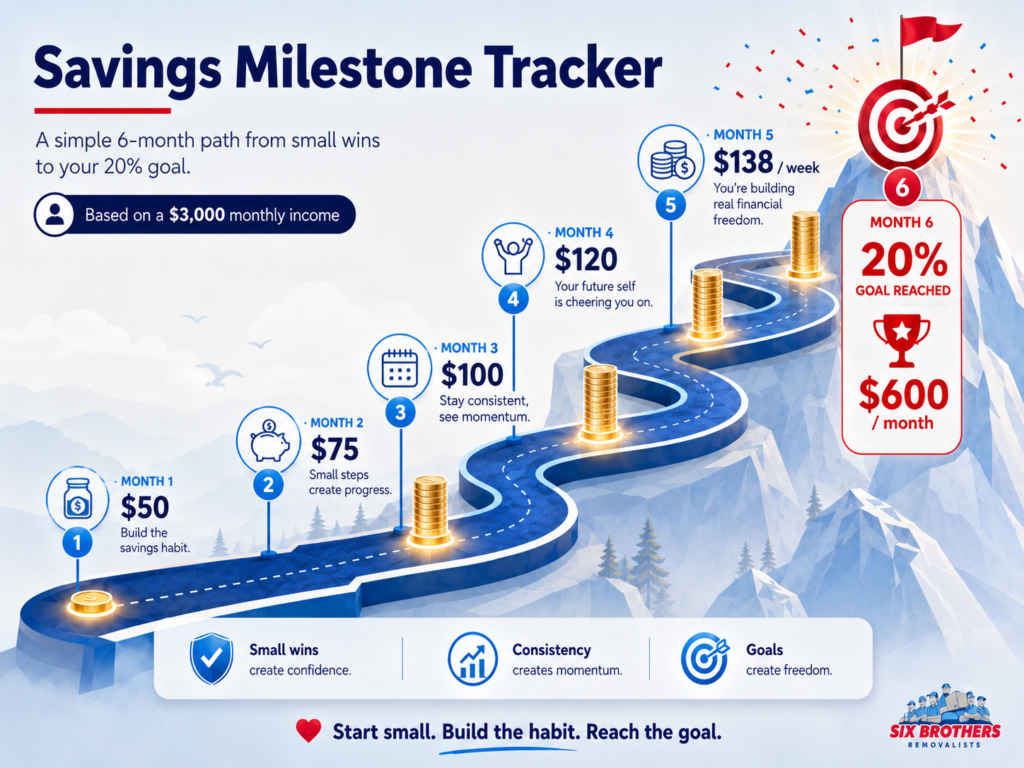
The short answer? Aim for 20%. Settle for 10%. Never settle for zero. That 20 percent savings rule isn’t random. Most Aussie financial planners point to it as the sweet spot. It builds an emergency fund. It funds future goals. It doesn’t starve you of fun. On $3,000 a month, 20 percent looks like $600. That’s your savings target.
Can’t hit it? Start at 10 percent. That’s $300 a month. Still useful. Still real progress.
Saving zero? That’s where most people get stuck. The trick is starting small and stacking wins.
How Much of Your Income Should You Save in Australia?
Australian finance bodies like Moneysmart push the 20 percent rule too. It lines up with what the Reserve Bank tracks as the household savings ratio. The national average bounces between 4 and 11 percent depending on the economy. So if you save 20 percent, you’re already beating most Aussies.
Big tip. Don’t compare your savings to mates posting holidays on Instagram. Compare it to your own version six months ago.
Most of my clients moving house in Sydney tell me the same thing. They wish they’d saved more before the move. Rent bonds, removalists, and connection fees stack up fast.
Read our complete guide on the money needed to move in Australia for exact figures
Monthly Savings Plan for a $3,000 Income Using the 50/30/20 Rule
The 50/30/20 budget rule is the easiest framework on the planet. Three buckets. No spreadsheets. No apps. Just three numbers.
Here’s how to budget $3,000 a month using it.
$1,500 for Needs (50%)
This is rent, food, transport, bills, insurance. The stuff you can’t skip without your life falling apart. In Sydney, $1,500 for needs is tight. We’ll get to that pain in a minute. But the rule still works as a starting line.
Needs include:
- Rent or mortgage
- Groceries (the real basics)
- Electricity, gas, water
- Phone and internet
- Public transport or fuel
- Health insurance
$900 for Wants (30%)
Wants are streaming, eating out, gym, new clothes, a beer on Friday. Stuff that makes life worth living but isn’t keeping you alive. $900 sounds like loads. It isn’t. One Uber Eats habit can swallow half of it.
$600 for Savings/Debt (20%)
This is the magic bucket. $600 a month. Roughly $138 a week. About $20 a day. Split it between savings and any high-interest debt. Credit card debt first. Always.
Saving Strategy for a $3,000 Monthly Income
Here’s the real talk. The 50/30/20 split is the ideal. Your reality might be messier. That’s fine.
The 20% Goal ($600/month)
If you can save $600 monthly, you’ll build a $7,200 emergency fund in a year. That covers most disasters. Job loss. Car repair. A surprise move across Sydney.
The 10% Minimum ($300/month)
When 20 percent feels brutal, drop to 10. $300 monthly is still $3,600 a year. Still a buffer. Still something.
Emergency Fund Focus
Before you invest, before you hit ETFs or crypto, build cash. Three months of expenses minimum. Six is better. For someone spending $2,400 a month on needs and wants, that’s $7,200 to $14,400 in cash.
Actionable Step
Open a separate high-interest savings account today. Not tomorrow. Today. Set up an auto-transfer for the day after payday. Out of sight. Out of mind. Into the savings pile.
What to Prioritise When Saving From a $3,000 Monthly Income?
Not all savings are equal. Where you park your money matters more than how much.
Emergency Fund
Always first. Always. Three to six months of essential expenses sitting in a high-interest account. This is the foundation. Skip it and one car breakdown can wipe out a year of progress.
High-Interest Debt
Credit cards charging 19 percent? Crush them before investing. No ETF reliably beats 19 percent.
Personal loans at 12 percent? Same energy. Kill them.
HECS-HELP? Different beast. Index-linked. Lower priority.
Specific Goals
Saving for a house deposit? A wedding? Moving to Brisbane next year? Open a named account for each. Brain treats them as untouchable when they have a label. Planning a move? Bond, removalists, and connection fees can hit $3,000 to $6,000 in Sydney. That’s a whole separate savings goal.
How to Adjust Your Savings Rate on a $3,000 Income?
Life isn’t a spreadsheet. Some months you’ll smash 25 percent. Some months you’ll save nothing. The point is the trend, not the perfect month.
If 20% Feels Too High
Drop to 15 or 10. Don’t stop. Consistency beats intensity. A small saver who never quits ends up wealthier than a hero who burns out in three months.
If You Have Low Expenses
Living at home? Sharing rent with three mates? You might bank 40 percent. Don’t waste that window. It closes fast. Front-load your savings while life is cheap. Future you will high-five present you.
Does the 50/30/20 Budget Rule Still Work on $3,000 a Month?
Honest answer? Kind of. It works as a framework. It struggles as a literal rule.
Why? In Sydney, $1,500 for needs barely covers rent in a shared house. Add groceries and a Opal card and you’re cooked.
Here’s the fix. Treat the 50/30/20 rule as a target, not a starting point. Start with your actual numbers. Track every dollar for one month. Then nudge toward the 50/30/20 split, one percent at a time. Some months your needs will hit 60 percent. That’s okay. Pull from wants, not savings.
Weekly Savings on a $3,000 Monthly Income: What Does 20% Look Like?
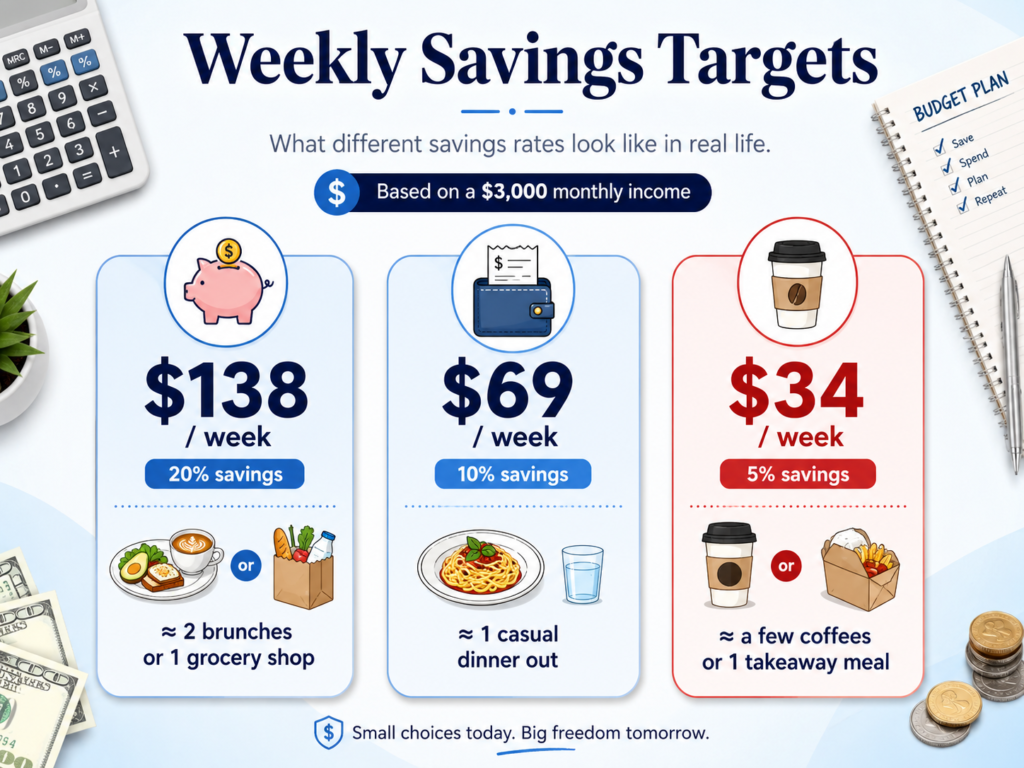
Monthly numbers feel abstract. Weekly numbers feel real. So let’s shrink them.
- 20% savings: $138 a week
- 10% savings: $69 a week
- 5% savings: $34 a week
$138 a week is two Friday nights out. Or one weekly grocery shop. Or three Uber rides across the inner west.
When you see it weekly, the trade-off becomes obvious. Every coffee, every takeaway, every impulse buy has a price tag in saved-future-cash. Want a fun rhetorical question? Is that $18 brunch worth pushing your house deposit back another month? Sometimes yes. Sometimes no. The choice is yours. But at least now you’re choosing.
How to Work Out the Right Savings Rate for Your Income?
Forget percentages for a second. Try this instead.
Step 1. Write down your essential monthly expenses. Rent, food, transport, bills.
Step 2. Subtract that from $3,000.
Step 3. Whatever’s left? Split it. Half for fun. Half for savings.
That’s your real-life budget. Not a TikTok formula. Your actual numbers. If essentials eat $2,200, you’ve got $800 left. Save $400. Spend $400. Done. This method works because it’s built around your life, not someone else’s spreadsheet.
Watch out for the hidden costs of moving that catch most first-time movers off guard.
Sydney Cost of Living Reality Check on a $3,000 Monthly Income
Let’s be brutally honest. Living in Sydney on $3,000 a month is a tightrope walk. Doable, but tight.
Rent And Shared Housing
A solo studio in inner Sydney? $450 to $550 a week. That’s $1,800 to $2,200 a month. Game over. Sharehouse in Marrickville or Lakemba? $250 to $350 a week. Way more workable. Most $3,000-a-month earners in Sydney share. It’s not a flex. It’s mathematics.
Transport And Tolls
Opal card daily cap is around $19.30 weekdays. Weekly cap helps. Budget $40 to $60 a week for public transport.
Got a car? Add fuel, rego, insurance, tolls. Easily $150 to $250 a week. Rough.
Groceries And Utilities
Groceries for one person in Sydney run $120 to $180 a week if you cook. More if you don’t. Power, gas, internet split with two flatmates? Maybe $40 to $70 a week each.
NSW Budget Support
The NSW government runs energy rebates. Service NSW also has cost-of-living vouchers. Check Service NSW for current programs. Free money is free money. Concession Opal cards exist for students, apprentices, and pensioners. Worth checking eligibility.
Alternative Budgeting Methods for a $3,000 Monthly Income
The 50/30/20 isn’t the only game in town. Some alternatives that might fit better.
Zero-based budgeting. Every dollar gets a job. Income minus expenses equals zero. Brutal but effective.
Pay yourself first. Move savings on payday. Live on whatever’s left. Forces discipline.
Envelope method. Cash in physical envelopes for each category. Old school. Works.
80/20 method. Save 20. Spend 80. No further breakdown. Simple for chaotic minds.
Try one for a month. If it sticks, keep it. If not, swap.
Common Saving Mistakes to Avoid
Watching my mates handle money over the years, I’ve seen the same traps over and over. Skip these.
Saving After Spending
Classic mistake. Spend all month. Save what’s left. Result? Nothing left. Pay savings first. Auto-transfer on payday. Don’t even see it.
Ignoring Small Leaks
A $4 coffee daily is $1,460 a year. Streaming subs you forgot about? Another $300. Gym you don’t use? $1,200. Small leaks sink big budgets. Audit your subscriptions every six months.
No Emergency Buffer
Building investments before an emergency fund is like buying a roof before walls. One job loss and the whole thing crumbles. Cash first. Always.
Copying Other Budgets
Your mate earns more. Or less. Or lives at home. Or has different priorities. Their budget isn’t yours. Build for your life. Not theirs.
Best Way to Start Saving This Month
Forget the perfect plan. Start ugly.
- This week: Open a high-interest savings account.
- This payday: Auto-transfer $50 the day money lands.
- Next month: Bump it to $100.
- Three months in: Hit 10 percent.
- Six months in: Push for 20.
That’s it. That’s the whole strategy. Saving on $3,000 a month isn’t about willpower. It’s about systems. Build the system once. Let it run on autopilot. And if you’re saving up for a move? Maybe across Sydney, or interstate, get a quote early. Knowing the exact cost helps you save the right amount.
At Six Brothers Removalists, we’ve helped thousands of Sydney families plan their move without blowing the budget. Whether it’s a studio apartment shift or a full house relocation, knowing your numbers upfront keeps the stress low.
Call us on 1300 764 372 or email info@sixbrothersremovalist.com.au for a transparent quote. We’re based at Suite 1 Level 5/58-60 Macquarie St, Parramatta NSW 2150.
Save smart. Move smarter.