

Table of Contents
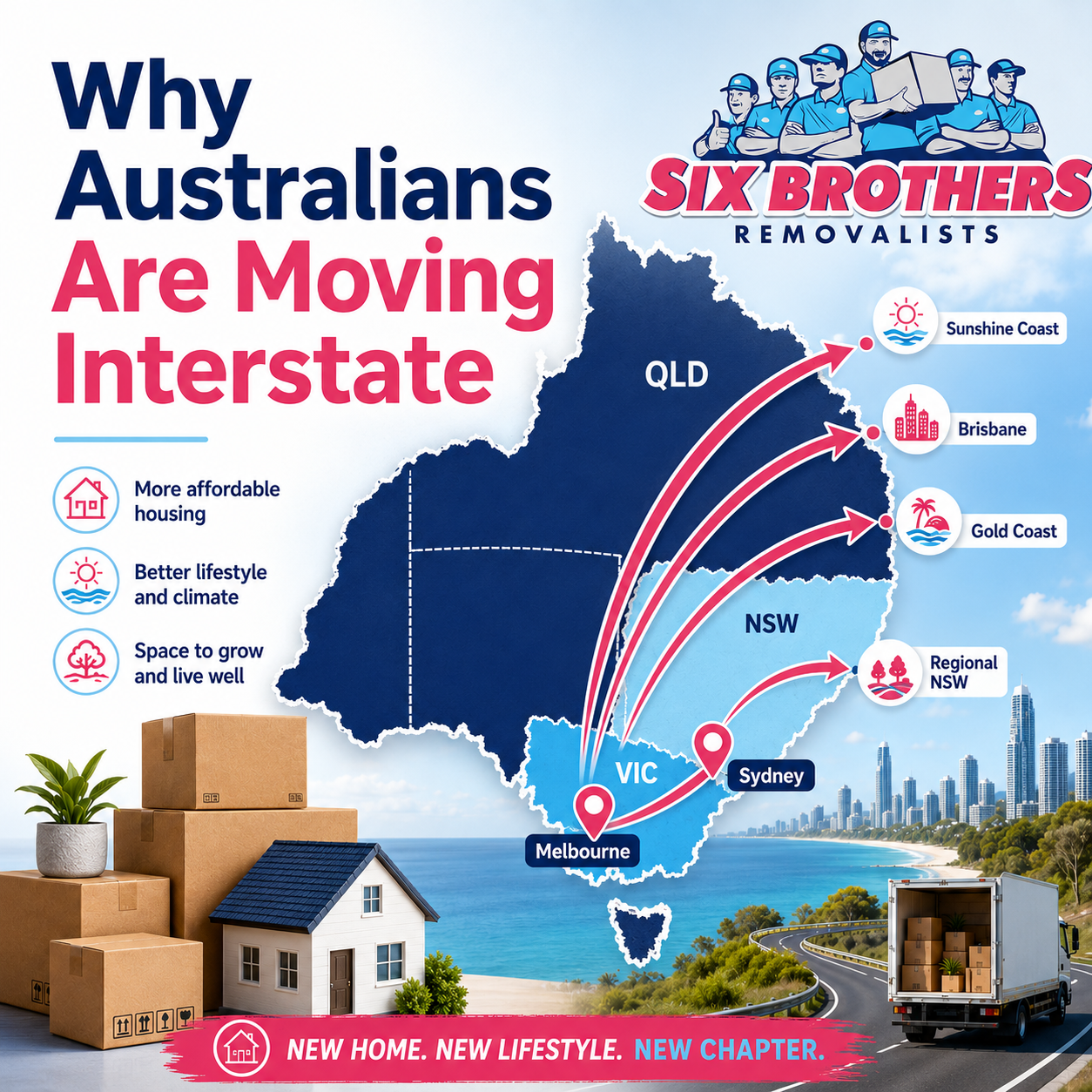
More Australians are packing up and crossing state lines than at any point in the past two decades. Housing costs, remote work, lifestyle shifts, and family ties are all driving people to reconsider where they live and act on it.
For residents and business owners in Parramatta and Greater Western Sydney, this trend is especially visible. Neighbours are leaving. Colleagues are relocating. And many people are weighing the same decision themselves.
This guide covers the real reasons behind Australia’s interstate migration surge, which states are gaining and losing residents, what an interstate move actually costs, and how to plan one without the stress.
The Biggest Reasons Australians Are Leaving Their Home State
Interstate migration in Australia has been climbing steadily, and the motivations are rarely simple. Most people move for a combination of reasons financial pressure, opportunity, lifestyle, and personal circumstances all play a role. Understanding what’s driving the trend helps you recognise whether your own situation fits the pattern.
Cost of Living and Housing Affordability
Housing affordability is the single most cited reason Australians move interstate. Sydney and Melbourne have consistently ranked among the least affordable cities in the world for housing, and that pressure has pushed thousands of families and individuals to look elsewhere.
According to the Australian Bureau of Statistics, Queensland and regional areas of Australia have recorded the strongest net interstate migration gains in recent years, with affordability being a primary driver cited in migration surveys.
For many Parramatta residents, the maths is straightforward: selling a home in Western Sydney and buying in Southeast Queensland or regional NSW can free up significant equity while maintaining or improving quality of life. Renters face the same pressure median rents in Greater Sydney have climbed sharply, making comparable properties in Brisbane, the Gold Coast, or regional centres far more attractive.
Job Opportunities and Remote Work Flexibility
Remote work changed the equation permanently. Before 2020, most people stayed close to their employer. Now, a growing share of the workforce can work from anywhere with a reliable internet connection and they’re using that freedom to move somewhere more affordable or appealing.
At the same time, infrastructure investment in Queensland, South Australia, and regional NSW has created genuine employment growth in construction, healthcare, education, and technology. People aren’t just escaping expensive cities they’re moving toward real opportunities.
For business owners, interstate relocation can mean lower commercial rents, access to different talent pools, and proximity to growing markets. Office relocations from Sydney to Brisbane or the Gold Coast have become increasingly common for exactly these reasons.
Lifestyle, Climate, and Sea Change Motivations
The “sea change” and “tree change” movements have been part of Australian culture for decades, but they accelerated dramatically after the pandemic. People who spent months working from home reassessed what they actually wanted from their daily lives and many concluded that a beachside suburb in Queensland or a regional town in NSW offered more than an expensive apartment in inner Sydney.
Climate plays a real role too. Queensland’s warmer winters, outdoor lifestyle, and lower population density appeal strongly to families with young children and retirees alike. Byron Bay, the Sunshine Coast, and Noosa have seen extraordinary demand from Sydney and Melbourne migrants.
Family Proximity and Personal Circumstances
Not every interstate move is driven by economics or lifestyle aspiration. A significant number of Australians relocate to be closer to ageing parents, to follow a partner’s career move, or to return to a hometown after years away. These personal circumstances are harder to quantify but represent a consistent and meaningful share of interstate migration.
For families in Western Sydney with relatives in Queensland or Victoria, the decision to move often comes after a health event, a new grandchild, or simply the realisation that distance has become too costly emotionally and practically.
Which States Are Australians Moving To (and Leaving)?
The direction of Australia’s internal migration tells a clear story. Some states are gaining residents rapidly. Others are losing them. And the patterns have real implications for anyone planning a move.
Queensland’s Population Boom and Why It Keeps Growing
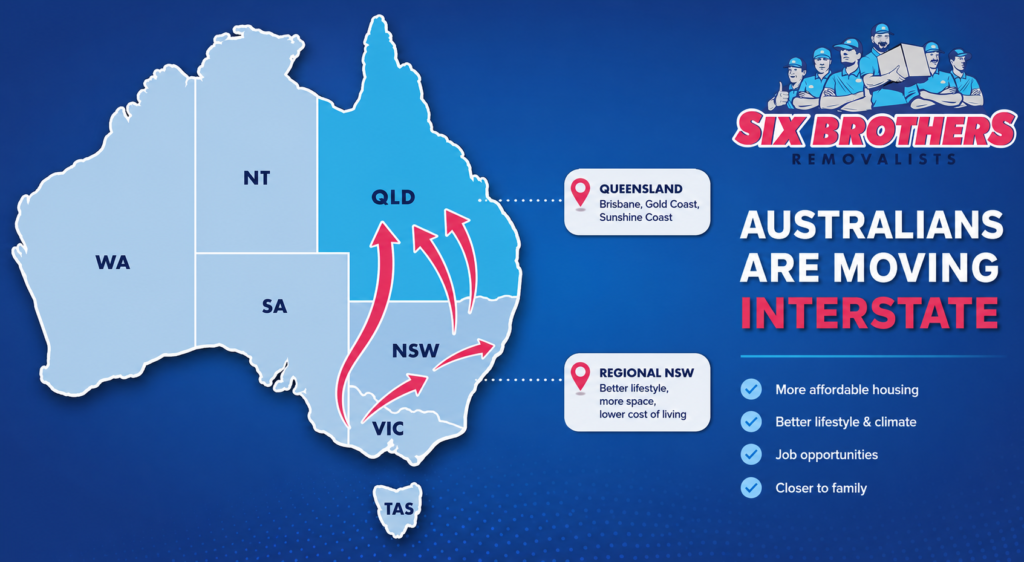
Queensland has been the dominant destination for interstate migrants for several years running. The ABS regional population data consistently shows Queensland recording the highest net interstate migration gains in Australia, drawing heavily from New South Wales and Victoria.
Southeast Queensland, Brisbane, the Gold Coast, the Sunshine Coast, and the Moreton Bay region absorbs the largest share of arrivals. The combination of relative housing affordability, strong infrastructure investment tied to the 2032 Brisbane Olympics, a warm climate, and genuine employment growth makes it a compelling destination for families, retirees, and professionals alike.
Why People Are Leaving Sydney and Melbourne
New South Wales and Victoria have recorded net interstate migration losses for several consecutive years. Sydney’s median house price, traffic congestion, cost of living, and density have all contributed to outflows particularly among families who can no longer afford to upsize, and younger buyers who have been priced out entirely.
Melbourne faces similar pressures, compounded by the city’s extended lockdown periods during the pandemic, which accelerated the reassessment of urban living for many residents.
It’s worth noting that both cities continue to attract international migrants and interstate arrivals the net loss reflects departures exceeding arrivals from other Australian states, not a collapse in overall population.
Regional Migration Trends Within NSW
Not everyone leaving Sydney crosses a state border. A significant share of NSW’s internal migration involves movement from Greater Sydney including Western Sydney and Parramatta to regional centres like Newcastle, the Central Coast, Wollongong, Bathurst, Orange, and the Hunter Valley.
These moves are driven by the same affordability and lifestyle factors as interstate migration, but with the added benefit of staying within NSW maintaining existing professional networks, family connections, and familiarity with the state’s services and systems.
For removalists operating out of Parramatta, regional NSW relocations represent a substantial and growing segment of the work. Routes to Newcastle, the Central Coast, and the Hunter are among the most frequently booked.
What Does an Interstate Move Actually Involve?
Understanding the logistics of an interstate move before you commit to one prevents costly surprises. The process is more involved than a local move, but it’s entirely manageable with the right planning and the right team.
Planning Timeline for an Interstate Relocation
The earlier you start, the better your options. For most interstate moves, a planning window of eight to twelve weeks is ideal. This gives you time to get multiple quotes, secure your preferred moving date, arrange storage if needed, and handle the administrative tasks that come with changing states updating your address, transferring vehicle registration, enrolling children in new schools, and notifying government agencies.
Booking a removalist six to eight weeks out is strongly recommended, particularly for popular routes like Sydney to Brisbane or Sydney to Melbourne. Demand on these corridors is high, and the best companies fill their schedules quickly.
What to Expect on Moving Day
On the day itself, a professional interstate removalist team will arrive at your property, complete a walkthrough, and begin loading your belongings systematically onto the truck. Furniture is wrapped and protected. Boxes are loaded strategically to prevent shifting during transit. Fragile items are secured separately.
For interstate moves, your belongings may travel on a dedicated truck (if you have a full load) or share space with other customers’ goods on a backloading service. Either way, a reputable company will provide you with a clear delivery window and keep you updated throughout transit.
Delivery at the destination involves unloading, placing furniture in the correct rooms, and reassembling any items that were disassembled for transport. A good removalist team leaves your new home functional, not just emptied of boxes.
How Long Does an Interstate Move Take?
Transit times vary by route and service type. Sydney to Brisbane typically takes one to two days by road. Sydney to Melbourne is a similar timeframe. Sydney to Perth can take five to seven days or more, depending on the route and whether the truck makes intermediate stops.
If you’re using a backloading service, delivery windows are broader typically three to seven days because the truck may be completing other deliveries along the route before reaching you. This is a normal and accepted trade-off for the cost savings backloading provides.
How Much Does It Cost to Move Interstate in Australia?
Cost is the question most people ask first, and the honest answer is that it depends on several variables. That said, there are reliable benchmarks that help you budget accurately and avoid being caught off guard.
Average Interstate Removalist Costs by Route
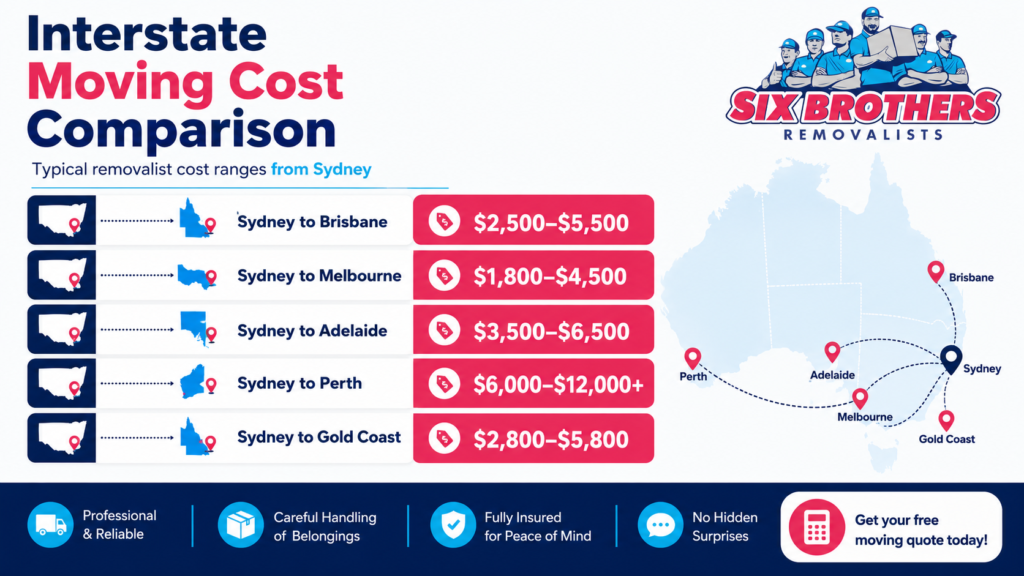
As a general guide, interstate removalist costs in Australia typically fall within these ranges for a standard three-bedroom home:
- Sydney to Brisbane: $2,500 to $5,500
- Sydney to Melbourne: $1,800 to $4,500
- Sydney to Adelaide: $3,500 to $6,500
- Sydney to Perth: $6,000 to $12,000+
- Sydney to Gold Coast: $2,800 to $5,800
These figures reflect full-service moves with a dedicated truck. Backloading services can reduce costs by 30 to 50 percent on the same routes, depending on availability and timing.
Studio apartments and one-bedroom properties cost significantly less. Large homes with pianos, pool tables, or extensive outdoor furniture cost more. Always get an itemised quote rather than a per-hour rate for interstate moves.
What Affects the Price of Your Interstate Move
Several factors influence your final cost:
Volume of goods. The more cubic metres your belongings occupy, the higher the cost. Decluttering before you move is one of the most effective ways to reduce your quote.
Distance. Longer routes cost more, but not always proportionally fuel, driver hours, and overnight stops all factor in.
Access at origin and destination. Narrow driveways, stairs, lifts, and long carries from the truck to the front door all add time and cost.
Timing. Moving during peak periods school holidays, end of month, weekends typically costs more than mid-week moves in quieter periods.
Packing services. If you want the removalist team to pack your home, this adds to the cost but saves significant time and reduces the risk of damage claims.
Insurance. Transit insurance is strongly recommended for interstate moves. Some companies include basic coverage; comprehensive coverage is usually an add-on worth considering.
Backloading as a Cost-Effective Interstate Option
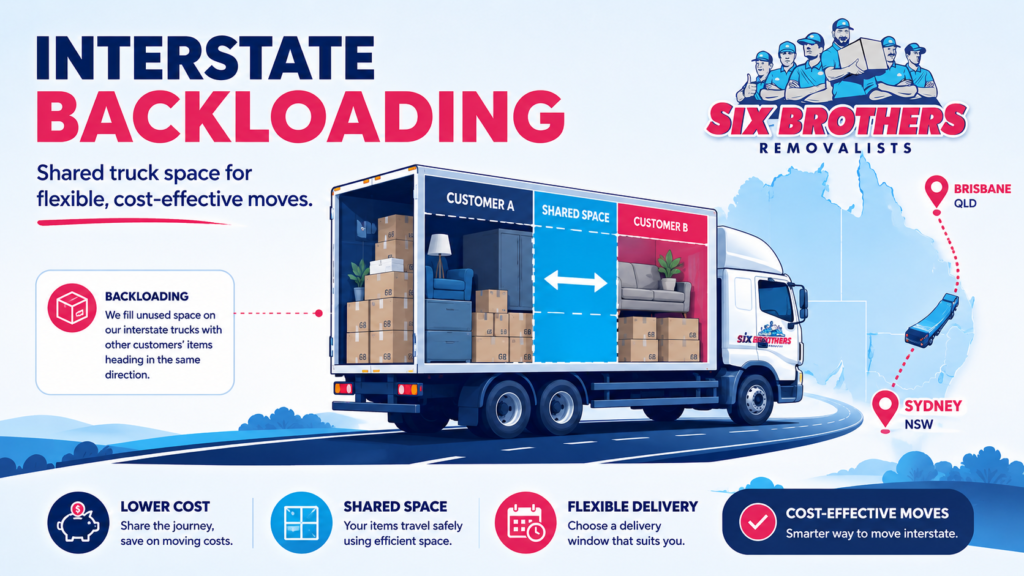
Backloading is one of the most practical and underused options for interstate movers on a budget. When a removalist truck completes a delivery interstate and needs to return to its home base, it often has empty space available. Backloading fills that space with another customer’s goods at a reduced rate.
For example, a truck delivering a full load from Sydney to Brisbane will often take on backloading jobs for the return trip to Sydney. If you’re moving from Brisbane to Sydney, you can access that truck at a fraction of the cost of a dedicated service.
The trade-off is flexibility. Backloading schedules are determined by the truck’s primary route, so you need to be adaptable on dates and delivery windows. For people who aren’t locked into a specific moving date, it’s an excellent option.
Six Brothers Removalists offers interstate backloading services on key routes from Parramatta and Greater Western Sydney. If your timeline has some flexibility, it’s worth asking about backloading availability when you request a quote.
How to Choose the Right Interstate Removalist
Choosing the wrong removalist for an interstate move is a costly mistake. Your belongings will be on a truck for days, potentially crossing multiple states, and you won’t be there to supervise. Getting this decision right matters.
What to Look for in an Interstate Moving Company
Start with licensing and insurance. In Australia, interstate removalists should hold appropriate business registrations and carry transit insurance. Ask specifically whether their insurance covers your goods during transit and what the claims process looks like.
Look for a company with verifiable reviews on Google, ProductReview, or similar platforms not just testimonials on their own website. Pay attention to how the company responds to negative reviews. A professional operation handles complaints transparently.
Experience on your specific route matters. A company that regularly runs Sydney to Brisbane loads will know the road conditions, timing, and logistics better than one doing it for the first time.
Questions to Ask Before You Book
Before committing to any interstate removalist, ask:
- Is the quote binding or subject to change on the day?
- Will my goods travel on a dedicated truck or be consolidated with other customers?
- What is the delivery window, and how will I be notified of the truck’s arrival?
- What insurance is included, and what does it cover?
- How are fragile and high-value items handled?
- What happens if something is damaged during transit?
- Do you offer packing services, and what materials do you use?
A reputable company will answer all of these questions clearly and without hesitation. Vague answers or pressure to book quickly without details are warning signs.
Red Flags to Watch Out For
Be cautious of any removalist who:
- Provides a quote without inspecting your goods (in person or via video call)
- Asks for a large cash deposit upfront before any work is done
- Has no verifiable physical address or ABN
- Cannot provide proof of insurance when asked
- Offers a price significantly below every other quote you’ve received
The removalist industry has its share of unreliable operators, and interstate moves are particularly vulnerable because you’re handing over your belongings for an extended period. Due diligence before booking protects you from significant financial and emotional stress.
Packing for an Interstate Move: What You Need to Know
Packing for an interstate move is different from packing for a local one. Your belongings will be in transit for longer, loaded and unloaded multiple times, and subject to road vibration over hundreds or thousands of kilometres. How you pack directly affects whether everything arrives intact.
Professional Packing vs. DIY Packing
Professional packing is worth considering seriously for interstate moves, particularly for fragile items, artwork, antiques, and electronics. Experienced packers use the right materials, pack boxes to the correct weight, and know how to protect items that are easily damaged in transit.
DIY packing is entirely viable if you’re organised and use quality materials. The most common mistake is using inadequate boxes old supermarket boxes, boxes that have been wet, or boxes that are overpacked and likely to fail. Invest in proper moving boxes.
If you choose to pack yourself, start early. Packing a three-bedroom home properly takes most people two to three full days, not the few hours they typically estimate.
Essential Packing Materials for Long-Distance Moves
For an interstate move, you’ll need:
- Double-walled cardboard boxes in a range of sizes (small boxes for heavy items like books, large boxes for light bulky items like linen)
- Packing tape — at least 5 to 8 rolls for a standard home
- Bubble wrap for fragile items
- Packing paper (unprinted newsprint) for wrapping dishes, glasses, and ornaments
- Furniture blankets or moving pads for large items (your removalist will typically supply these)
- Mattress bags to protect mattresses during transit
- Wardrobe boxes for hanging clothes
Label every box clearly with its contents and destination room. This saves significant time at the other end and helps you prioritise unpacking.
How to Pack Fragile and High-Value Items
Fragile items need individual wrapping, not just a layer of bubble wrap thrown over the top. Each glass, plate, and ornament should be wrapped separately in packing paper, then placed in a box with adequate cushioning on all sides.
Boxes containing fragile items should be clearly marked on all four sides and the top. They should be loaded last onto the truck and positioned so nothing heavy can be stacked on top of them.
For high-value items jewellery, important documents, laptops, and irreplaceable personal items carry them with you rather than putting them on the truck. No matter how careful a removalist team is, keeping your most valuable and irreplaceable items in your personal possession is the safest approach.
Storage Solutions for Interstate Movers
Storage is a practical necessity for many interstate moves, not a luxury. Settlement dates don’t always align perfectly, new homes aren’t always ready on arrival, and sometimes you simply need a buffer between leaving one property and occupying another.
When You Need Storage During an Interstate Move
The most common scenarios where storage becomes necessary:
- Your settlement date in the new state is later than your vacate date in NSW
- You’re renting temporarily while you search for a permanent home interstate
- Your new home needs renovations before it’s liveable
- You’re downsizing and need time to decide what to keep
In these situations, having a trusted storage option through your removalist simplifies the process considerably. Your goods are packed, loaded, stored, and then delivered all managed by one company, without the need to coordinate multiple providers.
Short-Term vs. Long-Term Storage Options
Short-term storage typically one to eight weeks is the most common need for interstate movers. It bridges the gap between leaving your current home and moving into your new one.
Long-term storage suits people who are travelling, working overseas temporarily, or in a significant life transition. Costs are typically charged monthly, and reputable storage facilities offer climate-controlled options for sensitive items like timber furniture, electronics, and artwork.
When evaluating storage options, ask about security (24-hour monitoring, individual unit locks), access hours, insurance coverage for stored goods, and whether your removalist can deliver directly from storage to your new address when you’re ready.
Six Brothers Removalists offers storage solutions for clients in transition whether you need a few weeks of bridging storage or a longer-term arrangement while you settle into your new state.
Interstate Moving Checklist for Parramatta and Western Sydney Residents
A structured checklist prevents the most common moving mistakes. Use this as your planning framework from the moment you decide to move until the day you’re settled in your new home.
8 Weeks Before Your Move
- Confirm your moving date and book your removalist
- Request itemised quotes from at least three companies
- Begin decluttering sell, donate, or dispose of items you won’t take
- Notify your employer, school, and key contacts of your upcoming move
- Research your destination schools, healthcare providers, local services
- Begin collecting packing materials if packing yourself
4 Weeks Before Your Move
- Start packing non-essential items (off-season clothing, books, decorative items)
- Notify Australia Post of your address change
- Update your address with banks, insurers, Medicare, and the ATO
- Transfer or cancel local memberships and subscriptions
- Arrange disconnection of utilities at your current address
- Arrange connection of utilities at your new address
- Confirm your removalist booking and provide any updated inventory details
Moving Week and Moving Day
- Finish packing all remaining items, leaving out only essentials for the final night
- Defrost the fridge and freezer at least 24 hours before the move
- Charge all devices and keep chargers accessible
- Prepare a “first night” box with essentials: bedding, toiletries, a change of clothes, phone chargers, snacks, and any medications
- On moving day, do a final walkthrough of every room, cupboard, and outdoor area before the truck leaves
- Confirm delivery details and contact information with your removalist team
- Keep important documents lease agreements, contracts, identification — with you, not on the truck
Conclusion
Australia’s interstate migration trend reflects genuine, structural shifts in how people think about where they live and work. Housing affordability, remote work, lifestyle priorities, and family circumstances are all driving Australians to reconsider their home state and many are acting on it. Understanding these motivations helps you make a more informed decision about your own situation, whether you’re seriously considering a move or simply trying to understand what’s happening around you.
For Parramatta and Western Sydney residents, an interstate move is a significant undertaking but it’s one that thousands of people navigate successfully every year with the right preparation and the right team behind them. The difference between a stressful move and a smooth one almost always comes down to planning early, choosing a reliable removalist, and knowing what to expect at every stage.
At Six Brothers Removalists, we’ve helped families, renters, and businesses across Western Sydney make interstate moves with confidence. Whether you’re heading to Brisbane, Melbourne, Adelaide, or anywhere in between, we handle the logistics so you can focus on the next chapter. Contact us today for an obligation-free quote on your interstate move.
Frequently Asked Questions
What is the most common reason Australians move interstate?
Housing affordability is consistently the most cited reason. High property prices and rents in Sydney and Melbourne have pushed many residents to seek more affordable options in Queensland, regional NSW, and other states where their money goes further.
Which state receives the most interstate migrants in Australia?
Queensland has recorded the highest net interstate migration gains in Australia for several consecutive years. Southeast Queensland particularly Brisbane, the Gold Coast, and the Sunshine Coast attracts the largest share of arrivals, primarily from New South Wales and Victoria.
How much does it cost to move interstate from Sydney?
Costs vary by destination and volume of goods. As a general guide, a three-bedroom home move from Sydney to Brisbane typically costs between $2,500 and $5,500 for a full-service move. Backloading options can reduce this by 30 to 50 percent for flexible movers.
What is backloading and is it a good option for interstate moves?
Backloading means your goods travel on a truck that is returning to its home base after completing a primary delivery, filling otherwise empty space at a reduced rate. It’s a cost-effective option for people with flexible moving dates, though delivery windows are broader than dedicated truck services.
How far in advance should I book an interstate removalist?
Booking six to eight weeks before your moving date is strongly recommended for interstate moves. Popular routes like Sydney to Brisbane and Sydney to Melbourne fill quickly, especially during school holidays and end-of-month periods.
Do I need storage when moving interstate?
Not always, but it’s a common requirement. Storage becomes necessary when settlement dates don’t align, when you’re renting temporarily while searching for a permanent home, or when your new property needs work before you can move in. Many removalists offer integrated storage solutions to bridge the gap.
What should I look for when choosing an interstate removalist?
Look for verifiable reviews, clear insurance coverage, transparent pricing, and experience on your specific route. Ask for an itemised quote, confirm whether your goods will travel on a dedicated truck or be consolidated, and check that the company holds appropriate business registrations and can answer your questions clearly.
How long does an interstate move from Sydney take?
Transit times depend on the destination. Sydney to Brisbane typically takes one to two days. Sydney to Melbourne is similar. Sydney to Perth can take five to seven days or more. Backloading services may have longer delivery windows of three to seven days due to intermediate stops along the route.
Is it cheaper to move interstate during certain times of the year?
Yes. Mid-week moves in quieter periods avoiding school holidays, public holidays, and end-of-month dates are generally less expensive. Demand peaks during January, June, and December, which typically pushes prices higher and reduces availability.
Can a removalist help with both packing and interstate transport?
Yes. Most professional interstate removalists offer full-service options that include packing, wrapping, loading, transport, unloading, and furniture placement. This is particularly valuable for fragile items, large furniture, and anyone who wants to reduce the physical and logistical burden of the move.