

You pack the last box, wave goodbye to the old postcode, and then bam. Your accountant drops a few words you didn’t expect. Stamp duty. Land tax. CGT. A fresh state revenue office asking questions.
Interstate moves in Australia can shift your tax position in ways most people never see coming. And honestly? A lot of folks only figure it out after they’ve already signed something.
So let’s walk through it, plain English, no jargon overload. This guide breaks down tax implications moving interstate Australia style, from Sydney to Melbourne, Brisbane to Perth, or anywhere in between. Grab a cuppa.
Quick note: This is general info, not personal tax advice. Chat with a registered tax agent before making big calls.

Why Moving Interstate Can Affect Your Tax Position
Australia runs on a two-layer tax system. The feds handle income tax, GST, and CGT. The states handle stamp duty, land tax, payroll tax, and vehicle rego. When you move states, the federal stuff usually stays the same. But the state rules can flip overnight. New thresholds, new rates, new forms.
Here’s the kicker. Your main residence might still be in NSW while you’re sleeping in QLD. Or your investment property in VIC just triggered a tax event. Small change of address. Big ripple effect.
Ever tried using the same key for two different locks? That’s what it feels like applying one state’s rules to another. They don’t match. Which is why a proper interstate relocation tax check matters before you load the truck.
Things that can shift after an interstate move:
- Land tax thresholds and liability in the new state
- Stamp duty on your next property purchase
- Payroll tax if you run a business
- Vehicle stamp duty and rego transfer costs
- CGT timing on your old home or rental
- Tax residency for specific state taxes
You don’t need to panic. You just need a plan. Let’s break each piece down.
Personal Income Tax Issues When Moving Interstate
Your federal income tax follows you. You still pay the ATO the same way. But a few edges get rough when you change states for work or life.
Moving Costs
Here’s the hard truth. Personal moving costs are not tax deductible in Australia. The ATO is pretty clear on this one. Packing boxes, removalist fees, fuel, meals along the way, temporary accommodation. All private in nature. Not work-related.
Tax ruling TD 94/33 lays this out. Moving house to start a new job or get closer to one doesn’t make the costs deductible. It’s a personal choice, not a work expense.
So no, you can’t claim the moving truck on your tax return. Even if the move is for a better job.
Relocation Allowances
Now this is where it gets more interesting. If your employer pays for your relocation, different rules apply.
Many relocation payments can be exempt from fringe benefits tax. Section 58B of the FBT Act covers removal and storage of household goods. That includes the removalist bill, temporary accommodation, house-hunting trips, and even connecting services.
Is relocation allowance taxable in Australia? Depends on how it’s paid.
- Lump sum cash allowance: Usually counted as assessable income. You’ll pay tax on it.
- Reimbursement of actual expenses: Often FBT exempt under s58B.
- Direct payment to removalist: Typically FBT exempt for the employer.
Ask your employer to structure it as reimbursement or direct payment. You keep more. They get the FBT exemption. Win-win.
Business Moves
Running a sole trader gig or small company? Different beast.
Some relocation expenses for the business itself can be deductible. Moving office equipment. Relocating stock. Professional fees for interstate registration changes. These are business costs with a clear link to earning income.
Your ABN stays the same when you move states. But you still need to update the ATO, ASIC, and your local state revenue office. Small admin, big compliance importance.
Running a company relocation? Try our Moving Office Calculator.
Are Moving Expenses Tax Deductible When Moving Interstate?
This question pops up every single move. Let’s sort it out properly.
No Personal Deduction
The short answer: no. Personal moving costs are not deductible on your individual tax return.
Is stamp duty tax deductible Australia wide? Also no, not for your main residence. It gets added to the cost base of the property for future CGT purposes. Same story for:
- Removalist fees for your home move
- Temporary hotel stays during the move
- Cleaning costs at the old or new home
- New furniture bought after moving
- Utility connection fees at the new place
These all count as private or domestic expenses. The ATO doesn’t let you claim them, even if you moved a thousand kilometres for the job of your life.
Employer-Provided Assistance
Here’s the workaround, and it’s legit.
If your boss pays directly, most relocation costs become FBT exempt. You don’t declare it. Your employer doesn’t pay FBT. It’s one of the cleanest exemptions in the Australian tax system. Items often covered under the relocation allowance FBT exemption:
- Removalist and storage costs
- Temporary accommodation (usually up to 21 days)
- Meals during temporary stay
- Sale costs of the old home (in some cases)
- Purchase costs of the new home (in some cases)
- Connection of utilities at the new address
Negotiate this before signing the contract. Once you’ve accepted a flat cash bonus, you’ve usually locked in the taxable version.
Pro tip: Keep every receipt. Removalist tax invoices, accommodation bookings, connection bills. Even if you don’t claim them personally, your employer will need them for FBT records.
Capital Gains Tax and Housing When Moving Interstate

This is where most interstate movers get blindsided. CGT rules on housing are generous but tricky.
Main Residence Exemption
Your main residence is generally exempt from capital gains tax when you sell. That’s the starting point. One home at a time, though. You can only have one main residence for CGT purposes. Spouses are treated as one unit, with some exceptions.
The six-year absence rule is gold for movers. Section 118-145 of the tax act lets you keep treating your old home as your main residence for up to six years after you move out. Even if you rent it out during that time. Conditions to use the six-year rule:
- You actually lived in the home first
- You’re not claiming another property as main residence
- You haven’t exceeded six years of absence while renting it out
- You make the election in your tax return
After six years of renting, CGT starts to apply on a pro rata basis.
Selling Before Moving
Selling your home before the interstate move is usually the cleanest option. Main residence exemption applies. No CGT to worry about.
Timing matters though. Settlement before you officially move keeps it tidy. Settlement after you’ve already relocated? Still fine, as long as the home was your main residence right up until you moved out.
What about buying and selling overlap? You can treat both homes as main residence for up to six months, as long as you sell the old one within that window. Handy when your settlement dates don’t line up.
Moving into a New Home
Bought a new place in the new state before selling the old one? You’ve got options. You can choose which home to treat as main residence for CGT. But only one at a time (outside the six-month overlap rule). The choice affects future tax outcomes.
Quick example. You buy in Brisbane. You keep your Sydney home and rent it out. If you elect the Sydney home as main residence for up to six years, Brisbane becomes partially CGT taxable. Pick your battles. Run the numbers.
Cost base tracking is essential. Keep every record of:
- Original purchase price and stamp duty
- Legal and agent fees
- Capital improvements like renovations
- Holding costs if the property was never income producing
Property and Investment Tax Issues When Moving Interstate
Property investors face the most complex tax position when moving interstate. Here’s what shifts.
Capital Gains Tax (CGT)
Investment properties are always subject to CGT on sale. The state you live in doesn’t change that. But your overall tax bracket might shift if your income changes after the move. A lower income year can be the perfect time to sell an investment property. More of the gain stays in the lower brackets.
Hold a property over 12 months and you get the 50 percent CGT discount as an individual. That doesn’t change state to state.
Land Tax
Land tax is where interstate moves bite hardest. Every state sets its own thresholds and rates.
- NSW land tax threshold sits around $1,075,000 in 2026 (check Revenue NSW for current rates)
- Victoria has a much lower threshold, around $50,000 for most owners
- Queensland threshold around $600,000 for individuals
- Other states all differ again
If your new state includes your old investment property in its land tax calculation, you might owe land tax in two places. Each state only taxes land located in that state. So owning a rental in VIC and living in QLD means you pay VIC land tax on the VIC property. Principal place of residence exemptions usually apply, but only in the state where the home is located and actually lived in.
Stamp Duty
Stamp duty hits when you buy a new property in the new state. No discount for being interstate. Each state sets its own schedule.
Some concessions might apply:
- First home buyer concessions (state specific)
- Off the plan duty reductions in some states
- Principal place of residence concessions in VIC
- Pensioner concessions in certain states
Foreign buyer surcharge and absentee land tax surcharge don’t apply to Aussie citizens moving states. But non-resident rules can catch you if you move overseas, not just interstate.
State Payroll Tax Issues When Moving Interstate
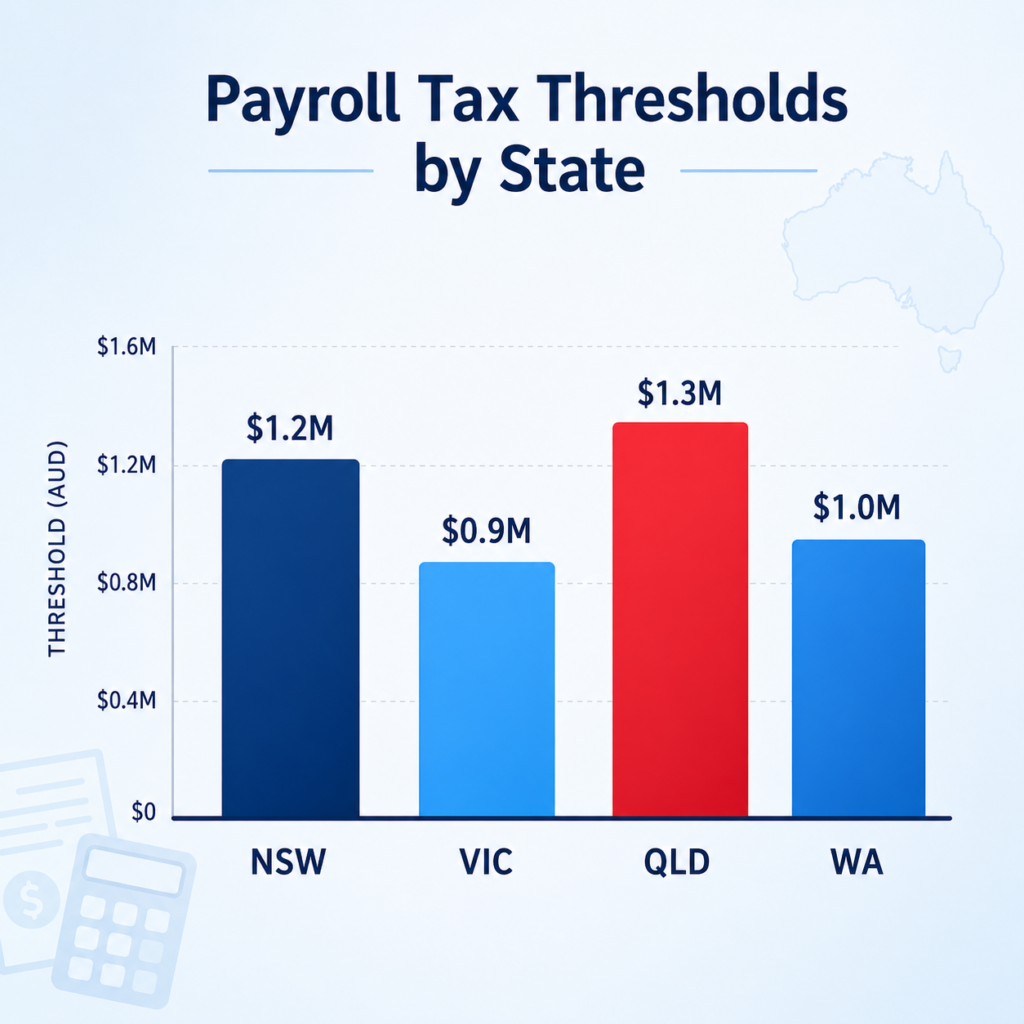
Business owners, listen up. Payroll tax is a state tax that catches a lot of interstate movers off guard.
Reduced Thresholds
Each state sets its own payroll tax threshold and rate. Move your business, and the numbers change.
- NSW payroll tax threshold around $1.2 million
- Victoria threshold around $900,000
- Queensland threshold around $1.3 million
- WA threshold around $1 million
Wages paid to employees working in a state count toward that state’s threshold. If you have staff in multiple states, you apportion wages and might hit thresholds in more than one. Grouping rules can also combine related businesses. Small companies that weren’t liable before can suddenly owe payroll tax after an interstate expansion.
Liability Changes
Register with the new state revenue office when you cross thresholds. Missed registrations mean penalties and interest. Interstate business moves also trigger:
- New workers compensation registration in the new state
- Different long service leave rules and portability
- Updated award and enterprise agreement coverage
- New superannuation fund defaults in some cases
Chat with a BAS agent or registered tax agent before the move. Many businesses find the payroll tax question is more complex than income tax itself.
Sydney to Interstate Tax Issues You Need to Know
Sydney movers face specific NSW rules worth knowing before heading to Melbourne, Brisbane, Adelaide, or elsewhere.
NSW Property Taxes
NSW land tax has a progressive rate above the threshold. Your Sydney investment property keeps triggering NSW land tax even after you move interstate. The premium rate kicks in at higher land values, so keep an eye on annual valuations from the Valuer General.
Surcharge purchaser duty and surcharge land tax apply to foreign buyers. Not relevant for Aussie citizens, but worth knowing if your family structure includes non-residents.
Interstate Home Purchase
Buying a home in Melbourne, Brisbane, or anywhere else? The duty on your new home can be significant. Check for:
- Principal place of residence concessions in VIC
- First home concession in QLD (up to $550,000 value)
- Off the plan duty reductions (state specific)
- Home Builder grant and state based builder grants
Stamp duty on a $750,000 home in VIC runs around $40,000. In NSW, similar. In QLD, slightly less. Budget for it early.
Registration Deadlines
Vehicle rego transfer deadlines are strict. Miss them and face late fees.
- NSW to VIC: 14 days
- NSW to QLD: 14 days
- NSW to SA: 14 days
- NSW to WA: 90 days
- NSW to TAS: 14 days
Stamp duty on the vehicle applies when you register in the new state. Some states offer exemptions for vehicles registered interstate in your name for a set period.
Investor Risk Areas
Sydney landlords moving interstate often keep the Sydney property. That’s fine, but the tax picture changes. Risk zones:
- Six year absence rule counter starts ticking
- NSW land tax still applies on the property
- Rental income feeds into your income tax
- Negative gearing still works, just with new state context
- CGT main residence election needs active decision
A lot of investors hold their Sydney home, rent it out, and assume nothing’s changed. It has. The tax clock starts the day you move out.
Tax Risks for Property Investors Moving Interstate
Investors have more moving parts than anyone else. Let’s map them out.
Keeping the Old Home
Holding the old home as a rental after moving interstate is common. And legal. And tax advantaged, if you play it right. The six year rule we mentioned? That’s your friend. Up to six years of rental income while still claiming main residence CGT exemption on sale. Few countries offer anything this generous.
But you lose the exemption after six years. Partial CGT starts applying based on the portion of time the home was income producing.
Rental Income Changes
Rental income is always taxable at federal level. State doesn’t matter for income tax. But your marginal rate might change. If moving interstate came with a pay cut or career change, your rental income sits in different tax brackets. Plan the financial year accordingly.
Don’t forget:
- PAYG instalments based on prior year estimates
- Medicare levy and Medicare levy surcharge
- HECS HELP repayments on combined income
- Family tax benefit reassessment if applicable
Apportioning Expenses
Rental expenses must be apportioned for any private use or partial rental period. This catches a lot of interstate movers. Say you moved out in March and started renting the property from May. The two months in between are private. Expenses during that time aren’t fully deductible.
Apportioning expenses properly:
- Interest deductible only while rented or genuinely available
- Council rates and water apportioned by days
- Insurance premiums split between private and rental periods
- Depreciation on assets only for income-producing period
Get this wrong and the ATO notices. Get it right and you protect your deductions.
Record Keeping Needs
Record keeping matters more than ever after an interstate move. You’re proving two things: the old home’s history and the new home’s cost base.
Keep for the old home:
- Original purchase documents and settlement statement
- Capital improvements with invoices
- Dates moved in and out
- Rental period dates and agent statements
- Property manager contracts
Keep for the new home:
- Purchase contract and settlement
- Stamp duty assessment
- Conveyancing invoices
- Any capital works from day one
Digital folders work. Paper folders work. Just keep them. You’ll thank yourself in seven years when you sell.
Vehicle and Administrative Tax Requirements When Moving Interstate

Cars and admin. Not sexy. Still matters.
Vehicle Registration
Transfer your vehicle registration within the legal timeframe in your new state. Every state has its own deadline and fee structure.
You’ll need:
- Proof of identity with new address
- Current rego papers from old state
- Vehicle inspection (some states require this)
- Proof of insurance (CTP transferred to new state)
- Payment for new rego plus stamp duty
The stamp duty on a vehicle re-registered interstate is usually calculated on the market value of the car. Some states waive this if the vehicle’s been registered in your name for 12 months or more.
Stamp Duty Exemption
Interstate stamp duty exemption on vehicles works like this. If you’ve owned the car and had it registered in your name for over 12 months, many states waive the stamp duty on transfer.
Always check with the new state’s transport authority. The rules shift around a bit.
ATO Notification
ATO change of address is free and takes five minutes. Do it through myGov or the ATO business portal. Miss this and you might miss a notice of assessment or a debt letter.
Also notify:
- Medicare via myGov
- Centrelink if you receive any payment
- Your super fund to get statements correctly
- Your private health insurer
- ASIC if you’re a company director
- Your state revenue office (old and new)
Here’s a fair dinkum Australian truth: she’ll be right only works for weather, not paperwork.
Interstate Move Tax Checklist for Australians
Print this. Stick it on the fridge. Or save it to your phone. Either way, here’s your interstate move tax checklist.
Before You Move
- Check your main residence election with a tax agent
- Get a property valuation if you own a home (useful for future CGT)
- Review rental arrangements if keeping the old home
- Plan the sale timing if selling before moving
- Negotiate employer relocation allowance as FBT exempt where possible
- Update your superannuation fund address settings
- Talk to your accountant about state revenue differences
- Get quotes from removalists and keep all tax invoices
- Check land tax exposure in the new state
During the Move
- Keep every receipt from the removalist, packers, storage, and fuel
- Photograph condition of household items for insurance
- Record the date you physically move for tax purposes
- Save email confirmations of bookings and allowances
- Track days spent at old versus new address
- Note odometer readings if driving yourself interstate
After You Arrive
- Update ATO change of address via myGov within 28 days
- Transfer vehicle registration within the state deadline
- Register for state revenue office if you own a business
- Update Medicare, Centrelink, private health
- Advise your super fund of the new address
- Update your driver licence
- Notify your employer for payroll records
- Check land tax returns in the new state
- Update electoral roll details
Documents to Keep
Hold these documents for at least five years. Longer for property-related records.
- Removalist tax invoice
- Temporary accommodation receipts
- Travel and fuel receipts during the move
- Employer relocation allowance documentation
- Real estate settlement statements
- Stamp duty assessment from both states
- Vehicle transfer paperwork
- Rental agreement start and end dates (if applicable)
Other Tax and Compliance Considerations When Moving Interstate
Two more pieces people forget. Quick, but important.
Update Your Address
This sounds basic. People still miss it. Every tax-relevant institution needs your new address. ATO. Medicare. Super fund. State revenue office. Bank. Insurance provider. Electoral roll. Your employer’s HR.
Miss one and you might miss a tax notice. Miss a notice and interest starts compounding. A stitch in time saves nine, especially with the tax office.
State Regulations
State regulations differ in ways that matter for tax. Land tax thresholds, stamp duty concessions, payroll tax rates, small business exemptions, first home owner grants. None of it’s uniform.
Before buying property or hiring staff in the new state, read the state revenue office website. Or pay a registered tax agent for an hour of their time. Far cheaper than getting a penalty notice six months later.
Ever wondered why two neighbours pay different land tax? Because one owns across states and gets taxed in each one separately. That’s how state-based systems work.
Final Thoughts on Tax and Your Interstate Move
Tax isn’t the exciting part of moving interstate. Nobody dreams of stamp duty calculations while they’re imagining the new backyard. But getting it right saves real money. Thousands, sometimes tens of thousands. A proper plan before the move turns tax from a landmine into a detail.
Three things to remember:
- Personal moving costs aren’t deductible, but employer-paid relocation often is tax-free under FBT rules.
- Your main residence CGT exemption can stretch up to six years if you rent the old home out after moving.
- State taxes change with every border crossing. Land tax, payroll tax, stamp duty, vehicle rego. Each one needs its own check.
Talk to a registered tax agent before the removalist shows up. It’s the cheapest insurance against a tax surprise. And when you’re ready to move, we can help you get there without the stress.
Ready to Move Interstate Without the Chaos?
Six Brothers Removalists runs professional interstate moves from Sydney to every corner of Australia. Melbourne, Brisbane, Adelaide, Canberra, Wollongong, Port Macquarie, Orange, Gosford. You name it.
We handle the heavy lifting. You handle the tax stuff.
Quick quote:
- Phone: 1300 764 372
- Email: info@sixbrothersremovalist.com.au
- Office: Suite 1 level 5/58/60 Macquarie St, Parramatta NSW 2150, Australia
Our Parramatta team has been moving Aussie families and businesses interstate for years. Transparent pricing. Tax invoices ready for your employer. No dodgy hidden fees. Just honest work and a truck that shows up on time.
FAQs
1. Are moving costs tax deductible in Australia?
No. Personal moving costs aren’t deductible for individuals. If your employer reimburses them, they’re often FBT exempt.
2. Is relocation allowance taxable in Australia?
Lump sum cash allowances usually count as income. Reimbursements and direct payments by the employer for removal, storage, and temporary accommodation are often FBT exempt.
3. Is stamp duty tax deductible Australia wide?
Stamp duty on your home isn’t deductible. It gets added to the property’s cost base for CGT. Stamp duty on investment property is also added to the cost base, not deducted.
4. Do I pay land tax in both states if I own property in each?
Yes. Each state taxes land located in that state. Your principal place of residence exemption only applies where the home is and you live there.
5. How long can I keep my old home as main residence after moving?
Up to six years if you rent it out and don’t claim another home as main residence. Unlimited if you don’t rent it out.
6. How quickly must I transfer my vehicle registration interstate?
Usually 14 days to 90 days depending on the state. Check the destination state’s transport authority.
7. Does the ATO need to know when I move interstate?
Yes. Update your address via myGov within a reasonable time. Most people do it within 28 days to avoid missed correspondence.