


So you’re staring down a moving date and your bank app is looking back at you sideways. Same.
Moving house in Sydney aint cheap. There’s the removalist, the bond, the cleaning, the utility connections, and the sneaky little fees nobody warned you about. And right in the middle of all that chaos, you’ve gotta answer one big money question.
Do you drain your savings? Or borrow some cash and pay it back later?
Both feel scary in different ways. One feels like you’re emptying the safety net. The other feels like you’re walking into a debt swamp wearing thongs. There’s an old Aussie saying that goes, “a penny saved is a penny earned”, but what if spending those pennies means peace of mind on moving day?
Let’s break this down properly. No fluff. No corporate finance speak. Just real talk for real people moving in Sydney, Parramatta, Dubbo, Wollongong, Wagga, and everywhere in between.

Using Savings to Pay for a Move
Paying for your move with savings is the cleanest path. No interest. No repayments. No bank calling you in six months. You spend what’s yours and walk away free.
But here’s the catch. Most people don’t have a fat savings buffer just sitting there. And the ones who do, often feel weird about touching it. That money has a purpose. An emergency fund. A future deposit. A holiday someday. So before you tap into it, you gotta know the pros and cons honestly.
Pros
Using your own money is simple. You see the price, you pay the price, and the move ends there.
- Zero interest cost. What you pay is what you pay.
- No debt hangover. No monthly repayments stretching into next year.
- Faster decision-making. No loan applications. No credit checks. No waiting.
- Better negotiation power. Cash-ready customers often get faster booking slots with movers.
- Lower total moving cost. Borrowing always adds 5% to 20% on top.
It also feels clean. There’s a quiet pride in knowing the move is fully funded by you.
Cons
But savings have a real downside too. Once it’s gone, it’s gone.
- Drained emergency fund. What happens if the car breaks down next month?
- Loss of investment growth. Money pulled from a high-interest account stops earning.
- Mental stress. Watching your buffer shrink is its own kind of anxiety.
- Less flexibility for the new home. Bond, furniture, repairs all need cash too.
Some folks regret using savings when an unexpected bill lands the week after moving day.
Best For
Savings work best for movers with a steady income and a healthy buffer. You should still have 3 to 6 months of living costs left after the move. If using savings would leave you with under a month of expenses, that’s a red flag.
It’s also smart for small moves. A speedy van move or a studio apartment shift usually costs under a grand. That’s a savings job, not a loan job.
High Interest Rates
Right now, personal loan rates in Australia sit between 7% and 20%. Credit cards hover around 18% to 22%. That’s brutal.
If you borrow $5,000 for a move at 15% over two years, you’ll pay back nearly $5,800. That extra $800 is just gone. You could’ve used it for new furniture, a holiday, or a buffer for the next emergency. When rates are this high, savings almost always win the math fight.
Debt Avoidance
There’s something to be said for moving house with zero debt attached. You start fresh. New suburb, new energy, new financial slate.
Debt has a way of following you into the new place. Every time you walk through your kitchen, you’ll remember the loan you took to get there. Some folks don’t mind. Others find it weighs on them more than they expected.
Emergency Fund Rule
Here’s the rule most financial planners stick to. Never empty your emergency fund for a planned expense.
Your move is planned. Your job loss or hospital visit is not. Keep at least 3 months of expenses tucked away, no matter what. If your move would wipe that out, you’re better off borrowing a small amount and protecting your buffer.
Borrowing Money for Moving Costs
Now let’s flip the coin. Borrowing isn’t always bad. It’s a tool. Used right, it can actually make your move less stressful. The trick is knowing when borrowing makes sense and when it doesn’t.
Pros
Loans give you flexibility. You move now, pay later, and keep your savings intact for emergencies.
- Keeps your safety net. Your emergency fund stays untouched.
- Spreads the cost. You pay in chunks over months or years.
- Funds bigger moves. Interstate relocations like Sydney to Brisbane or Sydney to Melbourne can cost $5,000 to $15,000.
- Quick access to cash. Personal loans often clear in 1-3 business days.
- Builds credit history. Repaid loans improve your credit score.
For interstate or large family moves, borrowing can be the difference between moving on time and delaying for months.
Cons
But borrowing has real costs too. Interest piles up. Repayments hang around.
- Interest charges. Even low rates add hundreds or thousands over time.
- Monthly repayments. New ongoing bill in an already tight budget.
- Credit score impact. Late payments hurt your record.
- Total cost is always higher. You pay more than the sticker price.
- Approval not guaranteed. Banks can say no.
A 3-year loan can outlast the move itself. You’ll still be paying for the truck long after you’ve forgotten which mover loaded it.
Best For
Borrowing makes sense when your savings are thin but your income is solid. If you can comfortably repay $200-$400 a month without stress, a loan can work.
It’s also smart for movers facing a time-sensitive opportunity. New job interstate, sudden lease ending, or a property settlement that can’t wait. Sometimes you need the move to happen now, and savings just aren’t there.
Protecting Long-Term Goals
Here’s something most people miss. Pulling savings out of a high-interest account or investment can hurt your long-term wealth more than borrowing.
Say you’ve got $10,000 in an account earning 5% interest. Pulling it out costs you $500 a year in lost growth. If you borrow $10,000 at 8%, you pay $800 a year. The gap is smaller than you think. For some movers, borrowing protects bigger plans like a house deposit or retirement fund.
Interest Rate Arbitrage
This is fancy talk for a simple idea. If your savings earn more than your loan costs, borrow.
Got money in a term deposit at 5%? Don’t break it for a 4% personal loan. That’s free money lost. Always compare what your money earns vs what borrowing costs. This only works if you actually have invested savings. If your money is just sitting in a transaction account doing nothing, use it.
Spreading the Cost
Moving costs hit hard and fast. Borrowing lets you absorb the shock over time.
Instead of dropping $8,000 in one week, you pay $250 a month for 3 years. Yes, you pay more in total. But your cash flow stays smooth. For renters, casual workers, or anyone with irregular income, this matters.
Savings vs Borrowing for Moving Costs: Key Comparison
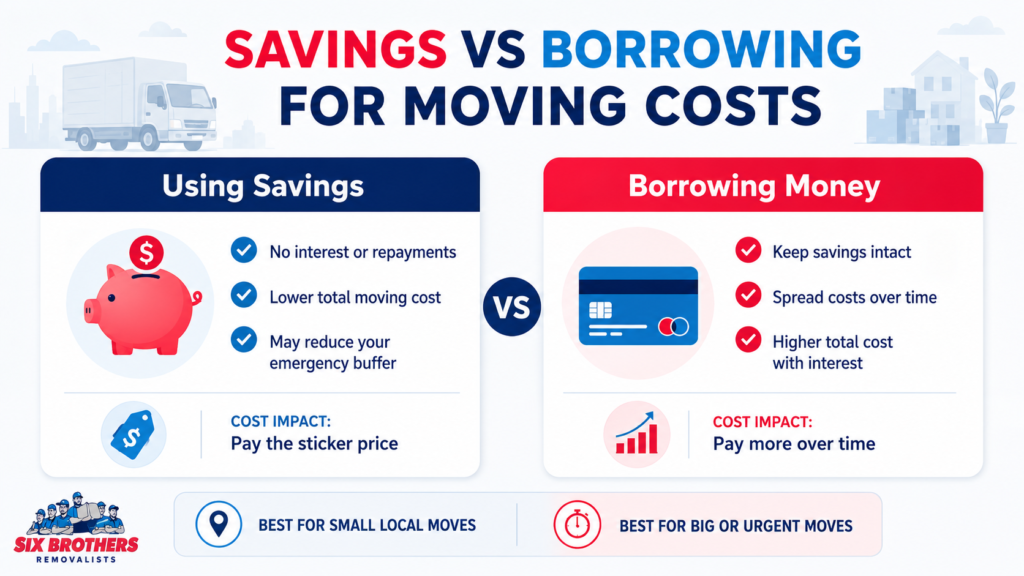
Let’s put both side by side. No spin, just numbers and outcomes.
Cost
Savings win the cost battle every time. You pay the sticker price, nothing more.
Borrowing adds interest, fees, and sometimes admin charges. A $5,000 loan at 12% over 2 years costs you about $5,650. That’s $650 in pure interest. For small moves under $2,000, the cost difference is tiny. For interstate moves over $8,000, it can be massive.
Debt
Savings keep you debt-free. Borrowing creates a new obligation. Some people can carry debt without stress. Others lose sleep over it. Know yourself before signing anything.
Safety
This is where it gets interesting. Borrowing actually feels safer for some movers because it protects the emergency fund.
Savings drained = no buffer for surprises. Borrowing kept = buffer intact, but new monthly bill.
The safest path is usually a mix. Use some savings, borrow a small amount if needed, and keep at least 3 months of expenses untouched.
Key Things to Consider Before Paying for a Move in Sydney
Sydney moving costs aint like the rest of the country. Parking permits, tight streets, strata rules, all add layers. Before you choose savings or borrowing, look at the bigger picture.
Prioritize Emergency Funds
This is rule number one. Your emergency fund is sacred. Aim to keep at least 3 months of essential expenses in a separate account. Rent, food, utilities, transport. Don’t touch it for the move unless you absolutely have to.
Avoid High-Interest Debt
Credit cards are the worst way to fund a move. Rates can hit 22% or higher. A $3,000 credit card balance can cost you $660 a year in interest alone. If you must borrow, go for a personal loan with a fixed rate. Or look at lower-cost options like borrowing from family with a clear repayment plan.
Use Savings for Large Deposits
Big upfront costs like rental bonds and removalist deposits are better paid from savings. They’re predictable and one-time. Save borrowing for the variable costs that pop up during the move itself. Like extra packing materials or last-minute storage.
When Borrowing for a Move Makes More Sense?
Sometimes borrowing is the smarter play. Here’s when. You’ve got a stable income and good credit. Repayments fit comfortably under 10% of your monthly take-home.
You’re moving interstate. Sydney to Melbourne, Sydney to Brisbane, or Sydney to Adelaide can easily run $8,000 to $15,000. Most people don’t have that lying around.Your savings are tied up in investments earning more than the loan costs. Math says borrow. The move is time-sensitive. New job, sudden lease end, or a settlement date you can’t move. You need to keep your emergency buffer intact. A small loan beats a wiped-out safety net.
When to Use Savings for Moving Costs?
Savings are the clear winner in these cases.
Your move is small. A studio apartment removalist job or a speedy van move under $1,500 doesn’t justify a loan. You’ve got 6+ months of expenses saved beyond your moving budget. Plenty of cushion. You hate debt. Some people just sleep better without it. That’s worth more than any interest savings.
Your credit isn’t great. Loan rates will be punishing. Savings sidestep the problem entirely. You’re moving locally. A short Parramatta to Blacktown move or Cronulla shift won’t cost enough to worry about financing.
How to Start Saving Money for a House Move?
If your move is 3-6 months out, you’ve got time to build a moving fund. Here’s how to start.
Open a separate high-interest savings account. Name it something like “Moving Fund” so you don’t dip in. Out of sight, out of mind. Set up an automatic transfer on payday. Even $50 a week adds up to $1,300 in six months.Cancel one subscription you barely use. Streaming services, gym memberships, app subscriptions. Most people have $50-$150 a month in forgotten subs.
Sell stuff you don’t need. Old furniture, gadgets, clothes. Marketplace listings are quick cash and one less thing to move. Skip one big expense a month. One restaurant dinner saved = $80 toward the move.
How to Save More Money Before Moving House
Already on the savings train? Let’s pour fuel on it.
Cook at home more. Even cutting takeaway from 3 nights to 1 saves $40-$80 a week. Use cashback apps for groceries and shopping. ShopBack, Cashrewards, and similar tools give 1-10% back on regular spending. Move during off-peak season. Mid-month, mid-week moves are cheaper. Avoid the end-of-month rush when everyone’s lease ends. Declutter aggressively. Less stuff = smaller truck = lower removalist cost. Donate, sell, or bin anything you haven’t used in a year.
Pack yourself if you can. Hiring packers adds hundreds to the bill. DIY packing with proper tips and tricks saves real money. Get 3-5 removalist quotes. Prices vary wildly. We’ve seen $200/hr differences for the same job.
Sydney Moving Costs and Cash Pressure
Sydney moves hit your wallet from every angle. Let’s break down where the cash actually goes.
Removalist Fees and Timing
Local removalist costs in Sydney run $120 to $200 an hour for two movers and a truck. A 1 bedroom unit removalist job usually takes 3-5 hours. A 3-4 bedroom unit/house can take a full day or more.
Weekends and end-of-month bookings cost more. Mid-week moves can save 15-25%.
Bond and Rent Upfront
If you’re renting, expect to pay 4 weeks bond plus 2 weeks rent in advance. On a $700/week rental, that’s $4,200 upfront before you even move in.
Cleaning and Utilities
End-of-lease cleaning costs $300-$600 for most apartments. Utility connections add another $100-$300 across electricity, gas, internet, and water.
Hidden Moving Costs
This is where budgets blow up. Storage between leases. Insurance for valuable items. Damages claims if something breaks. Parking permits in tight Sydney streets. Strata move-in fees in apartment buildings.
Build a 15-20% buffer into your moving budget for these. They always show up.Local removalist costs in Sydney run $120 to $200 an hour, see our full breakdown on how much do removalists cost per hour in Sydney.
How to Build a Moving Budget Before Moving House

A real moving budget has six parts. Miss one, and you’ll be scrambling later.
Removalist quote. Get this first. Use a moving home calculator to estimate based on your home size.
Packing materials. Boxes, tape, bubble wrap, labels. Budget $150-$400 depending on home size.
Bond and rent. If renting, this is usually the biggest single cost.
Cleaning. End-of-lease cleaning and any move-in cleaning at the new place.
Utility connections. Don’t forget internet setup fees and connection charges.
Buffer. Always 15-20% of total. Hidden costs are guaranteed.
Add it all up. Compare to your savings. The gap tells you whether to use savings only, borrow, or do a mix.
The worst move? Draining savings AND borrowing on credit cards. For budget-saving tactics, read how to move a house if you can’t afford it
Final Thoughts: Which Path Wins?
Honestly? Neither savings nor borrowing wins every time. It depends on your situation.
If you’ve got a healthy buffer and a small to mid-size move, use savings. Clean, fast, no regrets. If you’re moving interstate, juggling a tight budget, or want to protect long-term investments, borrowing has its place. Just keep the loan small, the term short, and the rate as low as you can get.
The worst move? Draining savings AND borrowing on credit cards. That’s the path to real money stress.
Whatever you choose, plan early. Get quotes. Build a budget. Talk to a removalist who knows Sydney. We’ve helped thousands of families across Parramatta, Sydney, Wollongong, Dubbo, Wagga, and beyond figure out the smartest way to move without breaking the bank.
Call Six Brothers Removalists on 1300 764 372 or email info@sixbrothersremovalist.com.au for a free quote. We’re at Suite 1 Level 5/58-60 Macquarie St, Parramatta NSW 2150.
Your move shouldn’t cost you sleep. Let’s make it smooth, affordable, and stress-free.