

So you got the job. Big offer, new city, fresh start. Then the moving quotes land in your inbox. Ouch.
You start wondering. Can I claim any of this back at tax time? Is there a salary sacrifice trick? Will the ATO actually help me out here? Look, the rules around moving for a new job tax benefits in Australia are weirder than most people think. Some folks miss out on thousands. Others double-dip and get burned in an audit. And a lot of Sydney professionals just wing it and hope for the best.
There’s an old Aussie saying. She’ll be right, mate. But when it comes to tax and relocation? She won’t be right unless you read the fine print. This guide breaks down what’s deductible, what’s not, and what your employer can quietly cover without paying extra tax. We’ll talk salary packaging, fringe benefits, FBT exemptions, the whole lot. By the end you’ll know exactly which receipts to keep and which arguments to push with HR.

Can You Claim Moving Costs for a New Job?
Short answer? Mostly no. But there’s nuance.
The ATO treats personal relocation expenses very differently to other work costs. Most movers don’t realise this until they file. Then they’re chasing receipts that won’t help.
Personal Claim Rule
Here’s the headline. You generally cannot claim moving expenses as a personal tax deduction in Australia. The ATO sees relocation as private spending. It’s not a cost of earning your income. It’s the cost of getting yourself ready to earn income. Subtle difference. Big consequence.
So if you paid removalists out of your own pocket? That cost stays out of your tax return. Same goes for packing supplies. Same for fuel on the drive up.
New Job Moves
Starting a new role with a new employer? The personal deduction door stays shut. Doesn’t matter if the new job pays double. Doesn’t matter if you had to relocate from Perth to Parramatta. The ATO’s view is consistent here.
But your employer can pay or reimburse you. And that’s where the real tax magic happens. We’ll dig into that soon.
Transfer Job Moves
What if your existing employer transfers you to another city? Bit different. Still no personal deduction at tax time. The rule is the same. But the FBT exemption for your boss is much easier to use.
Why? Because there’s already an employment relationship. The move is clearly work-driven. It’s not optional, in most cases.
Self-Employed Limits
Self-employed and moving to chase clients? Tough one.
You can’t claim the personal move costs. But if you’re shifting an actual business location, some costs become business expenses. Things like moving equipment, stock, or office furniture.
Talk to your accountant before booking anything. The line between personal and business move blurs quickly.
Personal Relocation Expenses and Tax Rules in Australia
Let’s get into the meat of it. The general rule comes from a long line of ATO rulings. Relocation costs are capital and private in nature. That phrase locks them out of your personal deduction list.
So what does that mean in plain English? It means the act of moving doesn’t earn you money. It just puts you in position to earn money. The Tax Office views this like buying a suit for work. Or a haircut before an interview. Necessary maybe. Deductible? Nope.
Common costs that are not personally deductible include:
- Removalist fees and labour charges
- Packing materials and boxes
- Truck or van hire if you DIY
- Fuel for the move
- Temporary accommodation between homes
- Storage fees during the gap
- Travel costs for you and the family
- Pet transport
- Insurance for the move
- Cleaning of old or new home
Feels harsh, right? It is. But there’s a workaround that almost nobody talks about properly. Salary sacrifice.
Salary Packaging Moving Costs for a New Job in Australia
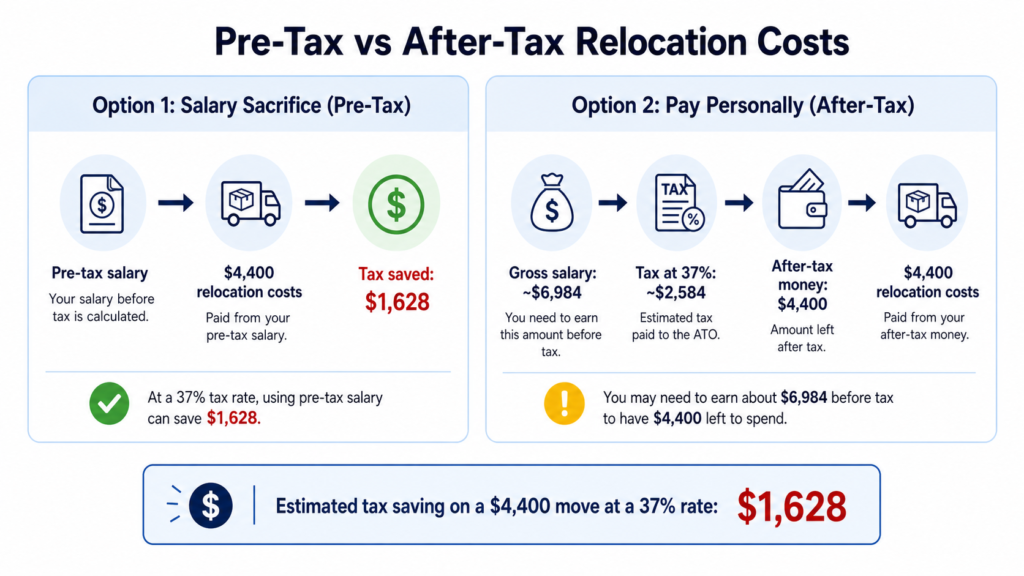
Here’s where smart relocators save serious money. Salary sacrifice relocation expenses can flip the whole equation. Instead of you paying with after-tax dollars, your employer pays. Then your salary is reduced by that amount. You get the move covered without losing thousands to tax first.
Sound too good? It’s real. And it’s been in the rules for decades.
How It Works
You agree with your employer before you start. They pay the moving costs directly. Your salary package is adjusted to absorb the cost. The cost comes out of your pre-tax salary. So you save your marginal tax rate on every dollar.
Most employers have a salary packaging provider. They handle the paperwork. You just submit invoices and they pay the supplier.
Tax Saving
Imagine you’re on a 37% tax bracket. You quote a Sydney move at $4,400. Pay it personally? You needed to earn about $7,000 to net that $4,400. Painful.
Salary sacrifice it? Your employer pays the $4,400 directly. Your taxable salary drops by $4,400. You save around $1,628 in tax. Just like that.
GST Benefit
Bigger employers can also claim GST input credits on the move. That’s another 1/11th saving on the bill. Some packaging providers pass that benefit back to you. Some keep it. Ask the question.
It can mean another few hundred bucks in your pocket. Worth a five-minute phone call.
Removalist and Storage Fees
Most relocation packages include the cost of professional removalists. This usually covers loading, transport, and unloading. Some also cover packing. Storage in between homes is generally covered. So if you sell early but settle late, the storage gap is included.
This is gold for anyone facing a settlement timing problem. Don’t pay it personally.
Transport Costs
Your travel to the new city is usually covered too. Flights, fuel, hotels along the route. Family members count. Spouse, kids, even pets in some packages.
Keep boarding passes and fuel receipts. The packaging provider needs them to process payment without FBT.
Home Sale/Purchase Costs
This one shocks people. Some FBT exemptions cover costs of selling your old home and buying the new one. We’re talking real estate agent fees. Stamp duty in some cases. Legal fees. Building inspections.
The rules are tight. The dollars saved can be huge. We’ll cover this in the FBT section below.
Employer Fringe Benefits Tax Concessions for Work Relocation
Now we’re in the engine room. The FBT relocation exemptions are why salary sacrifice works. Without these exemptions, employers would pay 47% FBT on every dollar they spent moving you. They’d refuse to package it. The whole thing would fall apart.
But the exemptions exist. So smart employers offer relocation packages to attract talent.
Exempt Relocation Costs
The Fringe Benefits Tax Assessment Act 1986 carves out specific exemptions. Sections 58B through 58F cover the main ones.
What’s exempt from FBT when you move for work?
- Removal and storage of household effects
- Transport for you and your family to the new location
- Costs of connecting utilities at the new home
- Sale of your old dwelling (in some cases)
- Purchase of a new dwelling (in some cases)
- Temporary accommodation at either end
- Meals during temporary accommodation periods
- Removal of pets
Each one has rules. Each one has a time limit. Miss the limit and the FBT bill lands.
Temporary Accommodation
Need a hotel for two weeks while your stuff arrives? Covered. The FBT exemption for temporary accommodation is in section 61C. It applies when you can’t reasonably stay in your old or new permanent home.
The time limits are tight. Generally 21 days at the new location. Up to 4 months in some cases. Longer if you’re trying to sell the old place.
Travel Costs
Flying the family to Sydney for the move? Covered. Section 58F exempts the transport, meals, and accommodation costs of relocation travel. Spouse and dependents are included by definition.
This is one of the most underused exemptions. People pay for their own flights all the time. Don’t.
Sale/Acquisition of Home
Big one here. Section 58C exempts certain costs of selling and buying a home as part of the relocation.
What’s covered?
- Real estate agent commission on sale
- Stamp duty on purchase
- Legal and conveyancing fees
- Loan establishment fees
- Building and pest inspection
- Some advertising costs
That can easily save you $20,000+ on a Sydney property purchase. Massive. But there’s a rule. You must sell within 2 years of relocating. And you must have lived in the old home as your main residence.
Timeframes
Time matters with FBT. The exemptions don’t sit there forever. Generally the move must be tied to a change in usual place of residence. The expenses must be incurred reasonably soon after the move.
For removal and storage? Usually 12 months from the move. For sale of old home? Usually 2 years. For purchase of new home? Usually 4 years. These dates are flexible in some cases. But don’t bank on flexibility. Move fast.
FBT Treatment
Even when exempt, the costs need to be reported correctly. Otherwise the ATO can reclassify them.
Your employer’s payroll team needs to know:
- The benefit qualifies under the relocation rules
- Documentation supports each expense
- Time limits are met
- The benefit is recorded properly
Get this wrong and the employer cops a 47% FBT bill. Then they pass it to you, often through a higher salary deduction.
Remote Area Housing

Heading to Dubbo, Wagga, or somewhere truly regional? The remote area concessions kick in. Section 58ZC exempts certain housing benefits for remote area employees. Rent assistance, mortgage interest help, electricity. The list is long.
This can change the whole picture. A regional posting that looked breakeven becomes a great deal after FBT exemptions stack.
Remote Areas
What counts as remote? The ATO has a list. Generally it’s locations more than 40 kilometres from a town with population over 14,000. Or more than 100 kilometres from a town over 130,000.
Most of regional NSW qualifies. Same for inland Victoria, most of QLD, and almost all of WA outside Perth. If you’re being asked to move from Sydney to Dubbo? Push hard for the full remote area package. The savings dwarf anything you’d see on a metro move.
Corporate Relocation Benefits and Tax Treatment
What does a typical corporate relocation package look like in Australia? Honestly, they vary wildly. A graduate role might offer $3,000 cash and good luck. A senior executive role might cover $80,000 of moving and selling costs. The smart packages bundle FBT-exempt items. The dumb ones just give you cash that gets taxed at full rates.
What to look for in a good corporate package:
- Direct payment to removalist and storage providers
- Coverage of temporary accommodation at both ends
- Travel costs for family
- Real estate sale and purchase fee assistance
- Connection of utilities at new home
- A small cash allowance for incidentals
What to avoid?
- Lump sum cash relocation allowance with no structure
- Gross-up that doesn’t actually cover the full cost
- Vague reimbursement promises with no FBT planning
If your offer letter says “$10,000 relocation allowance,” push back. Ask for a structured package with FBT-exempt components instead. It’s worth thousands in your pocket.
Managing the Tax-Free Threshold During a Work Relocation
Here’s a sneaky trap. When you change jobs mid-year, the tax-free threshold can mess you up. The first $18,200 of your income is tax-free. But each employer applies the threshold separately if you tick the box on both forms. Tick the threshold box twice and you’ll under-pay tax all year. Then a nasty bill arrives.
What to do?
- Tick the tax-free threshold for your highest-paying job only
- Update the form when you leave the old role
- Tell your new employer if you’re already mid-financial-year
This sounds boring. It’s also one of the most common reasons people end up owing money after a job move. Get it right early.
Key Tax Considerations When Moving for a New Job
Quick rundown of the stuff people forget. Don’t skip these.
No Personal Deduction
We said it before. Saying it again. Personal moving costs are not deductible. Don’t try to slip removalist fees into your tax return as “work expenses.” The ATO has audit triggers for this. You’ll get pinged.
The only way to get tax relief on a move is through your employer. Salary sacrifice or direct payment. Nothing else works for individuals.
Record Keeping
Even with salary sacrifice, you need every receipt. The packaging provider will ask for them.
What to keep?
- Removalist invoice with full breakdown
- Storage facility receipts
- Hotel bills with dates and names
- Flight bookings and boarding passes
- Fuel receipts if driving
- Real estate agent invoices
- Conveyancer fees and statements
- Utility connection bills
- Stamp duty notices
Snap photos of everything. Email them to yourself. Cloud storage helps if originals get lost in the move chaos.
How to Track and Document Moving Expenses for Tax Purposes
Here’s a simple system that actually works for busy professionals.
Step 1: Open a dedicated email folder. Call it “Move 2026” or whatever. Forward every receipt and invoice into it.
Step 2: Use a spreadsheet. Date, supplier, amount, GST, category, payment method. That’s six columns. Don’t overthink it.
Step 3: Snap and store. Phone camera plus cloud folder. Backup to an external drive once a month.
Step 4: Categorise weekly. Don’t let receipts pile up for three months. Memory fades. Receipts fade. Excuses pile up.
Step 5: Match to your salary package agreement. Each receipt should match an FBT-exempt category. If it doesn’t match, ask your packaging provider before the deadline.
This sounds like overkill. It isn’t. One missed receipt can mean a $1,000 personal cost you could’ve packaged.
Common Tax Mistakes That Waste Money During a Work Move
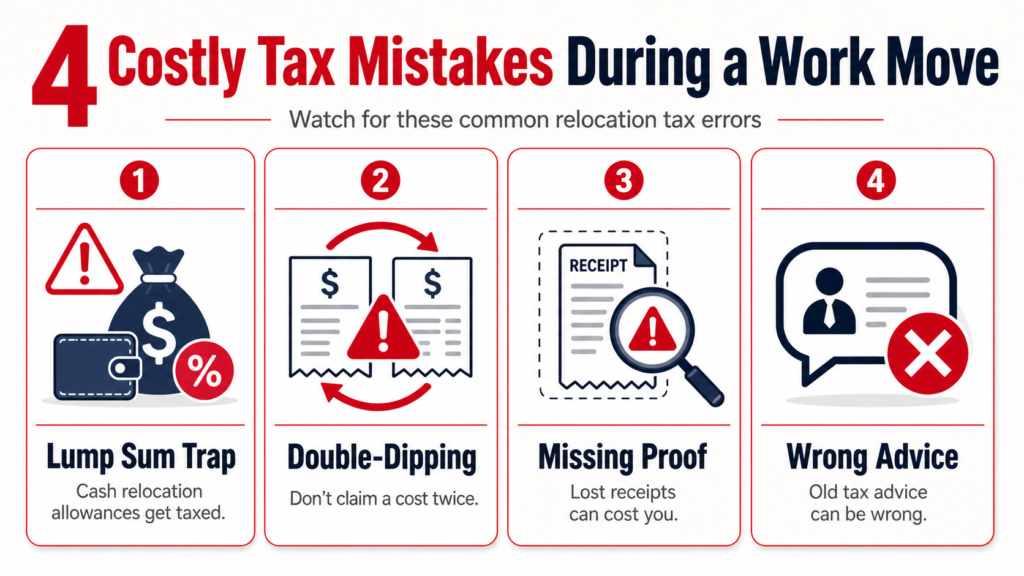
Want to know what burns the most cash? These four traps.
Lump Sum Trap
Your new boss offers a $15,000 relocation allowance as cash. Sounds generous. It isn’t. That cash is fully taxable as income. On a 37% rate, you net $9,450. The other $5,550 disappears.
Push for structured FBT-exempt benefits instead. A $10,000 structured package can deliver more value than a $15,000 cash one.
Double-Dipping Mistakes
Some folks try to claim costs both ways. They get reimbursed by the employer. Then claim the same costs personally. That’s a fast way to attract an audit. The ATO data-matches employer FBT reports against personal returns.
Pick one route. Don’t be greedy. The penalty interest stings far more than the saving.
Missing Proof
You’ve got a $3,000 removalist invoice somewhere. You think. When packaging deadline hits, you can’t find it. The benefit gets reclassified. You pay tax on the lot.
Don’t be that person. Document as you go.
Wrong Advisor Assumptions
A mate told you that moves are deductible if it’s for work. Your old accountant said the same thing in 2003. Things changed. Lots of times. The current rules are clear and getting stricter.
Check with a current tax professional. Not your cousin. Not Reddit. Not a 10-year-old blog from a forum.
Sydney Move Checklist Before Tax Time
You’re moving to or within Sydney for a new role? This is your shortcut list.
Before You Accept
Ask the employer about relocation in the offer stage. Not after you sign.
Questions to ask:
- Do you offer a structured relocation package?
- Is salary sacrifice for relocation costs available?
- Which expenses qualify as FBT-exempt?
- Who is your salary packaging provider?
- What’s the limit and the timeframe?
Get the answers in writing. A casual “yeah we cover that” doesn’t count.
Before You Move
Once you’ve signed, lock in your move plan.
- Get 3 quotes from licensed Sydney removalists
- Confirm packing materials are included or purchased separately
- Book temporary accommodation if needed
- Arrange storage if there’s a settlement gap
- Schedule the truck for a non-peak day if possible
- Notify utilities of disconnection and reconnection
- Update your address with banks and the ATO
For Sydney moves, weekday moves cost less than weekends. Tuesday and Wednesday are usually the cheapest.
After You Settle
You’re in. The truck has gone. Now pause and breathe.
But also:
- File every receipt before you forget where they are
- Submit your salary sacrifice paperwork promptly
- Confirm the packaging provider received everything
- Keep a folder of email confirmations
- Update your tax-free threshold details with HR
The first 30 days after a move are when receipts disappear. Stay on top of it.
At Tax Time
Filing season hits. What now?
- Don’t claim moving costs as a personal deduction
- Check your PAYG summary matches your salary package
- Confirm any reportable fringe benefits are listed correctly
- Speak to your accountant if anything looks off
A reportable fringe benefit can affect your Medicare levy surcharge, child support, and HELP repayments. It doesn’t add to your taxable income. But it does show up on a few calculations.
When to Get Expert Tax Help for a Job Relocation?
Some moves you can DIY. Some you really shouldn’t.
When to call a tax professional:
- Your relocation package is over $10,000
- You’re selling and buying a home as part of the move
- You’re moving interstate with kids and a partner
- You’re shifting from PAYG to self-employed
- Your new role pays significantly more
- Your employer doesn’t have a relocation policy
- You’re moving to or from a remote area
A good accountant pays for themselves on a move like this. Ten times over, sometimes.
What should they do for you?
- Review your offer letter and suggest restructuring
- Talk to HR about FBT-exempt packaging
- Set up your records correctly
- Plan for the tax-free threshold change
- File your return with everything aligned
Expect to pay $300 to $800 for the full review. Tax-deductible the year you pay it. The savings dwarf the fee.
Sydney Career and Finance Events for Professionals
Moving to Sydney for work? Plug into the local scene fast. Networking is half the battle in any new city.
Three event types worth looking up each month.
Career & Reputation Workshop
Many CBD venues run sessions on personal branding for professionals. They cover LinkedIn, executive presence, and reputation in your industry. Useful if you’re stepping up a level in your new role. Especially if you’re new to Sydney’s industry circles.
Search Eventbrite for “Sydney career workshop” and “professional reputation Sydney.” There’s something on most weeks.
How Professionals Can Pay Less Tax & Build Wealth
Tax-efficient wealth building events run regularly across Sydney. They cover salary sacrifice, super contributions, property investment, and SMSFs. Worth attending in your first six months in the city. The faster you learn the local system, the faster you start saving.
Some events are run by financial planners and are basically sales pitches. Others are independent. Read the speaker bios before you commit.
Business After Five Networking
Old school but still works. Most Sydney suburbs have a business network meeting evenings each month.Parramatta has a strong business community. Same for Chatswood, Bondi, and the CBD. Walk in with business cards. Walk out with three new contacts.
Especially valuable if you’re self-employed or running a small business. Sydney runs on referrals.
Why Six Brothers Removalists Knows the Sydney Move Game
We’ve been moving Sydney professionals for years. Some of them on full corporate packages. Some on a tight personal budget. Both work, but the tax treatment couldn’t be more different. If your employer is paying, we invoice them direct. Clean, simple, and audit-ready. The packaging provider gets exactly what they need.
If you’re paying personally, we keep the quote sharp. We’ve moved enough Parramatta professionals to know the cheapest day. The right truck size. The fastest packing rhythm.
Got questions about your move? Call us on 1300 764 372. Email info@sixbrothersremovalist.com.au. Drop into our office at Suite 1, Level 5, 58/60 Macquarie St, Parramatta NSW 2150.
We’ll quote you on the move. And we’ll structure the invoice the way your employer’s packaging provider needs it. No headaches, no chasing. Why does that matter? Because the cheapest move isn’t always the one with the lowest sticker price. It’s the one your tax setup actually rewards.
A move that fits your salary package saves you thousands. A move that doesn’t? Costs you in ways you’ll only see in July. Pick the right team and ask the right questions. Your bank account thanks you twice. Once on moving day. Once on tax day.