

You just landed a new job. The boss wants you in the Sydney office by Monday. Your stuff is in Wagga, and the truck quote stings. Then a mate says, “claim it on tax, mate.” You pause. Could moving expenses really be tax deductible in Australia? Short answer? Mostly no. But there are angles, and most folks miss them every year.
This guide breaks it all down in plain English. We’ll cover ATO relocation expenses, salary packaging, FBT exemptions, and the traps people fall into. By the end, you’ll know what you can claim. You’ll also know what you can’t. And when to ring an accountant.bWe see this confusion every week. Customers ring asking, “Can I claim removalists on tax?” Most are surprised by the answer.
Let’s clear it up. Fair dinkum, this stuff matters at tax time. So grab a cuppa and read on.

Are Moving Expenses Tax Deductible in Sydney and Australia?
Here’s the truth most people don’t want to hear. The ATO does not let you claim personal moving expenses on tax. It doesn’t matter if you moved across Parramatta or from Sydney to Brisbane. Doesn’t matter if it cost you ten grand. The rule applies the same way nationwide.
Why? The Australian Taxation Office sees moving as a private cost. Like buying groceries or paying your power bill. It’s not directly tied to earning your income. This rule comes from a famous old case called Lunney v Federal Commissioner of Taxation from 1958. The High Court ruled that costs of getting yourself to work aren’t deductible. Moving falls into that bucket too.
Sounds painful, right? But the story doesn’t end here.
There are real exceptions. Some folks get reimbursed by their employer. Others use salary packaging. A handful run businesses where parts of a move qualify. We’ll dig into all that below.
For now, the headline is simple. Personal moves? No deduction. Work-related moves under the right structure? Maybe. If you’re moving with us as your removalist, we won’t pretend the ATO will pay for it. We’ll just give you a fair quote. And get you there safely. This applies to every move type. A speedy van move, a studio apartment shift, or a 4-5 bedroom unit/house relocation. Personal is personal in the ATO’s eyes.
Key Tax Rules About Claiming Moving Expenses in Australia
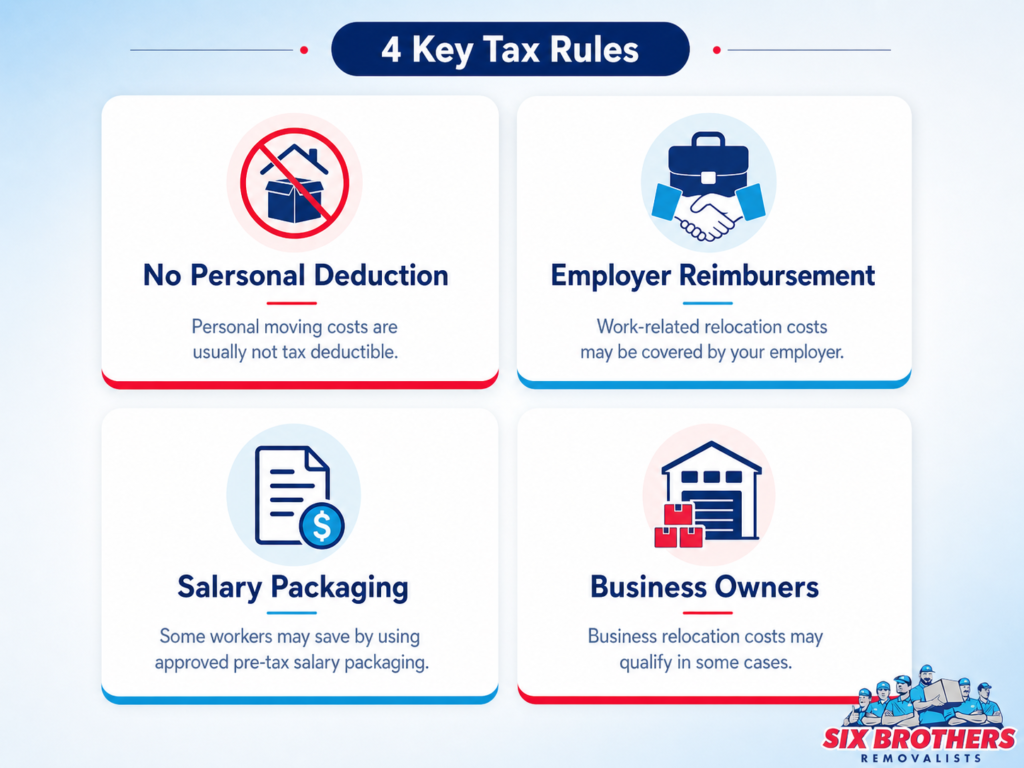
The tax rules around moving feel like a maze. But once you know the corners, it’s not so bad. Let’s walk through the four big rules every Aussie should know.
No Personal Deduction
If you move yourself, you pay yourself. Full stop. The ATO does not care if it’s a small one-bedder or a massive house. They don’t care if you used cheap movers Sydney crews or top-tier teams. Personal moves are private spending.
You can’t claim:
- Removalist fees from any movers
- Packing materials and boxes
- Cleaning costs at either property
- New utility connection fees
- Hotel stays during the move
This rule trips up so many Aussies every July. Don’t be one of them. Even if your move was for “lifestyle” reasons or to be closer to work, the answer stays no. The ATO calls this “private and domestic” spending. Those words show up in their guidance often.
Employer Reimbursement
Now here’s where things get spicier. If your employer pays for your move, you might dodge tax altogether. When a company moves you for work, they can cover the cost. Under specific rules, this isn’t taxed as income. It’s not a deduction for you. It’s a benefit your boss provides under the FBT framework.
Common reimbursed costs include:
- Removalist fees, even for a Sydney to Melbourne removalist run
- Storage for up to three months
- Temporary accommodation while you settle
- Reasonable travel to the new location
Always check the offer letter before you sign. Some employers cap the amount. Others want receipts on the dot. Push back if the policy seems weak. A solid relocation package can be worth thousands. Don’t undersell it.
Salary Packaging
Salary packaging is a clever trick. You agree with your employer to pay for the move using pre-tax salary. That means lower taxable income. It’s not the same as a deduction. It’s a way to pay with pre-tax dollars instead of post-tax dollars. The savings can be solid for high earners.
Most public health workers, charity staff, and some PBI employees can use this. Private sector workers sometimes can too. But your HR or payroll team has to play ball. Talk to your accountant before you sign anything. The savings can be real. So can the mistakes.
Business Owners
Run a business? Your rules are different. If you relocate your office, warehouse, or shopfront, those costs may be deductible. Office removals, warehouse moves, fit-out shifts, and equipment relocation can often be claimed.
This is where business removals work in your favour. You’re moving an income-producing asset, not just a couch. Keep every receipt and invoice in one folder. We’ve helped Parramatta firms and Dubbo removalists clients move offices. Most claim it under business expenses with their accountant’s blessing. The system rewards proper paperwork.
Why Moving Expenses Are Usually Not Tax Deductible?
Two reasons, really. Timing and private nature. Once you understand both, the rest of the rules click into place.
Timing
The ATO has this concept called “nexus.” Boring word, simple idea. To claim a deduction, the cost must directly link to earning your assessable income. Moving usually happens before you start the new job. Or right at the start. The income hasn’t kicked in yet. So no nexus, no claim.
Even if you move during a job, the move itself isn’t earning income. It’s just getting you to where the work happens. That’s the same logic as commuting costs. It feels unfair. But the ATO has held this line for decades.
This is also why even a quick movers Parramatta job to a closer suburb can’t be claimed. Even if the new place is two minutes from your office. The shorter commute doesn’t earn income directly.
Private Nature
The second reason is even simpler. Moving is private spending. You’re shifting your personal stuff. Your bed, your fridge, your kid’s bike. None of that earns you money. So none of it is deductible. Even if you move closer to work, the cost is private. The ATO doesn’t see “I moved to save commute time” as a business reason. They see it as a lifestyle choice.
Compare that to a tradie buying tools. The tools earn income. They’re deductible. A couch you slept on while job hunting? Not deductible. This is why hourly rate for removalists or packers and movers Sydney charges don’t show up on your tax return. They’re personal. Period. People often think searching “removalists near me” and getting a tax break go together. They don’t.
Understanding Relocation Costs and What You Can Claim on Tax?
OK, let’s flip the script. Some moving-adjacent costs can be claimed in special cases. You just need the right setup. The trick is separating personal moves from work or business activity. Here’s a handy breakdown for the smart Aussie.
You might be able to claim:
- Travel between two work sites (not home to work)
- Tools and equipment moved for work use
- Office or business location shifts
- Storage of business inventory or stock
- Some home office setup costs at the new place
- Depreciation on business assets after a move
- New office furniture for a home-based business
If you run a home-based business and move, the home office itself may bring some deductions. The move itself? Still not directly. But the new home office setup could give you some claims.
Another angle is depreciation. Some business assets you move can be depreciated over time. Office furniture, computers, tools. Talk to your accountant about asset register updates after a move. For most regular workers, the answer stays no. For business owners, contractors, and home-based operators, it gets more interesting.
We help clients move from Sydney to Wollongong, Sydney to Brisbane, Sydney to Adelaide, Sydney to Canberra, and beyond. The personal trip isn’t deductible. But if part of your gear is for business, that part may be. Always ask before you assume. The line between personal and business is thinner than people think.
A handy tip is to keep a logbook. Note which items moved are for work and which are for home. This split helps your accountant separate claims later.
Common Moving Costs You Cannot Claim on Tax
Let’s get blunt. Most moving expenses are off-limits at tax time. Here’s the full list of things you can’t claim if it’s a personal move:
- Removalist fees, even from removalists Parramatta or removalists Dubbo crews
- Truck hire or van rental for a DIY move
- Packing boxes, tape, bubble wrap, blankets
- Furniture pads and dollies you bought
- Hotel stays during the move
- Meals on moving day
- Cleaning bonds or end-of-lease cleaning
- Carpet steam cleaning at the old place
- New utility connection fees (gas, water, power)
- Internet installation at the new home
- Re-keying locks at the new property
- New furniture if the old stuff didn’t fit
- Travel costs to inspect new homes
- Real estate agent fees on the rental side
- Stamp duty on a property purchase
- Mortgage application fees
- Building inspection fees
- Pet boarding during the move
That’s a long list of “no.” Sorry to be the bearer. But here’s the silver lining. Many of these costs are tax-free if your employer covers them under a relocation policy. That’s why employer-paid moves are gold dust.
Storage is another tricky one. Personal storage at a removalist and storage near me facility? Not deductible. Business storage of stock? Often deductible. Same warehouse, different rules. This catches people out every year. Don’t try to slip personal moving costs into your work-related expenses. The ATO has data matching tools sharper than they used to be. Their cross-checks pick up patterns fast.
A cheap removalist Sydney bill is still a personal bill. The ATO won’t budge on this just because you went budget.
Possible Exceptions and Tax Workarounds for Moving Expenses
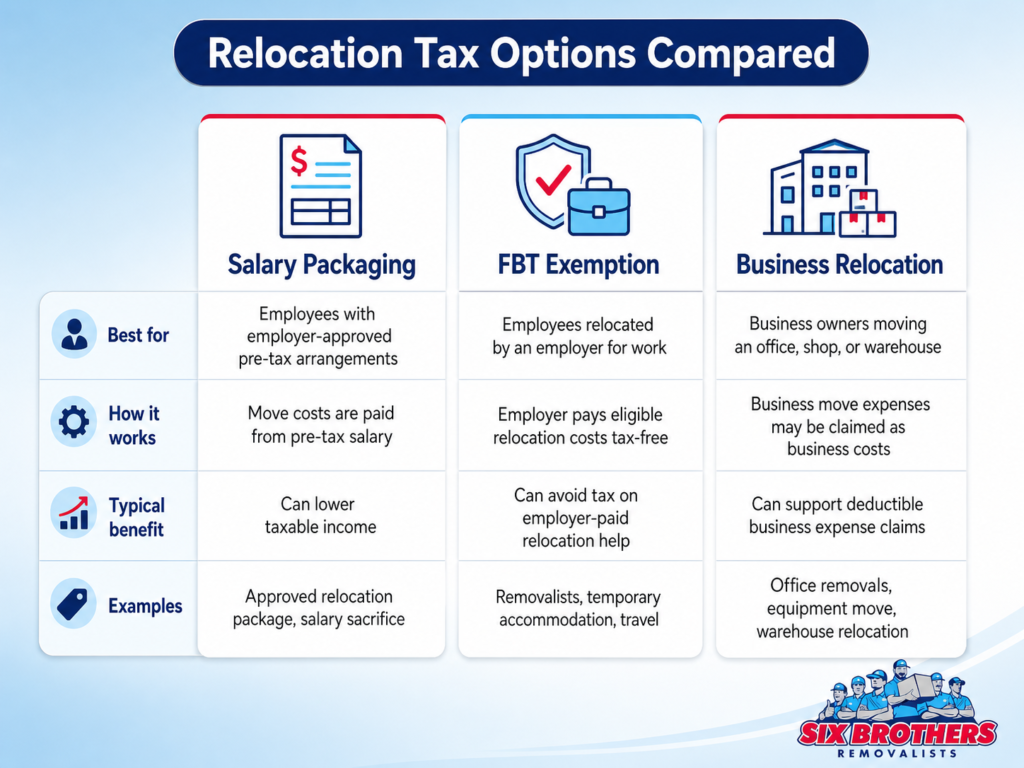
OK, here’s the part you came for. The exceptions. The legit workarounds. The bits that actually save money. These aren’t loopholes. They’re rules built into Australian tax law. Use them right and you can save thousands.
Salary Packaging/Sacrifice
Salary packaging is the heavyweight champ here. You agree with your employer to take part of your salary as a moving benefit instead of cash. The benefit comes from pre-tax dollars. So your taxable income drops. The move gets paid for. You save real money.
This works best for:
- Senior executives moving for a role
- Specialists relocating with the company
- Public health and charity workers
- FIFO and remote workers
- University and research staff
The rules around what counts as a “relocation expense” are tight. The move must be linked to a job change. The costs must be reasonable. Receipts must be kept for years. Talk to a tax pro before you set this up. One missed step and the benefit gets clawed back at audit time.
A quick example. Say your move costs ten grand. You earn 120k. Salary packaging that move could save you around three to four grand in tax, depending on your bracket. That’s not pocket change. That’s a holiday.
Fringe Benefits Tax (FBT) Exemptions
FBT is a tax employers pay on perks they give workers. Most perks attract FBT. But some relocation costs are exempt under the FBT Assessment Act.
If your employer relocates you for work, these can be FBT-exempt:
- Removalist fees for the household move
- Storage costs for up to three months
- Sale costs of your old home (in some cases)
- Purchase costs of your new home (in some cases)
- Temporary accommodation while you find a place
- Connecting and disconnecting utilities
- Travel to the new location for you and family
- Some incidental costs like pet transport
This is huge. The employer pays. You don’t get taxed on the benefit. No deduction needed. No FBT for the boss either. Most modern relocation policies use this framework. If your employer doesn’t, ask why. Push for it. A polite chat with HR can unlock thousands in tax-free help.
The relevant section is Section 58 of the FBT Assessment Act. Your accountant or the company’s payroll team should know it cold.
Business Relocations
If you run a business and the business moves, the rules flip. Business relocation costs are usually deductible.
This includes:
- Office removals from one location to another
- Moving warehouse stock and equipment
- Setting up the new office (within reason)
- Telecommunications connection at the new site
- Signage updates at the new place
- Notifying clients and suppliers
- Lost productivity hours of staff (in some cases)
- Lease break fees on the old premises (sometimes)
Business removals are a different beast from personal moves. Even an interstate backloading move for office gear may qualify if it’s business-purpose. Keep every invoice. Tag every cost as business or personal. Mixing the two is a fast track to an audit.
We’ve helped Sydney businesses shift to Melbourne, Brisbane, and Canberra. The boss claimed the move. The staff did not. That’s the rule of thumb.
Home-Based Businesses
This one’s underrated. If you run a business from home, parts of your move may have tax angles.
You can’t claim the move itself. But you can claim:
- Setup of the new home office space
- Office furniture for the new desk area
- IT equipment moved or replaced
- Phone and internet costs at the new place (business portion)
- Depreciation on assets moved over
- Some renovation costs for the office space
The ATO uses a “fixed rate” or “actual cost” method for home offices. Your accountant will pick the right one based on your numbers. This won’t refund your removalist fee. But it can ease the sting. Every dollar back from the tax man counts.
Common Tax-Time Mistakes With Moving Expenses
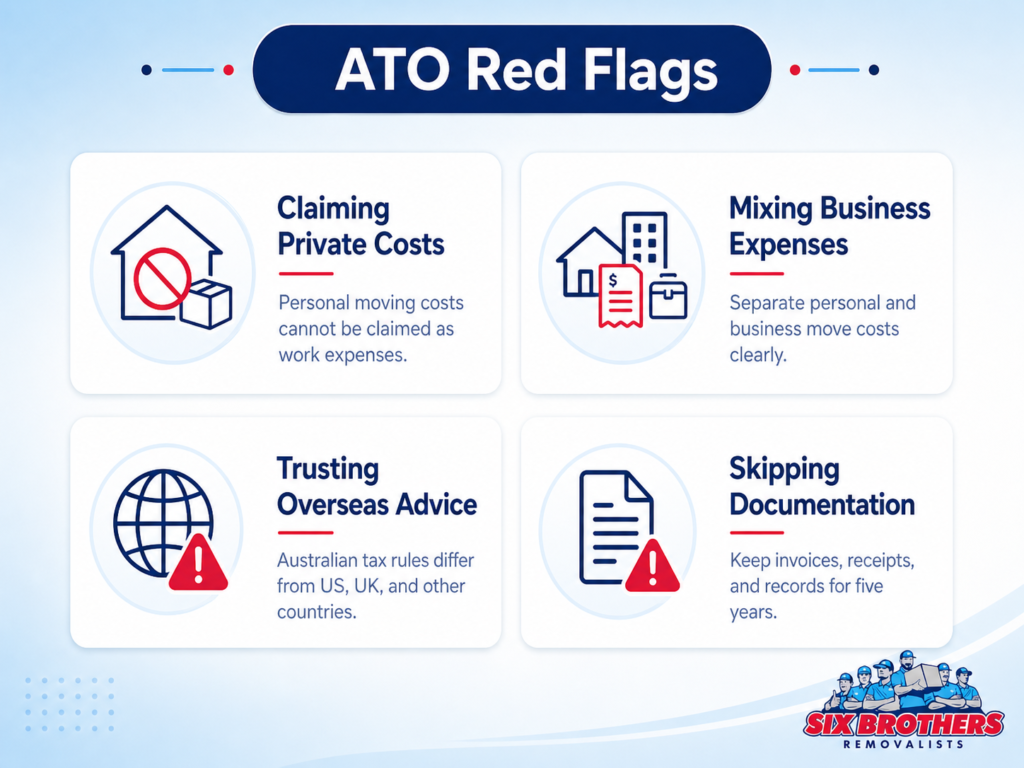
People mess this up every single year. The ATO knows. They watch for the same patterns over and over. Here are the four big traps. Avoid them and your tax return won’t get flagged.
Claiming Private Costs
The number one mistake. Trying to claim personal moving costs as work-related expenses. Folks tuck the removalist invoice into “other work expenses.” Or they pop it under “uniforms and laundry.” The ATO data matches. They see the patterns.
If you got audited, those claims would be reversed. You’d owe the tax back. Plus interest. Plus possible penalties. Don’t risk it. A personal move is a personal cost. Full stop. No matter how creative the framing.
Trying to disguise a removalist sydney to brisbane invoice as a “work travel expense” is a classic trap. The ATO sees it instantly.
Mixing Business Expenses
This one trips up sole traders and small business owners. They mix personal moving with business moving in one big invoice.
The fix? Separate invoices. Or a clear breakdown on a single invoice. If you move your home office along with the rest of your house, only the business portion is deductible. Square metres often help work out the split. Or asset by asset, item by item.
We’ve had Parramatta clients ring up asking us to split invoices. Happy to help. It saves them headaches at tax time. Just ask before the move, not after. A messy invoice is like a leaky bucket. Money drips out at tax time and you can’t catch it later.
Trusting Overseas Advice
This is a sneaky trap. The internet is full of US, UK, and Canadian tax advice on moving expenses. Some of those countries do let you deduct moving costs. The US used to be quite generous (less so now after 2017 changes). The UK has its own rules. Canada has theirs.
Australia is different. The ATO rules are unique. Don’t apply foreign advice to your Aussie tax return. Always check the ATO website or ask an Australian tax agent. What works in Texas won’t fly in Tweed Heads. What works in London won’t fly in Lithgow.
This is why those generic “moving tax tips” videos on TikTok can mislead Aussies fast. Watch where the creator is based.
Skipping Documentation
The fourth trap is laziness. Not keeping receipts. Even if you have a legit claim through employer reimbursement, salary packaging, or business relocation, you need proof. Without records, the claim collapses. Receipts are like breadcrumbs. They show the path your money took. The ATO follows that path during a review.
Keep:
- Removalist invoices and quotes
- Packing material receipts
- Travel logbooks if relevant
- Employer letters about the relocation
- Salary packaging agreements
- Bank statements showing payments
- Bond receipts and refund letters
Five years. That’s how long you keep records under ATO rules. Don’t toss them after one tax return. A folder on your computer works. So does a shoebox. Just keep them somewhere safe.
When to Speak to an Accountant About Moving Expenses?
Here’s a simple test. If your move involves any of these, ring an accountant before you file:
- Your employer paid for part or all of the move
- You used salary packaging for the costs
- You moved your home-based business
- You relocated your office, shop, or warehouse
- You’re a contractor with a home office space
- You have rental properties involved in the move
- You’re moving across state lines for work
- You’re moving overseas for a new job
- You’re a FIFO or DIDO worker shifting your base
Personal moves with no employer help? You probably don’t need an accountant for the tax side. Just know you can’t claim it. But for everyone else, an accountant pays for themselves. They’ll spot deductions you missed. They’ll structure salary packaging right. They’ll keep you out of ATO trouble.
Look for a registered tax agent. Check their TPB number on the public register. Ask if they’ve handled relocation claims before. Not every accountant has. We’re not accountants. We’re removalists. But we’ve moved enough people across Sydney, Wollongong, Brisbane, Adelaide, Canberra, and Port Macquarie to know the patterns. The folks who plan ahead always do better at tax time.
If you need a removalist who’ll give you clean invoices and clear records, give us a bell. We’re Six Brothers Removalists, based at Suite 1 level 5/58/60 Macquarie St, Parramatta NSW 2150. Phone 1300 764 372 or email info@sixbrothersremovalist.com.au. Our crew handles studio apartments, family homes, offices, and interstate runs.
You’ll handle the tax. We’ll handle the truck. Easy split.
Final Word
Can you claim moving expenses on tax in Australia? For most people, no. For some, yes, with the right structure.
The big takeaways:
- Personal moves equal no deduction
- Employer-paid relocations often run tax-free
- Salary packaging delivers pre-tax savings
- Business relocations are usually deductible
- Always keep records for five years
Don’t trust pub advice from your mate. Don’t copy what your American cousin does. The ATO rules are their own beast. Plan the move early. Talk to an accountant if it’s complex. Pick a removalist who keeps clean paperwork. And maybe download a change of address checklist Australia residents use to keep track of who needs your new details.
Who wants to leave money on the table at tax time? Not us. Not you.
Need a quote on your move? We’re Six Brothers Removalists in Parramatta NSW 2150. Call 1300 764 372. We’re cheap movers Sydney trusts, with crews that go anywhere from Wagga to Wollongong.
Now go book that move. Save those receipts. You never know when they’ll come in handy.