


Moving across the world sounds exciting. Then the paperwork starts. Suddenly you’re drowning in visa forms, customs rules, and shipping quotes. Your head spins.
An international move to Sydney doesn’t have to feel like climbing Everest in flip-flops. With the right plan, you can break it into small, clear steps. This moving to Sydney guide walks you through everything. From research and budgeting to packing day and settling in.
Whether you’re a solo expat or relocating a family of five, this is your roadmap. Let’s make it happen.
Why International Moves to Sydney Feel So Stressful
Here’s the honest truth. International relocations have about 50 moving parts. Visas. Shipping. Banking. Healthcare. Pet quarantine. Customs. Each piece depends on the next.
Most people feel stressed because they don’t know what they don’t know. You might nail the visa process and then forget about Australia’s strict biosecurity laws. Or you budget for shipping but ignore the cost of living in Sydney.
The real problem isn’t the move itself. It’s the lack of a clear timeline.
Think of it like building a house. You don’t start with the roof. You pour the foundation first. That’s exactly what this moving to Sydney checklist does. It gives you the order of operations so nothing falls through the cracks.
And honestly? Some stress is normal. You’re uprooting your entire life. But panic is optional. A solid plan turns chaos into a checklist.
How to Plan an International Move to Sydney Step-by-Step
Planning a move to Australia works best in layers. Start broad. Then zoom in. Here’s the big picture before we get into details.
Step 1: Research Sydney. Know the suburbs, climate, and culture.
Step 2: Sort your visa and documents early. Like, yesterday.
Step 3: Build a realistic budget. Include hidden costs.
Step 4: Declutter and decide what to ship.
Step 5: Hire professional international movers.
Step 6: Prepare for moving day with an essentials kit.
Step 7: Land in Sydney and start settling in.
Simple, right? Each step has layers. We’ll dig into every one below.
Research Your Destination Before Moving
You wouldn’t buy a car without a test drive. So why move to a city you barely know?
Sydney is massive. It stretches from the Northern Beaches down to Sutherland Shire. Each neighbourhood has its own vibe, price tag, and commute time. Researching your destination before moving saves you from expensive surprises.
Here’s what to study before you pack a single box:
- Weather and climate. Sydney has mild winters and hot summers. Nothing like London or Toronto.
- Public transport. Trains, buses, ferries, and light rail cover most areas. But some suburbs need a car.
- School systems. If you have kids, research public vs. private options early.
- Job market. Sydney’s economy runs on finance, tech, healthcare, and construction.
- Culture. Australians value honesty and humour. They call it “having a yarn.” As the old saying goes, “she’ll be right, mate.” Things tend to work out.
Spend time on expat forums. Join Facebook groups for people relocating to Sydney. Read real stories, not just government brochures.
Pre-Move Logistics and Administration
This is where the real work begins. Admin tasks aren’t glamorous. But skipping them creates headaches that follow you across the ocean.
Visa and Documentation
Your visa type depends on why you’re moving. Work? Study? Family? Each has different requirements.
Common visa categories for moving to Australia include skilled worker visas (subclass 189 and 190), employer-sponsored visas, partner visas, and student visas (subclass 500). In 2026, the permanent migration cap sits at 185,000 places. Competition is real.
Start your visa application as early as possible. Some visas take 6 to 12 months. You’ll need a skills assessment, English language test scores, and police clearances. Don’t forget to get your documents apostilled or notarised.
Keep certified copies of passports, birth certificates, marriage certificates, and educational transcripts. Store digital backups in the cloud. If you lose originals during transit, you’ll thank yourself.
Budgeting
How much does it cost to move to Australia? That depends on where you’re coming from, how much you’re shipping, and your lifestyle.
Here’s a rough breakdown. International sea freight for a 20ft container costs between $2,000 and $15,000. Flights for a family of four can run $3,000 to $8,000. Visa fees range from $300 to $8,000 depending on the type. Then add temporary housing, bond money, and initial living costs.
A realistic budget for a mid-size international move to Sydney sits between $15,000 and $40,000. That’s not small change. How much money do I need in my bank to move to Australia? Financial experts recommend having at least $5,000 to $10,000 AUD in savings on top of your moving costs. How much should I budget for a move? Build a spreadsheet. List every expense. Then add 15% for surprises.
What is the most expensive part of moving? Usually shipping and temporary accommodation. Those two eat up the biggest chunk.
Banking
Open an Australian bank account before you arrive. Most major banks like Commonwealth, ANZ, Westpac, and NAB let you apply from overseas. You’ll need your passport and visa details.
Transfer your funds in advance. Exchange rates fluctuate daily. Services like Wise or OFX often beat traditional bank transfer rates. Having local currency ready means you won’t scramble on day one.
Healthcare
Australia has Medicare, a public healthcare system. If you hold a permanent visa, you’ll likely qualify. Temporary visa holders usually need private health insurance. Student visa holders must buy Overseas Student Health Cover.
Research this before you fly. A single emergency room visit without cover can cost thousands. Don’t gamble with your health during an international relocation.
Essential Pre-Move Timeline for Moving to Sydney
Timing is everything. Start too late and you’ll scramble. Here’s a timeline that actually works.
12+ Months Out
- Research visa options and begin your application.
- Start a dedicated savings fund for the move.
- Research suburbs and neighbourhoods in Sydney.
- Book a consultation with a migration agent if needed.
- Begin decluttering your home. What is the 5 5 5 rule for decluttering? Find 5 things to throw away, 5 to donate, and 5 to put back in place. Do it daily.
6 Months Out
- Get quotes from international movers. How far in advance should I book my move? For international moves, 3 to 6 months is standard.
- Arrange pet relocation if needed. Moving to Australia with pets requires early planning because of quarantine requirements.
- Open your Australian bank account.
- Start selling or donating items you won’t ship.
- Apply for school enrolments if you have children.
3 Months Out
- Confirm your shipping company and dates.
- Arrange temporary housing for your first weeks in Sydney.
- Notify your current landlord, employer, and utility providers.
- Get medical and dental checkups. What vaccinations do you need? We cover that below.
- Start packing non-essential items.
1 Month Out
- Finalise your essentials kit for travel day.
- Confirm all travel bookings and accommodation.
- Redirect mail and close accounts you no longer need.
- Do a final walkthrough of your home.
- Breathe. You’ve done the hard work. How far in advance should you prepare to move? Starting 12 months out gives you breathing room. But even 3 months works if you stay focused.
Task Checklist for an International Move
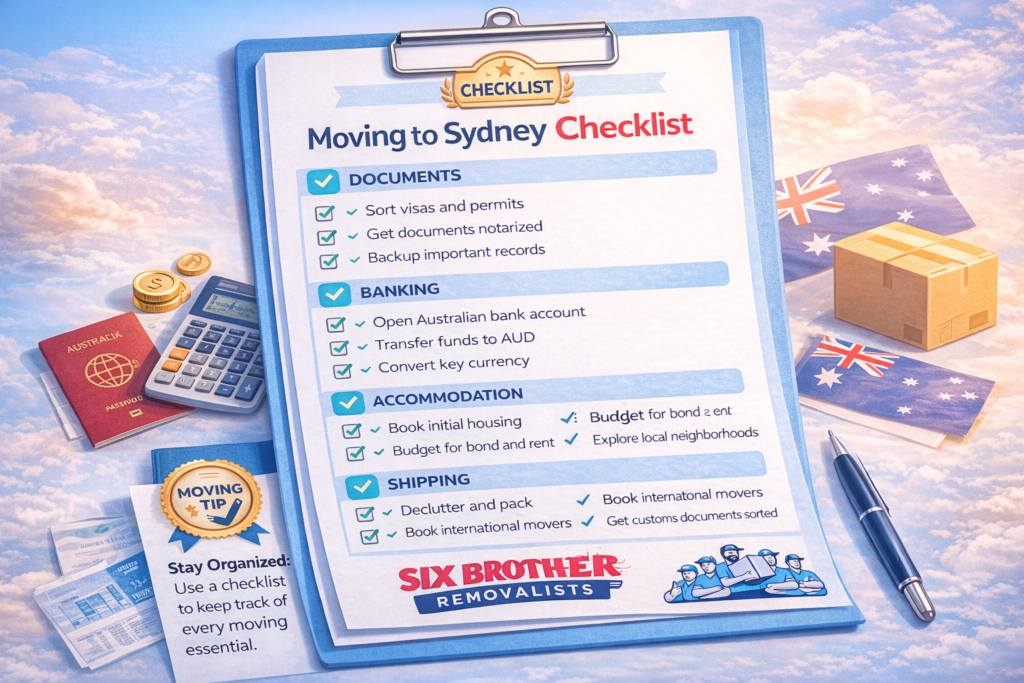
Checklists save lives. Or at least they save your sanity. Here’s a quick-reference moving to Sydney checklist broken into categories.
Documents
- Valid passport (minimum 6 months validity)
- Visa grant letter
- Certified copies of birth and marriage certificates
- Employment references and qualification certificates
- Driving licence (apply for an international permit)
- Medical records and vaccination certificates
- Pet import permits and vet records
Banking
- Australian bank account opened
- International funds transfer arranged
- Credit cards notified of travel
- Tax affairs settled in your current country
Accommodation
- Temporary housing booked for arrival
- Research rental market in your target suburb
- Budget for bond (usually 4 weeks rent) plus 2 weeks advance
Shipping
- Inventory list created for all items being shipped
- International movers booked and confirmed
- Shared container shipping to Australia arranged if needed
- Insurance purchased for goods in transit
- Customs declaration forms completed
Health
- Medical checkups completed
- Prescriptions filled (with doctor’s letter)
- Health insurance arranged for Australia
- Dental work done before departure
Shipping and Relocation Services for Moving to Sydney
Shipping your life across the ocean is the biggest logistical task in any international move. Get this wrong and you’ll either overpay or lose belongings. Get it right and it’s smooth sailing. Literally.
Decluttering
Before you pack anything, declutter. What items are not worth moving? Old furniture, worn clothing, cheap electronics, and anything you haven’t used in a year. Shipping costs are based on volume. Every extra box costs real money.
What is the most forgotten thing when moving? People often forget to cancel subscriptions, redirect mail, or pack important documents in their carry-on.
Apply the 5 4 3 2 1 rule of packing. Pack 5 tops, 4 bottoms, 3 shoes, 2 accessories, and 1 formal outfit in your suitcase. Ship everything else.
What will movers not pack? Hazardous materials, perishable food, and flammable items like aerosols. Check your mover’s prohibited list early.
Do movers prefer boxes or bags? Boxes. Every time. They stack better, protect contents, and make loading the truck safer. Bags collapse, shift, and offer zero protection.
International Movers
Choose an international moving company with experience in Australia. They should understand customs clearance, biosecurity requirements, and door-to-door vs port-to-port options.
How much to move a 20ft container? Expect $2,000 to $15,000 depending on origin country. How many bedrooms can fit in a 20ft container? Roughly 2 to 3 bedrooms. A 40ft container handles 4 to 5 bedroom homes. What’s the cheapest moving container? Shared container shipping to Australia (LCL) is the most affordable option for smaller loads. You share space with other shipments and only pay for what you use.
Does a shipping container need a foundation? Only if you’re using one for storage on land. For a standard international move, your mover handles all logistics. How much is a second hand 20 ft container? In Australia, used containers run between $3,200 and $5,500 AUD.
Get at least 3 quotes. Compare services, timelines, and insurance options. What are red flags with moving companies? No fixed address, no insurance, demands for large upfront cash deposits, and zero online reviews.
Pets and Plants
Moving to Australia with pets is doable but complex. Australia has some of the strictest animal import laws on the planet.
How to move a dog to Australia? Your dog needs a microchip, rabies vaccination, blood tests, and a stay in an approved quarantine facility. The full process takes about 6 months. How to move a cat to Australia? Similar requirements. Cats also need rabies testing and quarantine. Both dogs and cats must enter through Melbourne’s quarantine facility in Mickleham. There are no shortcuts.
Plan pet relocation early. Moving to Australia with pets costs between $3,000 and $10,000 per animal depending on size and origin. Budget for vet visits, airline-approved crates, and quarantine fees.
Plants are even trickier. Most live plants cannot be imported into Australia. The Department of Agriculture enforces this strictly. Leave the garden behind.
Hire a Professional Moving Company for Your Move
Is it worth paying for a moving company? 100%. International moves have too many variables for DIY. Customs paperwork alone can take days.
A professional removalist handles packing, loading, customs clearance, shipping, and delivery. They know the rules. They have the insurance. They’ve done this thousands of times.
Six Brothers Removalists has helped tens of thousands of Aussies relocate. Based in Parramatta, they handle local, interstate, and long-distance moves with a fleet of 25 specialist trucks. Whether you’re moving a studio apartment or a 4-5 bedroom house, their team provides expert handling, free boxes, and transit insurance.
What do professional movers hate to move the most? Heavy safes, pianos, and pool tables top the list. Give your movers a heads up about bulky or awkward items.
What is the hardest room to pack when moving? The kitchen. It’s full of fragile, oddly shaped items. How to pack fragile items? Wrap each piece individually in packing paper. Use bubble wrap for extra protection. Fill gaps in boxes with towels or clothing.
What to do before movers come? Clear pathways. Disassemble large furniture. Label every box with the room it belongs in. Have your inventory list ready.
When you hire movers, what do you do to not be awkward? Just be friendly, stay out of their way, and offer water or coffee. What are you supposed to do while movers move your stuff? Stay available to answer questions. But let them work. Hovering slows things down.
Are you supposed to feed movers? It’s not required but appreciated. Pizza, sandwiches, or snacks go a long way. Is $20 enough to tip each mover? For a local move, yes. For a full-day interstate job, $30 to $50 per person is generous. How much to tip on $500 move? $20 to $50 total is reasonable. Is 10% tip disrespectful? Not at all. Any tip is appreciated. Tipping isn’t mandatory in Australia, but it’s a kind gesture.
What to Bring When Moving to Sydney
You can’t bring everything. And you shouldn’t. Here’s what’s worth the shipping cost.
Bring these:
- Sentimental items (photos, heirlooms, gifts)
- Quality furniture that’s in good condition
- Specialty kitchen equipment
- Clothing for all seasons
- Electronics with universal voltage or adapters
- Important documents (originals and copies)
Leave behind:
- Cheap furniture you can replace
- Outdated electronics
- Heavy books (digitise what you can)
- Items that don’t meet Australian electrical standards
- Perishable goods and opened food items
Think of it this way. If replacing it costs less than shipping it, leave it behind. The cost to move a 1, 2, 3, or 4 bedroom home in Sydney varies hugely. Every box you eliminate saves money.
What Vaccinations Do You Need to Move to Australia?
Australia doesn’t have a long list of mandatory vaccines for most travellers. But there are recommendations you should follow.
Routine vaccinations should be up to date. These include measles, mumps, rubella, diphtheria, tetanus, and pertussis. A flu shot is also smart before a long flight.
Hepatitis A and B vaccinations are recommended if you’re not already protected. If you’ve lived in a country with yellow fever, you’ll need proof of yellow fever vaccination.
COVID-19 vaccinations are no longer mandatory for entry. But staying current protects you and your new community.
Talk to your doctor at least 3 months before departure. Some vaccinations require multiple doses over weeks.
Stress-Free Moving Day Tips for Your Sydney Relocation
Moving day is the marathon. You’ve trained for it. Now execute the plan.
Essentials Kit
Pack a carry-on bag with everything you need for the first 48 hours. Your shipped goods could take weeks to arrive.
Your essentials kit should include:
- Passport, visa, and travel documents
- Phone charger and adapter (Australia uses Type I plugs)
- 2 changes of clothing
- Toiletries and medications
- Snacks and a water bottle
- Important phone numbers written down (not just saved on your phone)
- A small amount of Australian dollars in cash
Biosecurity Awareness
Australia takes biosecurity seriously. Very seriously. Declare everything on your incoming passenger card. Food, wooden items, seeds, animal products, and soil can carry pests and diseases. Fines for undeclared items start at $660 AUD and can reach $630,000.
When in doubt, declare it. Customs officers are forgiving if you’re honest. They’re far less kind if you hide something.
This applies to your shipped goods too. Your international movers should guide you on prohibited items. But double-check the Department of Agriculture’s import conditions yourself.
Stay Connected
Buy a local SIM card at Sydney Airport. Telstra, Optus, and Vodafone all have airport kiosks. Having a working Australian phone number from day one makes everything easier. You’ll need it for accommodation applications, banking, and emergencies.
Download essential apps before landing. Google Maps, Opal Travel (for public transport), and Domain or Realestate.com.au (for housing).
Settling Into Sydney After an International Move
You’ve landed. Bags are through customs. Now what? The first few weeks set the tone for your new life.
Temporary Housing
Book at least 2 weeks of temporary housing before you arrive. Serviced apartments, Airbnbs, or short-term rentals give you a base while you search for a permanent home.
Don’t sign a long-term lease sight unseen. Rental scams exist. Always inspect a property in person before handing over bond money.
Cost of Living
Sydney is expensive. Let’s not sugarcoat it. A one-bedroom apartment in the CBD runs $500 to $700 per week. Groceries for two adults cost roughly $150 to $200 per week. Public transport costs around $50 per week with an Opal card.
What are the hidden costs of moving? Connection fees for electricity, internet, and gas add up fast. Bond money ties up a large sum. And eating out while you wait for your kitchen supplies to arrive gets pricey quick.
What is the cheapest way to move a house? Declutter hard, use shared container shipping, book movers on weekdays, and compare at least 5 quotes. How can I reduce moving costs? Sell what you don’t need. Pack yourself. Be flexible with dates. Choose interstate backloading if available.
How to move a house if you can’t afford it? Start small. Ship only essentials. Buy secondhand furniture in Sydney. Many Facebook Marketplace groups have quality items at fraction of retail.
Healthcare
Register for Medicare if you hold a permanent visa. Visit a Service Australia office with your passport, visa, and proof of address. You’ll receive a Medicare card within 2 weeks.
Find a local GP (general practitioner) near your new home. Bulk-billed appointments are free under Medicare. Specialists usually require a referral.
Local Logistics
Get your licence sorted. Some countries have reciprocal agreements with NSW. You may be able to swap your overseas licence directly. Others require a driving test.
Register your address. Update your details with your bank, employer, and the Australian Electoral Commission (if you become a citizen later).
Set up utilities. Electricity, gas, internet, and water. Compare providers on government comparison websites. Many offer bundle deals for new customers.
Communications
Australian internet runs on NBN (National Broadband Network) in most areas. Speeds vary by suburb and connection type. Research your new address before signing up.
Mobile plans start from $15 per month for basic prepaid. Unlimited data plans run around $45 to $65 per month.
Community
This might be the most important part. Building a community takes effort. But Sydney makes it easier than most cities.
Join local sports clubs, volunteer groups, or community centres. Meetup.com has dozens of expat groups in Sydney. Your kids’ school is another natural connection point.
What is the cheapest day to hire movers? Midweek. Tuesday through Thursday is usually cheaper. What month is the cheapest to move? Winter months (June to August in Australia) are the off-season. What’s the most expensive month to move? December and January. Everyone’s moving before the new year and school term.
Things to Know About Living in Sydney
Sydney isn’t perfect. But it’s close. Here are some things that catch new arrivals off guard.
The UV is no joke. Australia has some of the highest UV levels in the world. Wear sunscreen daily. Even in winter.
Coffee culture is serious. Forget chain coffee shops. Sydney runs on independent cafes. Order a “flat white” and you’ll fit right in.
Tap water is safe. No need for bottled water. Sydney’s tap water is clean and well-regulated.
Tipping is not expected. Unlike the US, Australian workers earn a living wage. Tips are appreciated but never required.
Wildlife is real. Possums in your roof. Bin chickens (ibis) stealing your lunch. The occasional spider in your bathroom. It’s all part of the charm. Are you really living in Sydney if a cockatoo hasn’t screamed at you at 6am?
The beaches are world-class. Bondi, Manly, Coogee, and Cronulla. Pick your favourite and make it your weekend ritual.
Best Sydney Neighbourhoods for Expats
Choosing where to live is half the battle. Here are the top picks based on lifestyle and budget.
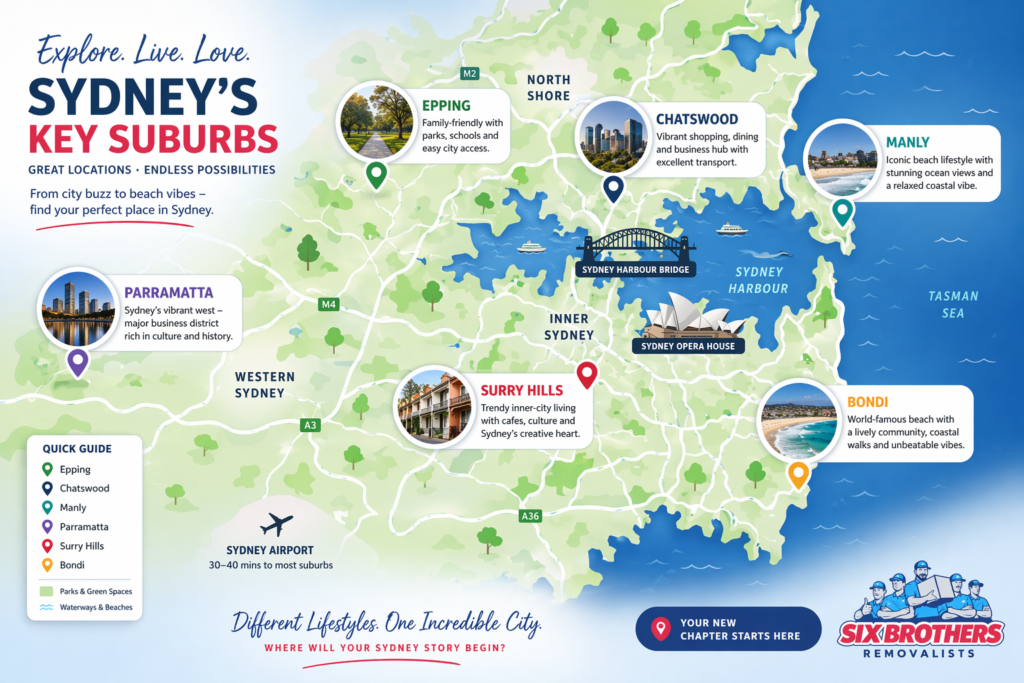
Parramatta. Sydney’s second CBD. Great transport links. Affordable compared to the eastern suburbs. Growing fast with new restaurants, shops, and cultural venues. Home to removalists Parramatta like Six Brothers Removalists.
Bondi / Bondi Junction. Beach lifestyle. Vibrant community. Higher rent but worth it for ocean lovers.
North Sydney / Chatswood. Close to the CBD. Excellent schools. Large Asian community with incredible food options.
Surry Hills / Newtown. Creative and eclectic. Cafes, galleries, and nightlife. Popular with young professionals.
Epping / Eastwood. Family-friendly. Good schools. Strong multicultural community. More affordable.
Manly. Beachside village feel with ferry access to the CBD. Perfect if you want sand between your toes daily.
How to Choose the Right Sydney Relocation Partner
Not all removalists are created equal. Choosing the right moving company can make or break your experience. How long does moving take? A local move takes a day. Interstate takes 2 to 7 days. International moves take 4 to 12 weeks including shipping.
Look for these qualities in a removalist:
- Experience with both local and interstate moves
- Transparent pricing with no hidden fees
- Transit and public liability insurance included
- Positive customer reviews and a proven track record
- Flexibility with scheduling and services
- Free boxes and packing materials
How much do removalists cost? Rates depend on the size of the move, distance, and services. How much do removalists charge per hour in Sydney? Hourly rates typically range from $120 to $180 per hour for a team of two. How much does a removalist cost Melbourne? Similar range, though rates vary by season.
Six Brothers Removalists ticks every box. With over 15 years of experience, they’re one of the most trusted cheap removalists in Sydney. Their team handles everything from studio apartment moves to full 4-5 bedroom house relocations. They offer house removals, office removals, business removals, and interstate services including Sydney to Melbourne, Sydney to Brisbane, Sydney to Adelaide, Sydney to Canberra, and Sydney to Wollongong routes.
They also provide interstate backloading for budget-conscious movers. Their packers and movers Sydney team includes packing, unpacking, furniture disassembly, and reassembly.
Contact Six Brothers Removalists today:
- Phone: 1300 764 372
- Email: info@sixbrothersremovalist.com.au
- Address: Suite 1 Level 5, 58-60 Macquarie St, Parramatta NSW 2150, Australia
Whether you need removalists near me for a local job or a full international relocation partner, Six Brothers has the fleet, the expertise, and the heart to get you home. They’re the cheap movers Sydney locals trust and the movers Parramatta families return to again and again.
Final Thoughts
An international move to Sydney is one of the biggest decisions you’ll ever make. It’s scary. It’s expensive. It’s exhausting.
But it’s also the beginning of something amazing.
With a solid plan, a clear timeline, and the right relocation partner, you’ll land in Sydney ready to build a life you love. Don’t let the fear of the unknown stop you. Take it one step at a time. Lean on the experts. And remember: every person who calls Sydney home was once a newcomer too.
Ready to start your Sydney move? Call Six Brothers Removalists at 1300 764 372 for a free quote. Let the experts handle the heavy lifting while you focus on the exciting part. Your new life in Sydney.