


Table of Contents
How to Move Musical Instruments Interstate Without the Heartbreak
Your guitar is not just timber and strings. It carries gigs, late nights, and years of muscle memory. So the thought of it riding 900km in the back of a truck? That churns the stomach a bit.
Moving musical instruments interstate is a different beast to shifting a couch. Instruments are fussy. They hate heat. They hate damp. And they really hate a hard knock in transit.
This guide walks you through the whole thing, step by step. You will learn how to prep, pack, ship, and insure your gear the right way. No cracked headstocks. No warped tops. No nasty surprise waiting at the other end.
Ever heard a string snap and ping across a room? You do not forget that sound. Let us make sure it never happens to your kit.
The short answer
Loosen the strings on stringed instruments to drop the tension. Pull the mouthpieces off woodwinds. Pack each instrument in its own hard case. Fill the gaps inside with bubble wrap or soft padding so nothing shifts.
Then slide that hard case into a double-walled, heavy-duty cardboard box. Pack padding all around it. Insure your gear properly before it travels interstate. When it lands, let it sit 12 to 24 hours before you open, tune, or play it.
That is the recipe. Now let us break down each step so nothing gets missed.
Why Interstate Moves Are Harder on Instruments
A local move across Sydney is one thing. Your gear is in the truck for an hour, maybe two.
Interstate is a marathon, not a sprint. Your instruments face long hours, rough roads, and big shifts in climate. Sydney can be humid. Canberra runs dry. The Melbourne leg gets cold at night.
Wood feels all of it. Your acoustic guitar is basically a wooden lung. It breathes with the weather around it. When the air gets dry, the wood shrinks. When it gets damp, the wood swells.
Sudden swings are the real danger. A slow change is fine. A fast one cracks tops, lifts bridges, and warps necks. That is why the way you handle humidity and temperature matters as much as the packing.
Then there is vibration. A truck rumbles for hundreds of kilometres. Loose parts rattle. Unsecured strings buzz. A poorly packed case lets your instrument bounce for the whole trip.
Distance stacks the odds too. A Sydney to Brisbane run is long. A Sydney to Perth haul is longer still. More hours on the road means more time in shifting conditions. Timing plays a part as well. A summer move bakes the load space. A winter move chills it overnight. Both extremes push your gear harder than a mild day would.
Get the prep right and none of this touches your gear. Get it wrong and you could be paying a luthier more than the move cost you.
| Did you know? Most guitar makers recommend keeping wooden instruments at around 45 to 55 percent relative humidity. Drift too far for too long and the timber can crack, the top can sink, or the bridge can lift. Rapid change does the worst damage, which is exactly what a long interstate trip can throw at your gear. |
Prepare Every Instrument Before It Goes Near a Box
Prep is where most damage gets prevented. Skip it and your case becomes a coffin. Because instruments react to pressure, humidity, and temperature, a little prep goes a long way. Each type needs its own approach. Here is how to handle the big ones.
String Instruments
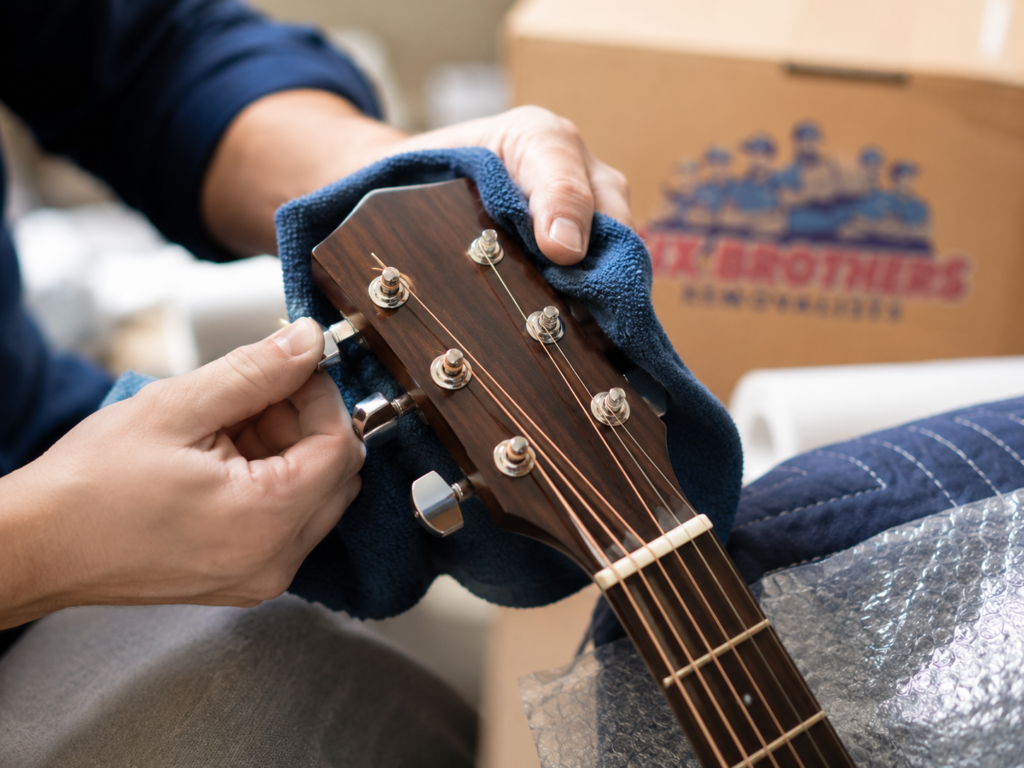
Guitars, violins, cellos, and basses all carry tension. The strings pull hard on the neck and bridge all day. Loosen the strings before the move. Do not take them right off. Just drop the tension a few turns. This eases the load on the neck and bridge.
Why bother? If the instrument gets dropped or knocked, tight strings can snap a bridge or crack a headstock. A slack string does far less harm.
Wrap the delicate wooden parts in a soft cloth or clean packing paper. Do not press plastic bubble wrap straight onto the finish. Some varnishes react badly to plastic over time.
Tuck a small humidity pack in the case if you have one. It helps hold a steady moisture level while the wood travels. Treat a violin like a throw pillow and you will hear about it later.
Support the neck inside the case too. Roll a small towel and rest it under the headstock. This stops the neck flexing every time the truck hits a bump. For a cello or double bass, mind the bridge above all. It sits under real pressure and topples easily. Slacken the strings enough to take the load off it, and pad it well.
Brass and Woodwind Instruments
Trumpets, saxophones, clarinets, and flutes come apart for a reason. Loose valves and slides get bent when they are left assembled. Take the mouthpiece off every woodwind. Break brass down into its main sections too. Think mouthpieces, valves, slides, and the body.
Wrap each piece on its own. This stops metal grinding on metal. It also stops scratches, dents, and bent keys during the trip. Pad the bell and the keys well. These are the parts that dent first. A dented bell is not just ugly. It can change how the instrument sounds.
Keep small bits like reeds, ligatures, and screws in a labelled zip bag. These vanish in a move. Losing a $200 mouthpiece to a lost bag stings. Give the pads and corks a quick check before you pack. Damp air in transit can swell them. A little care now saves a fiddly repair on the other side.
Keyboards, Digital Pianos, and Amps
Electronic gear has its own weak spots. The screens, knobs, and ports take the hits. Remove detachable stands, pedals, and cables first. Coil the cables and bag them. Label each one so setup at the new place is quick.
Wrap the keybed and control panel in foam or a moving blanket. Corners are the first thing to crack, so pad them twice. If you kept the original box, use it. Amps are heavy and the speaker cones are fragile. Never lay an amp face down loose in a truck. Keep it upright and strapped so it cannot tip.
Pull out any tubes from valve amps if you can. Tubes are glass and they shatter on a hard jolt. Pack them apart, wrapped, and clearly marked. Roll up leads and pedal cables neatly. Loose cables tangle and pull on jacks. A bent jack is a small part with a big repair bill.
Acoustic Pianos
An upright or grand piano is a job on its own. These things weigh a few hundred kilos and hold thousands of moving parts. Do not attempt a piano move yourself. The risk to your back and your floors is real. The risk to the piano is worse.
Secure or remove the lid prop, pedals, and any loose fittings first. Then leave the heavy lifting to trained hands. Our piano removals guide walks through the full process if you want the detail before you book.
Pianos also need to settle and be tuned once they arrive. Expect to book a tuner a couple of weeks after the move. The instrument needs time to adjust to the new room first.
Drums and Percussion
Drum kits look tough. They are not, once you get past the shells.
Break the kit down fully. Loosen the drum heads a touch to ease tension on the shells. Stack shells inside each other with soft padding between them, like nesting bowls.
Cymbals crack and chip if they knock together. Wrap each one and stand them upright in a padded bag. Never lay a stack of cymbals flat and loose. Bag the hardware separately. Stands, clamps, and pedals are heavy and sharp. Keep them well away from the shells and cymbals so nothing gets gouged.
| Prep in the right order | |
| 1. Release the tension | Loosen strings and drum heads. Remove woodwind mouthpieces. Break brass into sections. |
| 2. Wrap each part | Soft cloth or paper on bare wood. Bubble wrap on metal and hardware. Bag small bits. |
| 3. Case it, then box it | Snug hard case first. Then the case goes inside a padded, double-walled box. |
| Pro Tip: Snap a few photos of each instrument before you pack it. Get the serial number, any existing marks, and the accessories in the shot. If a claim ever comes up, this record is gold. It proves condition and value in seconds. |
How to Pack Instruments for the Long Haul
Packing is a two-layer game. The case protects the instrument. The box protects the case.
Would you toss your laptop in a bin bag and hope for the best? Of course not. Your gear deserves the same care. The same rules apply here as when you learn how to pack fragile items for any move.
Start With a Fitted Hard Case
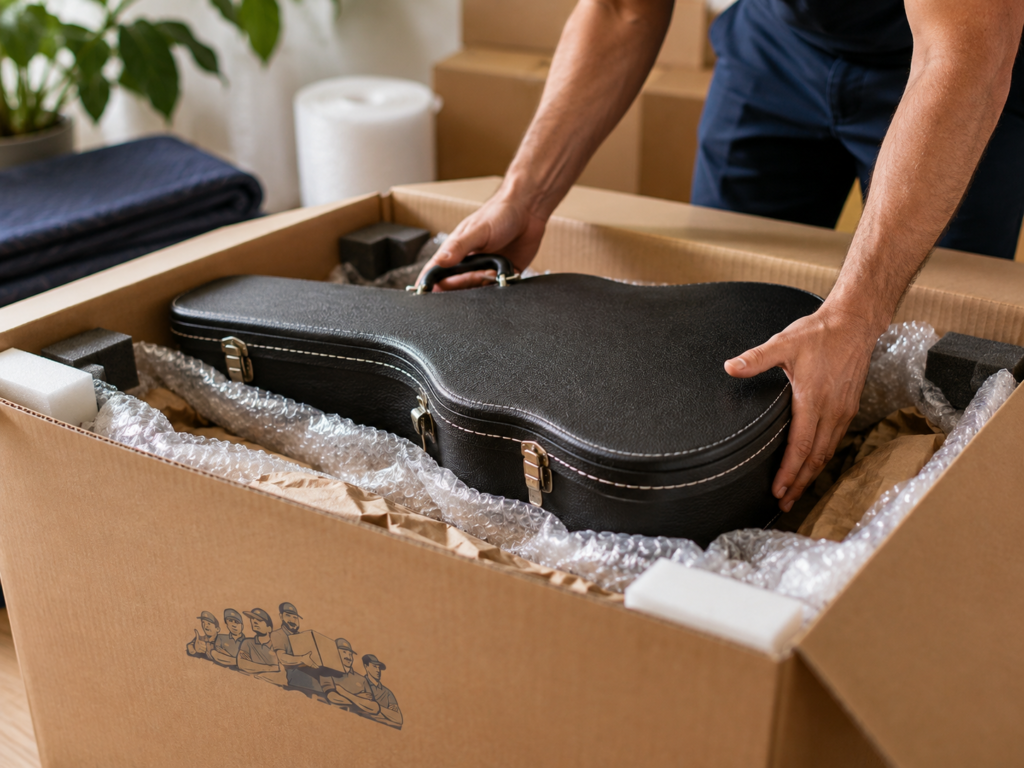
A soft gig bag is fine for a walk to band practice. It is not fine for an interstate truck. Use a proper hard case for each instrument. It is the single best bit of protection you can buy. A hard case is the seatbelt for your gear.
Line the inside with soft padding. Microfibre cloths or clean packing paper work well. The instrument should sit snug and not shift when you gently tip the case. If there is a gap, fill it. Any wobble inside the case means movement all trip. Movement means damage.
Box the Hard Case
Here is the step most people skip. The case alone is not enough for interstate.
Put the whole hard case inside a heavy-duty, double-walled cardboard box. This box is the airbag around your seatbelt. It takes the knocks so the case does not. Fill every empty space around the case. Use crumpled paper, foam, or bubble wrap on the top, bottom, and all sides. The case should not rattle or slide inside the box.
Tape the box well along every seam. A weak seam splits under weight. A split box is an open invitation for a knock. Reinforce the bottom before you load it. That is where the strain sits. A double strip of tape across the base stops a blowout mid-lift.
Do not overpack the box either. It should be firm, not bulging. A box under too much strain loses its shape and its strength.
Label It So Nobody Guesses
Movers cannot read your mind. A plain brown box tells them nothing. Mark every instrument box as “Fragile” and “This Side Up.” Write it big on more than one side. Add “Musical Instrument” so the handler knows it needs care.
An arrow pointing up is worth a thousand words. It stops a box being stacked upside down under something heavy.
| Quick prep guide by instrument | ||
| Instrument | Key prep step | Best case |
| Guitar / bass | Loosen strings, wrap headstock in cloth | Hard shell case |
| Violin / cello | Slacken strings, protect the bridge | Fitted hard case |
| Brass / woodwind | Disassemble, wrap each section | Moulded hard case |
| Digital piano | Remove stand, pad the keybed | Original box or flight case |
| Drum kit | Loosen heads, nest shells, wrap cymbals | Padded drum bags |
How to Actually Move Your Instruments Interstate
You have three real options. The right one depends on what you are moving and how much of it. Some people are shifting one guitar. Others are moving a whole home studio. Let us match the method to the job.
A Full-House Interstate Removalist
Moving your whole home? Then your instruments travel with everything else. This is the simplest path for most people.
Just make sure your remover has handled musical gear before. Ask the question straight up. A good crew packs instruments separately and clearly labelled. They keep them well away from heavy furniture that could shift and crush.
Not sure how big your load is? Our Moving Home Calculator gives you a quick estimate before you lock anything in. It helps you plan the truck and the budget.
If you have gear but not a full houseful, interstate backloading can save you real money. You pay for the space you use in a shared truck heading your way. Your instruments still travel padded and secure.
Fragile-Goods Couriers
Not moving house, just the instruments? A specialist courier is often the smart call.
Couriers that focus on fragile goods know how to handle valuable gear. Some offer custom crates or reinforced packing. For a rare vintage guitar, that extra care is worth every dollar.
Ask about their fragile handling before you book. A cheap standard parcel service is a gamble. There is no such thing as a free lunch when a bargain courier drops your cello.
Instrument Shipping Services
Prefer to manage it yourself? A dedicated shipping service can work well.
Pick one that offers tracking and proper fragile handling. Check that they cover musical instruments in their terms. Standard post is the wrong tool for a $3,000 saxophone.
Tracking matters more than you think. Knowing where your gear sits each day buys peace of mind on a long trip.
Plan the Move and List Every Piece
A good interstate move starts weeks out, not the night before. Rushing is how gear gets left loose or forgotten.
Make a full list of every instrument and accessory. Note the make, model, and rough value of each one. This list becomes your check-in sheet at both ends.
It also speeds up your quote and your insurance. A remover can price the job properly when they know what is coming. An insurer can set the right cover when the values are clear.
Book early for the date you want. Good crews fill up fast, and the best slots go first. Leaving it late can force a rushed, pricier option. Gather your packing supplies ahead of time too. Hard cases, double-walled boxes, bubble wrap, and strong tape. Chasing boxes on moving morning never ends well.
What Affects the Cost of Moving Instruments Interstate
Price is the question everyone wants answered. The honest reply is, it depends. A few clear factors set the number. Distance is the big one. A short interstate hop costs less than a cross-country haul. The further your gear travels, the more you pay.
Volume matters next. One guitar in a courier box is cheap. A full studio of amps, keys, and drums fills real truck space. The gear itself changes things. A basic keyboard is low risk. A rare vintage guitar or a grand piano needs custom care and higher cover.
Special handling adds cost too. Custom crates, extra padding, and specialist piano crews all carry a fee. That fee buys peace of mind on valuable gear. Timing can swing the price as well. Peak moving periods cost more. A quiet mid-week slot often lands you a better rate.
The trick is a clear, itemised quote. You want every charge spelled out before you commit. No vague estimates. No surprise line items when the truck rolls up.
The Insurance You Really Cannot Skip
Here is the part people rush. Do not rush this one.
Do not assume standard moving cover protects your instruments. Many policies cap high-value items or exclude them outright. In Australia we love a “she’ll be right” attitude. With a $4,000 cello riding interstate, she will not be right on hope alone.
Check the fine print before anything gets loaded. Look for value limits, exclusions, and the damage conditions. Ask if fragile musical instruments are named in the cover. If the answer is vague, get it in writing.
Reputable removers offer transit insurance that covers your goods while they are packed, moved, and stored. It pays to understand what that cover includes and where it stops. A few minutes now can save you thousands later.
Keep your receipts and those pre-move photos handy. A clear record of value and condition makes any claim faster and cleaner.
| Watch Out Basic contents and home insurance often do not cover items in transit interstate. Confirm your cover in writing before the truck leaves. A verbal “yeah, you’re covered” is worth nothing on claim day. |
When It Arrives, Let It Settle
Your gear made it. Big relief. Now hold your horses for a day.
Do not rip the box open and start playing. Your instrument has just travelled through changing humidity and temperature. It needs time to catch up to the new room.
Leave each instrument boxed indoors for 12 to 24 hours. This lets the wood and metal adjust slowly. A gentle change protects the instrument from cracking or warping.
Then open the case a little at first. Let it breathe. After a while, open it fully and check it over before you tune up. Once it has settled, tune slowly and gently. Bring stringed instruments back up to pitch in stages. Rushing the tension back can undo all your careful work.
| Pro Tip: Move instruments in the cabin with you when you can, not the trailer. A guitar behind the seats rides in stable air the whole way. It skips the heat, damp, and rattle of the load space entirely. |
Common Mistakes That Wreck Good Gear
Most instrument damage comes down to a handful of slip-ups. Dodge these and you are miles ahead. Leaving strings at full tension is a classic. One knock and a tight bridge lets go. Two minutes of loosening prevents it.
Using a gig bag for interstate is another. Soft bags offer almost no crush protection. They belong at the local rehearsal, not on the highway. Packing instruments loose with furniture is asking for trouble. Heavy items shift and slide on long trips. Your guitar should never share space with a wardrobe.
Skipping insurance is the mistake that hurts most. It costs nothing until the day something breaks. Then it costs you the full replacement. Last one. Playing straight away on arrival. Give the instrument its rest day first. Your ears can wait 24 hours.
Why Hand Your Instruments to Six Brothers
You could juggle couriers, boxes, and insurance paperwork on your own. Or you could pass the whole load to a crew that does this daily.
Six Brothers Removalists moves homes and studios across Australia every week. We pack instruments separately, label them clearly, and keep them clear of heavy freight. No cowboy quotes. No mystery charges on the day.
We keep pricing upfront so you know the cost before we lift a thing. That is the whole point. A move should feel like a weight off, not a fresh worry. Your gear turns up ready to play, not ready for repair.
Whether it is one prized guitar or a full band setup, we treat it like it matters. Because to you, it does.
| Moving soon? Get a free quote in 60 seconds — no hidden fees, no surprises.Get a free quote → sixbrothersremovalist.com.au/get-a-quote |
Bring It Home Safely
Moving musical instruments interstate is not about luck. It is about a plan.
Loosen the tension. Wrap each part. Case it, then box it. Insure it, then let it settle. Follow that and your gear rides interstate and lands ready to play. Your instruments carry your best moments. They deserve a move that treats them that way.
When you are ready, get a free quote from Six Brothers Removalists. Call us on 1300 764 372 or email info@sixbrothersremovalist.com.au. Let us get your gear there in one piece.
Frequently Asked Questions
Should I loosen guitar strings before an interstate move?
Yes. Drop the tension a few turns before you pack it. This eases the pull on the neck and bridge. It lowers the risk of a snapped bridge or cracked headstock if the case gets knocked. Do not remove the strings fully.
Do I need a hard case, or will a gig bag do?
Use a hard case for interstate travel. A gig bag has almost no crush protection. Place the hard case inside a padded, double-walled box for the trip. The case protects the instrument and the box protects the case.
Does normal moving insurance cover musical instruments?
Not always. Many policies cap or exclude high-value items. Check for value limits, exclusions, and damage conditions before you move. Ask your remover to confirm transit cover for instruments in writing.
How long should I wait to play after the move?
Leave each instrument boxed indoors for about 12 to 24 hours first. This lets the wood and metal adjust to the new room. Then open the case slowly, check it over, and tune up gently.
Can I move a piano interstate myself?
It is not worth the risk. Pianos are extremely heavy and easy to damage. Hire specialist piano movers to avoid injury and costly repairs. Book a tuner a couple of weeks after it arrives, once it has settled.
Is it better to ship instruments or take them in the car?
Take them in the car when you can. The cabin holds stable air the whole trip. It avoids the heat, damp, and rattle of a load space. For gear that will not fit, a fragile-goods courier or your removalist is the next best choice.