


So, you’re moving interstate. Maybe Sydney to Melbourne. Maybe Sydney to Brisbane. And the first question that hits you isn’t about boxes. It’s about money.
How much will this actually cost?
Here’s the honest truth. Interstate moving prices in Australia don’t follow one fixed price tag. They shift based on distance, volume, timing, and a bunch of small things people forget. Two families moving from Sydney to Adelaide on the same week can pay wildly different amounts. One pays $4,200. The other pays $6,800. Same route. Same week.
Why the gap? Because interstate moving is more like booking a flight than buying a coffee. The price moves. It changes with the season. It changes with the day. It changes with how much stuff you actually own.
There’s an old Aussie saying: “She’ll be right” — but when you’re shifting your whole life across state lines, “she’ll be right” isn’t a budget plan. It’s a fast track to a nasty surprise on moving day. This guide breaks down every single thing that affects the cost. Real numbers. Real factors. Real ways to save. Whether it’s a studio in Parramatta heading to Canberra or a 4-bedroom family home going to Brisbane, you’ll know what to expect by the end.
We’ll cover the cost drivers, the average prices for 2026, route-by-route differences, how the service actually works, prep steps, your own DIY quote formula, money-saving plays, quote comparison tactics, and the best option for your move type. By the end, you’ll know exactly what your move should cost, where the hidden fees hide, and how to dodge them. No fluff. No generic advice. Just real numbers, real tactics, and the kind of insider info most removalists keep close to the chest.
Ready? Let’s dig in.

Key Factors That Affect Interstate Moving Costs From Sydney
Interstate moving isn’t priced like a taxi ride. It’s not just kilometres. It’s a recipe. And every ingredient matters. Think of it like baking a cake. You can’t just throw flour in a pan and call it done. The flour matters, the eggs matter, the oven temp matters. Same here. Distance matters. Volume matters. Service level matters. Get one wrong, the whole thing flops.
Here’s what removalists actually look at when they quote you.
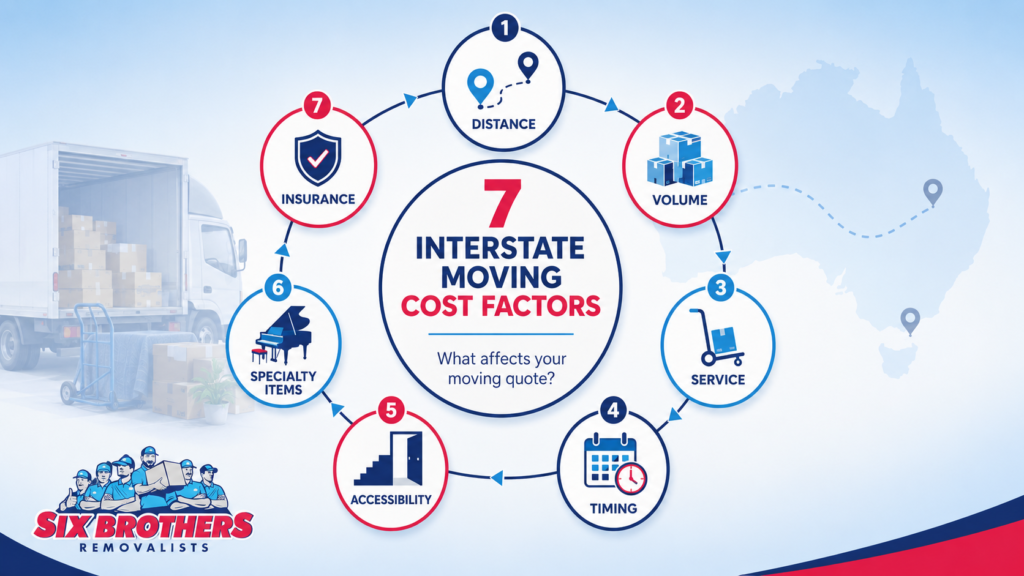
Distance
Sounds obvious, right? The further you go, the more it costs. But it’s not just fuel.
Drivers need rest breaks under Australian fatigue laws. Trucks need overnight stops. Some routes cross state border checkpoints. Sydney to Canberra is roughly 290km. Sydney to Perth is over 3,900km. The pricing gap is massive. Most companies charge per kilometre once you cross state lines. Some bundle it into a flat interstate rate. Either way, distance is the backbone of your quote.
Want a quick mental model? Every extra 1,000km of road usually adds $800–$1,500 to the total. Not exact, but close enough for planning.
Volume and Weight of Goods (m³)
This is the big one. Most Aussie removalists price interstate jobs by cubic metres (m³), not weight.
A studio apartment usually fits in 10–15m³. A 1-bedroom unit sits around 15–20m³. A 2-bedroom unit jumps to 20–28m³. A 3-bedroom home? Around 30–40m³. A 5-bedroom family house can easily hit 60m³+.
More volume = bigger truck = more fuel = higher quote. It’s that simple.
Tip: Walk through every room before you ask for a quote. Even the garage. Even the shed. People always forget the shed. Then on moving day the truck’s already half full and the guys are pulling a lawnmower, two bikes, and a rusty BBQ out of the corner you forgot about.
Some removalists offer free in-home volume surveys. Take them up on it. A measured volume beats a guessed volume every time.
Level of Service
Not all interstate moves look the same. You pick the level of help you want.
• Basic load-and-go: You pack. They lift, drive, deliver.
• Full-service: They pack, wrap, load, drive, unload, unpack.
• White-glove: Includes furniture disassembly, reassembly, even rubbish removal.
Each step up adds cost. But for busy families, full-service can be the only way to stay sane. Think about it like flying. Economy gets you there. Business class gets you there feeling human. Same trip, very different experience.
Timing and Seasonality
Moving in summer? Brace yourself. December to February is peak season in Australia. Quotes can jump 20–35% higher than off-peak.
Why? End of school year. End of lease cycles. Holiday timing. Everyone moves at once.
Winter (June–August) and shoulder months like March or October usually offer the friendliest rates. Trucks aren’t fully booked. Crews have breathing room. Companies sharpen their pencils. If you can flex your dates by even 2 weeks, you can often save hundreds.
Accessibility
Can the truck park out front? Or does it need to circle a block?
Long carry distances, narrow staircases, no lift access, tight driveways, they all add hours. And hours add dollars.
If you live in a high-rise unit in Sydney CBD with strict lift bookings, mention it upfront. Same for narrow streets in Newcastle or steep driveways in the Blue Mountains. Even something as small as a 50-metre walk from the truck to the front door can add $150–$300 to a job. And it goes both ways. The pickup address and the delivery address both get checked. So if you’re moving from a ground-floor unit to a 3rd-floor walk-up in Brisbane, that walk-up adds the cost.
Specialty Items
Got a piano? A pool table? A fridge that doubles as a small wardrobe? Or maybe a fine art collection?
Specialty items need specialty handling. Pianos alone can add $400–$900 to an interstate quote. Pool tables similar. Large pot plants? They might be banned across state borders due to biosecurity rules. Same with some firewood. Don’t hide them. The removalists will see them eventually. Better to plan and price it right than have a confused conversation at 7am on moving day.
Insurance and Extra Services
Standard transit insurance is usually included. But full replacement cover? That’s extra. And worth it.
Other add-ons that affect price:
• Storage between move-out and move-in dates
• Cleaning services for the old place
• Unpacking and box removal at the new home
• Pet or vehicle transport coordination
• Custom crating for fragile or high-value items
Each extra service adds a line to the invoice. Decide what’s actually worth it for you. Reviewing the removalist insurance Australia options before you sign helps you avoid surprise gaps in cover.
Average Interstate Moving Costs in Australia in 2026
Want real numbers? Here’s a ballpark for 2026 based on common Sydney interstate routes.
Keep in mind these are estimates. Your actual quote depends on every factor we just covered. Use these as a starting point, then refine with a proper site visit or video survey.
1–2 Bedroom Home
Volume: roughly 15–25m³
• Sydney to Canberra: $1,200 – $2,200
• Sydney to Melbourne: $1,800 – $3,200
• Sydney to Brisbane: $1,900 – $3,400
• Sydney to Adelaide: $2,500 – $4,200
• Sydney to Perth: $4,500 – $7,500
Great for singles, couples, or young professionals shifting across states for a new job or fresh start. Studio and 1-bedroom volumes fit this range comfortably. If you’re at the upper end of this volume, ask about backloading. It can knock 30% off without changing service quality.
3-Bedroom Home
Volume: roughly 30–40m³
• Sydney to Canberra: $2,200 – $3,800
• Sydney to Melbourne: $3,200 – $5,500
• Sydney to Brisbane: $3,400 – $5,800
• Sydney to Adelaide: $4,200 – $6,800
• Sydney to Perth: $7,500 – $11,500
This is the most common interstate move in Australia. Family homes, with kids, pets, garages full of stuff. Most 3-bedroom moves include a fridge, washing machine, lounge suite, dining set, beds, wardrobes, plus 30–50 boxes. Plan for the full volume up front.
4+ Bedroom Home
Volume: 45–65m³+
• Sydney to Canberra: $3,800 – $6,500
• Sydney to Melbourne: $5,500 – $9,000
• Sydney to Brisbane: $5,800 – $9,500
• Sydney to Adelaide: $6,800 – $10,500
• Sydney to Perth: $11,500 – $18,000+
Big homes, bigger jobs. These usually need two crews, larger trucks, or even split loads. Worth getting at least 3 detailed quotes.
At this size, also ask about double-handling. Some moves load into a depot, then onto a long-haul truck. Each handle adds a small risk of damage. Direct loads cost slightly more but reduce that risk.
Does Interstate Moving Cost Change Depending on Which States You Move Between?
Short answer: yes. Big time.
Long answer? Each route has its own quirks. Some are smooth highways with daily truck traffic. Others are remote stretches with limited backload options.
Booking a Sydney to Melbourne removalist gets you the busiest interstate corridor in Australia. Lots of trucks running both ways daily. That means more backloading deals and competitive pricing.
Sydney to Brisbane follows the M1. Smooth route. Decent options. Slightly higher than Melbourne due to one-way truck balance. More people move north to QLD than back, so empty return trips push prices up.
Sydney to Adelaide or Sydney to Perth stretches across vast remote stretches. Fuel, driver overnight stops, and limited backload options push the price up.
Sydney to Hobart? Add ferry crossing fees from Melbourne to Devonport. That alone tacks on $800–$1,500. Tasmania moves always cost more because of that ferry. It’s not a choice; it’s the only way to get a truck across.
Sydney to Darwin? Brace yourself. Long distances, fewer competitors, and tropical weather considerations. These moves can rival or exceed Sydney to Perth costs.
Each direction matters too. Trucks running back to Sydney empty often offer cheaper backloading rates for the right time slot.
How Interstate Removal Services Work in Australia
Ever wondered what actually happens behind the scenes? Here’s the flow.
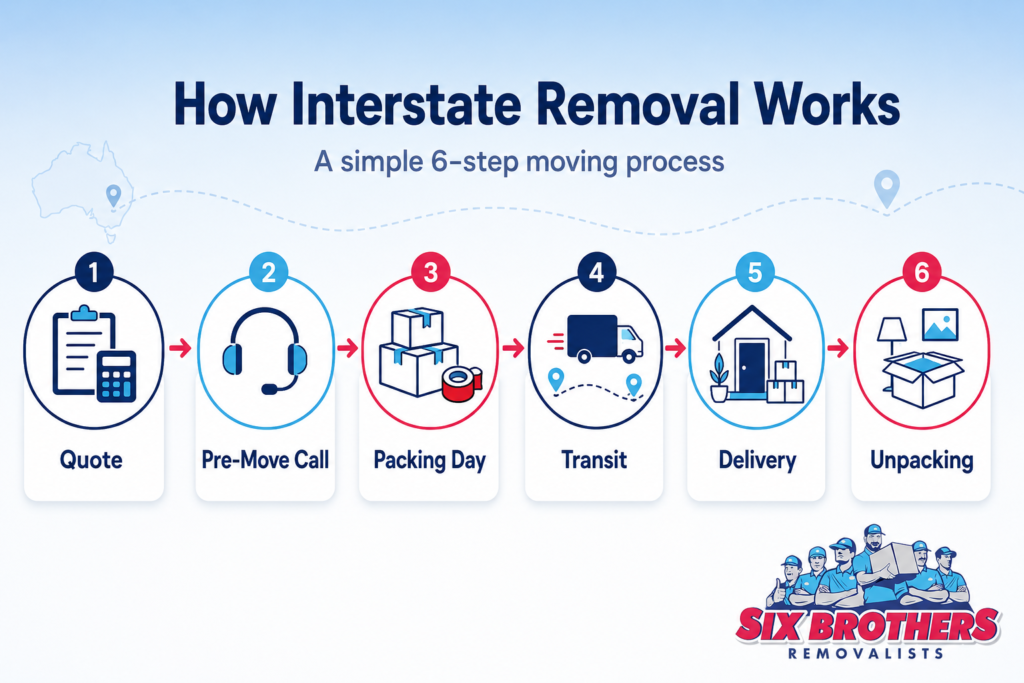
Step 1: Quote. You share home size, address, dates, and any specialty items. The removalist calculates volume and distance. Most quotes come back within 24–48 hours.
Step 2: Pre-move call. A coordinator confirms dates, parking, lift bookings, and access details. They’ll also flag anything that might cost extra so there are no surprises.
Step 3: Packing day (if you booked the service). Pros wrap furniture, label boxes, and load the truck. Packing can take 1 day for a unit, 2–3 days for a larger home.
Step 4: Transit. The truck heads interstate. Some companies offer GPS tracking. Most provide an ETA window. Drivers stop overnight at approved truck stops along the way.
Step 5: Delivery. The crew unloads at your new home, places items in the right rooms, and reassembles furniture. This is where labelled boxes really earn their keep.
Step 6: Unpacking (optional). They open boxes, set up the kitchen, the bedroom, whatever you’ve booked.
Some moves take 2 days. Some take 7. Sydney to Perth can sit at 7–10 days depending on the load schedule and route.
Pro tip: if you book a fixed delivery date instead of a window, expect to pay a premium. But if you have a settlement date you can’t move, that premium is worth it.
How to Prepare for an Interstate Move
Prep is everything. A well-planned interstate move runs smoothly. A rushed one bleeds money.
Start at least 8 weeks out. Here’s a tight prep list, built from real moves our Sydney removalist crews see every week.
• Declutter ruthlessly. If you haven’t used it in 12 months, sell it or donate it.
• Get 3 written quotes. Compare volume estimates, not just totals.
• Lock in your dates. Mid-week off-peak slots disappear fast.
• Update your change of address. Banks, Medicare, electoral roll, super fund, your kid’s school.
• Pack a survival kit. Phone chargers, toiletries, a kettle, mugs, a change of clothes. Things you’ll want before boxes get unpacked.
• Label boxes by room AND priority. Mark the “Open First” ones in bold.
• Confirm insurance cover. Read the fine print. Standard cover doesn’t always cover everything.
• Transfer utilities. Electricity, gas, internet — book disconnect at old place and connect at new place to overlap by 1 day.
• Notify your strata or landlord. Most leases require 14–28 days written notice.
A change of address checklist Australia families swear by saves you weeks of admin chaos later. Tape a copy to the fridge in week one. Tick boxes as you go.
How to Calculate Interstate Moving Costs for a New Location
Want to ballpark your own quote before calling anyone?
Here’s the formula most removalists use behind the scenes:
Total cost ≈ (Volume in m³ × Base rate per m³) + Distance fee + Service add-ons + Insurance
Rough working values for 2026:
• Base m³ rate: $80–$150 per m³ for typical interstate routes
• Distance fee: Built into the base for common Sydney → capital city routes
• Service add-ons: $30–$80 per hour for packing labour, plus materials
• Insurance: 0.5%–2% of declared goods value
Example 1: A 3-bedroom Sydney to Brisbane move. 35m³ × $110 = $3,850 base. Add $400 packing labour. Add $80 insurance. Total ≈ $4,330.
Example 2: A 1-bedroom Sydney to Melbourne move. 18m³ × $100 = $1,800 base. DIY packing. Add $50 insurance. Total ≈ $1,850.
Example 3: A 4-bedroom Sydney to Perth move. 55m³ × $140 = $7,700 base. Add $700 packing. Add $250 insurance. Total ≈ $8,650.
Use this as a sanity check. If a quote comes in way higher or way lower, ask why. You can also plug your numbers into our moving home calculator for a faster estimate.
Ways to Save Money on an Interstate Move
Want to keep more cash in your pocket? Of course you do. Here are the four strategies that actually work. Combine them and you can shave 30–50% off your final invoice.
Decluttering
This is the cheapest way to move interstate Australia families use without even thinking about it. Every cubic metre you don’t move = money you don’t spend. Sell old furniture on Facebook Marketplace. Donate clothes to Vinnies or Lifeline. Toss the broken stuff.
A serious declutter can shave $500–$1,500 off your final bill. Plus you arrive at the new place with only the things you actually want. That’s worth the weekend of sorting alone.
Backloading
Backloading is the smartest secret in Aussie removals. Here’s how it works: a truck delivering to Melbourne has empty space on the way back to Sydney. You fill that space at a discount. Win-win.
Going with interstate backloading removals can save 30–50% compared to a dedicated truck. Perfect for flexible move dates and smaller loads.
The catch? You’re sharing the truck. Delivery dates may shift by a few days depending on the route. If your timing is fixed, backloading might not be the right fit.
Moving Mid-Week
Friday, Saturday, Sunday busiest days. Tuesday, Wednesday quietest.
Book mid-week and you’ll often get 10–20% off. Some companies throw in free boxes too. Friday afternoons are the most expensive slot in the entire week. Also avoid the first and last 3 days of any month. End-of-month lease cycles flood the market with people who need movers urgently. Prices rise. Availability drops.
Comparing Quotes
Always get at least 3 written quotes. Don’t just look at price.
Compare:
• Volume estimates
• Insurance cover
• Cancellation policy
• Hidden fees (stair fees, long carry, weekend surcharges)
• Crew size and truck size
A $200 difference upfront often hides a $600 difference at the end.
Pro Tip to Save Money on Interstate Moving
Here’s the move most people miss.
Book your interstate removalist quote during the off-peak window March, April, late October, or November but book for the actual move date you need. Most companies lock in the rate at the booking date, not the move date.
Combine that with a mid-week slot. Add a backload option. And you’re looking at the cheapest way to move furniture interstate without compromising on service quality. One more thing: pack yourself, but pay pros to load and drive. That hybrid model usually saves 25–40% versus full-service.
And here’s the bonus play: order your own boxes from the removalist’s box program in advance. They’re often cheaper than retail box shops. You get the right sizes, plus tape and bubble wrap thrown in.
How to Compare Interstate Moving Quotes
Three quotes land in your inbox. Now what? Don’t just stare at the bottom line. Run them through this checklist:
• Volume estimate. Are they all quoting the same m³? If one is way smaller, they might lowball, then upcharge on moving day.
• Inclusions. Packing, materials, insurance, fuel — is it all in the price?
• Insurance type. Limited liability vs full replacement cover are very different things.
• Deposit and refund policy. Some take 50% upfront. Some are non-refundable. Read carefully.
• Reviews and reputation. Google reviews, ProductReview, word of mouth. Look for patterns, not single complaints.
• ABN and AFRA membership. Legitimate Aussie removalists belong to industry bodies and have real registration. The AFRA member directory lets you verify any company in seconds.
• Communication style. Did they reply quickly? Answer all your questions? That’s how moving day will feel too.
Cheapest is rarely best. But most expensive isn’t automatically safest either. Aim for the middle quote with the strongest reviews. That’s usually the sweet spot.
Learn more….. How to Compare Interstate Removalist Quotes
Best Interstate Moving Option by Move Type
Not every move needs the same plan. Match the service to the situation.
Small Apartment Moves
Studio or 1-bedroom unit? Backloading is your friend. You probably only need 8–15m³ of truck space.
Mid-week backload + DIY packing = lowest possible price. Often under $2,000 for short interstate hops.
Family Home Moves
3 or 4 bedrooms, kids, pets, the works? Go full-service. Time is more valuable than the few hundred dollars you’d save DIY-packing. Book a dedicated truck so your stuff arrives on a fixed day, not a 7-day window. Coordinate your move with the school term break if you have kids less disruption all round.
Office Interstate Moves
Business relocations need precision. IT equipment, files, furniture, signage. A proper office removal crew that handles weekend or after-hours moves is worth every dollar. Downtime costs more than the move itself. Map out workstation layouts before the truck arrives. Label every cable, every monitor, every chair. The setup at the new office will be 10× faster.
Flexible Backload Moves
Got 2 weeks of wiggle room? Use it. Flexible date backloads are the cheapest interstate option going. You wait, the truck times your job into its existing route, you save big.
High-Value Item Moves
Art, antiques, pianos, designer furniture? Pay for full replacement insurance. Always. Pick a removalist with specialty packing crates and crew experience. Don’t risk a $20,000 painting on a $50 saving.
When Interstate Moving Prices Rise Quickly
Prices don’t sit still. Watch out for these spikes.
• End of financial year (June). Businesses move offices. Trucks book out.
• December–January. End of school, holiday timing, lease cycles. Worst time for cheap rates.
• Public holiday weeks. Easter, Anzac Day, Australia Day, long weekends. Avoid if you can.
• Sudden fuel price hikes. Diesel jumps directly hit interstate quotes within weeks. The ACCC fuel price reports are a quick way to track movements.
• Last-minute bookings. Anything under 2 weeks lead time costs 15–30% more.
• Major weather events. Floods, bushfires, cyclones disrupt routes. Detours add cost.
Plan ahead. Book early. Stay flexible. That’s the formula.
Wrapping It Up
Interstate moving prices in Australia come down to one truth: the more you know, the more you save. Distance, volume, timing, accessibility, service level every factor stacks. Get it right, and a 3-bedroom Sydney to Brisbane move costs $3,400. Get it wrong, and the same move pushes $6,000. Same boxes. Same family. Different prep.
At Six Brothers Removalists, we’ve helped thousands of families and businesses cross state lines without the panic. Whether it’s a studio to Canberra or a 5-bedroom haul to Perth, the playbook is the same plan early, pack smart, pick the right crew.
Ready to get a real quote tailored to your move?
Call us on 1300 764 372 or email info@sixbrothersremovalist.com.au. Six Brothers Removalists, Suite 1 Level 5/58-60 Macquarie St, Parramatta NSW 2150.
Your next chapter starts with the right truck. Let’s make sure it’s ours.

Quick Answers to Common Interstate Moving Questions
People ask the same questions every week. Here are the fastest answers.
How far in advance should I book an interstate move?
At least 6–8 weeks for peak season. 3–4 weeks for off-peak. Last-minute bookings under 2 weeks usually cost 15–30% more.
Is backloading really cheaper or is it a trap?
Genuinely cheaper if you’re flexible on dates. Not a trap. Just a different model. Your stuff shares the truck with someone else’s goods.
Do removalists move plants across state borders?
Some do. Some don’t. WA, TAS, and SA have strict biosecurity rules. Always ask before packing pot plants. You may need to leave certain plants behind.
Can I track my goods during interstate transit?
Many companies now offer GPS tracking. Ask up front. If it matters to you, pick a company that provides it.
What if my new home isn’t ready when the truck arrives?
Most removalists offer short-term storage. Daily or weekly rates apply. Book this option upfront, last-minute storage costs more.
Do I need to be home for delivery?
Yes. Or someone authorised. You’ll need to inspect items, sign delivery paperwork, and direct the crew on where to place furniture.