

Got a new job in another city? Moving for work feels exciting and stressful at once. Then the bills start landing.
Most Aussies ask the same thing. Can I claim moving costs on my tax? The honest answer takes a minute to unpack.
This guide cuts through the noise. We’ll cover what the ATO allows. We’ll show how employers can chip in. We’ll explain salary packaging too. Whether you’re heading from Sydney to Brisbane or just across town, knowing the rules saves real money. Sometimes thousands.

Moving for a New Job: Tax Benefits Explained
So you packed your life into boxes. Truck booked. New city waiting. Now what about the cost? Australia has tight rules on work moving expenses. The ATO doesn’t hand out personal deductions for relocation. That’s the bad news. Here’s the better news. The system has back doors. Legal ones, not dodgy ones.
Your employer can pay your moving costs directly. Special tax rules called FBT relocation concessions cover this. The result? Tax-free help for you.
You might salary package some costs. That means using pre-tax dollars to cover the move. Big savings if your employer offers it.
Business owners and sole traders play by a different rulebook. Some moving costs count as deductible business expenses. We’ll get to that.
A fair go on tax means knowing where the rules bend. Most workers miss it. You won’t.
Are Moving Expenses Tax Deductible When You Relocate for Work in Australia?
Short answer: not for regular employees. Long answer: there’s nuance.
The ATO sees moving costs as private expenses. Even if the move is for a new job. Even if you had no real choice.
Why? Because moving sets you up for the income. It doesn’t earn the income directly. Tax law calls this “private or domestic in nature.”
So if you hire removalists in Parramatta and pay yourself, you can’t claim it. Same goes for cheap movers Sydney or any removalists near me. But the rules change when your employer gets involved. That’s where the magic happens.
The FBT relocation exemption is the workaround. Your boss pays. The Tax Office doesn’t tax it. You move for free. Or you might get an allowance instead. That’s taxed as income. Different beast.
The takeaway? Personal claims are dead. Employer-paid moves are alive and well.
Why Employees Usually Cannot Claim Moving Expenses on Tax
Let’s break this down. Why does the ATO block personal moving claims?
The answer sits in tax law basics. To claim a deduction, the cost must directly help you earn income. Moving doesn’t pass that test. Think of it this way. The job earns the income. The move just gets you to the job. Two different things, like the road and the destination.
So even if your new role demands relocation, the moving cost stays personal. Removalists, fuel, packing boxes, storage. All private. This applies whether you book a removalist Sydney to Wollongong or movers Parramatta. Doesn’t matter the distance. Doesn’t matter the reason for the move.
What about the hourly rate for removalists you paid? Still private. The truck hire? Private. New utility connections at your new place? Private.
The ATO is firm on this. Many taxpayers have tried over the years. Almost all have failed in tribunal cases. So if you paid yourself, you wear the cost. Plain and simple. But there’s hope. Your employer holds the key.
Employer-Paid Relocation Benefits and FBT Concessions
Now we get to the good stuff. The FBT relocation concession is a game-changer. When your employer pays for your move, that would normally count as a fringe benefit. Fringe Benefits Tax kicks in. Expensive for the boss.
But specific rules under the Fringe Benefits Tax Assessment Act exempt many relocation costs. Sections 58A through 58F cover the bulk of it. The boss pays no extra tax. You get a tax-free move.
This isn’t a loophole. It’s official policy. The government wants to help workers move for jobs. Let’s walk through what’s covered.
Removal and Storage
Your employer can pay full removalist fees. No FBT for them. No tax for you. This includes packing, loading, transport, and unloading. Whether you book a Speedy Van Move or a 4-5 bedroom unit/house removal, it’s all covered.
Storage works too. Need to keep stuff in storage during the transition? The boss can pay. Up to 12 months in most cases. Sometimes longer with valid reason. This is huge for interstate moves. A removalists sydney to brisbane gig might need temp storage at both ends. All FBT-exempt under the rules.
Travel Costs
Getting your family to the new city counts too. Flights, fuel, meals, hotels along the way. If you drive from Sydney to Adelaide, your employer can cover petrol. Toll costs too. Even meals during the trip.
Family travel is included. Your spouse, your kids, your dependents. The whole crew gets covered. This applies for one trip to find a place too. House-hunting visits before the move. All FBT-exempt under specific conditions.
Temporary Accommodation
Sometimes your new place isn’t ready. Your old place might still be selling. Gap accommodation fills that hole. Your employer can pay for hotels, serviced apartments, or short rentals. Both ends of the move. No FBT, no tax for you.
There are time limits. Usually 21 days at the old location. Up to six months at the new one. Different limits apply if you’re selling property. Pretty solid coverage when you think about it.
Connection Fees
Setting up utilities at the new place? Electricity, gas, water, internet, phone. All standard household stuff. Your employer can cover those connection costs. FBT-exempt. They can also cover disconnection fees at the old place.
It’s the small stuff that adds up. A few hundred bucks here, a few hundred there. Nice to have it covered.
Home Sale/Purchase Costs
This one’s a beauty. If you sell your old house and buy near the new job, your employer can pay the transaction costs. We’re talking real estate agent fees, conveyancing, stamp duty, lender fees, advertising costs. The lot.
Time limits apply. The sale and purchase must connect to the relocation. Usually within two years of the move. For families relocating long distance, this benefit alone can save tens of thousands.
Relocation Consultant Fees
Some companies hire relocation consultants to help staff. School research, suburb advice, settling-in services.
Those fees? FBT-exempt when paid by the employer. Worth knowing if you’re negotiating an offer.
Tax-Free Benefit for Employees
Here’s the kicker. When your boss pays for any of these, you get the benefit tax-free. The cash value of your move doesn’t count as taxable income. You don’t report it. You don’t pay tax on it. This is why employer-paid moves beat self-paid moves every time. Same job, way better deal.
Want to know a secret? Many employers don’t offer this because employees never ask. The squeaky wheel gets the oil.
Common Covered Costs
Let’s recap what your employer can pay FBT-free:
- Removalist fees including packing and unpacking
- Storage costs for household goods
- Transport for you and your family
- Temporary accommodation at both ends
- Utility connection and disconnection
- Real estate transaction costs for home sale and purchase
- Relocation consultants and house-hunting trips
- Pet transport in many cases
- Vehicle transport if you have a second car
- Cleaning costs for the old residence
That’s a decent list. Worth raising with HR before you sign the offer letter.
Salary Packaging Moving Costs for a New Job
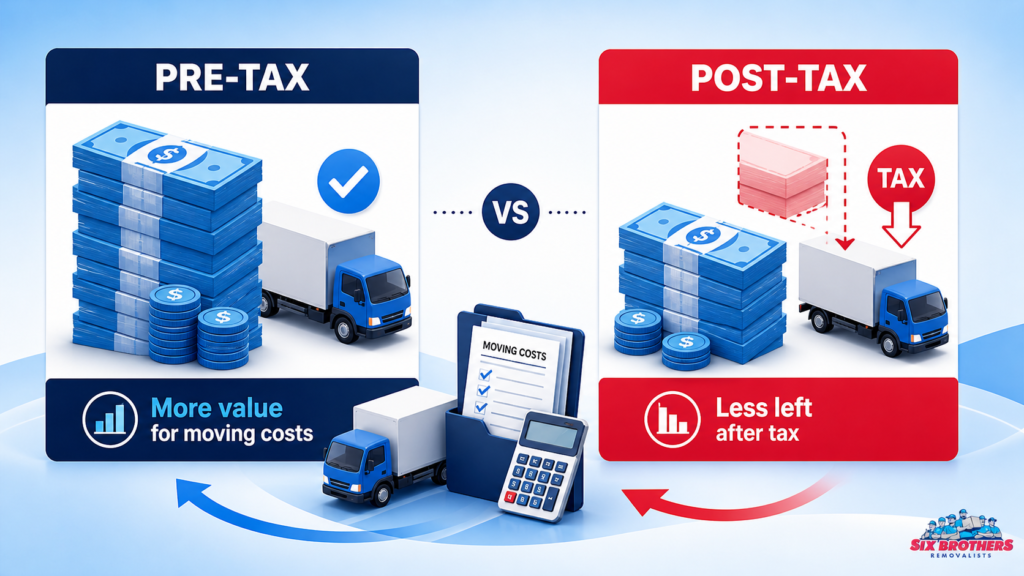
Salary packaging is the second-best path. Some folks call it salary sacrifice. Here’s how it works. You agree to give up part of your salary. In exchange, your employer pays for certain expenses on your behalf.
The catch? Those expenses come from pre-tax dollars. You save the tax you’d have paid on that income. For high earners, this means huge savings. Marginal tax rate of 39%? You save 39 cents on every dollar packaged.
Not every employer offers it. Charities and public benevolent institutions are big users. Hospitals, unis, and government bodies too. But the FBT relocation rules apply here as well. So salary packaging relocation expenses uses the same exempt categories we covered above.
Eligible Expenses for Packaging
Most employer-paid relocation costs can be salary packaged. The trick is the same FBT exemption rules apply. So if it qualifies for FBT exemption, it can usually be packaged. Let’s run through the main categories.
Removalist Fees
Hiring removalists? Whether you choose a 1 bedroom unit/house move or a full 3-4 bedroom unit/house relocation, salary packaging works.
You pay nothing personally upfront. The cost comes from pre-tax salary. The removalist gets paid through your employer. Big savings on a $4,000 to $8,000 move. Might be the easiest tax win you’ll get all year.
Temporary Accommodation
Stuck between homes? Pre-tax dollars can cover the temp stay.
Hotels, motels, serviced apartments. All in scope. As long as the FBT rules are met properly. The time limits we mentioned still apply. Don’t try to package six months of rent at a permanent new place. The Tax Office watches.
Utility Connections
Connection fees for power, gas, water, internet. All packageable. Same with phone connections. Even pay TV in some cases. The list is broad. These small bills add up fast. Packaging them takes a real bite out of your total cost.
Transport Costs
Travel for the move itself can be packaged. Flights, fuel, parking, tolls. If you drive from Wollongong to Sydney for a new role, the petrol and toll costs can be salary packaged. Same goes for one house-hunting trip. Often booked before you officially start the new job.
Property Transaction Costs
Real estate agent commissions. Legal fees. Stamp duty. Mortgage discharge fees. All can be packaged when the sale or purchase relates to the relocation. Strict timing rules apply here. This is where the biggest savings sit for homeowners. Worth getting professional advice on the package structure.
Can Business Owners or Sole Traders Claim Relocation Costs?
Now to the small business crowd. The rules are different here. If you run your own gig, you don’t have an employer. So FBT doesn’t apply. But other deductions might be available.
The key question? Is the move for the business or for you personally? That distinction matters. The ATO splits it sharp.
Deductible Business Relocation Costs
Moving your business premises? That’s a deductible cost in most cases.
You can claim:
- Removalist fees to shift business assets
- Transport costs for equipment and stock
- Storage for business gear during the move
- Setup costs at the new location
- New lease costs including legal fees in some cases
- Disconnection and reconnection of business services
A removalist Sydney to Adelaide move for a business gets full deduction status. As long as the move is genuinely for business purposes.
Same with movers and packers Parramatta who shift your office furniture. Or removalists Dubbo who relocate your trade tools. Sole traders moving a home office face trickier rules. The ATO scrutinises home-based business claims hard.
Non-Deductible Personal Costs
Even sole traders can’t claim personal moving costs. Your fridge, your kids’ beds, your couch. All private. If you mix the move (some business, some personal), you must split the bill. Apportion the cost. Claim only the business share.
Keep clean records. Receipts. A logbook for vehicle costs. The ATO can ask years later. Don’t try claiming the family’s removal as a business expense. That’s a fast track to audit.
Who Can Deduct Moving Expenses?
Let’s spell out who actually gets a deduction. The list is short.
Employees: Generally can’t deduct anything. Personal in nature.
Business owners moving premises: Can deduct genuine business relocation costs. Furniture removalist costs included.
Sole traders relocating their business: Same rules. Business portion deductible.
Companies and trusts: Can deduct business relocation costs as standard business expenses.
Investment property owners: Can deduct certain costs related to rental property fittings or fixtures.
That’s the lot. Notice employees aren’t on the list? That’s why FBT-exempt employer benefits matter so much. They’re the only path to a tax-free move for most workers.
Want a quick test? Ask yourself: am I moving the business or moving my home? If it’s home, no deduction.
Which Moving Costs Stay Private and Non-Deductible?
Some costs are always private. No matter who you are. No matter the reason.
Here’s the list of personal moving expenses that never qualify:
- Personal furniture removal (unless employer-paid under FBT)
- Family vehicle transport
- Pet relocation (with limited employer exceptions)
- New furniture for the new place
- Renovations at the new home
- Curtains and carpets for the new place
- Disconnection fees for personal services (employer can pay though)
- Boxes and packing supplies you bought yourself
- Time off work for the move
- Cleaning your old place to get the bond back
- New school uniforms for the kids
- Lost income during the move
- Insurance excess on damaged goods
- Mail redirection fees
- Drivers licence updates
- Rebonding services at the new property
That’s a long list. Most of it stays in your pocket. Or comes out of it. The lesson? Plan ahead. Get employer help where possible. Salary package what you can.
How to Handle a Work Move Properly for Tax Purposes
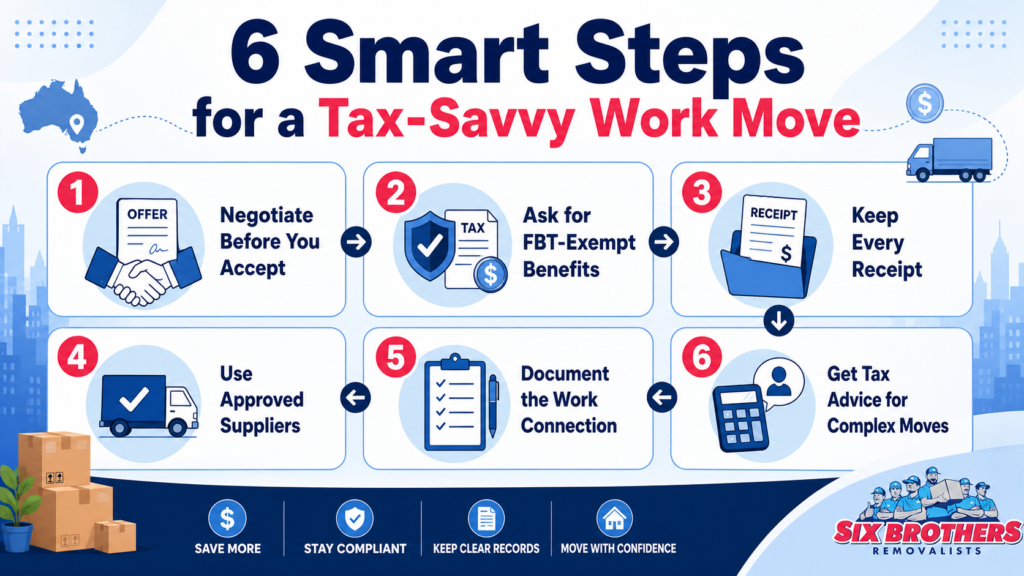
Right, let’s talk practical steps. Here’s how to play this smart.
Step 1: Negotiate before you accept the job.
The job offer stage is your strongest moment. Ask about relocation support. Most companies have policies, even small ones.
Get the offer in writing. Specify which costs are covered. Save the email.
Step 2: Ask for FBT-exempt benefits, not allowances.
A relocation allowance is taxable income. You’ll lose 30 to 45 percent to tax.
Direct payment of expenses by the employer? That’s FBT-exempt. You keep 100 percent.
Same money. Way better outcome.
Step 3: Keep every receipt.
Even if your employer pays directly, hold onto receipts. They might want them later. The ATO might ask one day too.
Removalist invoices, hotel bills, fuel receipts, real estate fees. All of it.
Step 4: Use approved suppliers.
Some employers have preferred removalist providers. Some let you choose. Either way, use a registered, insured operator.
A no-name backyard van might save $200 today. It costs you $5,000 in damaged goods next week.
Step 5: Document the work connection.
Keep proof the move was for work. Job offer letter. Old contract end date. New contract start date. Employer correspondence.
If the ATO ever questions the FBT exemption, you’ll have the paper trail.
Step 6: Get tax advice if your move is complex.
Moving from interstate? Selling property? Salary packaging? Big amounts? Talk to a registered tax agent.
A few hundred bucks for advice can save thousands in tax.
Important Tax Notes About Moving for a New Job
Here’s the small print. The stuff that catches people out.
No Personal Deduction
Repeat after me. Personal moving costs are not tax deductible.Doesn’t matter if the new job demanded it. Doesn’t matter if you couldn’t take the role without moving. The ATO has been clear for decades. Many tribunals have backed this view.
If anyone tells you otherwise, they’re wrong. Don’t risk an audit chasing a deduction that doesn’t exist.
Allowances vs. Reimbursement
This bit is important. There’s a real difference between three things.
An allowance is cash paid to you. Usually a lump sum. It counts as taxable income. You pay tax on it.
A reimbursement is your employer paying back specific costs you covered first. With FBT exemption, this is tax-free.
Direct payment is the cleanest. Your employer pays the supplier straight up. No money touches your bank.
Direct payment beats reimbursement. Reimbursement beats allowance. Always. If your employer offers a $5,000 relocation allowance, push back. Ask for direct payment instead. Same money to you. Less tax for both sides.
Get Expert Advice
Tax law isn’t a DIY sport. Especially for big moves. A registered tax agent or accountant earns their fee on a relocation. They know the FBT rules cold. They spot opportunities you’d miss otherwise.
The Tax Office also has free guidance. Check the ATO website for relocation expense rules. They publish detailed FBT guides. Or call us at 1300 764 372. We’re not tax advisors, but we know how relocation packages work in the real world. We can point you the right direction.
A registered tax agent costs $200 to $500 for a consult. The savings on a relocation can run into five figures. Easy maths.
Why Six Brothers Removalists Makes Work Moves Easier
A work relocation is more than a truck and a tax form. It’s your whole life on wheels. We’ve handled thousands of work moves across NSW. Sydney, Parramatta, Wollongong, Dubbo, Wagga. Interstate too. We work with HR teams every week. We know how to invoice direct to employers for FBT-exempt billing. We also know how to handle salary packaging providers cleanly.
Need a quote your employer can lock in? Call 1300 764 372. Email info@sixbrothersremovalist.com.au. We’re at Suite 1 Level 5, 58/60 Macquarie St, Parramatta NSW 2150.
We do studio apartment moves. We do 4-5 bedroom unit/house moves. We handle office removals and business relocations too. From a single van trip to a full interstate run, we’ve got the gear. Our quotes break down clean. No hidden fees. No surprise hourly slip-ups. Just honest numbers your accountant or HR can process fast.
Moving for a new job is stressful enough without tax confusion making it worse. Get the move right. Get the paperwork right. Get on with the new chapter.
FAQ
Can I claim my own removalist if I move for work?
No. Personal moves stay personal. Even if the new job is interstate. Even if you found cheap removalist Sydney quotes. The ATO blocks personal claims.
What if my employer gives me a lump sum allowance?
It’s taxable income. You pay tax at your marginal rate. Better to ask for direct payment of specific bills instead.
Are removalists wagga or removalists Dubbo trips covered under FBT?
Yes, if your employer pays directly. The FBT exemption applies regardless of postcode. Sydney, Wagga, Dubbo, anywhere.
Can my company pay packers and movers Sydney bills FBT-free?
Yes. Packing and removal services fall under the FBT removal exemption. Same rule applies for movers and packers Parramatta or any other suburb.
What about a removalist and storage near me situation?
Storage costs are FBT-exempt for up to 12 months in most cases. Both at the old end and the new end.
Does it cover hourly rate for removalists?
Yes. Whether the removalist charges hourly or fixed, your employer can pay either way under the exemption.
What if I’m a freelancer or contractor?
You’re treated like a sole trader. Personal moves stay private. Business relocation costs may be deductible.
Can I claim mileage for driving to the new city?
Not if you’re an employee. Sole traders moving a business may claim a portion. Get advice on the split.
Is there a dollar cap on FBT-exempt relocation?
No fixed cap on most categories. But the rules require costs to be reasonable and directly tied to the relocation.
Does the rule cover movers from Sydney to other cities?
Yes. Whether it’s a removalist sydney to wollongong run or removalists sydney to brisbane, the FBT exemption applies the same way.