

You hired a removalist. The bill landed. Your eyes watered a bit. Now tax time creeps up. You’re staring at the receipts wondering if any of it counts.
Short answer? In most cases, no. The ATO usually treats moving costs as private spend. Sorry to crush the dream early. But there are a few small wrinkles worth knowing. Some workers do get help. Some employers pick up the tab. And there are smart ways to save even when a deduction won’t fly.
This guide breaks the rules down in plain words. We’ll cover what the ATO actually says. We’ll point out the traps people fall into. And we’ll show what to do instead.
Heads up: This is general info, not personal tax advice. For your situation, ring a registered tax agent or check the ATO website.
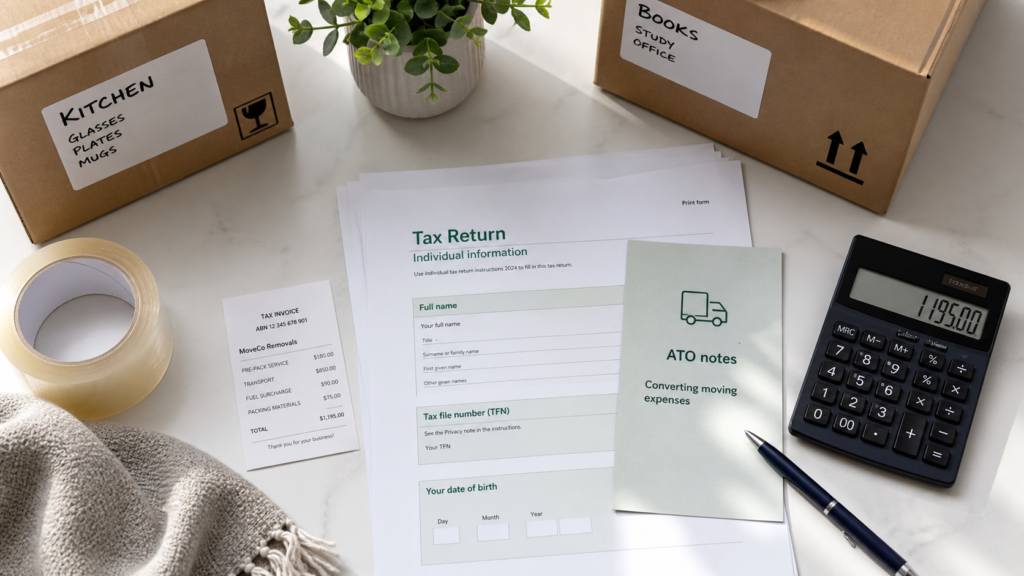
Are Moving Expenses Tax Deductible in Australia?
Most of the time? No. The ATO sees moving as a private choice. You picked the suburb. You chose the apartment. The tax office sees that as your call, not your job’s.
That makes the cost personal. And personal costs aren’t tax deductible. Same rule that stops you claiming weekly groceries. Even if you moved closer to work, the rule still bites. Even if you moved for a new job. Even if your new gig sits two hours away. The ATO line stays the same.
There’s an old Aussie saying that fits here. “If it sounds too good to be true, it probably is.” Tax-deductible house moves fall into that bucket for most folks. That said, grey areas do exist. Employers, fringe benefits, and business moves can shift the picture. We’ll get to those soon.
What the ATO Says About Claiming Moving Expenses
The ATO has a clear stance. Relocation costs you pay yourself are private. Private means not deductible. You can read the rule under TR 95/13 and similar guidance. The tax office spells it out plainly. No claim for the move itself.
The reason is simple. The expense isn’t tied to earning your income. It’s tied to where you choose to live. The ATO calls this the “nexus” test. No nexus to income, no claim. That’s the gate every work expense has to pass.
Your removalist invoice doesn’t pass it. Neither does your packing tape. Neither does your moving truck fuel. Even when the move feels work-related, the rule still applies. The cost happened before the new role started. Or it happened so you could choose a new postcode. Both put it in the private box.
So if you’ve been Googling “ato relocation expenses” hoping for a green light, here’s the reality. Most moves don’t make the cut.
Why You Usually Cannot Claim Moving Expenses on Tax in Australia
Here’s where people get stuck. Their move feels work-related. The bill is huge. So why doesn’t the tax office help?
Because the law looks at the purpose of the cost. Not how it feels. The cost has to directly help you earn income. A move puts you in a place to earn. It doesn’t earn for you. Three common scenes where folks expect a claim. None of them fly.
A Transfer Within Your Existing Job
Got moved by your boss to a new branch? Bummer, but no deduction. The ATO sees the cost as personal. You moved your home. That’s a private act, even if work caused it.
If your employer pays for the move, the picture shifts. They might cover it as a fringe benefit. We’ll dig into that later. But out of your own pocket? You can’t claim it back at tax time. Not the truck. Not the boxes. Not the storage fees.
Taking Up a New Job With a Different Employer
This one stings. You land a great job. It’s interstate. You pack up and move. The cost still counts as private. The ATO says you weren’t earning income from that job yet. So the move isn’t tied to existing income.
It’s a chicken-and-egg trap. You moved to start the job. You weren’t earning at the time of the move. So the link isn’t there. Same goes for your first job after uni. Or a career switch. Or a sea change. The bill is yours to wear.
Relocating to Be Closer to Your Workplace
Sick of the commute? Moved closer to the office? Smart move for your sanity. Bad move for your tax return. The ATO sees this as private. You chose the suburb. You picked the address. That’s lifestyle, not work. Doesn’t matter if it saves you fuel. Doesn’t matter if it saves your knees. The line is the same.
What Moving Expenses Are Not Tax Deductible in Australia?

Let’s name the line items. The ones people think might slip through. Spoiler: they don’t.
Removalist Fees and Furniture Storage
Your removalist invoice. The hourly rate for removalists you booked. The crew’s time. The packing materials. None of it counts. Same rule for furniture storage between properties. Even if storage drags on for months.
Self storage rentals also fall outside the rules. So do moving container hire fees. If you’ve searched “hourly rate for removalists” hoping a deduction kicks in, we feel you. But the answer doesn’t change. And searching “removalist and storage near me” won’t unlock a hidden tax break either.
Temporary Accommodation and Meals During the Move
Stayed at a motel mid-move? Ate takeaway for three nights? That’s all on you. Travel away from home for personal reasons isn’t deductible. The ATO calls it private living costs. Same as eating out on a normal Tuesday.
Hotel rooms, meals, snacks, coffee runs. None of it makes the tax return. This catches people out. They expect “travel” to mean “deductible”. Nope. Work travel rules are very different.
Connecting Utilities
New address, new bills. Power, gas, water, internet, NBN connection fees. All private spend. Setup fees, transfer fees, redirect fees. The tax office sees them as part of running your home.
Same rule for changing your driver’s licence, updating insurance, or redirecting mail. They’re life admin costs. Useful tip though. Australia Post mail redirection might still be worth paying for. It saves headaches even if it costs you a few bucks.
Legal Fees or Stamp Duty
Bought a new place and moved into it? The legal fees aren’t deductible. Stamp duty isn’t either. At least not as a regular expense. Stamp duty becomes part of the property’s cost base. That matters later for capital gains tax. But it doesn’t help your yearly return.
Conveyancing fees, building inspections, pest reports. All in the same boat. Capital costs, not yearly deductions. For investment property, the rules differ. Talk to a tax agent there. The web of rules around investment moves is its own beast.
Can You Claim Household Goods and Personal Effects When Moving?
The simple answer is no. Household goods are private property. Moving them is a private act.
our couch, your bed, your dinner set, your clothes. All personal items. The ATO doesn’t count them as work tools.
Same goes for boxes, bubble wrap, and tape. The packing pack you bought from Bunnings? Private. Even if you needed it for the move. What about appliances? Your fridge, your washing machine, your TV? Still no.
Now, work tools are a different story. If you’re a tradie and you move your work ute, the travel and tool transport tied to earning income can be a different conversation. But that’s about ongoing work, not the home move itself. The rule of thumb is dead simple. If the item is for living, the move cost is private. If the item is purely for income work, dig deeper with a tax agent.
Don’t try to lump your TV with your tradie tools to sneak a claim. Audits are a thing. The ATO has eyes on this stuff.
Can You Claim Travel Expenses When Moving House?
Another no. Travel from your old home to your new home is private travel. The ATO doesn’t see it as work travel. Even if you drove yourself. Even if you flew with the family. Even if you did three trips back and forth. Petrol, tolls, flights, taxis, Ubers. None of it goes on the tax return.
What about driving the moving truck? Same answer. The drive itself is the move. The move is private. So the petrol is too. Now, here’s the curveball. If you travel for work during the move, that part might still count. Say you drive to Melbourne for a work meeting on the same day you move. The work bit could still be claimable. But you’d need clear records.
Distance, time, purpose, kilometres for work versus personal. The ATO loves clean records. Mixing personal and work in one trip gets messy fast. Most people don’t have this overlap. Most people just move and get on with it. So most people can’t claim travel.
What Counts as Moving Expenses for Tax Purposes?
Let’s define the term. Moving expenses are the costs of shifting your home from one place to another.
That includes:
- Removalist fees and crew labour costs
- Truck or van hire if you DIY
- Packing materials and packing services
- Furniture storage between addresses
- Travel to the new home by car or plane
- Temporary accommodation during the move
- Cleaning costs at the old place
- Connecting and disconnecting utilities
- Mail redirection through Australia Post
- Updating ID and registrations
The ATO bunches all of this under “private domestic” expenses. None of it earns you income. So none of it ticks the deduction box. For people researching moving house checklist australia, it’s worth knowing this upfront. You can plan for the cost without expecting a tax win.
You may also see “relocation costs” used the same way. The terms overlap a lot. The tax treatment stays the same. So when someone asks what counts as moving expenses for tax purposes, the honest answer is everything to do with the move. And almost none of it is deductible.
Understanding Relocation Costs and Tax Deductions
People mix up “relocation” and “moving.” For tax, the words mean the same thing. A relocation cost is the cost of shifting your life. New address, new bed, new kitchen. The works.
Some relocations come with extra costs. Storage. Cleaning. Bond loss. Real estate fees. Loan refinancing. Buying new whitegoods to fit the new place. All of those costs sit in the private bucket. They aren’t tied to earning income.
There’s a slightly different rule when an employer pays. The employer might be able to provide some of the move tax-free under the FBT rules. The worker still doesn’t claim anything. So the trick isn’t claiming. The trick is who pays first. If your boss pays, you might score a tax-free perk. If you pay, you wear the cost.
That can change the maths on a relocation costs Australia conversation in a big way.
ATO Rules on Relocation Expenses and Tax Deductions
The ATO publishes guidance every year. The core rules don’t change much.
Here’s what stays the same:
- Self-paid moving expenses are private and non-deductible
- Stamp duty is a capital cost, not a yearly deduction
- Legal and conveyancing fees on a home aren’t deductible
- Travel for the move is private travel
- Storage and removalist fees are private
The ATO also covers the employer side. There are FBT exemptions for some relocation help. Things like:
- Removalist costs paid by the employer
- Storage for furniture during the move
- Temporary accommodation while finding a new home
- Sale and purchase costs of the home in some cases
- Connection and reconnection of utilities
- Some travel for the worker and family
Notice the pattern. The employer pays. The employer claims. The worker isn’t taxed on the perk. But the worker doesn’t get a deduction. They just dodge the tax bill on the benefit.
If you’re moving for work and your boss won’t help, ask. Even partial help saves you money. And it doesn’t cost the employer much extra thanks to FBT exemptions.
Possible Exceptions and Alternatives to Claiming Moving Costs
There are a few sideways paths. None give you a direct tax claim. But they can ease the cost.
Salary Sacrifice
Salary sacrifice means trading some of your wages for a benefit. Your boss pays for the benefit before tax. Some relocation help can be salary sacrificed. The exact rules depend on your employer’s setup. And on what counts under the FBT rules.
The win? You don’t pay income tax on the sacrificed amount. Your take-home looks smaller. But your move gets paid for with pre-tax money. That can be huge for big moves. A $10,000 move on pre-tax dollars beats $10,000 from your post-tax bank account.
Talk to your payroll team. Ask if the company has a relocation salary packaging policy. Some big employers do. Many smaller ones don’t.
Fringe Benefits Tax (FBT) Exemptions
FBT is the tax employers pay on perks they give workers. Many perks are taxed. Some aren’t.
Relocation help has special exemptions. The ones we listed above. Removalist fees, storage, temporary stay, utility connection, and more.
When the FBT exemption applies, the boss pays nothing extra. You don’t pay tax on the perk. Win-win.
This is why a relocation package matters when you’re job hunting. Even a small package saves real money.
If you’re moving for a new role and they offer relocation, take it. If they don’t, ask. Many bosses will negotiate.
Business Moves
Running your own business? Different rules apply. Sometimes.
Moving a business location can be deductible. Things like:
- Moving business equipment between offices
- Reinstating fit-out at the new place
- Disconnecting and reconnecting business utilities
- Moving stock and machinery
These costs link to earning business income. So they pass the nexus test. But moving the owner’s home isn’t deductible. Even if the owner runs a home business. The home move stays private.
Sole traders, mixed-use property folks, and home offices need careful advice here. The lines blur fast. A registered tax agent or accountant should weigh in. For company directors and shareholders, the rules layer on top. Don’t guess. Get help.
What to Do Instead of Claiming Moving Expenses on Tax?

OK, you can’t claim. So what can you do? A few smart moves can save real money. They aren’t tax tricks. They’re spend tricks.
1. Get multiple quotes. Three quotes minimum. Compare carefully. Cheap doesn’t always mean good. But the gap between quotes can be huge.
2. Move off-peak. Mid-month and mid-week moves cost less. End of month is the busiest time. Weekends are pricey too.
3. Pack yourself. Packing services add cost. If you have time, do it yourself. Or do most of it and let the pros handle fragile bits.
4. Declutter first. Less stuff means less truck space. Less truck space means less cost. Sell, donate, or bin what you don’t need.
5. Use cheap or free boxes. Bunnings boxes, supermarket boxes, friend’s leftover boxes. They all work. Or order proper kits sized to your home.
6. Time it right. Mid-financial year is often quieter. Avoid the EOFY rush if you can.
7. Bundle services. Some movers offer storage and packing combos. Bundles often save cash.
8. Negotiate. Ask for a discount. Worst they say is no. Many movers price-match.
9. Get insurance smartly. Don’t pay for cover you don’t need. But don’t skip it on a big move.
10. Plan early. Last-minute moves cost more. Always. Book ahead.
If you’re searching “how to save money when moving house,” you’ve got the right mindset. Save the cash now. The tax man won’t help, but smart planning will.
Common Tax-Time Mistakes With Moving Expenses in Sydney
Sydney movers make the same mistakes every June. Let’s name them so you don’t.
Confusing Allowances
Got a relocation allowance from work? It might be taxable. It might not. Don’t assume. Ask payroll. Check your payment summary. The wrong assumption can cost you a chunk.
If the allowance is taxed, you don’t get to claim the move costs against it. The allowance is income. The move is private. They sit in two different boxes. If the allowance falls under FBT exemption, you’ve got nothing to claim either. But you also don’t pay tax on it. That’s the better outcome.
Mixing Travel Rules
Work travel rules are not moving travel rules. People blur the lines and get into trouble. Driving to a work meeting? Deductible if it ticks the rules.
Driving from old home to new home? Not deductible. Even if you stop at work on the way. Don’t dump moving travel into your “car expenses” claim. The ATO can spot it. Audits aren’t fun.
Trusting Generic Advice
Mate at the pub said you can claim it. American website says you can claim it. Old article from 2018 said you can claim it. None of that matters. The Australian rules are specific. The 2025–2026 rules are what counts now.
Always check the ATO website. Or ring a registered tax agent. Generic advice is great for a chat. It’s bad for your tax return.
Missing NSW Costs
NSW has stamp duty quirks. First home buyer concessions can play a role. Land tax rules differ from other states. People moving in or out of Sydney miss these. They focus on the move and forget the property side.
Stamp duty isn’t yearly deductible. But it does feed into capital gains tax later. Track it. Keep the records. If you’re moving from interstate into NSW, talk to a tax agent. The cross-state rules can save or cost you.
When It Is Worth Getting Extra Tax Advice?
Tax advice costs money. Sometimes it saves more than it costs. Here’s when paying an expert pays off:
- You’re moving for a new job and your boss is offering a relocation package
- You’re shifting between rentals or moving an investment property
- You’re a sole trader or run a small business out of home
- You’re moving interstate and shifting your tax residency
- You’re moving overseas, even temporarily
- You’re getting a relocation lump sum and aren’t sure how it’ll be taxed
- You sold a property and bought a new one in the same year
Why pay for advice in these cases? Because the rules tangle fast. A tax agent untangles them. They might find a salary sacrifice path. Or an FBT exemption. Or a capital gains tax angle. A registered agent costs a few hundred bucks. The savings can run into thousands. That’s a return worth chasing.
You can find tax agents on the Tax Practitioners Board register. Always check they’re registered. Unregistered agents can’t legally lodge for you. Avoid free advice from social media. Avoid “tax hacks” on TikTok. Most are wrong. Some are dangerous.
For straight-up tax facts, the ATO website is gold. It’s free. It’s official. It’s up to date.
Wrapping It Up
Did we want this article to end with a fat refund? Same. But the truth is the truth.So can you claim relocation costs on tax australia? In most cases, no. The ATO sees moving expenses as a private cost. Your tax return will too.
There are smart paths around the cost. Salary sacrifice. FBT exemptions. Business deductions for business moves. And solid planning to keep the bill low. Most of the savings come before the move. Get good quotes. Pack smart. Declutter hard. Time it well. If your move is complex, get help. A few hundred dollars on advice can save thousands. That’s a deal worth taking.
Need a hand with the move itself? Six Brothers Removalists has been shifting Sydney homes for years. Quick, careful, fair price. Whether you’re after cheap movers Sydney trusts, packers and movers Parramatta locals rate, or a Sydney to Brisbane interstate run, we’ve got the truck and the team.
📞 1300 764 372 📧 info@sixbrothersremovalist.com.au 📍 Suite 1, Level 5/58/60 Macquarie St, Parramatta NSW 2150
Get a quote. Get going. We’ll handle the heavy lifting while you sort the paperwork.