

Table of Contents
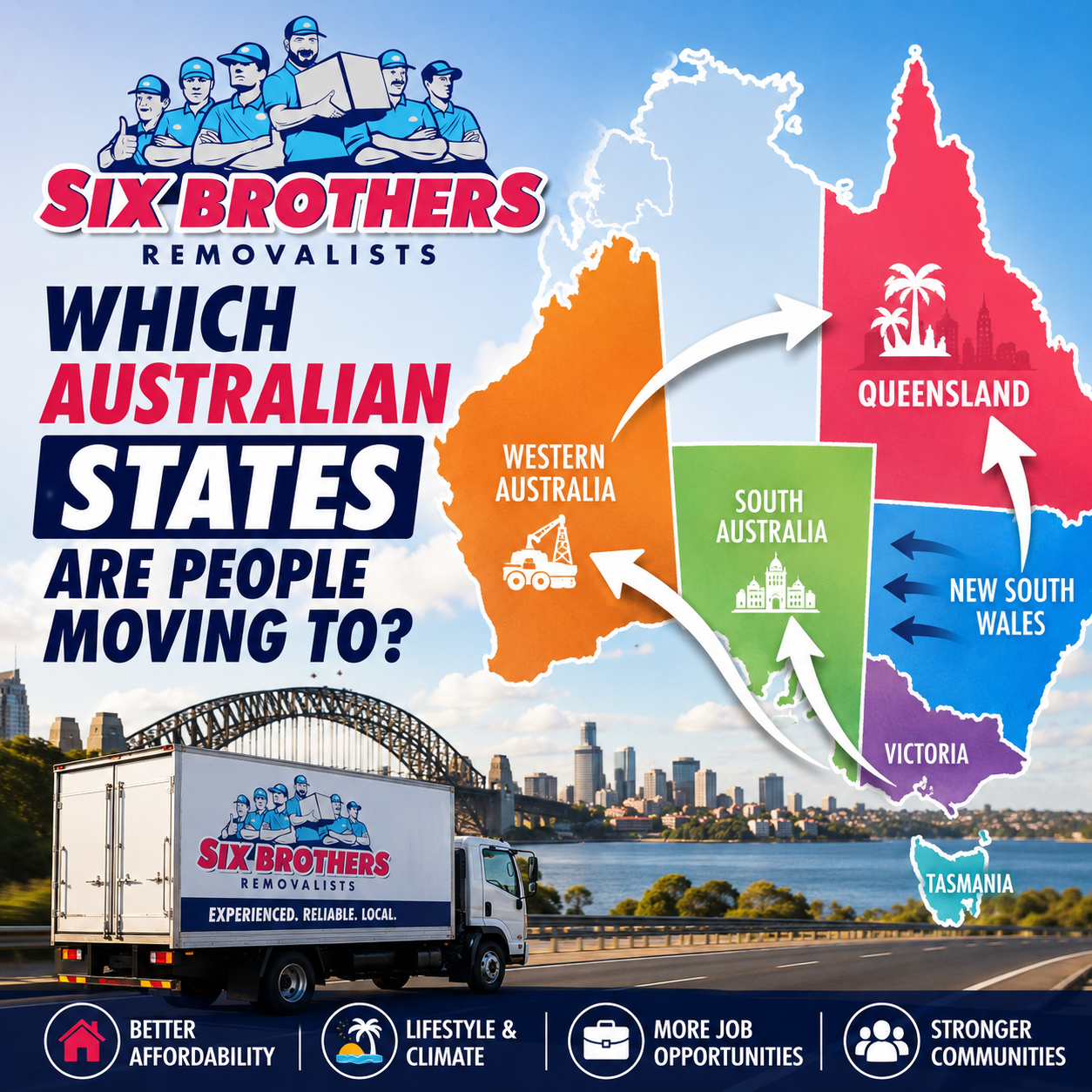
Queensland and Western Australia are leading the charge as Australia’s top relocation destinations in 2025, drawing thousands of families, workers, and retirees away from Sydney and Melbourne each year. If you’re sitting in Parramatta weighing up an interstate move, you’re not alone. Net interstate migration data consistently shows more people leaving NSW than arriving.
Whether you’re chasing affordability, lifestyle, or work opportunities, understanding where Australians are actually moving helps you plan smarter. It also shapes how much your move will cost, how long it takes, and what logistics you need to sort out before the truck rolls.
This guide breaks down the latest state-by-state migration trends, explains why people leave, covers what each destination offers, and walks you through the practical side of relocating interstate from Western Sydney.
Overview of Interstate Migration Trends in Australia
Australia’s internal migration patterns have shifted dramatically since 2020. The pandemic accelerated trends that were already building, and many of those shifts have stuck. People aren’t just moving for jobs anymore. They’re moving for housing costs, lifestyle, climate, and remote work flexibility.
The Australian Bureau of Statistics tracks net internal migration between states and territories each quarter. The data tells a clear story: NSW and Victoria consistently lose residents to other states, while Queensland, Western Australia, and South Australia gain them.
For anyone in Parramatta or Greater Western Sydney, this matters. You’re in one of the most expensive housing markets in the country. The median house price across Western Sydney still sits well above what you’d pay in Brisbane, Perth, or Adelaide. That price gap is one of the biggest drivers pushing people out.
What the Latest ABS Data Tells Us
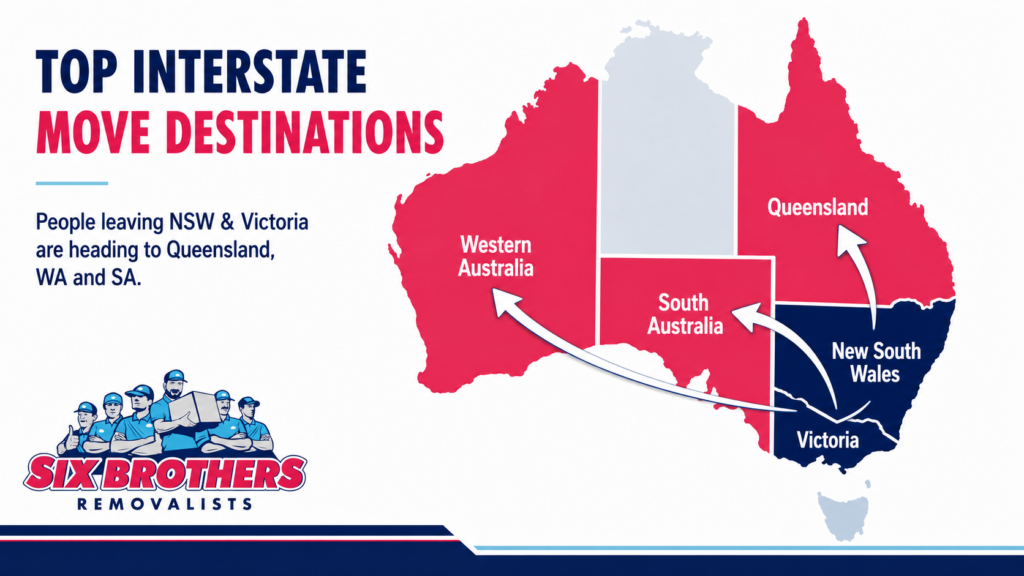
The most recent ABS provisional estimates show that NSW recorded a net interstate migration loss of more than 12,000 people in the 2023-24 financial year. Victoria wasn’t far behind. Meanwhile, Queensland gained the largest share of interstate arrivals, followed by Western Australia and South Australia.
These aren’t small numbers. They represent families packing up homes, workers transferring offices, and retirees selling up to stretch their superannuation further. The trend has been consistent for over five years now, and 2025 shows no sign of reversal.
What’s notable is the demographic spread. It’s not just young renters leaving. Families with school-aged children, tradespeople, small business owners, and downsizing retirees all feature heavily in the outflow from NSW.
Key Drivers Behind Australians Relocating Between States
Several factors overlap to push people toward an interstate move:
Housing affordability remains the dominant driver. The gap between Sydney’s median house price and Brisbane’s or Perth’s can exceed $400,000 to $600,000 depending on the suburb comparison. For a family renting in Parramatta at $650 per week, the same money buys significantly more space in Logan, Ipswich, or Rockingham.
Cost of living beyond housing also matters. Groceries, childcare, insurance, and utilities all factor in. States with lower overall costs attract people who feel squeezed in Sydney.
Remote and hybrid work changed the equation permanently. If your employer doesn’t require you in a CBD office five days a week, the logic of paying Sydney prices weakens fast.
Lifestyle and climate pull people north and west. Warmer weather, less congestion, proximity to beaches or bushland, and a slower pace of life appeal to families and retirees alike.
Employment growth in specific sectors draws workers to mining regions in WA, infrastructure projects in Queensland, and defence industry expansion in South Australia.
Which States Are Gaining the Most New Residents?
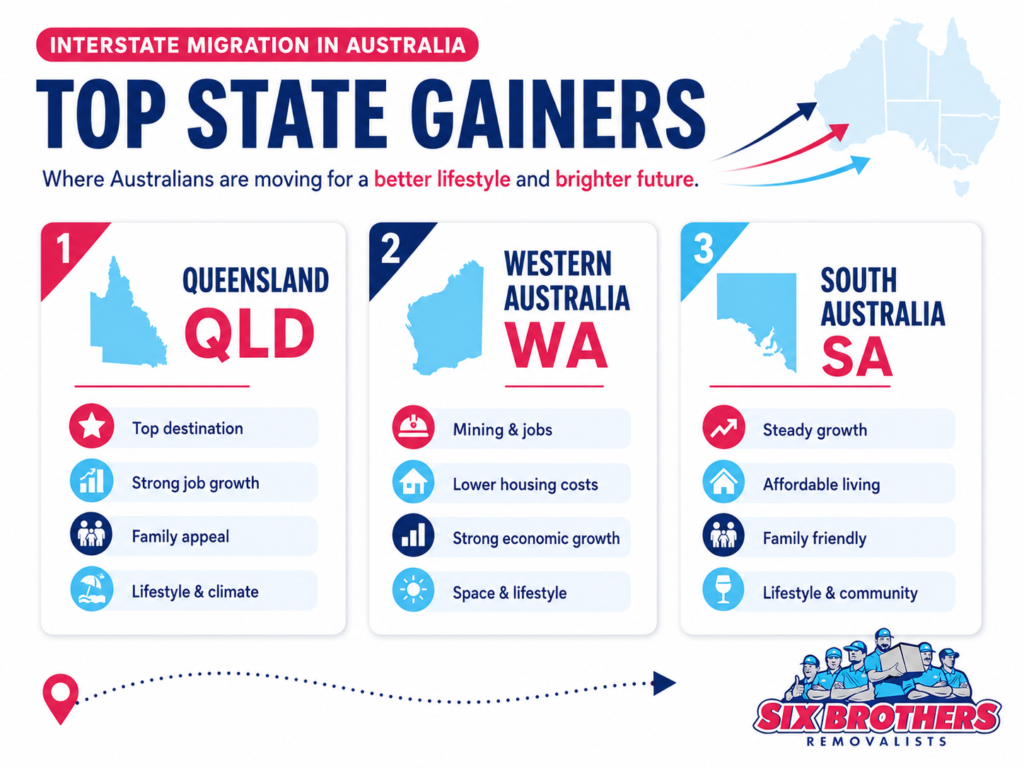
Not all states benefit equally from interstate migration. The gains concentrate in three main destinations, with two others picking up smaller but meaningful numbers.
Queensland: The Top Destination for Interstate Movers
Queensland has been Australia’s number one interstate migration destination for most of the past decade. According to the Queensland Government Statistician’s Office, the state gained a net 30,000+ interstate migrants in the 2023-24 period when combined with overseas arrivals settling there.
South East Queensland absorbs the bulk of arrivals. Brisbane, the Gold Coast, and the Sunshine Coast are the primary landing zones. But regional centres like Townsville, Cairns, Toowoomba, and Mackay also attract movers, particularly those in trades, healthcare, and mining support services.
The appeal is straightforward. A three-bedroom house in suburbs like Springfield, Caboolture, or Upper Coomera costs a fraction of what you’d pay in Parramatta, Blacktown, or Penrith. The climate is warmer. Infrastructure investment is booming, with the 2032 Brisbane Olympics driving billions in transport and venue projects.
For families moving from Western Sydney, the Gold Coast and northern Brisbane corridors offer a familiar suburban feel with newer housing stock, good schools, and shopping centres, just at a lower price point.
Western Australia: A Fast-Growing Magnet for Workers and Families
Western Australia has surged as a migration destination, particularly since 2022. Perth’s relative affordability compared to Sydney and Melbourne, combined with a roaring resources sector, makes it attractive to a broad range of movers.
The WA Government’s Department of Planning reports strong population growth driven by both interstate and overseas migration. Perth’s median house price, while rising, still sits significantly below Sydney’s. Suburbs in Perth’s northern and southern corridors offer new builds with land packages that would be unthinkable in NSW at the same price.
The mining and energy sectors provide high-paying employment, but Perth’s economy has diversified. Healthcare, education, construction, and technology sectors are all hiring. For tradespeople leaving Sydney, WA offers higher wages and lower living costs, a combination that’s hard to ignore.
The main consideration for movers from Parramatta is distance. Perth is roughly 4,000 kilometres by road. An interstate move to WA typically takes 5 to 7 days by truck, and flights are around 5 hours. It’s a genuine long-distance relocation, which means planning, logistics, and choosing the right removalist matter more than a move to Brisbane.
South Australia: Affordable Living Drawing Steady Interest
South Australia, and Adelaide in particular, has quietly become one of the most attractive interstate destinations. It doesn’t grab headlines like Queensland, but the numbers are consistent. SA has recorded positive net interstate migration for several consecutive years.
Adelaide’s median house price remains among the lowest of any Australian capital city. Suburbs like Elizabeth, Salisbury, and Morphett Vale offer established housing at prices that would buy you a studio apartment in parts of Sydney.
The state’s economy is growing through defence contracts (the Hunter-class frigate program at Osborne), renewable energy projects, and a strong food and wine sector. For families, Adelaide offers good public schools, manageable commute times, and a lifestyle that balances city amenities with easy access to wine regions, beaches, and the Adelaide Hills.
From a moving logistics perspective, Adelaide is roughly 1,400 kilometres from Sydney. It’s a common backloading route, which means removalist costs can be competitive if you’re flexible on timing.
Victoria and Tasmania: Where Do They Fit?
Victoria, specifically Melbourne, has historically been a two-way migration corridor with NSW. People move between Sydney and Melbourne for work, family, and lifestyle reasons. However, in recent years, Victoria has also experienced net interstate migration losses, though smaller than NSW’s.
Melbourne’s housing costs have risen but remain below Sydney’s in most comparable suburbs. The city still attracts movers who want urban culture, strong public transport, and diverse employment. But it’s no longer the clear second choice it once was. Many people who might have moved to Melbourne are now choosing Brisbane or Perth instead.
Tasmania saw a spike in interstate arrivals during 2020-2022, driven by remote workers and lifestyle seekers attracted to Hobart’s character and the island’s natural environment. That wave has moderated. Housing supply in Hobart is tight, and the job market is smaller. Tasmania remains a niche destination rather than a mass migration target.
Northern Territory and ACT: Niche Moves for Specific Reasons
The Northern Territory and the Australian Capital Territory attract interstate movers for specific reasons rather than broad lifestyle appeal.
Darwin and the NT draw workers in mining, defence, and government services. The climate is challenging (tropical heat and a distinct wet season), and the population base is small. Moves to the NT are almost always employment-driven.
Canberra and the ACT attract public servants, defence personnel, and university students. It’s a well-planned city with high average incomes, but housing costs have risen sharply. For most Parramatta residents, Canberra isn’t a cost-of-living move. It’s a career move.
Both destinations require careful logistics planning. Darwin is remote, and freight costs reflect that. Canberra is closer (about 3 hours from Sydney by road) but has specific access considerations for larger trucks in some suburbs.
Why Are People Leaving New South Wales?
Understanding why people leave NSW helps you assess whether an interstate move makes sense for your situation. The reasons are practical, not emotional.
Housing Costs and Rental Pressure Across Sydney
Sydney’s housing market is the single biggest push factor. CoreLogic data consistently shows Sydney as Australia’s most expensive capital city for both purchasing and renting.
In Parramatta and surrounding suburbs like Merrylands, Granville, Harris Park, and Westmead, median rents for a three-bedroom house have pushed past $600 per week. Buying a median-priced house in the Parramatta LGA requires a household income well above the national average, even with a 20% deposit.
For young families, this creates a squeeze. Childcare costs on top of rent or mortgage repayments leave little room for savings. The maths often works out better in Brisbane, Perth, or Adelaide, even after factoring in the cost of the move itself.
Employment Shifts and Remote Work Opportunities
The rise of remote and hybrid work removed the anchor that kept many people in Sydney. If you only need to be in the office two days a week, or not at all, living in a cheaper city becomes viable.
Some industries have also shifted their growth centres. Mining and resources jobs concentrate in WA and Queensland. Defence manufacturing is growing in SA. Infrastructure construction is booming across multiple states. Workers in these sectors can earn comparable or higher wages in states where their dollar goes further.
For business owners, the calculation includes commercial rent, staff costs, and local market size. Some small businesses have relocated entirely, particularly those in e-commerce, consulting, and trades that serve a broad geographic area.
Lifestyle and Climate Considerations
Sydney’s congestion, commute times, and urban density push some residents toward states offering a different pace. The average commute in Greater Western Sydney can exceed 45 minutes each way. In Brisbane’s outer suburbs or Perth’s northern corridor, similar commute distances cover more ground with less traffic.
Climate preferences also play a role. Queensland’s warmer winters appeal to families tired of Sydney’s cooler months. Perth offers a Mediterranean climate with hot, dry summers and mild winters. Adelaide’s climate is similar to Perth’s but with slightly cooler winters.
These factors rarely drive a move on their own, but combined with cost savings, they tip the balance.
How Interstate Migration Affects the Removalist Industry
The sustained flow of people out of NSW has reshaped the removalist industry. Understanding these dynamics helps you get better service and pricing when planning your own move.
Demand Patterns on Major Interstate Routes
The Sydney-to-Brisbane corridor is the busiest interstate removalist route in Australia. Trucks run this route daily, and competition among removalists keeps pricing relatively competitive. The journey is approximately 900 kilometres and typically takes 1 to 2 days for a full truck.
Sydney to Melbourne remains busy in both directions, covering roughly 880 kilometres. Sydney to Perth is the longest major route at around 4,000 kilometres, requiring 5 to 7 days of transit time.
Sydney to Adelaide sits in the middle at about 1,400 kilometres, usually a 2 to 3 day journey. This route is well-serviced by backloading options, which can reduce costs significantly.
Demand peaks during summer (November to February) and around school holiday periods. If you can move during autumn or winter, you’ll often find better availability and pricing.
What This Means for Moving Costs from Parramatta
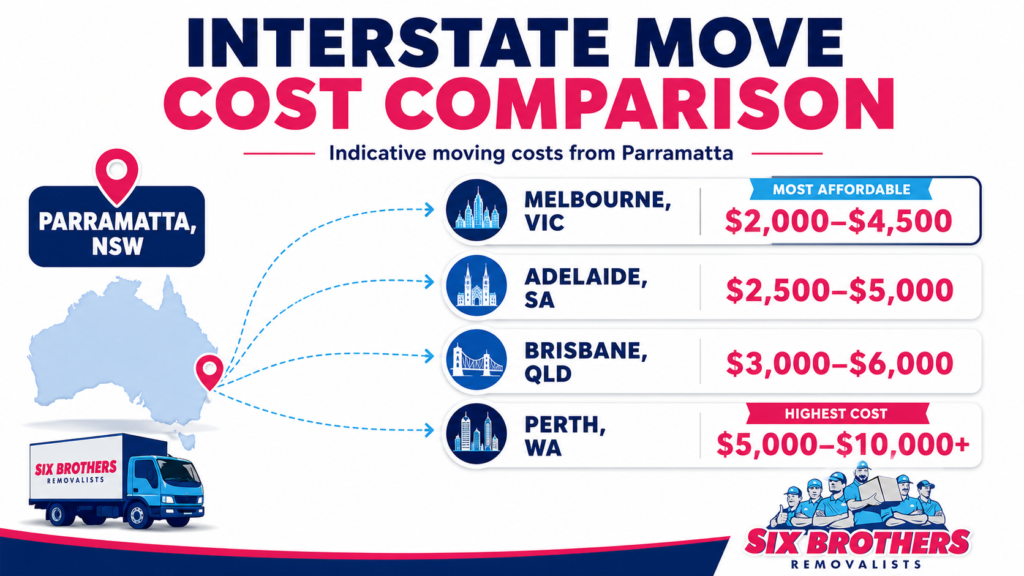
Interstate moving costs from Parramatta vary based on distance, volume, timing, and service level. As a general guide:
A three-bedroom house move from Parramatta to Brisbane typically ranges from $3,000 to $6,000 for a dedicated truck, depending on access, packing requirements, and insurance. Backloading on the same route can bring costs down to $1,500 to $3,500.
Moves to Perth cost more due to distance and fuel. Expect $5,000 to $10,000+ for a full service, or $3,000 to $6,000 for backloading with flexible dates.
Adelaide moves fall between Brisbane and Perth pricing. Melbourne moves are generally the most affordable interstate option from Sydney due to proximity and route frequency.
These figures are indicative. Every move is different. The number of heavy items (pianos, pool tables, safes), stair access, parking restrictions, and packing services all affect the final quote.
Planning an Interstate Move from Western Sydney
If the data has you seriously considering a move, the planning process matters as much as the destination choice.
Choosing the Right Time to Relocate
Timing affects cost, availability, and stress levels. The removalist industry’s peak season runs from October through February. During this window, trucks are booked weeks in advance, and prices reflect the demand.
Moving mid-week (Tuesday to Thursday) is typically cheaper than weekends. Mid-month moves are less hectic than end-of-month, when lease cycles drive a surge in demand.
If you’re moving for a job start date, book your removalist as early as possible, ideally 4 to 6 weeks ahead for interstate moves. For flexible timelines, backloading offers the best value because you’re filling empty space on a truck already heading your way.
School term dates matter for families. Starting kids at a new school at the beginning of a term reduces disruption. Aligning your move with Queensland or WA school calendars (which differ slightly from NSW) takes some planning but pays off.
Comparing Removalist Options for Interstate Moves
Not all removalists handle interstate moves equally. Key factors to compare:
Dedicated vs. backloading service. A dedicated truck carries only your belongings and runs direct. Backloading shares truck space with other customers, which costs less but requires date flexibility. Both are legitimate options. The right choice depends on your budget and timeline.
Insurance and liability. Ask every removalist what happens if something breaks. Some offer transit insurance as standard. Others charge extra. Some only cover damage caused by their crew, not transit damage. Get this in writing before you book.
Packing services. Full packing, partial packing, or DIY. Professional packing adds cost but reduces breakage risk, especially for fragile items, artwork, and electronics. If you’re packing yourself, invest in quality materials: sturdy boxes, bubble wrap, packing paper, and tape.
Storage options. If your new home isn’t ready when you arrive, you’ll need short-term storage. Some removalists offer warehouse storage at the destination. Others partner with storage facilities. Clarify costs and access terms upfront.
Track record and reviews. Check Google reviews, ProductReview.com.au, and ask for references. An interstate move puts your entire household in someone else’s hands for days. You want a crew that communicates, shows up on time, and handles your belongings with care.
Packing, Storage, and Logistics Tips for Long-Distance Moves
Interstate moves involve more logistics than local ones. A few practical tips from years of handling these relocations:
Declutter before you pack. Every item you don’t move saves weight and space. Sell, donate, or dispose of anything you haven’t used in 12 months. This is especially true for bulky furniture that might not suit your new home’s layout.
Label everything by room and priority. When the truck arrives at your new address, you want essentials (kettle, bedding, toiletries, phone chargers) accessible immediately. Pack a “first night” box that travels with you, not on the truck.
Photograph valuable items before packing. If something arrives damaged, photos make insurance claims straightforward.
Notify services early. Electricity, gas, internet, mail redirection, school enrolments, Medicare address updates, vehicle registration transfers. Interstate moves involve more admin than local ones. Start the paperwork at least two weeks before moving day.
Check access at both ends. Can a large truck park outside your Parramatta home? Does your new street in Brisbane or Perth have clearance for a moving truck? Narrow streets, low-hanging trees, and body corporate rules can all create problems on the day.
State-by-State Snapshot: What Each Destination Offers Movers
Here’s a concise comparison to help you weigh your options side by side.
Queensland: Cost of Living, Job Market, and Lifestyle
Median house price (Brisbane): Approximately $850,000 (rising but still below Sydney’s $1.4M+). Rental market: Tight in Brisbane CBD and inner suburbs, more available in outer growth corridors. Job sectors: Construction, healthcare, education, tourism, mining services. Climate: Subtropical. Warm to hot year-round, with a wet season from November to March. Lifestyle: Beach access, outdoor living, newer suburban developments, strong café and dining culture. Moving distance from Parramatta: ~900 km. Transit time 1-2 days.
Queensland suits families seeking space, warmth, and lower housing costs without sacrificing urban amenities.
Western Australia: Mining Boom, Space, and Opportunity
Median house price (Perth): Approximately $750,000 to $800,000, with strong growth in recent years. Rental market: Very tight. Vacancy rates in Perth have been among the lowest in the country. Job sectors: Mining, oil and gas, construction, healthcare, agriculture. Climate: Mediterranean. Hot, dry summers and mild, wet winters. Lifestyle: Beaches, outdoor recreation, spacious suburbs, relaxed pace. Moving distance from Parramatta: ~4,000 km. Transit time 5-7 days.
WA suits workers in resources and trades, families wanting space, and anyone comfortable with geographic distance from the east coast.
South Australia: The Quiet Achiever
Median house price (Adelaide): Approximately $750,000, with some outer suburbs well below this. Rental market: More balanced than Sydney, Brisbane, or Perth. Job sectors: Defence, manufacturing, wine and food production, healthcare, renewable energy. Climate: Mediterranean. Hot summers, cool winters. Lifestyle: Wine regions, beaches, festivals, manageable city size, short commutes. Moving distance from Parramatta: ~1,400 km. Transit time 2-3 days.
SA suits families and retirees seeking affordability, a slower pace, and a well-rounded lifestyle without the intensity of larger capitals.
Victoria, Tasmania, and Other Destinations
Melbourne remains a strong option for those wanting cultural depth, diverse food scenes, and established public transport. Housing is cheaper than Sydney but more expensive than Brisbane, Perth, or Adelaide. The weather is famously variable.
Tasmania offers natural beauty and a tight-knit community feel but has limited job diversity and housing supply constraints. It’s best suited to remote workers, retirees, or those with transferable skills in healthcare or education.
Canberra is a career-driven destination with high incomes and good infrastructure but rising housing costs. It’s close enough to Sydney for a relatively simple move.
How Six Brothers Removalists Supports Interstate Relocations
Moving interstate from Parramatta requires a removalist who understands the full scope of what’s involved, not just loading a truck.
Our Interstate Routes and Backloading Services
Six Brothers Removalists runs regular interstate services from Parramatta and Greater Western Sydney to all major Australian destinations. Our most frequent routes cover Sydney to Brisbane, Sydney to Melbourne, Sydney to Adelaide, and Sydney to Perth.
Our backloading service is particularly popular with interstate movers watching their budget. When one of our trucks completes a delivery in another state, we offer return-trip space at reduced rates. You get the same professional crew and careful handling, just at a lower price because you’re sharing transport costs.
We handle the logistics end to end: pre-move assessment, packing materials supply, professional packing if needed, loading, transport, unloading, and furniture placement at your new home. For moves requiring short-term storage, we offer secure warehouse facilities.
What to Expect When You Book With Us
When you contact us for an interstate quote, we start with a detailed inventory discussion. We need to understand what you’re moving, where you’re moving from and to, access conditions at both properties, and your preferred timeline.
We provide a written quote that breaks down costs clearly. No hidden fees. No surprise charges on delivery day. If your move includes packing, we specify what’s included. If you need storage, we outline daily or weekly rates upfront.
On moving day, our crew arrives on time with the right truck size, protective materials, and equipment for heavy or awkward items. We wrap furniture, protect floors and doorframes, and secure everything for transit. For interstate moves, we provide tracking updates so you know where your belongings are.
At the destination, we unload, place furniture where you want it, and reassemble anything we disassembled. We don’t leave until you’re satisfied.
Conclusion
Australia’s interstate migration patterns are clear. Queensland, Western Australia, and South Australia are gaining residents, while NSW continues to lose them. Housing affordability, lifestyle preferences, and employment opportunities drive these moves, and the trend shows no sign of slowing in 2025.
For Parramatta residents considering an interstate relocation, the decision involves more than choosing a destination. It requires careful planning around timing, costs, logistics, and the right removalist partner to get your household safely across state lines.
We handle interstate moves from Western Sydney every week at Six Brothers Removalists. If you’re ready to explore your options, get a clear quote, or just talk through the logistics, contact our Parramatta team today and let us take the stress out of your move.
Frequently Asked Questions
Which Australian state has the highest interstate migration growth in 2025?
Queensland consistently records the highest net interstate migration gains. South East Queensland, including Brisbane, Gold Coast, and Sunshine Coast, absorbs the majority of new arrivals from NSW and Victoria.
Why are so many people leaving NSW for other states?
Housing affordability is the primary driver. Sydney’s median house price and rental costs are the highest in Australia. Combined with remote work flexibility and lifestyle preferences, many residents find better value in Queensland, WA, or SA.
How much does it cost to move interstate from Parramatta?
Costs vary by destination and volume. A three-bedroom house move to Brisbane typically ranges from $3,000 to $6,000 for a dedicated service. Backloading options can reduce this to $1,500 to $3,500 with flexible dates.
What is backloading and how does it save money on interstate moves?
Backloading uses empty space on a truck returning from a delivery in another state. Because the truck is already making the trip, you share transport costs. It’s cheaper than a dedicated service but requires flexibility on pickup and delivery dates.
How long does an interstate move from Sydney to Perth take?
The road distance is approximately 4,000 kilometres. Transit time for a moving truck is typically 5 to 7 days, depending on route conditions and rest stops. Air freight for urgent items is faster but significantly more expensive.
Is Queensland still affordable compared to Sydney?
Brisbane’s median house price sits well below Sydney’s, though the gap has narrowed as demand increases. Outer suburbs and regional Queensland centres like Toowoomba and Townsville offer even greater affordability.
What should I look for when choosing an interstate removalist?
Check for transit insurance coverage, clear written quotes, experience on your specific route, customer reviews, and whether they offer packing and storage services. Ask what happens if items are damaged during transit.
When is the cheapest time to move interstate from Sydney?
Autumn and winter (March to August) are generally cheaper and less busy than the peak summer season. Mid-week moves and mid-month dates also tend to offer better rates and availability.
Do I need to transfer my vehicle registration when moving interstate?
Yes. Each state requires you to register your vehicle locally within a set period after establishing residency, usually within three months. You’ll also need to update your driver’s licence to the new state.
Can Six Brothers Removalists handle moves to all Australian states?
Yes. Six Brothers Removalists services all major interstate routes from Parramatta and Greater Western Sydney, including Brisbane, Melbourne, Adelaide, Perth, Canberra, and regional destinations. We offer both dedicated and backloading options.