


Moving house shakes up life for everyone. But when kids are in the picture, the question hits different. What is the hardest age to move for children? And how do Sydney families handle it without losing their minds?
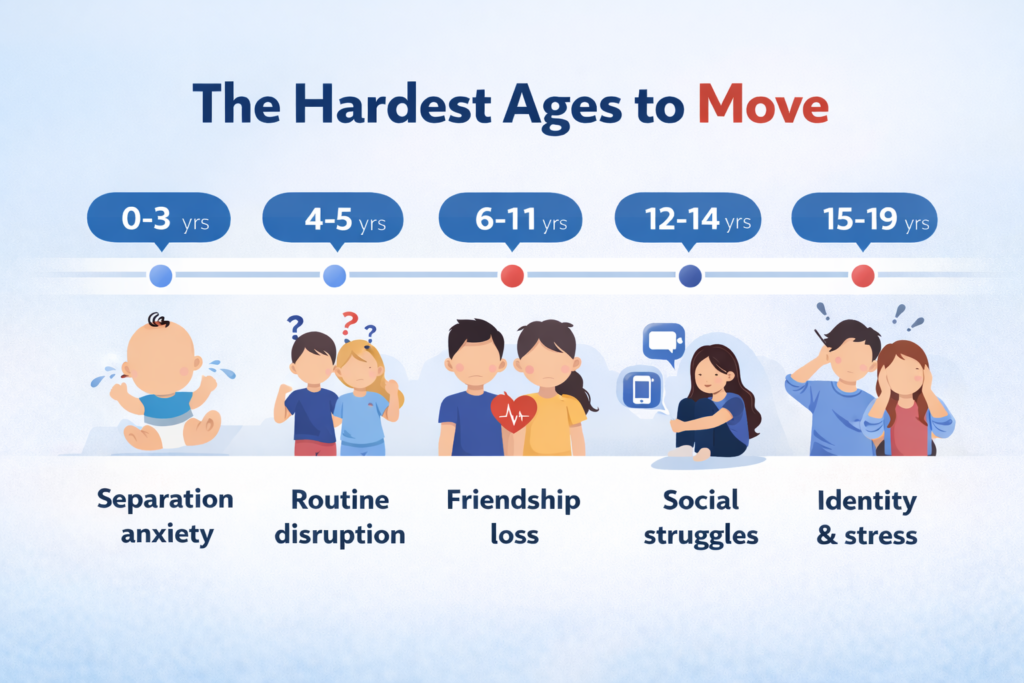
Short answer: early adolescence (ages 12 to 14) is the hardest age to move. But that short answer hides a lot of messy detail. Every age group faces its own version of moving stress. And every kid reacts in their own way.
This post breaks it all down by age. We’ll dig into the emotional impact of moving, the academic risks, and the real-world challenges Sydney families face. Plus we’ll cover practical tips so your next move doesn’t wreck your kid’s world.

Why This Question About the Hardest Age to Move Matters for Sydney Families
Sydney is a city in motion. Families move suburbs for better schools. They chase affordable rent. They relocate for work. Some move interstate. Others just move across Parramatta. But here’s what most parents forget. A house move is not just a logistics problem. It’s an emotional event. Especially for kids.
When you’re packing boxes and booking removalists, your child is processing something huge. They’re losing their bedroom. Their street. Their friends. Their routine. That’s a big deal at any age. But at certain ages, it can feel like the ground just dropped out.
Understanding the hardest age to move helps you plan better. It helps you protect your kid’s mental health. And it helps you time your move so the adjustment goes smoother. As the old saying goes, “It takes a village to raise a child.” Well, moving your child out of that village takes extra care.
What Is the Hardest Age to Move for Children?
Research points to early adolescence (12 to 14) as the hardest age to move. Kids at this stage are already dealing with puberty. Their brains are rewiring. Their social world is everything. Now throw a house move on top.
A 2010 study in the Journal of Social Science & Medicine found that children who moved during early adolescence had higher rates of stress, behavioural issues, and academic problems. The disruption hits right when kids are forming their identity.
But let’s be clear. That doesn’t mean moving at other ages is easy. It just means the risk peaks around 12 to 14. The emotional impact of moving shows up differently at every stage. So what makes each age group tick? Let’s walk through it.
Why Some Ages Handle Moving House Better Than Others
Think of a child’s world like a web. At birth, that web is tiny. Just parents and carers. By age 6, the web includes school friends, teachers, and the neighbourhood. By age 13, that web is massive. Best friends. Group chats. Sport teams. Inside jokes. A whole identity built around where they live and who they know.
The bigger the web, the harder the move rips through it.
That’s why a toddler adjusts in weeks. But a teen might take a full year. The web isn’t just about people. It’s about belonging. Routine. Comfort.
Some kids are also wired for change. Extroverted kids who make friends fast tend to bounce back quicker. Introverted or anxious children may struggle more. Personality plays a big role in child adjustment after moving.
Challenges of Moving House by Child Age Group
Infants and Toddlers (0–3)
Good news first. Babies and toddlers are the easiest age group to move with. They don’t have school ties. They don’t have deep friendships outside the home. But that doesn’t mean zero stress. Toddlers thrive on routine. A new house means a new crib location. New sounds at night. New light patterns in the room.
Common reactions:
- Sleep disruption and night waking
- Clinginess and separation anxiety
- Regression (like bedwetting or tantrums)
The fix is simple. Keep their routine rock solid. Same bedtime. Same blanket. Same order of events. Kids this age read safety from their parents’ calm.
If you’re moving with infants, the logistics are actually the bigger headache. You need professional removalists who can work fast while you handle the baby. That’s where a crew like Six Brothers Removalists makes life easier. They handle the heavy stuff so you can hold the little one.
Preschoolers (4–5)
Preschoolers are starting to build a world outside the home. They’ve got daycare friends. A favourite park. Maybe a little routine at the local library.
At this age, kids don’t fully grasp why you’re moving. They might worry the family is breaking apart. Or that they did something wrong. Their imagination fills in the blanks, and not always kindly.
Common reactions:
- Asking the same questions on repeat
- Fear of losing toys or pets
- Increased clinginess at drop-off
What helps: Give them a simple, honest explanation. Let them pack a special box with their favourite things. And visit the new neighbourhood before moving day.
Elementary School Age (6–11)
This is where things start getting tricky. Kids aged 6 to 11 have real friendships. They know their teacher’s name. They play on a sport team. They walk to school with a mate.
Moving at this age means ripping up social roots that took years to grow. School performance after moving can dip. Kids may act out, go quiet, or suddenly struggle with subjects they used to nail.
But here’s the silver lining. Kids in this age range are adaptable. They’re old enough to understand the reason for the move. And they’re young enough to form new friendships relatively fast.
Key tip: Get them enrolled in after-school activities right away. Sports clubs, art classes, scouts. Anything that puts them in a room with other kids their age.
Early Teens (12–14)
This is it. The peak. The hardest age to move.
Why? Because everything collides at once. Puberty. Identity formation. Social pressure. Academic expectations. Hormonal changes. Brain development.
At 12 to 14, kids are asking “Who am I?” And a huge part of that answer comes from their peer group. Moving rips that mirror away.
A teen in this age group isn’t just losing friends. They’re losing their sense of self. That’s why early adolescence is the hardest age to move.
You might see:
- Withdrawal or anger
- Refusing to unpack or decorate their room
- Dropping grades
- Risky behaviour
We’ll dig deeper into this section below.
Teenagers (15–19)
Older teens have more coping tools. They can stay in touch with friends through social media. They understand the reason for a move. Some even welcome the fresh start.
But don’t mistake independence for indifference. A 16-year-old forced to switch schools in Year 11 is going to be furious. And fair enough. They’re staring down exams, uni applications, and the end of their school life.
The risk here is academic. A badly timed move can mess up HSC preparation. It can break study groups. It can kill motivation.
Best approach: If possible, avoid moving in Year 11 or 12. If you must, keep them at the same school even if it means a longer commute. Stability in senior year is worth the drive.
Why Early Adolescence Is the Hardest Age to Move
Double Stress
Early teens are already riding a hormonal rollercoaster. Their brains are literally under construction. The prefrontal cortex (the part that manages emotions) is still developing.
Now add the stress of moving house. New suburb. New school. New faces. It’s like asking someone to solve a puzzle while the table is shaking.
This double stress is what makes 12 to 14 the worst age to relocate. The child’s internal world is unstable. And their external world just got torn up.
Identity and Peers
“Who am I?” is the central question of adolescence. And for most early teens, the answer is: I am who my friends say I am.
Peers aren’t just social contacts. They’re mirrors. When a teen moves and loses their peer group, they lose that mirror. They have to rebuild their identity from scratch.
That’s brutal. It can trigger anxiety, depression, and social withdrawal. Some kids overcompensate by trying too hard to fit in. Others shut down completely.
Long-term Risks
Studies show that kids who move during early adolescence are more likely to:
- Drop out of school
- Experience long-term mental health issues
- Have lower lifetime earnings
That’s not to scare you. It’s to help you plan. If you know 12 to 14 is the danger zone, you can take steps to soften the blow.
Impact of Moving House on Children
Adolescent Stress
Moving house stress doesn’t always look like crying. In teens, it often shows up as anger. Defiance. Sarcasm. Or just total silence. Parents sometimes mistake this for bad attitude. But it’s grief. Your teen is mourning a life they didn’t choose to leave.
The best thing you can do? Acknowledge it. Say, “I know this is hard.” Don’t try to fix it with logic. Just sit in the mess with them for a bit.
Long-term Outcomes
The long-term effects of childhood relocation depend on how the move was handled. Kids who felt heard and involved tend to recover well. Kids who were blindsided or ignored tend to carry the scar.
One study found that adults who moved frequently as children reported lower life satisfaction. But adults who moved once or twice with strong parental support showed no lasting negative effects.
The move itself isn’t the problem. How you handle it is.
Academic Hurdles
Changing schools is one of the most disruptive parts of moving. Different curricula. Different teaching styles. Different social codes.
In Sydney, school catchment areas can be confusing. Moving suburbs might mean your child can’t attend their preferred school. And mid-term moves are the worst for academic adjustment.
If you’re relocating within Sydney, check catchment zones before you sign a lease. This one step can save months of stress.
Factors That Make Moving House Harder for Kids in Sydney
Frequency
One move is manageable. Three moves in five years? That’s a different story.
Kids who move multiple times are at higher risk for behavioural issues and friendship disruption. Each move resets the clock on social adjustment.
If you’ve moved before and you’re about to move again, be extra mindful. Your child might seem fine on the surface. But the cumulative toll adds up.
Timing
When you move matters almost as much as where. Moving mid-term is harder than moving during school holidays. Moving in Year 12 is harder than moving in Year 3.
Sydney families have a unique advantage here. NSW school terms are spaced with decent breaks. Use them. A move during Term 2 break gives your child a buffer to adjust.
Personality
Not every kid reacts the same way. Some children are naturally adaptable. Others need more time and support.
Kids with anxiety or neurodivergent traits (like ADHD or autism) may find moving especially hard. Sensory issues can flare up in a new environment. Familiar textures, sounds, and smells are gone.
If your child has special needs, loop in their support team early. Teachers, therapists, and school counsellors should all know about the move.
What Makes Moving House Harder for Any Age
Let’s zoom out for a second. Beyond age, several universal factors make moving harder.
Lack of communication. Kids who are told about the move at the last minute feel blindsided. Even toddlers deserve a heads-up.
No sense of control. When everything is decided for them, kids feel powerless. Let them pick their room colour or arrange their furniture.
Parent stress spilling over. Kids are emotional sponges. If you’re panicking about the budget, they feel it. Managing your own stress is part of managing theirs.
No closure. Leaving without saying goodbye to friends, teachers, or favourite spots leaves emotional loose ends.
Could you move house without planning for your child’s feelings? Sure. But would you board a plane without checking the weather at your destination?
Best Time to Move in Sydney With School-Age Kids
Term Breaks vs Mid-Term Moves
NSW school holidays are your friend. Moving during a term break gives kids time to process the change before facing a new classroom.
The ideal window? End of Term 4 (December). Your child finishes the year at their old school. They start fresh in February at the new one. Clean break. If December doesn’t work, the Term 2 break (July) is the next best option. It splits the year and gives a natural reset point.
Mid-term moves are the hardest. Walking into a classroom where everyone already knows each other is nerve-wracking for adults. Imagine it at age 11.
Catchments and School Transfers
Sydney school catchment areas are strict. Moving from Parramatta to the Northern Beaches might mean your child loses their spot at their current school.
Before you move, check the NSW Department of Education’s school finder tool. Confirm your new address falls within the catchment of your target school.
For private schools, the process is different. But don’t assume a transfer is automatic. Start the paperwork early.
Local Moves vs Interstate Moves
A move across Sydney is disruptive. An interstate move is a whole different beast.
Interstate moves mean new state curricula. New school systems. Possibly new slang and social norms. Kids moving from Sydney to Melbourne or Sydney to Brisbane face a bigger adjustment curve.
If you’re planning an interstate move with children, consider an interstate backloading service to cut costs. And give your child extra time to adjust. The cultural shift is real, even within Australia.

How to Make Moving House Easier for Your Kids
Start early. Tell your kids about the move as soon as the decision is final. Not the night before. Not the week before. As early as possible.
Validate their feelings. “I know you’re upset. That makes sense.” That sentence alone does more than 100 logical explanations.
Visit the new area together. Drive through the new neighbourhood. Find the nearest park. Spot the ice cream shop. Let them build a mental map.
Keep routines sacred. Bedtime. Mealtimes. Weekly family movie night. Whatever your anchors are, keep them.
Unpack their room first. Before you deal with the kitchen or living room, set up your child’s space. A familiar room is a safe harbour in a sea of change.
Let them say goodbye. Throw a small farewell party. Do a photo walk of the old house. Make a memory box. Closure matters.
Connect them fast. Enrol in local sports clubs, art classes, or community groups within the first week. The sooner they meet other kids, the sooner they settle.
How to Make Moving House Easier by Age
Babies (0–1): Stick to their sleep schedule. Bring their favourite blanket and toys. Keep the nursery setup as close to the old one as possible.
Toddlers (1–3): Read picture books about moving. Let them “help” pack a box. Keep their comfort objects within arm’s reach.
Preschoolers (4–5): Explain the move with simple words. Visit the new house before moving day. Let them pick a new decoration for their room.
Primary school (6–11): Involve them in decisions. Let them research the new suburb. Set up a video call with old friends after the move.
Early teens (12–14): Listen more than you talk. Respect their anger. Help them find one social anchor fast (sport team, music group, anything).
Older teens (15–19): Discuss the move as a family decision. Be flexible on school arrangements. Give them space but check in often.
Common Parent Mistakes When Moving House With Kids in Sydney
Waiting Too Long to Tell Kids
This is the number one mistake. Parents think they’re protecting their kids by waiting. But kids sense change before you announce it. Hushed phone calls. Visits to random houses. Packing boxes appearing in the garage. Kids aren’t dumb. They fill silence with fear.
Tell them early. Tell them honestly. Tell them together.
Underestimating School Stress
Parents focus on the logistics. The lease. The bond. The removalists. But for your child, the biggest stress is often the school change.
New teachers. New playground rules. New lunch spots. New everything. Don’t brush this off with “You’ll make friends in no time.”
Instead, meet the new teacher before the first day. Ask about buddy programs. Prepare your child for the social learning curve.
Making the Move All About Logistics
Boxes. Trucks. Timelines. Budgets. These matter. But if that’s all you talk about, your kid hears: “This move is about stuff, not about me.”
Balance the logistics with emotional check-ins. Ask your child how they’re feeling. Not once. Repeatedly. Throughout the whole process.
And when moving day comes, don’t try to do everything yourself. Hire professional removalists who handle the physical side so you can be present for your child. Six Brothers Removalists (phone: 1300 764 372) have been helping Sydney families relocate for years. They understand that a family move is more than furniture on a truck.
You can email them at info@sixbrothersremovalist.com.au or visit their office at Suite 1 Level 5, 58/60 Macquarie St, Parramatta NSW 2150. They offer everything from house removals to packing services to interstate backloading.
Because the hardest part of moving isn’t the heavy lifting. It’s making sure your family lands softly on the other side.
Final Thoughts
So what is the hardest age to move? Early adolescence. Ages 12 to 14. But every age has its challenges. And every child deserves a thoughtful, well-planned move. Whether you’re moving across Parramatta or from Sydney to Brisbane, the difference between a traumatic move and a manageable one comes down to preparation.
Plan early. Talk openly. Hire help. And put your child’s emotional world on the same checklist as the packing tape and the truck. Your kids didn’t choose this move. But you can choose how it feels for them.