


Table of Contents
Did the final invoice suddenly grow after the truck left? Start with the written quote, not the total. An invoice audit checks every charged hour, fee, material, credit, and variation. That simple check can stop a small mismatch becoming a large argument.
A Sydney removalist cost should follow the pricing method you accepted. Hourly jobs need accurate time records and billing increments. Fixed quotes need a clear scope and written variations. Either way, the paper trail should tell one consistent story.
This guide shows what to compare before you approve the final bill. It also explains your NSW itemisation rights and practical dispute steps. Six Brothers Removalists can provide a clear quote before the job starts. Call 1300 764 372 for help planning your move.

Invoice Comparison Summary
Hourly Labor
Hourly labour should match the removalist hourly rate in your accepted quote. Check crew size, hourly unit, and billed duration. Apples with apples matters because a low rate can hide different billing rules.
Recalculate the labour line yourself. Multiply the agreed rate by the billable time. Then check whether that rate covered two removalists, three removalists, or another crew setup. A crew change should have a clear reason.
Travel / Call-out
Travel and call-out charges should follow the booking terms you accepted. Check when travel starts, when it stops, and whether return travel applies. A call-out fee should not appear from thin air after the move.
Some removalist companies price depot travel separately. Others build travel into the rate or fixed quote. The audit question stays simple. Does the final line match the written method you received before booking?
Packing Materials
Packing materials should show what was actually supplied during the move. Check boxes, tape, wrap, covers, and specialty protection. Small items can snowball when quantities or unit prices are unclear.
Ask for quantities when the invoice uses one lump sum. Compare those materials with the quote and job notes. A furniture removalist may use extra protection for fragile or polished items. That should still be traceable.
Surcharges / GST
Surcharges and GST should match the disclosed charging method. Look for weekend fees, fuel levies, card costs, tolls, or access charges. Read the fine print before accepting any unexplained percentage.
Check whether the quote showed GST as included or added later. The invoice should follow the same treatment. If a surcharge appears only after completion, ask for its contractual basis and calculation.

Fixed Quote vs Estimate Audit
Fixed-Price Scope
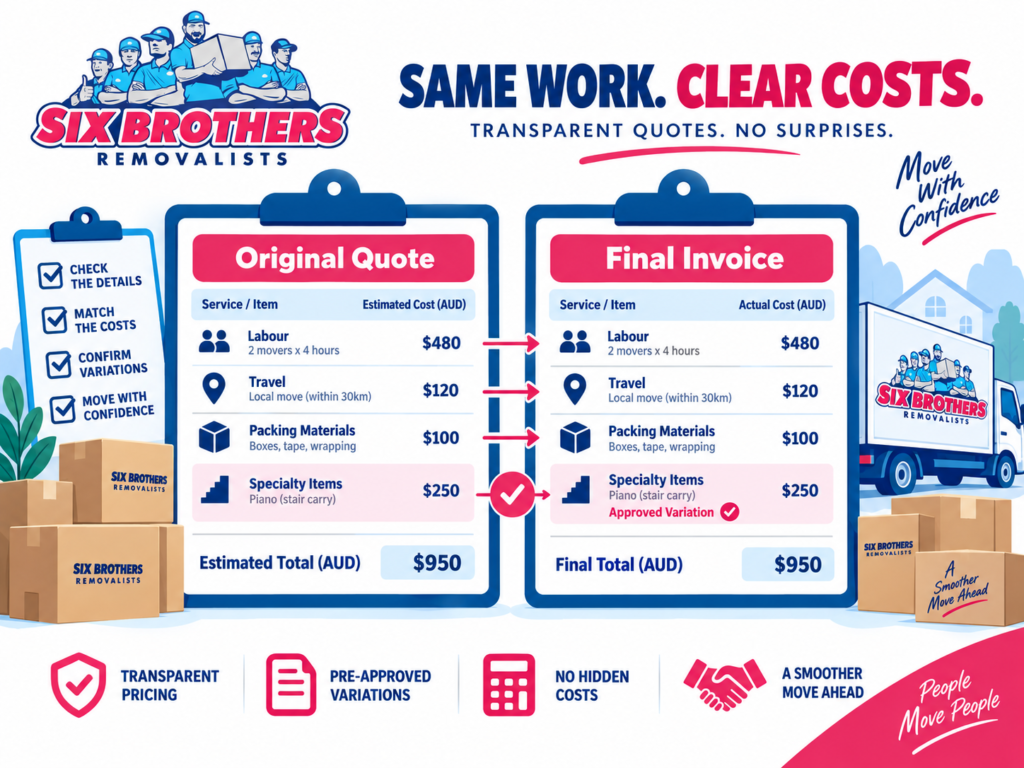
A fixed-price quote protects the agreed scope, not an unlimited moving task. Check the inventory, addresses, access, crew, truck, and included services. The devil is in the detail when one missing item changes the job.
A good fixed quote works like a marked map. The route is clear because the scope is clear. If the invoice exceeds that figure, identify the exact scope change before accepting the difference.
Estimate Variance
An estimate can move when actual hours or work differ from reasonable assumptions. That does not make every variance fair. Compare the estimate assumptions with what actually happened on removal day.
How do you know whether the variance makes sense? Trace each extra dollar to time, distance, materials, access, or a requested service. Vague wording like extra work is not enough for a useful audit.
Approved Variations
Approved variations should have a clear request, reason, price effect, and approval trail. Email, text, or signed paperwork can help. Put it in black and white before the invoice grows.
This is especially important after quote revisions. A documented quote revision can protect both sides when inventory changes. The customer sees the reason, and the removalist has a record of approval.
Changed Move Scope
Changed scope can justify a changed price when the customer requests extra work. Added stops, furniture, packing, storage, or dismantling can increase labour. A larger truck or extra crew may also change the calculation.
Different services use different pricing models. Interstate removalists and an interstate removalist may price distance differently. International removalists can use another structure. Interstate furniture removalists may include storage, depot handling, or delivery windows.
The same applies to house removalists, office removalists, furniture removalists, and piano removalists. Removalists Melbourne and removalists Brisbane may also use different local charging models. A removalist truck hire line needs agreed scope. So does any removalist furniture handling fee missing from the original quote.
Time & Labor Verification
Start and End Times
Start and end times should match the real working window and agreed billing rules. Check arrival messages, building bookings, photos, and payment records. Watch the clock, because fifteen minutes can become costly across a crew.
Confirm whether the bill starts at your property or from a depot. Then confirm the finish rule. Some jobs finish after unloading, while others include return travel under disclosed terms.
Call-Out / Travel Fee
A call-out or travel fee should not duplicate time already billed elsewhere. Check whether travel is a flat fee, timed charge, or included amount. The same minutes should not be sold twice.
People comparing removalists near me or removalist near me often see different travel models. Search results are only a shortlist. Your signed quote controls the audit, not another provider’s advertisement.
Breaks deducted
Break treatment should follow the agreed billing method and actual work record. Ask how meal breaks, long pauses, or non-working delays were handled. Fair go means paying for the agreed service, not unexplained idle time.
Do not assume every pause must be deducted. Some delay can come from customer access or building restrictions. The useful question is whether the invoice follows the stated billing terms.
Minimum charge
A minimum charge creates a billing floor even when the physical move ends early. Check the minimum hours before challenging the total. There is no free lunch when a booking reserved a full minimum window.
If the job exceeded the minimum, check how extra time was rounded. Removalist cost questions often miss this detail. A half-hour billing increment can change the total more than expected.
Materials & Extra Charges
Packing supplies
Packing supplies should match delivered quantities and agreed prices. Review cartons, tape, bubble wrap, mattress covers, and protective materials. Small leaks sink ships when many unverified items stack together.
If unused materials were returned, check whether credits apply under your agreement. If materials stayed with you, confirm the quantity. A clean materials list makes the final invoice easier to trust.
Specialty items
Specialty items can need extra labour, equipment, protection, or crew planning. Pianos, safes, stone tables, gym equipment, and fragile artwork are common examples. Horses for courses applies to difficult items.
Furniture removalists Sydney and a furniture removalist Sydney may price bulky handling differently. Piano removalists can also require dedicated equipment. The invoice should connect any extra fee to a disclosed item or service.
Difficult access fees
Difficult access fees should reflect known stairs, long carries, lifts, gates, or parking limits. Compare the invoice with access photos and booking notes. Access should not become a surprise after unloading.
Removalists Sydney CBD, removalists Sydney inner west, and removalists north Sydney can face different access patterns. That does not create an automatic fee. The quote should explain how access affects charging.
Taxes, Fees, and Discretionary Charges
GST inclusion
GST treatment should match the quote and invoice presentation. Check whether the accepted price was GST-inclusive or GST-exclusive. Keep your eye on the ball, because inconsistent presentation can make totals look misleading.
Do not add ten percent automatically during your audit without checking the original terms. Compare the same basis on both documents. The invoice should make the final amount understandable.
Credit card surcharges
Card charges need special attention because Australian rules are changing in 2026. Current card surcharge rules apply through 30 September 2026. Major card networks introduce no-surcharge rules from 1 October 2026.
For an invoice dated before that change, check the payment type and disclosed surcharge. A surcharge should never be treated as a mystery service fee. Keep the receipt and payment method together with the invoice.
Fuel levy
A fuel levy should match the rule quoted for your booking. Do not accept a new percentage without checking the paperwork. The proof is in the pudding when the calculation matches disclosure.
Six Brothers publishes its current removalist rates and charging information online. Check the version that applied when you booked. Then compare the fuel line against your route and agreed terms.
Calculation Errors That Inflate the Final Bill
Time Rounding
Time rounding can inflate a bill when each block is rounded incorrectly. Check the agreed increment first. Measure twice, pay once by recalculating the start time, finish time, and rounding rule.
One final rounding step is different from rounding several small periods separately. Ask for the method if the invoice is unclear. A transparent calculation should be repeatable with a calculator.
Crew-Hour Multipliers
Crew-hour multipliers can confuse customers when a rate already includes the full team. Check whether the quote states a team rate or per-person rate. Never multiply again unless the agreement requires it.
This mistake can turn a normal labour line into a much larger total. Full service removalists Sydney may package labour differently. Your audit must follow the specific rate structure you accepted.
Duplicate Charges
Duplicate charges happen when one cost appears under two different labels. Compare travel, fuel, call-out, materials, and labour lines carefully. Two names do not justify charging the same cost twice.
A common audit method is to highlight every line by category. Then compare each category with the quote. That simple pass catches overlaps before you argue about the grand total.
Rate Calculation Errors
Rate errors happen when the invoice uses the wrong hourly figure or service package. Compare the quoted removalist hourly rate with the billed rate. Confirm any approved rate change and its start time.
If the maths is wrong, show the calculation clearly. Keep emotion out of the first message. A neat comparison often resolves a simple error faster than a broad complaint.
If your invoice does not reconcile, ask for a corrected calculation before paying the disputed line. Six Brothers Removalists can also explain the quote structure before booking. Call 1300 764 372 for a free quote.
Deposits, Credits and Discounts Check
Deposit Credit
A paid deposit should reduce the final amount when it counts as part-payment. Check the booking receipt and invoice balance. Every dollar counts when the same money risks being charged twice.
Do not confuse a refundable deposit with a separate bond or fee. Read the booking terms. The invoice should explain how the amount was applied.
Booking Fee Credit
A booking fee may be separate or credited against the final bill. The contract should say which. Follow the money from the booking receipt to the invoice total.
If the fee was promised as a credit, check that subtraction appears. If it was non-creditable, confirm that condition was disclosed. Clear terms beat assumptions every time.
Quoted Discounts
Quoted discounts should survive into the final calculation unless the stated conditions failed. Check promotional, loyalty, package, or written manager discounts. A promise should not vanish at the finish line.
Cheap removalists Sydney and affordable removalists Sydney searches often focus on headline savings. A cheap removalist Sydney offer only helps when the final bill keeps that saving. Audit the final payable amount.
Overpayment Credit
An overpayment credit matters when payments exceed the final amount. Check bank records against the invoice ledger. Do not leave money on the table after reconciliation.
Ask for a corrected balance or refund record when needed. Keep that document with the invoice. It closes the paper trail cleanly.
Sydney-Specific Moving Cost Overview
Base Hourly Rate
Your base hourly rate should match the accepted crew and truck rate. Market averages are secondary. Horses for courses matters because Sydney moves differ by access, volume, equipment, and team size.
Searches like removalist Sydney, Sydney removalists, and removalists in Sydney show broad price ranges. A removalist in Sydney may use different inclusions. Best removalists Sydney can also package services differently. Recommended removalists Sydney listings can mix different inclusions. Audit your contract, not a generic average. Use the moving home calculator before booking when you need a clearer volume estimate.
The same applies to house removalists Sydney and home removalists Sydney offers. Compare each house removalist Sydney offer on the same billing basis. Removalists Sydney price and removalists Sydney prices can look similar online. Your removalists Sydney cost audit must still follow the booking. Check removalist services Sydney terms against the invoice.
Toll Costs
Toll costs should match the agreed travel policy and route. Check whether tolls were included, passed through, or excluded. Forewarned is forearmed when a route crosses several tolled roads.
Ask for route support when a toll line looks unusual. A single total without context can be hard to audit. The invoice should make the charge understandable.
Strata & Access Fees
Strata and building costs can include lift bookings, loading docks, or access deposits. Separate building charges from removalist charges. One hand should know what the other hand is doing.
Office removalists Sydney, office removalist Sydney, and commercial removalists Sydney often coordinate managed buildings. A commercial removalist Sydney may face different booking windows. Your house invoice should reflect only your actual access costs.
Sydney Parking and Permit Charges

Council Parking Permits
Council parking requirements vary by location and street conditions. Check what permit was actually needed and who arranged it. Better safe than sorry means planning legal access before the truck arrives.
Removalists Parramatta and removalists western Sydney can face different council and kerb rules. A permit charge should connect to a real booking or council requirement. Ask for evidence if the line is unclear.
Loading Zone Costs
Loading zones have signed conditions, time limits, and vehicle rules. A removalist cannot treat any loading space as unlimited parking. Check whether a specific booking or access cost was incurred.
A loading problem can add labour time even without a separate fee. Keep that distinction clear. Time cost and permit cost are different audit categories.
Parking Meter Fees
Parking meter charges should match the actual paid amount when passed through. Request a receipt when the figure looks unusual. A stitch in time saves nine when parking evidence is kept with the job file.
Meter costs can be small compared with labour delays. Still, every pass-through charge should be traceable. That keeps the invoice tidy and defensible.
Parking Fines
A parking fine differs from a planned parking or permit cost. Ask why the invoice makes it your responsibility. Do not assume a fine automatically belongs to the customer.
Check the contract and circumstances before accepting that line. If the position is unclear, raise it with management. Written terms matter more than an after-the-fact explanation.
Proof of Transaction and Invoice Details
Removalist Business Name
The invoice should identify the supplier clearly. Check the removalist business name against your quote and booking. A paper trail speaks louder than a vague trading name when a dispute starts.
This check also helps with brand variants. Six Brothers Removalists should be identifiable across the quote, invoice, and payment record. Consistency makes later follow-up easier.
ABN or ACN
NSW proof-of-transaction guidance includes the supplier’s ABN when they have one. An ACN can appear where relevant. Check these identifiers before filing the invoice away.
The number helps identify the legal supplier behind the service. It is especially useful when several removalist companies use similar names. Keep it with your contract and receipt.
Service Date
The service date should match your removal day or clearly stated billing period. Check split moves, storage legs, or delayed delivery dates carefully. Dates keep the audit in order when one job spans several days.
An incorrect date can also confuse payment records and itemisation requests. Ask for correction when needed. Good records save headaches later.
Service Description
The service description should explain what work the invoice covers. House removals, packing, storage, furniture handling, or extra stops should be distinguishable. Say what you mean and mean what you say.
A generic labour line may be enough for a simple job. Complex jobs need more detail. The description should let you connect the invoice with the service performed.
Your Right to an Itemised Bill in NSW
30-Day Request Window
In NSW, consumers can request an itemised bill within 30 days. The period runs from service supply or bill receipt, whichever happens later. Know where you stand before that window closes.
The official itemised bill guidance explains this right for supplied services. Keep your request dated and written. That creates a clear record if follow-up becomes necessary.
7-Day Supply Rule
After a valid request, the supplier must provide the itemised bill within seven days. The bill should be clear and legible. That deadline gives your audit a practical next step.
Do not wait for a dispute to become heated. Request the breakdown early when the total is unclear. Calm documentation usually works better than a rushed accusation.
Free Itemisation
The itemised bill must be supplied without charge. You should not pay a fee simply to understand the calculation. That is a useful protection when an invoice lacks detail.
Ask for itemisation in plain language. Keep the original invoice unchanged. Compare the new breakdown against the quote and your own time records.
Price Calculation Breakdown
The itemised breakdown can show how the price was calculated. It can include labour hours, hourly rates, materials, and material charges. The numbers should now tell a complete story.
This is where a removalist hourly rate audit becomes much easier. You can test time, rate, materials, and extras separately. One clear breakdown often turns a messy dispute into simple arithmetic.
Did you know?
In NSW, a consumer can request a free itemised bill within 30 days. The supplier must provide it within seven days of the request.
Charges for Incomplete or Unperformed Work
Missing Services
Missing services should not disappear inside a full-service charge without explanation. Compare promised packing, dismantling, wrapping, delivery, or setup against actual work. You paid for the whole job, not a half-finished checklist.
NSW consumer guarantees apply to removalist services. Services must be provided with due care and skill. Remedies depend on the problem and circumstances.
Unfinished Reassembly
Unfinished reassembly matters when assembly was included in the agreed scope. List the specific beds, tables, desks, or units left incomplete. Then compare that list with the quote.
Do not treat every loose screw as a major failure. Give the business a reasonable chance to fix a minor problem. Keep messages and photos showing what remained.
Undelivered Items
Undelivered items need immediate documentation. List each missing item and check the inventory or delivery records. Keep your powder dry by gathering facts before making broad claims.
Contact the removalist promptly and ask them to trace the item. If storage or split delivery was planned, confirm the schedule. Keep all responses in writing.
Service Shortfalls
Service shortfalls can involve damage, missing work, delay, or an unmet agreed purpose. Match each issue to the written service promise. The remedy depends on how serious the problem is.
Avoid mixing invoice maths with damage claims in one unclear complaint. Separate each issue and requested outcome. A structured complaint is easier for management to resolve.
Unapproved Invoice Variations
Verbal Add-Ons
Verbal add-ons are harder to audit than written variations. Ask who requested the extra work, when, and at what price. Get everyone on the same page before paying an unexplained addition.
A genuine requested service can still be chargeable. The issue is evidence and calculation. Ask for the variation record when the final bill relies on a conversation.
Extra Crew Charges
Extra crew charges should connect to an approved crew change or stated condition. Check when extra people joined and how long they worked. A team change should not become an all-day multiplier without support.
Good removalists Sydney may add crew when safety or workload requires it. Budget removalists Sydney may structure teams differently. Your invoice still needs to reflect the agreed pricing method.
Additional Truck Fees
Additional truck fees need a clear operational reason and pricing basis. Check whether volume, access, or customer-added items required another vehicle. One truck becoming two should not be a surprise after completion.
If the original inventory was accurate, ask why capacity changed. If the scope grew, compare the added items with the revised plan. That keeps responsibility tied to facts.
Unauthorised Services
Unauthorised services deserve immediate review because you did not knowingly request them. Ask what was supplied, why, and who approved it. Do not let vague labels muddy the water.
This can include packing, disposal, storage, special handling, or extra stops. The removalist should connect the service to the job record. If they cannot, escalate the line item.
How to Handle Invoice Disputes
Pause Payment
Pause the payment process only as far as your contract and circumstances allow. Do not assume a blanket right to withhold everything. Keep calm and carry on with a documented invoice check.
Identify the disputed amount first. Consider separating any undisputed amount from the questioned lines. Seek independent advice when payment rights or contract terms are unclear.
Reference the Written Quote
Reference the written quote line by line when you raise the dispute. Attach the invoice, variation records, payment receipts, and relevant messages. Facts beat frustration when both sides can see the same documents.
If your move had changed access or inventory, include those updates too. The outer Sydney moving costs guide shows how scope gaps can create overruns. Your complaint should acknowledge genuine changes while challenging unsupported ones.
Escalate to Management
Escalate unresolved invoice issues to management with a short written summary. State the disputed lines, evidence, and outcome you want. Keep it fair dinkum, specific, and easy to answer.
NSW Fair Trading recommends giving the business a chance to resolve the problem first. If that fails, you can consider a Fair Trading complaint. Keep copies of your correspondence and transaction records.
Six Brothers Removalists can also explain quote terms before removal day. Get your free quote or call 1300 764 372. Clear scope upfront makes the final invoice easier to check later.
FAQs
How Much Do Removalists Charge Per Hour?
There is no single Sydney rate. Compare the quoted team rate, billing increment, minimum charge, travel method, and final hours.
What Is a Removalist Call-Out Fee?
A call-out fee usually covers travel or mobilisation under the provider’s pricing model. It should be disclosed before booking and not duplicated.
What should I compare on a final removalist invoice?
Compare labour, travel, materials, GST, surcharges, credits, deposits, and approved variations with the written quote.
Can a removalist add charges after the move?
Extra charges can arise from changed scope or agreed conditions. Ask for the contractual basis and approval trail for each variation.
What if the invoice does not match a fixed quote?
Identify the exact difference and any changed scope. Ask the removalist to explain the variation and calculation in writing.
How do I request an itemised bill in NSW?
Make a dated written request within the applicable 30-day window. Ask for labour hours, rates, materials, and price calculations.
Should I pay a parking fine shown on my removalist invoice?
Do not assume a parking fine is automatically your cost. Check the contract, circumstances, and why the business allocated it to you.
What should I do before escalating an invoice dispute?
Check the contract, contact the business, attach your records, and propose a clear resolution. Escalate if the issue remains unresolved.