


Table of Contents

A practical plan for Sydney movers stuck in the gap between homes
Your moving date is locked. Your new home? Not so much. Maybe settlement slipped a week. Maybe the builder rang with bad news. Maybe you’re heading from Parramatta to Adelaide and the keys just aren’t ready. Either way, you’ve got a gap.
Here’s the part most people get wrong. They treat a delay like a disaster. It isn’t. It’s a timing problem, and timing problems have clean fixes. Storage. Split delivery. A few buffer days. Sorted early, the gap shrinks to nothing. This guide walks you through the whole plan in plain words. What to do first. Where your stuff goes. What to tell your removalist. And how to keep your life running while the new place catches up.
Interstate moving is bigger than people think. The Australian Bureau of Statistics has tracked interstate migration by state since 1981. Thousands of families do this every quarter. Delays come with the territory.
And homes are taking longer to finish than they used to. ABS data shows average new house completion times rose by half over a recent five-year stretch. A new build that runs late isn’t bad luck anymore. It’s normal. Plan for it.
So read this before you book a truck. Ten minutes now saves you hundreds later and a whole lot of moving-week panic.
QUICK ANSWER
If your move-out date is fixed but your move-in date is uncertain, the answer is storage-in-transit plus a split delivery for your essentials. Confirm every date in writing, store the rest, and redeliver the day you get keys.
Top 3 Ways to Handle the Timing Gap
When your old place needs you gone but the new one isn’t ready, you’ve got three solid plays. Each suits a different kind of gap. Pick by how long the wait runs and how much you need to touch your stuff.

Mobile Storage Containers (DIY)
A secure container gets dropped at your old home. You load it at your own pace. They cart it off and hold it. This suits hands-on movers. You control how things sit inside. Load once, and the same sealed container shows up when your new place opens. Less double handling, fewer hands on your boxes.
The catch? You do the lifting. And driveway space matters. No room for a container at a tight Sydney terrace, and this plan stalls fast.
Removalists With Storage (Full-Service)
Here the removalist runs the whole show. They pick up, store, and redeliver when you say go. It’s the calmest option for most people. Your goods stay inside one moving workflow. No juggling three companies. The crew that loads is tied to the crew that delivers, and that continuity protects your stuff.
This is called storage-in-transit. Your goods get collected, held safely, then delivered once you have access. For an interstate move with shaky dates, it’s often the smartest setup. Many full-service interstate removalists build it right into the quote.
Staged Moving (Split Delivery)
Why store everything when you’re only waiting on the house, not the basics? Split delivery sends some items straight to where you stay. Clothes, a work laptop, the kids’ gear. The rest goes into storage until the new place is ready.
It costs a touch more to separate the loads. But for families and business owners, that small cost buys real sanity. No digging through a storage unit for clean socks.
Plan Around Settlement, Lease End, and Key Handover
Most timing gaps come from dates that refuse to line up. Old lease ends. Settlement runs late. Keys arrive whenever. The fix is to pin every date down in writing before you book a truck. Vague dates are the enemy. “Should be ready soon” is not a date. Chase the real one.
Confirm the Vacate Date
Start with the day you must be out of the old place. This one’s usually firm. A lease end, or settlement on the sale. This date anchors your whole plan. Everything else bends around it. Get it confirmed by your agent, landlord, or conveyancer in writing.
Get Handover in Writing
Now the new home. When can you legally walk in? That’s your access date. Not the hoped-for date. The confirmed one. Push for it in an email or text. A verbal “next Friday” helps no one when next Friday slips. Written dates protect you when things go sideways.
Build in Buffer Days
Never plan for the dates to be perfect. They rarely are. Add a few buffer days between move-out and move-in. Those spare days are your shock absorber. A settlement that slips 48 hours won’t blow up your week if you’ve planned a cushion.
Check Late Settlement Risk
Buying and selling at once? The risk doubles. If your sale settles late, your purchase can follow. Ask your conveyancer how likely a delay is. If it’s a real chance, your storage plan needs to flex. Our guide on how to buy and move at the same time covers the timing traps in full.
WATCH OUT
Never lock a final delivery date on a verbal promise. Settlement and key handover slip all the time. Get the confirmed access date in writing before you set your redelivery window with the removalist.
Sort Out Where You’ll Stay
Your stuff has a plan. Now where do you sleep? The gap between homes means you need somewhere to live, even if it’s brief. The right choice depends on how long the wait runs.
Short Delays (Days to Weeks)
A few days? Crash with family. Book a cheap hotel. Grab a short Airbnb. Keep it simple and cheap. You don’t need a full setup for a small gap. Just a bed, a shower, and a spot for your essentials bag. Stash the rest in storage and ride it out.
Long Delays (Months)
Waiting on a build or a reno? You could be looking at months. That changes the game.
A serviced apartment or short-term rental gives you a kitchen, laundry, and room to breathe. Worth it when work, school, and pets all need a routine. One heads-up: rental vacancy figures in Australia come mostly from private firms and vary a lot. So don’t assume a short-term rental is easy to grab. Start looking early.
LOCAL TIP
Sydney’s eastern suburbs and inner-city units have the tightest move-out windows, especially over summer when everyone moves at once. Book your removalist, storage, and any short-term rental weeks out, not the night before.
Choose the Best Storage Spot for the Gap
Where your goods wait matters more than people think. The wrong spot means extra trips, extra handling, and extra cost. The right spot keeps it smooth. Ask one question first: do you need to touch your stuff during the gap, or not?
That single answer points you the right way nearly every time. Need regular access? Lean toward a self-storage unit you hold the key to. Happy to leave it sealed until the home is ready? Removalist depot storage or a container is cleaner and usually cheaper.
Store Before Leaving Sydney
You can store at the start, near your old home. The removalist holds your goods in Sydney, then ships them once you’re ready. This works for a short delay when the new home’s location is set. Your stuff stays close to the pickup crew. One catch: it still has to travel later, so the move isn’t fully done.
Store Near the New Home
Or your goods travel first, then wait near the destination. Closer to the final drop. This shortens the last leg. When the home opens up, delivery is quick and cheap. Smart for longer delays where you know the new address but not the exact day.
Use Depot Holding
Many removalists hold goods at their own depot. Your stuff sits in their warehouse, inside their system.
This is clean and controlled. The same company tracks everything from pickup to drop-off. Just know depot storage usually limits how easily you can pop in and grab an item. If you’ll need regular access during the gap, flag it before you book so you don’t get caught out.
Avoid Double Handling
Every time your boxes get loaded and unloaded, the damage risk climbs. That’s double handling, and it’s the silent budget killer.
Pick a setup that minimises the touches. Container and storage-in-transit options shine here. Fewer hands, fewer dings, lower stress.
DID YOU KNOW
The Self Storage Association of Australasia says the region has more than 3,000 storage facilities holding belongings for over 500,000 families. A delayed move-in is one of the most common reasons people reach for short-term storage, so you’re in good company.
Backloading vs Dedicated Truck During a Delay
How your goods travel interstate shapes both your cost and your flexibility. Two main paths. One bends to flexible dates. One gives tight control.
Backloading for Flexible Dates
Backloading means your goods share a truck that’s already heading your way. You pay for the space you use, not the whole truck.
It’s the budget-friendly pick for a flexible mover. When your move-in date is loose, backloading flexes with it. Our interstate backloading service is built for exactly this kind of open-ended timing.
Dedicated Truck for Control
Want a fixed date and your goods alone on the truck? That’s a dedicated removal. You get more control over timing. The truck moves on your schedule, not someone else’s route. It costs more, but for tight deadlines or big loads, that control is worth paying for.
Storage Changes the Quote
Add storage to the mix and your quote shifts. Now you’re paying for the hold, not just the haul. Expect line items for storage duration, handling, and redelivery. A good removalist spells these out upfront. Ask for the full breakdown so nothing surprises you later.
Compare Delivery Windows
Different setups offer different delivery windows. Backloading might give a date range. A dedicated truck pins a day.
Match the window to your certainty. Sure about your access date? A fixed window works. Still waiting on the builder? A flexible range saves you stress. The right window is the one that bends the way your delay does.
Confirm Access at Both Homes
A delayed move has two access points, not one. The old home and the new home. Both need checking. Miss one, and your crew arrives to a locked gate or a booked-out lift.
Sydney Loading Zones and Parking
Loading a truck in inner Sydney? You may need a loading zone or a council permit. Tight streets and clearways don’t forgive. Check parking rules at both addresses. A spot close to the door saves hours. No spot means a long carry, and that can cost you.
Apartment Lift Bookings
Moving into a unit? Book the lift. Many buildings make you reserve it and protect it with padding. Do this days ahead. A free lift means furniture goes up fast. A lift you forgot to book means a frustrating wait or a rescheduled crew.
Strata Move Rules
Strata buildings often set their own move rules. Set hours, a bond, forms to fill. Some ban weekend moves entirely. Ring the building manager before the day. Know the rules so your crew isn’t turned away at the door.
Final Delivery Access
Once the new home is ready, confirm delivery access all over again. Things change while your goods sit in storage.
Keys in hand? Parking sorted? Lift booked? Run the full check before you give the redelivery green light. This is where a smooth delivery is won or lost.
ACCESS CHECK
Before you trigger redelivery, confirm five things: keys collected, truck parking sorted, lift booked, strata rules checked, and one contact person free on the day. A ready site keeps the crew moving and your bill down.
Pack an “Interim” Toolkit
Here’s the mistake that wrecks delayed moves: packing the stuff you need every day into storage you can’t reach. Your interim toolkit stops that cold. This is the bag that lives with you, not in the warehouse. Pack it last. Keep it close.
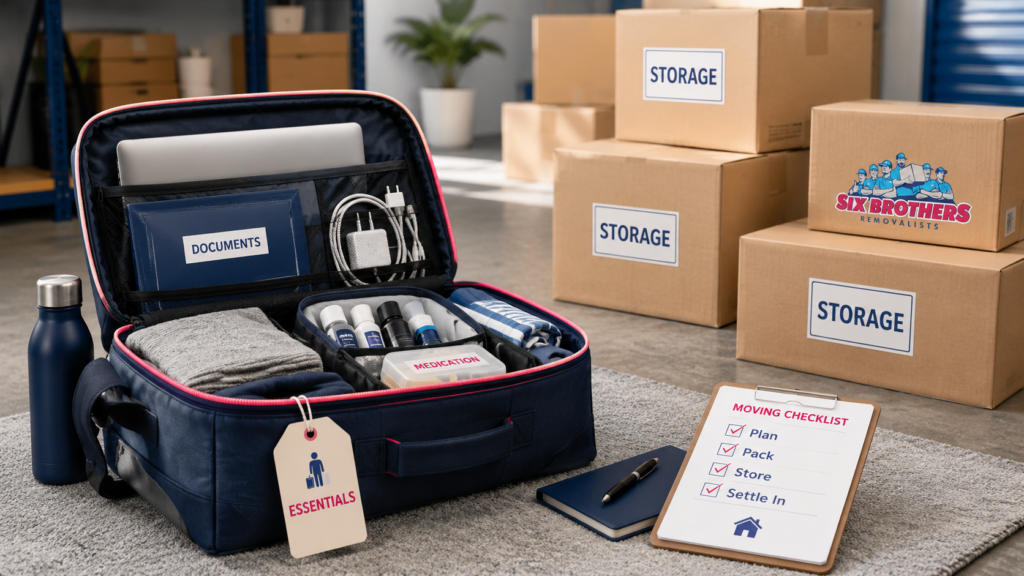
Documents and Valuables
Passports, lease papers, settlement docs, Medicare cards. The stuff you can’t replace in a hurry. Keep these on you, never in storage. A clear folder or a small locked case works. If a date slips and you need to prove something, you’ll have it in hand.
Work Gear
Laptop, chargers, notebook. Whatever keeps your income flowing. Running a business through the gap? Your tools come with you. Stock, a POS device, key records. Box them as direct-delivery, not storage. For keeping a business move tidy, see our office removalist service.
Daily Comforts
Clothes for two weeks. Toiletries. Medications. The kettle. Phone chargers. The kids’ favourite toy. These small things make a strange place feel okay. Pack a comfort kit so the gap feels less like camping. Pets need their basics too: food, bowls, a familiar blanket.
Protect Your Goods Before Storage
Storage is tougher on furniture than a quick move. Stuff sits. Stacks press down. Dust settles. A few smart habits protect it through the wait.
Wrap It Right
Wrap furniture in breathable blankets, not plastic that traps damp. Use proper cartons for fragile items. Photograph valuables before they go in. Good packing is your best insurance. Our furniture protection guide goes deep on wrapping and stacking the right way.
Purge Before You Pack
Why pay to store and ship things you don’t even want? Storage charges by space and time. Junk costs you twice.
Sort before you pack. Sell it, donate it, bin it. The lighter your load, the cheaper your storage and your move. A delay is the perfect nudge to declutter. Be ruthless with the things you have not used in a year. If it would cost more to store than to replace, let it go.
Manage Utilities and Admin During the Gap
Utilities and paperwork get messy between two homes. Connect power too early and you pay for an empty house. Forget the licence rules and you drive on an invalid licence. A little planning saves you bills and stress.
Time Your Connections
Don’t switch on power at the new home until you’ll actually live there. Set your connection date to your real access date, not the original plan. If it slips, ring the provider and push it. Internet takes the longest, sometimes weeks. Work from home? Line up a mobile hotspot for the gap and book the new connection the moment your access date firms up.
Redirect Your Mail
Set up mail redirection through Australia Post. During the gap, point it to where you’re actually staying. Then update it again when you move into the new home. Two steps, but it stops your mail vanishing into the void. Bills and official letters won’t wait for you to settle.
Sort Licence and Rego
New state means new rules for your licence and car. The deadlines differ by state.
In NSW you can drive on an interstate licence for up to three months before you must switch. In Victoria you’ve got six months. Check your destination state’s rule so you don’t get caught out.
STAY ORGANISED
Keep one running document with every key date and fee: vacate date, pickup, storage start, access date, redelivery window, and licence deadline. One source of truth beats a dozen scattered texts and emails.
How Much Does a Delayed Move Cost?
A delay costs money. No way around it. But surprises hurt more than known costs, so budget for the extras now. Storage prices swing on size, duration, and features.
Monthly self-storage usually runs between $200 and $500. Climate control and bigger units push you toward the top of that range. A few days of storage-in-transit through your removalist often costs far less than a full month at a self-storage facility, so match the option to your real timing.
Beyond the headline rate, watch for handling fees, redelivery charges, waiting time if access isn’t ready, and access surcharges for stairs or narrow streets. Ask for an all-in figure, not just the monthly number. Want the full end-to-end picture? Our removalist cost guide breaks down what shapes the bill.
What Drives the Price
• Storage duration. The longer the wait, the bigger the tab. Budget for the worst-case delay.
• Move distance and volume. More kilometres and more cubic metres push the quote up.
• Handling and redelivery. Getting goods in and out of the depot is a separate charge from the haul.
• Access difficulty. Long carries, stairs, and shuttle trucks for tight streets all add cost.
BUDGET CHECK
Storage at $200 to $500 a month adds up fast. If your delay is short, a few buffer days of storage-in-transit is cheap insurance compared with locking in a monthly unit you barely use.
Check Insurance Before Goods Go In
Your goods are covered in transit. But are they covered while they sit in storage? Many people assume yes. Many people are wrong. Check this before pickup, not after a claim goes sideways.
Transit vs Storage Cover
Transit cover protects goods while they move. Storage cover protects them while they wait. They’re not always the same policy.
Ask your removalist what each covers. Removalists aren’t required by law to insure your goods, and most only cover their own truck. A gap between transit and storage cover is where claims fall apart. Make sure both legs are protected.
Keep Proof of Condition
You can’t claim for what you can’t prove you had. List everything going into storage, number the boxes, and keep the list with you.
Photograph fragile and high-value pieces before they go in. Note their condition. If a claim comes, those photos are worth their weight in gold. And declare valuables: standard cover may cap out below their worth.
Know Your Consumer Rights
Your rights matter here too. Under the consumer guarantees that apply to removalist services, the work must be done with due care and skill and within a reasonable time. That covers your goods in storage as well as in transit.
Get every promise in writing. A friendly phone chat means nothing if a box turns up dented. The contract is what counts.
WHY IT MATTERS
With storage-in-transit, your belongings are handled once and held under one roof, with one chain of custody. Fewer touches means fewer dings, scratches, and lost boxes on a long interstate haul, and one number to call if anything goes wrong.
How Storage-in-Transit Actually Works
Storage-in-transit is the unsung hero of a delayed interstate move. It’s storage built right into the journey, and it erases most of the hassle.
Here’s the flow. Your removalist packs and loads in Sydney. The goods travel toward your new state. If your home isn’t ready, they hold everything at a secure depot. When you say go, they deliver. One company, one chain of custody, one invoice.
Picture the alternative. A separate self-storage unit means renting a truck, loading it, driving to the depot, unloading, then doing it all again when your home is ready. That’s a lot of lifting in a city you barely know. Storage-in-transit skips the whole circus, and you don’t lift a finger between pickup and delivery.
Build a Backup Plan for When the Delay Changes
Here’s the hard truth about delays. They love to change. The date you were promised slips again. So your plan needs a plan. Build flexibility in from the start, and a second slip won’t break you.
Extend Storage Early
Sense the delay growing? Extend your storage before it lapses, not after. Last-minute extensions can cost more or hit availability problems. Ask early and you keep your spot and your rate.
Keep Delivery Flexible
Lock in a rigid delivery date and a slip leaves you stuck. Keep the window flexible while the date is uncertain. Talk to your removalist about how much notice they need to redeliver. A short notice period means you can move fast when the home is finally ready.
Nominate One Contact
Pick one person to handle all move communication. One voice, one phone, one inbox. This stops crossed wires. The removalist calls one number. Your family checks one person. On redelivery day, that contact is free and ready. Simple, but it saves chaos.
Ready to Move Interstate Without the Stress?
A home that isn’t ready feels like a wall. It’s not. It’s a gap, and gaps have bridges.
Confirm your dates in writing. Choose storage that fits your delay. Split out your essentials so daily life keeps moving. Check your insurance covers both transit and storage. Budget for the extras. Build a backup for when the date slips again. Do those things and a delayed move stops feeling like a crisis.
At Six Brothers Removalists, we handle the move and the storage under one roof. Your goods stay with one crew from Parramatta to wherever you’re headed. No middlemen, no lost boxes, no stress. Whether you need a few days of storage-in-transit or a flexible long-term hold, we’ll size it right and price it fair.
We’ve moved Sydney families to every corner of the country. Melbourne, Brisbane, Adelaide, Perth, and the small towns in between. Storage gaps, lift bookings, tight streets. We’ve seen it all and sorted it all, so a delayed move-in date doesn’t faze us.
Call us on 1300 764 372 or email info@sixbrothersremovalist.com.au for a free, no-pressure quote. Tell us your dates and your home size, and we’ll tell you straight what your delay needs. No upsell, no spin. Just an honest plan that fits your move.
Frequently Asked Questions
Do interstate removalists offer storage as standard?
Not always, but many do. Storage-in-transit is common for long-haul moves where dates don’t line up. Ask up front so you know it’s on the table before you book, and confirm the redelivery terms in writing at the same time.
How much do interstate removalists cost when storage is involved?
There’s no single price, because it depends on your load and your gap. Cost drivers include move distance, cubic metres, storage duration, handling, redelivery, and access difficulty. A short hold costs far less than a three-month wait. Monthly self-storage often runs $200 to $500, while a few days of storage-in-transit can cost a fraction of that. The honest way to know is a live quote based on your real situation, with the storage and redelivery line items spelled out.
Is my furniture insured while in storage?
Only if you arrange it. Removalists aren’t required to insure your goods by law. Extend your transit cover across the storage period for a separate premium, and you’re protected the whole way through.
What should I never pack into storage?
Anything you need daily or can’t replace. Documents, medications, valuables, a week of clothes, and chargers travel with you. Perishables, plants, and flammable liquids stay out of storage entirely. Storage is for the bulky and the boring, not the precious.