
Moving is one of the biggest life events you’ll go through. And almost nobody budgets for it correctly the first time.
You think about the truck. Maybe the boxes. But the real expensive part of moving? It’s the stuff that sneaks up on you — stamp duty, stair carry charges, bond payments, short-term storage fees. By the time you add it all up, the number is usually bigger than you planned.
This guide breaks it all down. Every cost. Every factor. No filler, no spin — just what you actually need to know before your next move across Sydney or beyond.
The Biggest Property Transaction Costs When Moving in Sydney
Before a single removalist shows up, you’re already spending serious money. Property transaction costs are often the most painful moving expenses in Sydney — because they hit before the physical move even starts.
Most people plan for the truck. Few plan for what comes before it.
Stamp Duty (Buying)
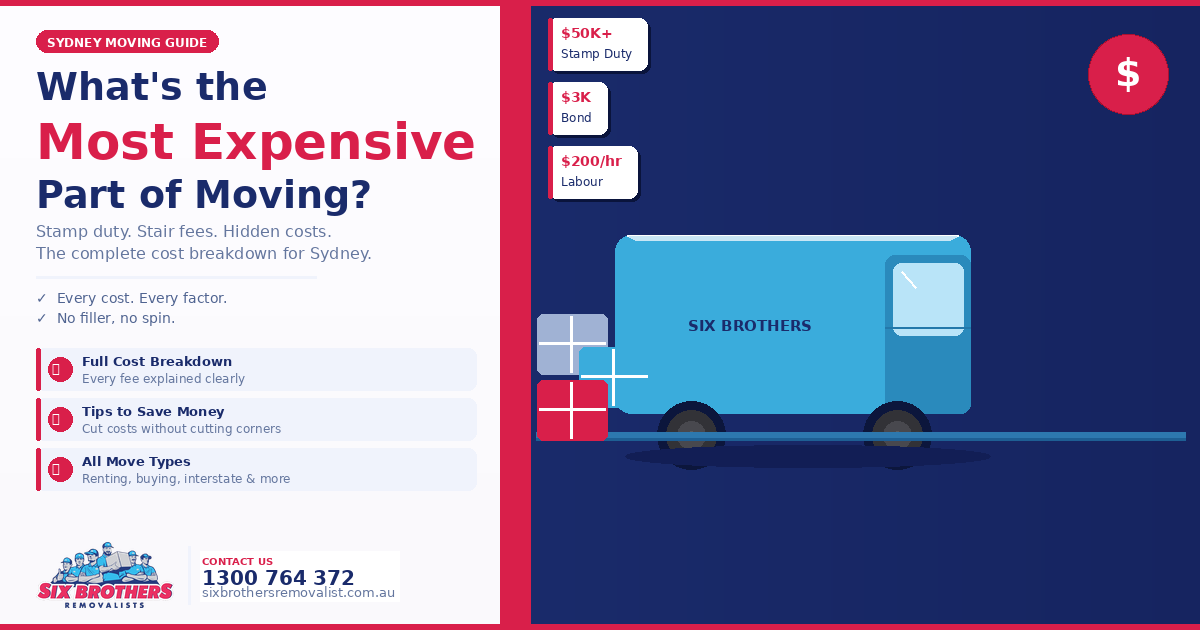
Stamp duty is one of the biggest upfront fees any buyer faces in NSW. Depending on the property value, it can run anywhere from $15,000 to well over $50,000.
You pay it in full before settlement. There’s no installment plan. It lands on your budget like a dropped piano.
First home buyers may qualify for relief under the NSW First Home Buyer Assistance Scheme — so it’s worth checking your eligibility early. If it’s not your first purchase, you’re paying the full rate, no exceptions.
Key factor to remember: Stamp duty is non-negotiable, non-refundable, and often underestimated. Add it to your moving budget before you do anything else.
Real Estate Agent Fees (Selling)
If you’re selling a property in Sydney, agent commission typically sits between 1.5% and 2.5% of the sale price. On a $1.2 million home, that’s $18,000 to $30,000 gone before you see any profit.
Then add marketing — photography, online listings, signboards, floor plans. That’s another $3,000 to $8,000 depending on your suburb and agent strategy.
It’s a big expense. But a good agent earns their fee. The key is choosing one who actually moves properties, not just lists them. Compare records. Ask hard questions.
Rental Bond (Renting)
Renting in Sydney means fronting a bond — typically four weeks of rent — before you get the keys.
If your weekly rent is $750, your bond alone is $3,000. Add your first month’s rent and you’re covering close to $6,250 before your belongings cross the threshold of your new home. That’s a significant cash hit, right at the start.
Budget for this separately. It’s easy to lump it in with “moving costs” and underestimate the real number.
Major Moving Service Costs in Sydney
Now we get to the physical move itself. The truck, the crew, the packing, the logistics. This is where most people feel the pinch.
Interstate/Long-Distance Logistics
Long-distance moves often cost significantly more than local ones — and the gap is bigger than most people expect.
Sydney to Melbourne typically runs $1,500 to $4,500 or more. The weight of your belongings, the volume you’re moving, and your exact delivery window all push the price up or down.
The further you go, the higher the fuel consumption, the more driver hours you’re paying for, and the bigger the truck needs to be. That’s not a complaint — it’s just the math of how relocation across state lines works.
Labor & Specialized Handling
Labor costs are real and they compound quickly. Standard removalist teams in Sydney charge $130 to $200+ per hour for a two-person crew. A bigger team costs more per hour but finishes faster.
Specialty items change the math again. A piano. A billiard table. A large safe. These need extra hands, specialized equipment, and more time. Expect an additional charge of $200 to $600 per specialty item, sometimes more.
If you’ve got valuable items that need careful handling, be upfront about them when you get your quote. No surprises — for you or the crew.
Packing Services
Professional packing is a legitimate time-saver. But it does add to the bill.
Expect to pay $50 to $80 per hour per packer. A full-home pack for a three-bedroom house can run $800 to $2,500. That’s before you factor in packing materials — bubble wrap, tape, boxes, packing paper — which can add another $150 to $400.
If you’re watching your moving budget closely, packing is one area where doing it yourself saves real money. More on that in the tips section below.
Why Transportation Costs Dominate Moving Expenses
Transportation costs are usually the single biggest line item on any moving invoice. And they don’t move in a straight line.
Distance is the obvious driver. But fuel consumption, truck size, tolls, and travel time all stack up quietly behind the scenes. Think of it like a taxi meter — it starts the moment the truck leaves the depot, and it doesn’t stop until the job is done.
A standard local Sydney move for a four-bedroom house typically runs $1,200 to $2,800 for the truck and crew combined. But add a narrow driveway, a second-floor apartment with no lift, or CBD parking restrictions — and those transportation costs jump by $100 to $400 without you seeing it coming.
Professional movers charge based on time and distance. Longer distances mean more hours. More hours mean a higher charge. This isn’t hidden — it’s just how the industry works. What matters is that you understand it before you book.
The honest truth: Transportation is almost always the largest single expense in any move. Budget generously for it and you’ll avoid surprises on the other side.
Labor Costs — The Second Biggest Moving Expense
Labor is where moving budgets quietly blow out. Most people underestimate how much skilled physical work goes into a proper move.
A two-person team at $160/hour takes 6 to 10 hours on a three-bedroom move. That’s $960 to $1,600 in labor alone — before stairs, long hallway walks, or furniture disassembly are even considered.
Each extra task adds time. Disassembling a bed frame — 20 minutes. Carrying a fridge down two flights of stairs — another 30. A stair carry fee applies in many buildings too. It covers the extra physical effort and risk involved.
Labor costs vary based on crew size, job complexity, and how prepared you are on the day. A well-labelled, pre-packed home with clear truck access will always cost less than an unpacked, hard-to-reach one.
Most Expensive Moving Costs by Scenario in Sydney
Every move is different. Here’s an honest breakdown of what to expect in each situation.
Renting a Home
Renting means upfront costs that hit fast and pile up before you even get the keys.
- Bond: 4 weeks’ rent
- First month’s rent paid upfront
- Moving service fees: $600–$2,500 depending on size and distance
- End-of-lease cleaning: $200–$600
- Total range: $4,000–$9,000+
Buying a Home
Buying layers property transaction costs on top of physical moving expenses.
- Stamp duty: $15,000–$50,000+
- Conveyancing/legal fees: $1,500–$3,000
- Building and pest inspection: $500–$1,200
- Moving service: $800–$3,500
- Total range: $20,000–$60,000+ for the full transition
Selling a Home
Selling means spending before you earn.
- Agent commission: $18,000–$30,000
- Marketing: $3,000–$8,000
- Home staging/styling: $1,500–$4,000
- Moving out costs: $800–$3,000
- Total range: $25,000–$50,000 in selling expenses
Interstate Moves
Moving out of NSW pushes every cost category higher.
- Long-distance truck and logistics: $1,500–$6,000+
- Moving insurance: $200–$800
- Storage fees (if timing doesn’t line up): $150–$500/month
- Total range: $3,000–$10,000+ for a full interstate relocation
Storage-heavy Moves
When settlement dates don’t align, you end up in limbo — and limbo costs money.
- Short-term storage fees: $150–$500/month
- Extra packing for storage: adds time and packing materials cost
- Double handling (load, store, reload): increases labor costs
- Total add-on: $500–$2,000+ on top of standard moving expenses
Key Moving Cost Drivers and Factors
Involves understanding what moves the numbers helps you budget effectively and avoid being caught short.
Transportation & Labour
Distance and time drive everything. The farther you go, the more fuel the truck burns. The longer the job takes, the more labor you’re paying for.
Even within Sydney, a move from Parramatta to Bondi costs more than Parramatta to Blacktown. Traffic, tolls, and road access are all real cost factors.
Timing
Weekends cost more. School holidays cost more. Summer moves cost more. Supply of available removalists tightens during peak periods, and demand pushes prices up accordingly.
A mid-week move in winter is almost always the most affordable option. You’ll also get better flexibility on your preferred date and a crew that isn’t stretched across twelve other jobs.
Accessibility Fees
This one catches people off guard. An apartment on a high floor with no service lift? That’s a stair carry charge. A narrow street with no truck parking? That means longer walks, more time, and a higher bill.
Always check building access rules before booking your move. Find out if you need to book a service lift. Ask your removalist what accessibility fees might apply.
Packing Services
Full packing service is convenient but adds significantly to the total cost. A middle-ground approach — self-packing most items while letting the crew handle fragile items and specialty items — can save you hundreds.
If you supply your own packing materials and do the boxing yourself, you reduce both labor hours and material costs.
Sydney-Specific Cost Triggers That Increase Moving Expenses
Sydney has its own personality when it comes to moving. And some of those quirks come with a price tag.
Apartment Access Issues
Sydney is one of the most apartment-dense cities in Australia. That means lifts, stair carries, and building access rules are a normal part of nearly every city move.
Many apartment buildings require advance lift bookings — sometimes days ahead. If you miss that step, the whole moving day gets complicated. You might end up paying crew to wait while access gets sorted.
Some buildings charge their own fee for using the service lift. It’s not the removalist’s charge — it’s the building’s. Check with your building manager before the move. Don’t find out about it on the day.
CBD Parking Limits
Moving in or out of Sydney’s CBD is a logistics puzzle that professional movers solve every week. But it does cost more.
Truck access is restricted on many city streets. Parking permits take time and money. Time windows are tight — which means crews work faster and more intensively, sometimes incurring additional fees if the job runs over.
Local removalists who know Sydney navigate this well. That’s one real advantage of hiring an experienced local company over a generalist operator.
Travel and Call-outs
Most Sydney removalists charge a travel fee to get to your location. This typically runs $50 to $150 depending on where you are.
If you’re in an outer suburb or a hard-to-reach area, expect higher call-out fees. It covers the driver’s time and fuel getting to you. It’s fair — and it’s usually disclosed upfront. Just make sure you ask for it when you get a quote.
Regional Moving Cost Differences Across Sydney
Where you move from — and where you’re going — makes a genuine difference to your final bill.
High-Cost Moving Areas
Some Sydney suburbs consistently attract higher moving charges:
- Inner-city areas (Newtown, Glebe, Surry Hills) — tight streets, limited parking, high demand
- Eastern Suburbs (Bondi, Coogee, Randwick) — premium market, narrow roads, heavy truck restrictions
- CBD and North Sydney — parking permits, time restrictions, permit costs
- Northern Beaches (Manly, Dee Why) — distance from depots adds travel time and cost
Lower-Cost Areas
These suburbs are typically easier and more affordable to move to or from:
- Western Sydney (Parramatta, Blacktown, Penrith) — wider streets, easier access, competitive market
- South-West Sydney (Liverpool, Campbelltown) — lower demand, straightforward logistics
- North-West (Castle Hill, Kellyville, Rouse Hill) — newer estates with great road infrastructure
Moving Costs in Sydney by Season
Timing your move right is one of the smartest things you can do for your budget.
Peak Season (Summer)
October through February is the busiest moving period in Sydney. School years end, leases expire, and it feels like half the city is moving at once.
During peak seasons, moving rates rise 15–30%. Supply of removalists tightens. Availability on popular dates drops. You’ll have less flexibility on timing and pay more for less choice.
Book at least four to six weeks ahead if you’re planning a move during this window. Waiting until the last minute during peak season is how people end up paying a premium for whatever’s left available.
Off-Season (Winter)
June through August is genuinely the best time to move in Sydney if you have flexibility. Demand drops. Removalists compete harder for your business. You can often negotiate a better rate or get included extras.
You’ll get your first-choice date. Crews are less rushed. And your belongings get more careful attention when the team isn’t racing from job to job. As the saying goes — “the early bird gets the truck.” Plan ahead and move in winter if you can.
Common Hidden Moving Expenses
These are the costs that don’t show up in the quote. But they definitely show up on your bank statement.
Temporary Storage
Settlement dates don’t always line up. You might be out of your old place two weeks before you can move into the new one. That gap costs money.
Storage fees run $150 to $500 per month for a standard unit. If you have large furniture or need a climate-controlled space for valuable items, the cost goes higher. Good storage solutions exist — but they’re not free.
Budget for at least one month of storage as a contingency. Even if you don’t use it, having that buffer in your moving budget will protect you.
New Home Setup
Your new home won’t come with everything your old one had. Curtains, blinds, light fittings, garden tools — these are easy to overlook in the excitement of moving.
New home setup costs catch most people off guard. Set aside $500 to $2,000 for the unexpected purchases that come in the first few weeks. You’ll spend it one way or another.
Cleaning & Repairs
End-of-lease cleaning is usually a legal requirement. Professional cleaners charge $200 to $600 for an average home. Bond-back cleaning specialists can run higher but typically guarantee results.
If there’s damage — a scuffed wall, a cracked tile, a broken blind — you’ll cover the repair cost out of your bond. Sometimes more than the bond covers.
Do a thorough condition report when you move into any rental. Photograph everything on day one. It’ll safeguard you when you leave. This one tip has saved people thousands.
What to Expect on Moving Day with a Sydney Removalist
Knowing what happens on the day removes a lot of stress. Here’s an honest picture of how a professional move actually goes.
Your team arrives within a 30-minute window of the agreed time. They do a quick walk-through of the property. They note what’s fragile. They identify specialty items, access points, and anything that needs extra care.
Then loading starts. Large furniture goes first — beds, sofas, wardrobes. Boxes get stacked by weight and organised by destination room. Fragile items and bubble-wrapped pieces get loaded last and secured carefully. Getting your belongings from one location to another safely is the whole job — and a good crew treats it that way.
Loading a three-bedroom home typically takes two to four hours. Add drive time. Then unloading — which usually runs a bit faster. At the other end, you direct the crew. They carry. You point to rooms.
One thing people genuinely forget: Have water and some snacks for the crew. It’s not in any contract. But it’s a good human thing to do — and a team that feels respected tends to take more care with your stuff. Small detail. Real impact.
Six Brothers Removalists includes insurance coverage for your belongings. Always ask about your insurance and protection options upfront. If you have existing home contents insurance, check whether it covers goods in transit — many policies do, but the coverage limits vary. Comprehensive moving insurance is available and worth considering for high-value or fragile items.
Tips to Lower Moving Costs
You can reduce your moving budget without cutting corners on the things that actually matter. Here’s what works.
Declutter
Less stuff means a smaller truck, fewer labor hours, and a lower total charge. Before you pack a single box, go through every room.
Sell what you haven’t used in 12 months. Donate the rest. Dump what’s genuinely broken. Most people are shocked by how much they’ve quietly accumulated. Decluttering before a move is one of the highest-return things you can do — it reduces your moving costs and makes your new home feel cleaner from day one.
Self-Pack
Packing services are convenient. But they’re expensive. Self-packing cuts a significant slice off your bill.
Buy quality boxes — not random grocery store ones that collapse mid-move. Stock up on bubble wrap, tape, and packing paper. Include boxes in the right sizes: small boxes for books and heavy items, large ones for light bedding and pillows.
Label everything clearly. “Kitchen — fragile — top load only” beats a scrawled “K” on the side every time. Good labelling means the crew can unload faster and your breakables survive.
Book Mid-week
Saturday moves are the priciest. Everyone wants them. Supply gets tight.
Book a Tuesday or Wednesday and you’ll save 10 to 20% in most cases. You’ll also hit less Sydney traffic, which means a faster move and fewer hours charged. A mid-week, off-peak booking is one of the easiest ways to reduce moving costs without sacrificing quality.
Compare Quotes
Don’t accept the first quote you receive. Get at least three. But compare them properly — not just the headline number.
Some quotes include packing materials. Some charge separately for stair carries. Some include a fuel levy. Others don’t. A lower quote that excludes five things you actually need isn’t really lower.
Ask what’s included. Ask what’s not. Ask what triggers additional charges. Choose the best value option — not just the cheapest upfront number.
Ready to budget effectively for your Sydney move? Call Six Brothers Removalists on 1300 764 372 or email info@sixbrothersremovalist.com.au for a clear, no-surprises quote. We’re based at Suite 1 Level 5, 58–60 Macquarie St, Parramatta NSW 2150 — and we move people all across Sydney every single day.
Summary: What’s Really the Most Expensive Part of Moving?
Honestly? It depends on your situation.
For buyers, stamp duty wins by a mile. For renters, the bond and upfront rent hit hardest. For everyone doing a physical move, transportation and labor costs together dominate the bill.
The most expensive part of moving isn’t one thing. It’s the combination of costs that people didn’t plan for — the stair fee, the storage gap, the cleaning bill, the new blinds.
The fix is simple: budget for more than you think you’ll spend. Plan for the unexpected. Get multiple quotes. And choose professional movers who are upfront about what they charge and why.
That’s not a perfect happy ending. That’s just good planning.
What is the most expensive part of moving and how can insurance and protection help?
The most expensive part of moving typically cost-wise is long-distance transport and the replacement value of large or specialty items; companies often charge more when weight, distance, and handling risk increase. Insurance options can safeguard your belongings by covering loss or damage during transit, but coverage levels vary and you should independently verify what each policy covers. It’s crucial to compare basic carrier liability (often minimal, charged per pound) with third-party insurance or full-value protection to ensure you’re not surprised by hidden costs if a possession is damaged.
How should I plan my moving budget to reduce unexpected and hidden costs?
To prepare effectively, build a moving budget that accounts for several factors: transport fees, packing supplies, insurance options, storage fees, and potential specialty item handling. Companies often add charges for stair carries, long carries, or fuel surcharges, so include contingency funds for unexpected expenses. Accounting for per pound or hourly rates, and estimating supply and labor costs, will make your budget more efficient and help reduce the chance of being overwhelmed by surprise bills.
Is it cheaper to hire movers or do a DIY move for household items?
Whether you should hire movers or DIY depends on weight, distance, and complexity. A DIY move can reduce direct moving fees but may increase risk of damage, hidden costs, and time spent; you’ll also need to factor in rental truck fees, fuel, and insurance options. Hiring professional movers is often more efficient for large households or specialty items because they provide labor, packing supplies, and transport expertise, but they typically cost more upfront. Evaluate both options, account for your time and physical ability, and choose the approach that keeps your overall moving budget realistic.
What hidden costs should I expect from storage solutions and storage fees?
Storage solutions can add substantial hidden costs such as monthly storage fees, insurance for stored possessions, administrative or access charges, and climate-control premiums for delicate items. Some facilities charge for moving in/out or require minimum rental periods, so include these in your moving budget. To avoid overwhelm, ask storage providers about all fees up front, compare options, and ensure the unit size and access terms align with your plans.
How are specialty items priced and how can I safeguard them during the move?
Specialty items—pianos, antiques, artwork—are priced higher because they need extra packing, specialized handling, and sometimes special transport equipment; movers may quote per pound or flat-rate fees depending on the item. To safeguard these belongings, choose movers experienced with specialty items, request an itemized breakdown of charges, and consider independent valuation insurance. Proper packing supplies and professional crating are crucial to minimize damage and reduce potential accounting disputes over condition after delivery.
What steps can I take to prepare effectively and ensure a smooth move without getting overwhelmed?
Start by creating a checklist that accounts for several factors: inventory of household items, deciding what to sell or donate, obtaining and comparing quotes, and reviewing insurance and protection options. Label boxes, keep an essentials bag with immediate possessions, and confirm arrival logistics with your mover to ensure smooth timing. If you prefer, hire movers for the heavy lifting but still prepare effectively by researching company reputations and reading contracts so you understand responsibilities and hidden costs before moving day.