
Table of Contents
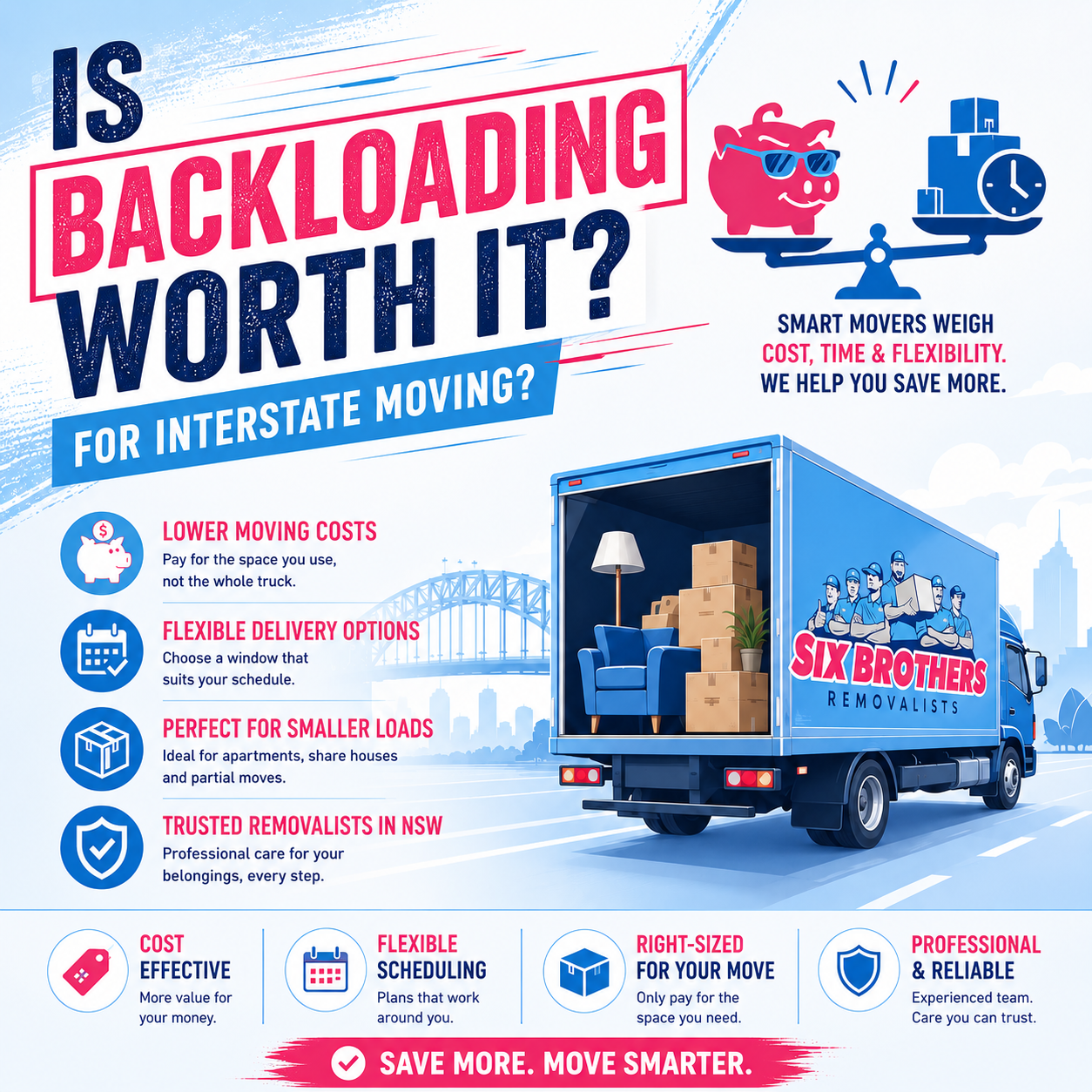
Backloading is worth it for most interstate moves where flexibility on delivery dates is possible and the load is smaller than a full truck. It can cut your moving costs significantly compared to booking a dedicated vehicle, making it one of the most practical options for budget-conscious movers heading between NSW and other states.
But “worth it” depends entirely on your situation. The savings are real, but so are the trade-offs around timing, load size, and how your belongings are handled alongside someone else’s.
This guide covers exactly how backloading works, what it costs, where it makes sense, where it doesn’t, and how to choose a removalist in Parramatta or Greater Western Sydney who will actually deliver on their promises.
How Does Backloading Work for Interstate Removals?
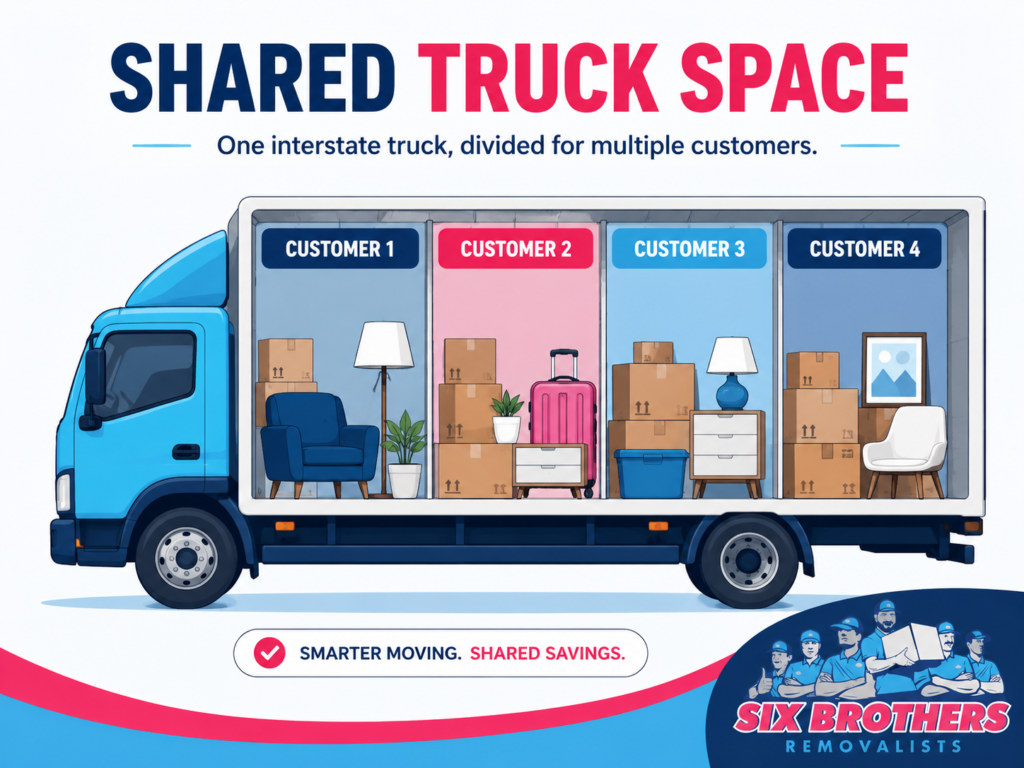
Backloading is a space-sharing arrangement. A removalist truck completes its primary delivery run say, from Sydney to Melbourne and rather than returning empty, it picks up another customer’s load along the way or on the return journey. You pay only for the cubic metres your belongings occupy, not the entire truck.
The concept is straightforward: the truck is already going in that direction. You’re filling space that would otherwise be wasted. The removalist recovers fuel and labour costs, and you get a significantly reduced rate compared to chartering a full vehicle.
This is not a budget compromise in the way that “cheap” often implies. Reputable backloading companies use the same trucks, the same trained crews, and the same transit routes as their full-load services. The difference is scheduling, not quality provided you choose the right operator.
What Happens to Your Belongings During a Backload?
Your items are loaded onto a truck that already carries another customer’s goods, or they’re loaded first and another customer’s items are added at a later pickup point. The removalist is responsible for securing all loads correctly so nothing shifts in transit.
Professional operators use furniture blankets, strapping, and load barriers to separate and protect each customer’s belongings. Your items should be clearly labelled and inventoried before loading so the crew knows exactly what belongs to whom at the delivery end.
The key risk here is not the sharing itself it’s whether the removalist has the experience and equipment to manage a shared load properly. This is why vetting your operator matters more with backloading than with a dedicated truck hire.
Which Interstate Routes Support Backloading in NSW?
Backloading is most readily available on high-traffic interstate corridors. From Parramatta and Greater Western Sydney, the most common backloading routes include:
- Sydney to Melbourne (and return): The busiest backloading corridor in Australia, with frequent truck movements in both directions
- Sydney to Brisbane (and return): High demand, particularly for northbound loads
- Sydney to Adelaide: Less frequent but available through established operators
- Sydney to Canberra: Short-haul backloading, often available with faster turnaround
- Sydney to Gold Coast / Sunshine Coast: Popular for lifestyle relocations
Less common routes such as Sydney to Perth or Darwin exist but require longer lead times and more flexible delivery windows. If you’re moving to a regional destination off the main highway corridors, backloading availability drops and wait times increase.
How Much Does Backloading Cost Compared to a Full Truck Hire?
The cost difference between backloading and a dedicated truck hire is one of the most searched questions in this space and for good reason. The savings can be substantial.
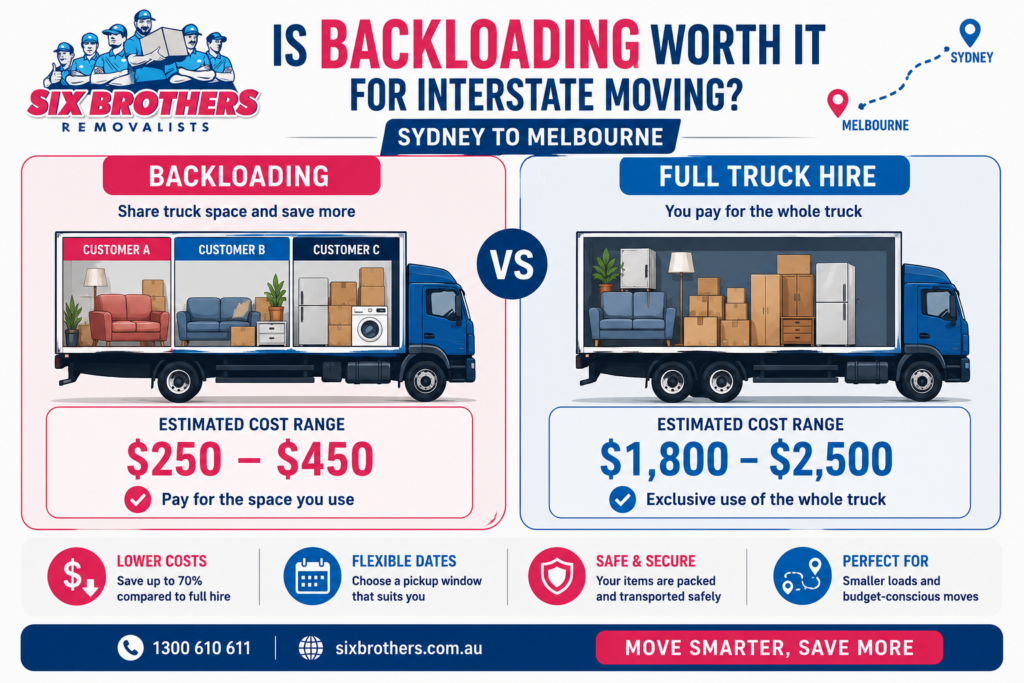
As a general guide for interstate moves from Sydney:
| Move Type | Estimated Cost (Backloading) | Estimated Cost (Full Truck) |
| 1-bedroom apartment (Sydney to Melbourne) | $800 – $1,500 | $2,000 – $3,500 |
| 2-bedroom house (Sydney to Melbourne) | $1,500 – $2,500 | $3,500 – $5,500 |
| 3-bedroom house (Sydney to Melbourne) | $2,500 – $4,000 | $5,000 – $8,000+ |
| 1-bedroom apartment (Sydney to Brisbane) | $900 – $1,800 | $2,200 – $4,000 |
These are indicative ranges. Actual quotes depend on volume, access conditions, packing requirements, and the specific operator. Always request a cubic metre estimate before accepting any quote.
The savings on a typical 2-bedroom move can range from $1,500 to $3,000. For many households in Western Sydney, that’s a meaningful difference enough to cover bond payments, connection fees, or the first month’s rent at the new address.
What Factors Affect the Price of a Backload?
Several variables move the price up or down:
- Volume (cubic metres): The primary pricing unit. More cubic metres means a higher cost, but the rate per cubic metre is still lower than a dedicated truck.
- Distance: Longer routes cost more. Sydney to Perth will cost significantly more than Sydney to Canberra.
- Route popularity: High-traffic corridors like Sydney-Melbourne have more competition among operators, which tends to keep prices lower.
- Timing and availability: If you need to move within a tight window, you may pay a premium for a confirmed slot. Flexible movers get better rates.
- Access conditions: Narrow driveways, stairs, lifts, or long carries at either end add labour time and cost.
- Packing services: If you need the removalist to pack your items, this is charged separately.
- Insurance: Transit insurance is often optional but strongly recommended. It adds to the cost but protects your belongings.
Are There Hidden Costs in Backloading You Should Know About?
Yes and this is where many movers get caught out. Some operators advertise low base rates and then add charges that weren’t mentioned upfront. Watch for:
- Fuel levies: Some companies add a fuel surcharge on top of the quoted rate. Ask whether the quote is all-inclusive.
- Cubic metre overages: If your load exceeds the estimated volume, you may be charged for the additional space at a higher rate.
- Redelivery fees: If you’re not available when the truck arrives, some operators charge for a second delivery attempt.
- Storage fees: If your delivery is delayed and the operator needs to hold your goods, storage charges may apply.
- Insurance exclusions: Basic transit cover often excludes items that weren’t professionally packed. Read the policy carefully.
The safest approach is to ask for a written, itemised quote that specifies exactly what is and isn’t included. A reputable removalist will provide this without hesitation.
What Are the Advantages of Backloading for Interstate Moves?
Backloading offers genuine advantages that go beyond just cost. Understanding them helps you decide whether this service model fits your move.
Cost savings are the headline benefit. Paying for cubic metres rather than an entire truck means you’re not subsidising empty space. For smaller households or partial loads, this is the most financially rational choice.
Environmental efficiency is a secondary benefit that matters to many movers. A truck that would otherwise return empty is now carrying useful cargo. Fewer trucks on the road for the same volume of goods moved.
Access to professional equipment and crews without the full-truck price tag. You’re still getting a proper removalist truck with trained staff not a hire van you’re driving yourself.
Availability on major corridors means you don’t have to wait long for a suitable truck if you’re moving between Sydney, Melbourne, Brisbane, or Adelaide. Operators run these routes regularly.
Reduced stress compared to self-moving. Driving a hire van interstate, managing fuel stops, navigating unfamiliar roads, and unloading at the other end is exhausting. Backloading hands that responsibility to professionals.
Is Backloading a Good Option for Small Loads or Partial Moves?
Backloading is arguably at its best for small loads. If you’re moving a studio apartment, a single bedroom’s worth of furniture, or a partial load of office equipment, booking a full truck is wasteful and expensive. You’d be paying for space you don’t need.
With backloading, you pay for exactly what you’re moving. A studio apartment load might occupy 10-15 cubic metres. A full truck might carry 60-80 cubic metres. The maths is straightforward.
The practical threshold where backloading starts making strong financial sense is roughly anything under a 3-bedroom house load. Above that, the gap between backloading and full-truck costs narrows, and the scheduling flexibility of a dedicated truck becomes more valuable.
Can Backloading Work for Office or Business Relocations?
It can, with some important caveats. Office relocations often involve sensitive equipment computers, servers, filing systems, and furniture that needs careful handling. Backloading works for office moves when:
- The volume is manageable (not a large commercial fitout)
- The timeline allows for a delivery window rather than a fixed date
- Items are properly packed and protected before loading
- The operator has experience with commercial goods
For larger office relocations or moves involving IT infrastructure, a dedicated truck with a fixed schedule is usually the better choice. The cost premium is justified by the control it gives you over timing and handling.
What Are the Risks and Limitations of Backloading?
Backloading is not the right solution for every move. Understanding the limitations upfront prevents disappointment later.
Delivery windows, not fixed dates. This is the most significant limitation. Because your load is sharing a truck with other customers, the delivery schedule depends on the truck’s overall route. You’ll typically receive a delivery window often 2 to 5 days rather than a guaranteed date and time.
Longer transit times on some routes. A dedicated truck goes directly from A to B. A backloading truck may make multiple stops. On busy corridors this is usually manageable, but on less common routes it can add days to your transit time.
Less control over scheduling. You’re working around the truck’s availability, not the other way around. If you have a hard deadline a lease start date, a school enrolment, a work start date backloading may not give you the certainty you need.
Shared space requires trust in the operator. Your belongings are loaded alongside someone else’s. If the operator doesn’t manage the load correctly, items can shift, get damaged, or be misidentified at delivery.
Not ideal for very fragile or high-value items. Antiques, artwork, pianos, and items requiring special handling are better suited to a dedicated vehicle where the crew can focus entirely on your load.
How Flexible Are Delivery Dates with Backloading?
Delivery flexibility is the central trade-off in backloading. Most operators will give you a delivery window of 2 to 7 days depending on the route and how quickly a suitable truck becomes available.
On the Sydney-Melbourne corridor, windows are often shorter sometimes 2 to 3 days because trucks run frequently. On less common routes, you might wait longer for pickup and receive a wider delivery window.
The practical implication: you need somewhere to stay at the destination end while you wait for your delivery. If you’re moving into a new rental, confirm with your landlord that you can access the property before your furniture arrives. If you’re staying with family or in temporary accommodation, factor in the cost of those extra days.
Some operators offer “express backloading” at a higher price point, which prioritises your load on the next available truck. This narrows the window but doesn’t eliminate it entirely.
Is Your Furniture Safe When Sharing Truck Space?
Yes — when the operator is competent and properly equipped. The safety of your furniture in a shared load depends on:
- Proper wrapping and padding: Furniture blankets, bubble wrap, and corner protectors should be used on all items susceptible to scratching or impact damage.
- Correct load securing: Straps, load bars, and barriers prevent items from shifting during transit.
- Accurate inventory management: Every item should be listed and checked at pickup and delivery.
- Experienced crew: Staff who know how to stack and secure a mixed load without creating pressure points between items.
Ask your removalist directly how they manage shared loads. A good operator will explain their process clearly. If the answer is vague or dismissive, that’s a warning sign.
When Is Backloading Worth It – and When Should You Book a Dedicated Truck?
This is the decision most movers in Parramatta and Greater Western Sydney are actually trying to make. Here’s a practical framework.
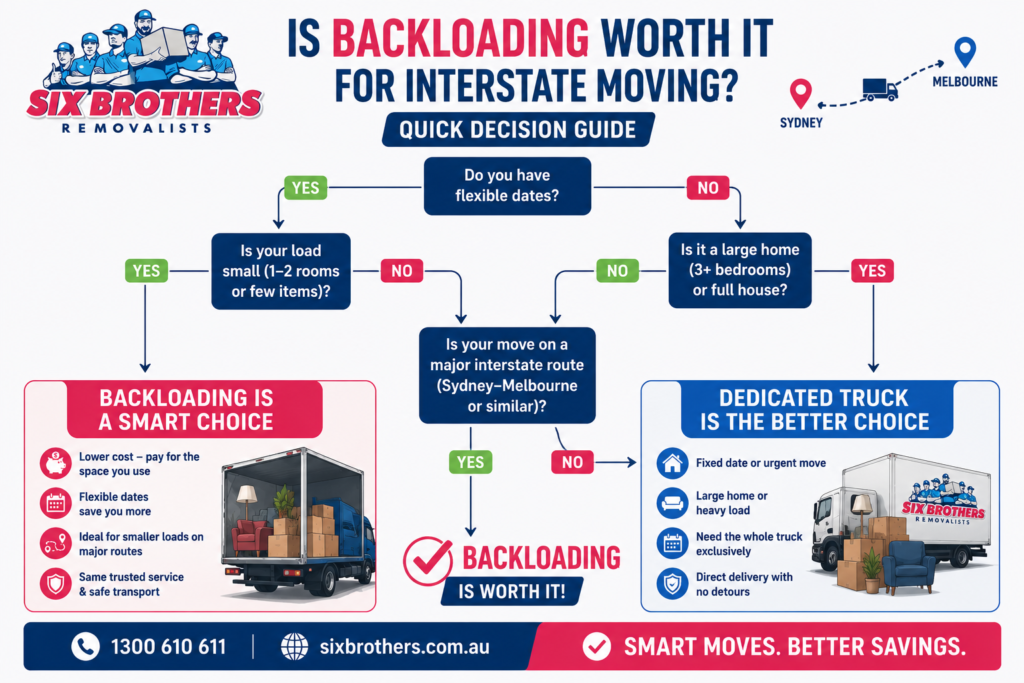
Backloading is worth it when:
- Your load is smaller than a full 3-bedroom house
- You can accept a delivery window of 2 to 7 days
- You’re moving on a well-serviced corridor (Sydney to Melbourne, Brisbane, Adelaide)
- Budget is a primary concern
- You have flexible accommodation at the destination end
- You’re not moving fragile, high-value, or specialist items
A dedicated truck is the better choice when:
- You have a fixed move-in date that cannot shift
- You’re moving a large household (4+ bedrooms)
- You have items requiring specialist handling
- You’re moving to a regional or remote destination with limited backloading availability
- You need guaranteed same-day or next-day delivery
- The cost difference between options is small enough that certainty is worth paying for
Neither option is universally superior. The right answer depends on your specific circumstances.
How Much Stuff Do You Need to Move to Make Backloading Worthwhile?
There’s no hard minimum, but backloading becomes most cost-effective when your load is between 5 and 40 cubic metres. Below 5 cubic metres, some operators have minimum charges that reduce the savings. Above 40 cubic metres, you’re approaching full-truck territory and the price gap narrows.
A rough guide to common load sizes:
- Studio apartment: 8-15 cubic metres
- 1-bedroom apartment: 15-25 cubic metres
- 2-bedroom house: 25-40 cubic metres
- 3-bedroom house: 40-60 cubic metres
- 4-bedroom house: 60-80+ cubic metres
If your load sits in the 25-50 cubic metre range, backloading typically delivers the strongest value proposition. You’re paying for meaningful space without approaching the cost of a full truck.
What If Your Moving Timeline Is Fixed or Urgent?
If your timeline is non-negotiable, backloading carries real risk. A fixed lease start date, a school term beginning, or a job that starts on a specific Monday means you cannot afford a delivery window that might stretch to 5 or 7 days.
In these situations, a dedicated truck is the safer choice. The premium you pay for a fixed delivery date is essentially insurance against the disruption of arriving at your destination without your belongings.
Some movers split the difference: they send most of their load via backloading and carry essential items clothing, documents, laptops, medications, children’s items in their own vehicle or as carry-on luggage. This approach captures most of the cost savings while ensuring you have what you need from day one.
What Should You Ask a Removalist Before Booking a Backload?
Before committing to any backloading service, get clear answers to these questions:
- What is the estimated delivery window for my route?
- Is the quoted price all-inclusive, or are there additional charges for fuel, access, or overages?
- How do you protect and separate items in a shared load?
- What transit insurance do you offer, and what does it cover?
- Are you licensed and insured to operate interstate?
- How do you handle delays or changes to the delivery schedule?
- Will I receive an itemised inventory at pickup?
- What happens if my load exceeds the estimated cubic metres?
- Do you have experience moving on my specific route?
- Can I get the quote in writing with all terms clearly stated?
A removalist who answers these questions confidently and in writing is a removalist worth trusting with your belongings.
How to Choose a Reliable Backloading Removalist in Parramatta and NSW
The backloading market in NSW includes operators ranging from highly professional to genuinely unreliable. The price difference between them is often small. The difference in experience is not.
When evaluating removalists from Parramatta or Greater Western Sydney, look beyond the quote. Check how long they’ve been operating, whether they have verifiable reviews on Google or independent platforms, and whether they communicate clearly and promptly from the first enquiry.
A company that takes days to respond to a quote request, provides vague answers about their process, or can’t explain their insurance coverage is showing you exactly how they’ll handle your move. First impressions in this industry are usually accurate.
Six Brothers Removalists has built its reputation in Parramatta on exactly this kind of transparency. Every backloading quote is itemised, every process is explained, and every move is handled by experienced crews who treat your belongings with the same care they’d give their own.
What Licences and Insurance Should a Backloading Company Have?
In Australia, interstate removalists are required to hold appropriate business licences and, in most states, must comply with consumer protection regulations governing the moving industry. Specifically, look for:
- Public liability insurance: Covers damage to property at pickup or delivery locations
- Transit insurance (goods in transit): Covers your belongings while they’re on the truck
- Workers compensation insurance: Covers the crew relevant because an uninsured injury on your property can create complications
- AFRA membership (optional but valuable): The Australian Furniture Removers Association sets industry standards for member companies
Always ask for proof of insurance before signing any agreement. A legitimate operator will provide this without hesitation. If a company is reluctant to share insurance documentation, that’s a significant red flag.
How Do You Compare Backloading Quotes Without Getting Burned?
Comparing backloading quotes requires more than looking at the bottom-line number. Here’s how to do it properly:
- Compare cubic metre rates, not total prices. If one company estimates your load at 20 cubic metres and another estimates 30, the cheaper total quote may actually be the more expensive rate per cubic metre.
- Check what’s included. Fuel levies, insurance, and access charges should all be specified.
- Ask about the delivery window. A cheaper quote with a 10-day window may be less useful than a slightly higher quote with a 3-day window.
- Read the terms and conditions. Pay particular attention to clauses about delays, damage liability, and cancellation.
- Check reviews independently. Google reviews, ProductReview, and word-of-mouth from people who’ve used the service are more reliable than testimonials on the company’s own website.
- Trust your gut on communication. How a company handles your enquiry is a preview of how they’ll handle your move.
How to Prepare Your Belongings for a Backloading Move
Preparation makes a significant difference to how well your belongings survive a backloading move. Because your items will share space with another customer’s load, they need to be more robustly protected than they might be in a dedicated truck where the crew has full control of the space.
Start early. Rushed packing leads to inadequate protection, which leads to damage. Give yourself at least a week for a 2-bedroom household, longer for larger moves.
Disassemble furniture where possible. Bed frames, dining tables, and flat-pack items take up less space and are easier to protect when broken down. Keep all screws and fittings in labelled zip-lock bags taped to the relevant piece.
Label every box clearly with your name, destination address, and the room it belongs to. In a shared load, clear labelling is the difference between your boxes arriving at the right address and ending up on someone else’s delivery.
What Packing Materials Work Best for Shared Truck Loads?
For a backloading move, prioritise protection over speed:
- Double-walled cardboard boxes for heavy or fragile items. Single-wall boxes compress under weight.
- Furniture blankets for all timber, glass, and upholstered items. If your removalist doesn’t supply these, hire or purchase them.
- Bubble wrap for fragile items — glassware, ceramics, electronics, mirrors.
- Stretch wrap (plastic wrap) for drawers, doors, and items that could open in transit.
- Packing paper (not newspaper — the ink transfers) for filling void space in boxes and wrapping individual items.
- Heavy-duty tape — not masking tape or light packing tape. Boxes need to hold their shape under stacking pressure.
- Mattress bags for all mattresses. A mattress that arrives dirty or damp from a shared truck is a significant problem.
If you’re unsure about packing, ask your removalist whether they offer a packing service. For a backloading move, professionally packed items are less likely to be damaged and may be better covered by transit insurance.
Should You Use Storage Between Pickup and Delivery?
Storage becomes relevant in two backloading scenarios. The first is when your pickup date and your access date at the destination don’t align your current lease ends before your new place is available. The second is when the delivery window extends beyond what you can manage with temporary accommodation.
Short-term storage is a practical solution in both cases. Many removalists, including Six Brothers Removalists, offer storage facilities that integrate with their moving services. Your goods are picked up, held securely, and delivered when you’re ready without requiring a separate storage arrangement.
When evaluating storage options, ask about:
- Security (CCTV, access controls, pest management)
- Climate control (important for timber furniture, electronics, and artwork)
- Insurance coverage while in storage
- Minimum storage periods and weekly or monthly rates
- How delivery from storage is coordinated
Storage adds cost, but it removes the pressure of having to be at the destination the moment your delivery arrives. For interstate moves with uncertain timelines, that flexibility is often worth the additional expense.
Conclusion
Backloading is a genuinely useful service for interstate moves not a compromise, but a deliberate choice that makes financial and logistical sense for the right situation. If your load is smaller than a full house, your timeline has some flexibility, and you’re moving on a well-serviced corridor like Sydney to Melbourne or Sydney to Brisbane, backloading can save you thousands of dollars without sacrificing the professionalism of a managed removalist service.
The risks are real but manageable. Delivery windows, shared truck space, and the importance of choosing a trustworthy operator are all factors worth understanding before you book. The movers who get burned by backloading are usually the ones who didn’t ask the right questions upfront.
At Six Brothers Removalists, we handle interstate backloading from Parramatta and across Greater Western Sydney with the same care and transparency we bring to every move. If you’re weighing up your options, we’re happy to give you an honest assessment of whether backloading suits your situation and a written, itemised quote with no surprises. Contact us today to get started.
Frequently Asked Questions
What is backloading in interstate moving?
Backloading is when your belongings share space on a removalist truck that is already travelling your route. You pay only for the cubic metres your load occupies, rather than the full cost of a dedicated truck, which makes it a cost-effective option for smaller interstate moves.
How long does a backloading interstate move take?
Transit times vary by route and operator, but most backloading moves between major cities like Sydney and Melbourne take 2 to 5 days from pickup to delivery. Less common routes may take longer, and delivery windows are typically given as a range rather than a fixed date.
Is backloading safe for furniture and fragile items?
Backloading is safe when the operator uses proper load securing, furniture blankets, and strapping to protect items in a shared truck. Fragile or high-value items should be professionally packed, and transit insurance should be confirmed before booking.
How much cheaper is backloading compared to a full truck hire?
Backloading typically costs 40 to 60 percent less than a dedicated truck hire for the same route. A 2-bedroom move from Sydney to Melbourne might cost $1,500 to $2,500 via backloading compared to $3,500 to $5,500 for a full truck, though exact prices depend on volume, access, and the operator.
Can I choose my delivery date with backloading?
Most backloading services offer a delivery window rather than a fixed date. The window is typically 2 to 7 days depending on the route and truck availability. If you need a guaranteed delivery date, a dedicated truck hire gives you more control over scheduling.
What should I look for when choosing a backloading removalist?
Look for a removalist with verifiable reviews, clear written quotes, proof of transit insurance, and transparent answers about their process for managing shared loads. AFRA membership is a useful indicator of professional standards, though not all reputable operators are members.
Is backloading available from Parramatta to all interstate destinations?
Backloading from Parramatta is most readily available on high-traffic routes to Melbourne, Brisbane, Adelaide, and Canberra. Less common destinations such as Perth or Darwin are possible but require longer lead times and more flexible delivery windows. Contact a local operator to confirm availability for your specific route.