
Table of Contents
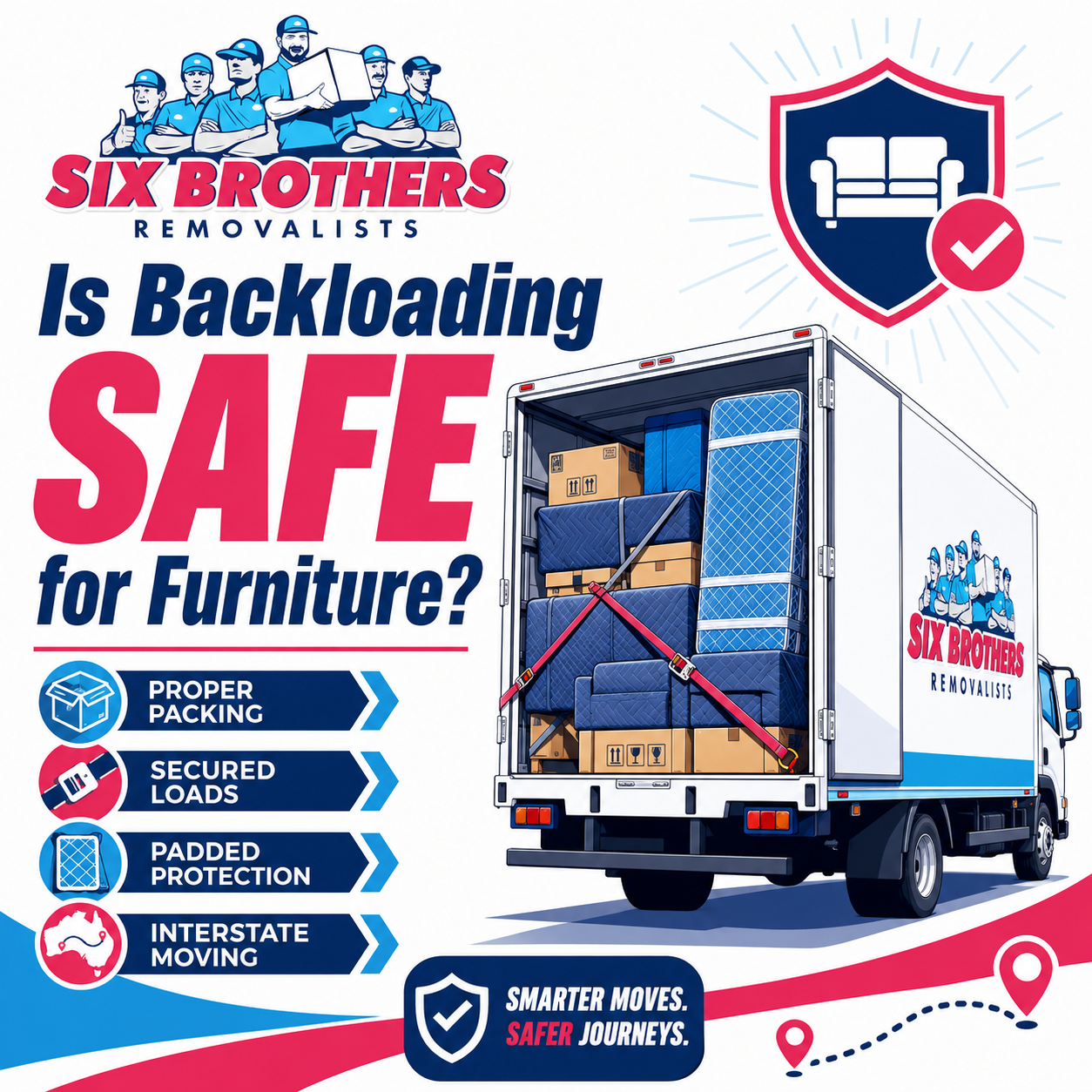
Backloading is safe for furniture when it is handled by a professional removalist who uses proper packing materials, load securing techniques, and clear communication about shared truck space. Most furniture from sofas and bed frames to dining tables and wardrobes travels without incident on well-managed backloading runs every day across NSW and interstate.
That said, not all backloading services are equal. The difference between furniture arriving in perfect condition and arriving with scratches or broken legs usually comes down to who packed it, how it was loaded, and whether the removalist actually knew what they were doing.
This guide covers everything you need to know: how backloading works, what makes it safe or risky, which items need extra care, how to choose a trustworthy operator, and what to expect on interstate runs from Parramatta and Greater Western Sydney.
What Is Backloading and How Does It Work for Furniture Moves?
Backloading is a removalist service where your furniture and belongings share space on a truck that is already travelling to your destination. Instead of hiring a dedicated truck that drives solely for your move, you book available space on a vehicle that has completed a primary delivery and is returning or continuing along a set route.
The truck operator fills the remaining capacity with additional loads from other customers heading in the same direction. You pay only for the cubic metres your belongings occupy, which makes backloading significantly more affordable than a full dedicated truck hire, particularly for interstate moves.
For furniture specifically, backloading works well when items are properly wrapped, packed, and secured before loading. The logistics are managed by the removalist company, who coordinates pickup, transit, and delivery across the route.
How Backloading Differs from a Dedicated Removalist Truck
With a dedicated truck, the vehicle is booked exclusively for your move. It arrives at your address, loads your belongings, and drives directly to your destination. You control the timeline, and your furniture shares space with nothing else.
Backloading shares that truck space with other customers’ goods. Your furniture is loaded alongside other items, which means the removalist must manage multiple loads carefully to prevent contact damage. The timeline is also less fixed delivery windows are broader because the truck is running a route, not a single point-to-point job.
The key difference is not safety it is control and flexibility. A well-run backloading service protects furniture just as effectively as a dedicated truck. The risk increases only when operators cut corners on packing, securing, or communication.
What Types of Furniture Are Typically Moved via Backloading?
Backloading handles the full range of household and office furniture. Sofas, armchairs, bed frames, mattresses, dining tables, chairs, bookshelves, wardrobes, desks, filing cabinets, and flat-pack furniture all move regularly on backloading runs between Sydney, Melbourne, Brisbane, Adelaide, and regional NSW.
Smaller household loads a one or two-bedroom apartment’s worth of furniture are particularly well-suited to backloading because they occupy a modest volume and fit easily into available truck space without complex loading arrangements.
Is Backloading Safe for Your Furniture? The Honest Answer
Yes, backloading is safe for furniture but the honest answer comes with context. Safety depends almost entirely on the quality of the removalist you choose, the packing methods used, and how the load is managed inside the truck.
Thousands of furniture items move across NSW and interstate via backloading every week without damage. The process itself is not inherently risky. Furniture does not know whether it is on a dedicated truck or a shared one. What matters is whether it is wrapped correctly, positioned securely, and handled by people who treat other people’s belongings with care.
The concern most people have about backloading safety is legitimate shared loads mean your furniture is in proximity to other customers’ items, and if the operator is careless about load management, contact damage can occur. But this is a people problem, not a backloading problem.
What Makes Backloading Safe When Done Correctly
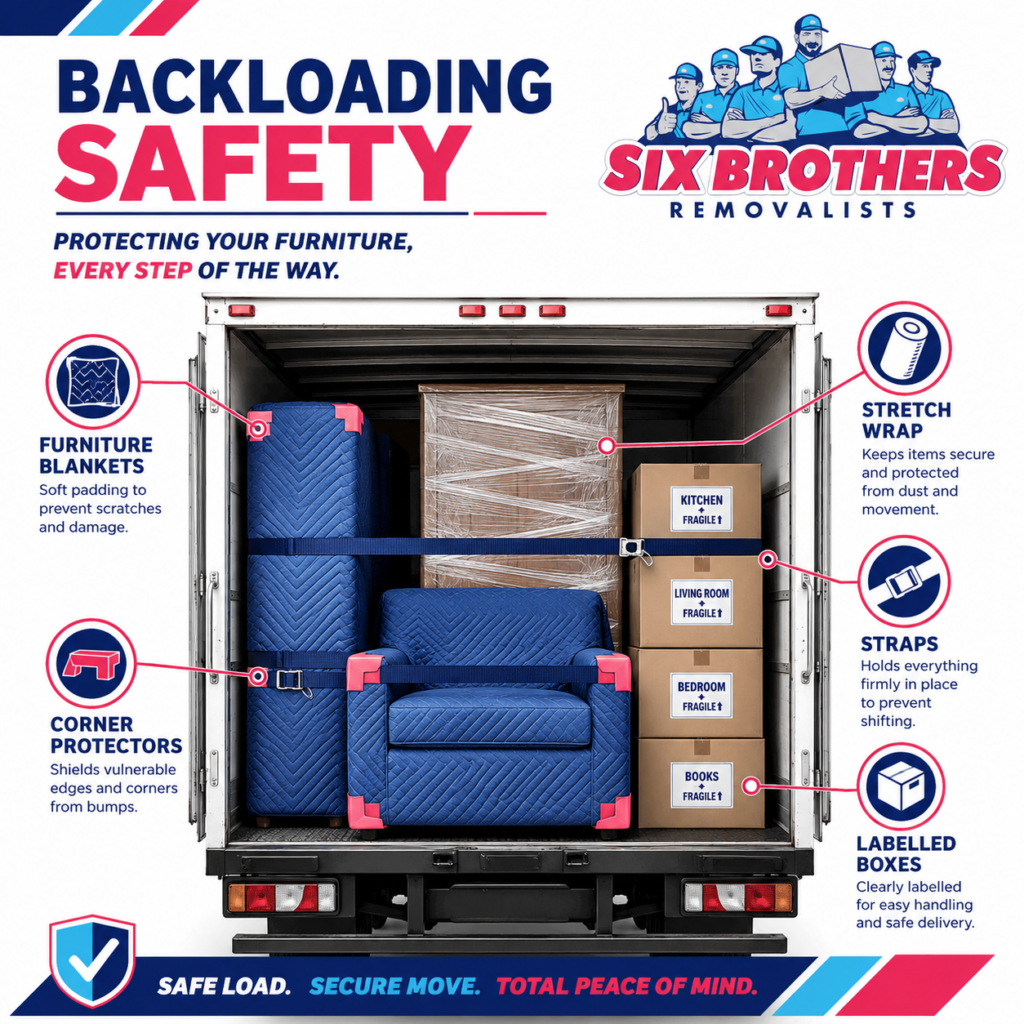
Several factors make backloading genuinely safe for furniture:
Professional packing. Furniture wrapped in moving blankets, stretch wrap, and corner protectors is protected from surface contact regardless of what else is in the truck.
Proper load securing. Straps, load bars, and furniture pads prevent items from shifting during transit. A well-loaded truck keeps everything stable even on long interstate runs.
Experienced handlers. Removalists who understand weight distribution, fragile item placement, and how to stack loads without creating pressure points protect furniture far better than inexperienced operators.
Clear inventory management. Reputable backloading companies document every item, label loads clearly, and ensure your furniture is not confused with another customer’s belongings at delivery.
What Are the Real Risks of Backloading Furniture?
The genuine risks of backloading are worth understanding clearly so you can make an informed decision.
Longer or less predictable delivery windows. Because the truck is running a route with multiple stops, your delivery may not happen on a specific day. Reputable operators provide a delivery window often two to five days for interstate runs rather than a guaranteed single date.
Contact damage from poor load management. If a removalist does not properly separate and secure loads from different customers, furniture can rub against or press against other items during transit. This is the most common cause of backloading damage and is entirely preventable with correct technique.
Handling by multiple crew members. On longer routes, different crew members may handle your furniture at different points. Consistent packing standards and clear labelling reduce this risk significantly.
Operators who underquote and overload. Some budget backloading operators accept more volume than they can safely manage, leading to rushed loading and inadequate securing. This is a business practice problem, not a structural flaw in backloading itself.
How Professional Removalists Protect Furniture During Backloading
Professional removalists use a consistent set of techniques to protect furniture on shared loads. These are not optional extras they are the baseline standard for any operator who takes their work seriously.
Understanding what good protection looks like helps you evaluate whether a backloading company is worth trusting with your belongings.
Packing Standards That Prevent Damage on Shared Loads
Every piece of furniture that goes onto a backloading truck should be prepared before it is loaded. This means:
Moving blankets wrapped around timber furniture, upholstered pieces, and anything with a finished surface. Blankets absorb impact and prevent scratching from contact with other items or the truck walls.
Stretch wrap applied over blankets to hold them in place during transit. Without stretch wrap, blankets shift and leave surfaces exposed.
Corner protectors on tables, cabinets, wardrobes, and any item with vulnerable edges or corners. Corners are the most common point of damage during loading and unloading.
Disassembly where appropriate. Bed frames, dining tables, and flat-pack furniture are safer when broken down into components, wrapped individually, and reassembled at the destination. This reduces the risk of legs snapping or joints cracking under load pressure.
Mattress bags for all mattresses. Mattresses are difficult to clean if they pick up dirt or moisture during transit, and a mattress bag is a simple, inexpensive protection measure.
How Furniture Is Secured Inside a Backloading Truck
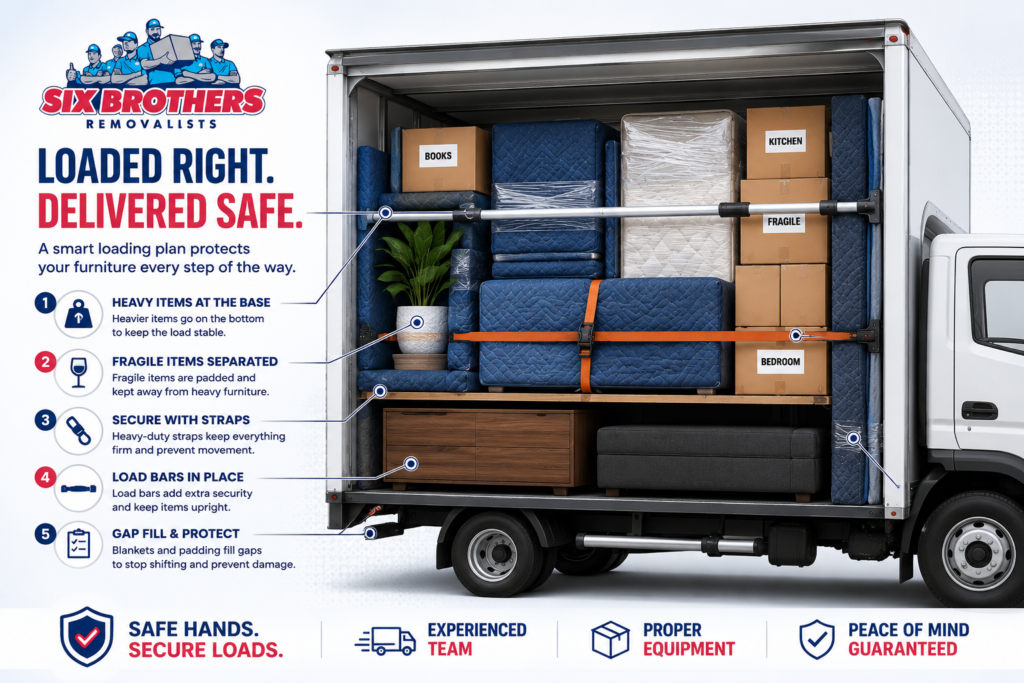
Loading technique matters as much as packing. Inside a well-managed backloading truck:
Heavy items refrigerators, washing machines, large wardrobes are loaded first and positioned against the truck walls or bulkhead. This creates a stable base and prevents heavy items from shifting onto lighter furniture.
Sofas and upholstered pieces are typically stood on end or positioned to maximise space while minimising pressure on cushions and frames.
Load bars and straps are used to divide the truck into sections and prevent loads from different customers from mixing or pressing against each other.
Fragile items are loaded last and positioned where they will not be compressed by other loads.
A professional removalist thinks about the truck as a three-dimensional puzzle where every piece has a correct position not just a space to fill.
What Furniture Is Safe to Backload – and What Should You Reconsider?
Most furniture is perfectly safe to backload with proper preparation. There are, however, some categories that require extra consideration not because backloading cannot handle them, but because they need specific packing or handling arrangements that not every operator provides.
Items That Travel Well on Backloading Runs
The following furniture types move reliably on backloading services with standard professional packing:
- Sofas and three-piece suites (wrapped in blankets and stretch wrap)
- Bed frames (disassembled, components wrapped individually)
- Mattresses (in mattress bags)
- Dining tables and chairs (table disassembled, chairs wrapped)
- Wardrobes and tallboys (emptied, wrapped, doors secured)
- Bookshelves and display units (disassembled if possible)
- Office desks and chairs
- Flat-pack furniture (disassembled and flat-packed for transit)
- Chest freezers and washing machines (drained and secured)
These items have predictable shapes, manageable weights, and respond well to standard wrapping and securing techniques.
Fragile, Oversized, or High-Value Items That Need Extra Care
Some items require a conversation with your removalist before booking a backloading service:
Antique furniture. Pieces with significant monetary or sentimental value deserve extra packing attention custom crating in some cases and a removalist who understands how to handle aged timber, veneer surfaces, and delicate joinery.
How to Move Antique Furniture Interstate….Read more
Glass-topped tables and display cabinets. Glass requires specific packing (vertical positioning, edge protection, and separation from other loads) and should be discussed explicitly with your operator.
Pianos. Upright and grand pianos are specialist items. Not all backloading operators have the equipment or experience to move pianos safely. Ask directly before booking.
Large artwork and mirrors. These need custom wrapping and vertical positioning. Confirm your operator has the materials and experience to handle them.
Items with existing damage. If a piece already has a crack, loose joint, or structural weakness, transit stress can worsen it. Document the condition before loading and discuss it with your removalist.
None of these items are impossible to backload they simply require the right operator and the right preparation.
How to Choose a Safe and Reliable Backloading Removalist
Choosing the right backloading company is the single most important decision you make in this process. The service itself is sound. The variable is the operator.
Here is how to evaluate a backloading removalist before you hand over your furniture.
Questions to Ask Before Booking a Backloading Service
Ask these questions directly and pay attention to how confidently and specifically the operator answers:
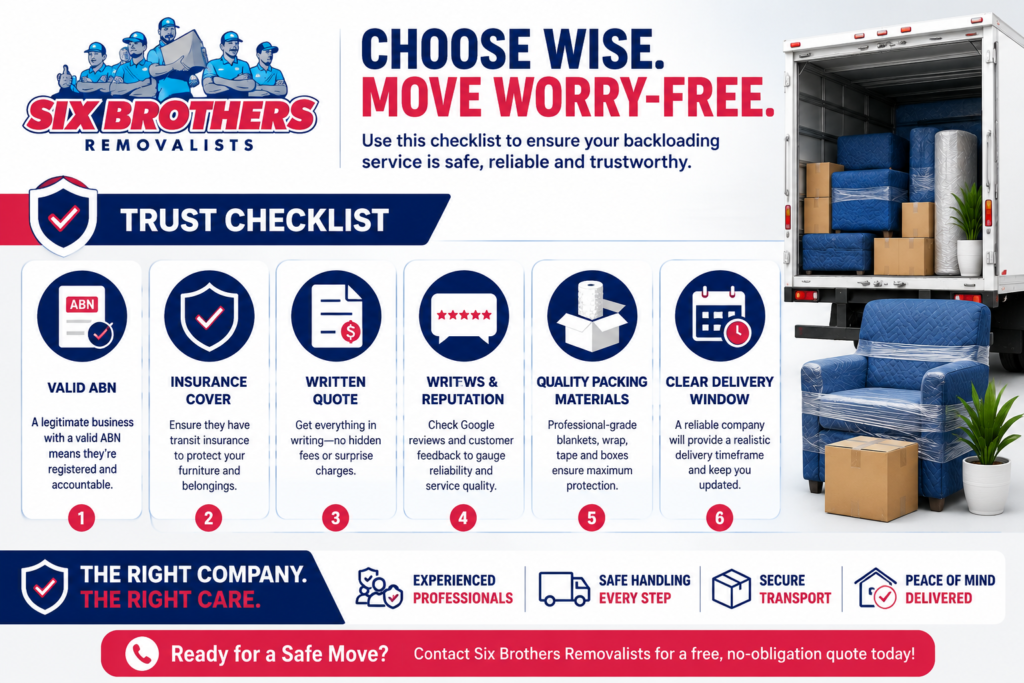
Do you use moving blankets and stretch wrap on all furniture? A professional will say yes without hesitation. Vague answers about “taking care of your stuff” are not sufficient.
How do you separate loads from different customers inside the truck? Look for specific answers about load bars, straps, and load management. If they cannot explain their method, that is a concern.
What is your delivery window for this route? Understand the timeframe before you book. A two-to-five-day window is normal for interstate backloading. Anyone promising a guaranteed single-day delivery on a backloading run is either misleading you or running a dedicated truck at a backloading price which is unlikely.
Are you licensed and insured? In NSW, removalists should hold appropriate business insurance. Ask specifically about goods in transit insurance and what it covers.
Can you provide references or reviews for this route? Established operators have a track record. Google reviews, Word of Mouth, or direct references from previous customers on the same route are meaningful signals.
What happens if something is damaged? Understand the claims process before anything goes wrong. A reputable operator will explain it clearly.
Red Flags That Signal an Unsafe Backloading Operator
Watch for these warning signs when evaluating backloading companies:
No physical address or verifiable business details. Legitimate removalists have a real business presence. If you cannot find a physical address, ABN, or verifiable contact details, walk away.
Prices that seem too low to be real. Backloading is cost-effective, but it is not free. Operators who quote dramatically below market rates are often cutting corners on insurance, packing materials, or crew quality.
No mention of insurance. Any professional removalist should be able to tell you immediately what insurance they carry. If they deflect or cannot answer, that is a serious red flag.
Vague answers about packing and securing. If an operator cannot explain specifically how they protect furniture, they probably do not do it well.
No written quote or booking confirmation. Verbal agreements leave you with no recourse if something goes wrong. Always get a written quote that specifies the volume, route, delivery window, and price.
Pressure to pay large deposits upfront. A reasonable deposit is normal. Demanding full payment before pickup is not standard practice among reputable operators.
Backloading vs. Dedicated Truck: Which Is Safer for Your Furniture?
This is one of the most common questions people ask when planning an interstate move, and the answer is more nuanced than most comparisons suggest.
A dedicated truck gives you exclusive control over your load. Your furniture is the only thing on the truck, the timeline is set around your schedule, and there is no risk of contact with another customer’s belongings. For large household moves, time-sensitive relocations, or moves involving specialist items, a dedicated truck is often the right choice.
Backloading is not inherently less safe it is a different service model. The safety outcome depends on the operator’s standards, not the truck arrangement. A professional backloading service with proper packing and load management will protect your furniture just as effectively as a dedicated truck.
When Backloading Makes Sense and When It Doesn’t
Backloading makes sense when:
- You are moving a one or two-bedroom home interstate and do not need a full truck
- Your timeline is flexible and a delivery window of two to five days is acceptable
- You want to reduce interstate moving costs significantly without compromising on care
- You are moving furniture only, without time-critical items like business equipment or perishables
- You have chosen a reputable operator with verified experience on your route
A dedicated truck makes more sense when:
- You have a large household (three bedrooms or more) with enough volume to fill a truck
- You need delivery on a specific date with no flexibility
- You are moving specialist items like pianos, antiques, or high-value artwork that require bespoke handling
- You are relocating a business with equipment that cannot be delayed
- You want the simplicity of a single-customer load with no shared logistics
For many Parramatta and Western Sydney residents moving interstate, backloading is the practical, cost-effective choice provided the operator is professional and the furniture is properly prepared.
Interstate Backloading from Parramatta: What to Expect
Parramatta sits at the geographic centre of Greater Western Sydney, which makes it a well-connected starting point for interstate backloading runs. Trucks heading south to Melbourne, north to Brisbane, or west to Adelaide pass through or near the Parramatta corridor regularly, which means backloading availability from this area is generally good.
Understanding what the process looks like from pickup to delivery helps you plan your move without surprises.
Common Backloading Routes from Western Sydney
The most frequently serviced backloading routes from Parramatta and Greater Western Sydney include:
Sydney to Melbourne. This is the highest-volume interstate backloading corridor in Australia. Trucks run this route multiple times per week, which means availability is strong and delivery windows are typically shorter often two to four days.
Sydney to Brisbane. Another high-frequency route. Backloading trucks travel the Pacific Highway or New England Highway regularly, with delivery windows of two to five days depending on the operator’s schedule.
Sydney to Adelaide. Less frequent than the eastern seaboard routes but still well-serviced. Delivery windows are typically four to seven days.
Sydney to Canberra. A shorter interstate run where backloading is particularly cost-effective. Delivery windows can be as short as one to two days.
Sydney to regional NSW. Many backloading operators also service regional centres including Newcastle, Wollongong, Orange, Dubbo, and Wagga Wagga.
Typical Timeframes and Delivery Windows for Interstate Backloads
Backloading delivery windows are broader than dedicated truck timelines because the truck is running a route with multiple stops. This is a normal and expected feature of the service not a sign of poor organisation.
Typical delivery windows from Parramatta:
| Destination | Typical Delivery Window |
| Melbourne | 2–4 days |
| Brisbane | 3–5 days |
| Adelaide | 4–7 days |
| Canberra | 1–2 days |
| Regional NSW | 1–3 days |
These windows begin from the confirmed pickup date. A reputable operator will contact you when the truck is loaded and again when it is approaching your destination, so you are not waiting without information.
If you need a guaranteed delivery date, discuss this with your removalist before booking. Some operators can accommodate tighter windows for an additional cost, or may recommend a dedicated truck if your timeline is non-negotiable.
How Six Brothers Removalists Handles Backloading Safely
At Six Brothers Removalists, backloading is not a budget afterthought, it is a fully managed service built on the same standards we apply to every move we handle.
Every item that goes onto one of our backloading trucks is wrapped in moving blankets and stretch wrap before it leaves your home. Furniture is disassembled where appropriate, corners are protected, and mattresses travel in bags. We do not skip steps because a load is shared.
Inside the truck, loads are separated and secured with straps and load bars. Your furniture does not travel in contact with another customer’s belongings. Our crew manages the load as a whole, not as a collection of individual jobs thrown together.
We service backloading routes from Parramatta and Greater Western Sydney to Melbourne, Brisbane, Adelaide, Canberra, and regional NSW. Our team communicates clearly about pickup dates, delivery windows, and any changes along the route because we know that waiting for your furniture without information is one of the most stressful parts of any interstate move.
If you have items that need extra care antiques, glass, specialist furniture tell us before booking. We will give you an honest assessment of what is needed and make sure the right preparation is in place before your belongings leave Parramatta.
Conclusion
Backloading is a safe, practical, and cost-effective way to move furniture interstate when it is handled by a professional removalist who applies proper packing and load securing standards. The process itself is sound the outcome depends on the operator you choose and the preparation that goes into your load.
For Parramatta and Western Sydney residents planning interstate moves, backloading offers genuine value without compromising on care, provided you ask the right questions and choose a company with a verifiable track record on your route.
At Six Brothers Removalists, we handle every backloading job with the same attention we bring to dedicated truck moves because your furniture deserves to arrive in the same condition it left. Contact us today to get a clear, honest quote for your interstate backloading move from Parramatta.
Frequently Asked Questions
Is backloading safe for antique or fragile furniture?
Antique and fragile furniture can be moved safely via backloading when the operator uses appropriate packing moving blankets, corner protectors, custom wrapping, and careful load positioning. Discuss your specific items with the removalist before booking to confirm they have the materials and experience to handle them correctly.
How long does interstate backloading take from Parramatta?
Delivery windows from Parramatta typically range from two to four days for Melbourne, three to five days for Brisbane, and four to seven days for Adelaide. These windows are broader than dedicated truck timelines because the truck services multiple stops along the route, which is a normal feature of backloading.
Does backloading cost less than a dedicated removalist truck?
Yes, backloading is generally significantly cheaper than hiring a dedicated truck for interstate moves, because you pay only for the cubic metres your belongings occupy rather than the full truck. For a one or two-bedroom home, the cost difference can be substantial, making backloading the most practical option for smaller interstate loads.
What happens if my furniture is damaged during backloading?
If damage occurs, you should document it immediately with photographs and notify your removalist in writing. Reputable operators carry goods in transit insurance and have a claims process in place. Before booking any backloading service, ask specifically about their insurance coverage and how damage claims are handled.
Can I backload a full house worth of furniture?
Yes, a full household load can be moved via backloading, though larger volumes may be better suited to a dedicated truck depending on availability and your timeline. For three-bedroom homes or larger, discuss your total cubic metreage with your removalist they can advise whether backloading is practical or whether a dedicated truck offers better value and scheduling certainty.
How do I know if a backloading company is reputable?
Look for verifiable business details including an ABN, physical address, and genuine customer reviews on Google or Word of Mouth. Ask directly about their packing methods, insurance coverage, and delivery process. A reputable operator will answer these questions clearly and specifically vague or evasive responses are a warning sign.
Is backloading available from Parramatta to Melbourne or Brisbane?
Yes, both routes are well-serviced from Parramatta and Greater Western Sydney. Sydney to Melbourne is one of the highest-frequency backloading corridors in Australia, with trucks running multiple times per week. Sydney to Brisbane is also regularly serviced. Six Brothers Removalists operates on both routes with clear delivery windows and consistent communication throughout the move.