

Table of Contents
Every year, tens of thousands of Australians pack up and relocate to a different state, and those collective decisions reshape housing markets from Sydney to Perth. Interstate migration is one of the most powerful yet underappreciated forces driving property prices, rental vacancy rates, and new housing construction across the country.
Whether you’re a homeowner watching your suburb’s value shift, a renter competing for limited stock, or a business owner planning a commercial relocation, understanding these migration patterns gives you a genuine advantage. The numbers tell a clear story about where demand is heading and why.
This guide breaks down the key migration corridors, explains how population movement translates into real housing pressure, and covers what it all means for anyone planning a move within or out of New South Wales.
What Is Interstate Migration and Why Does It Matter for Housing?
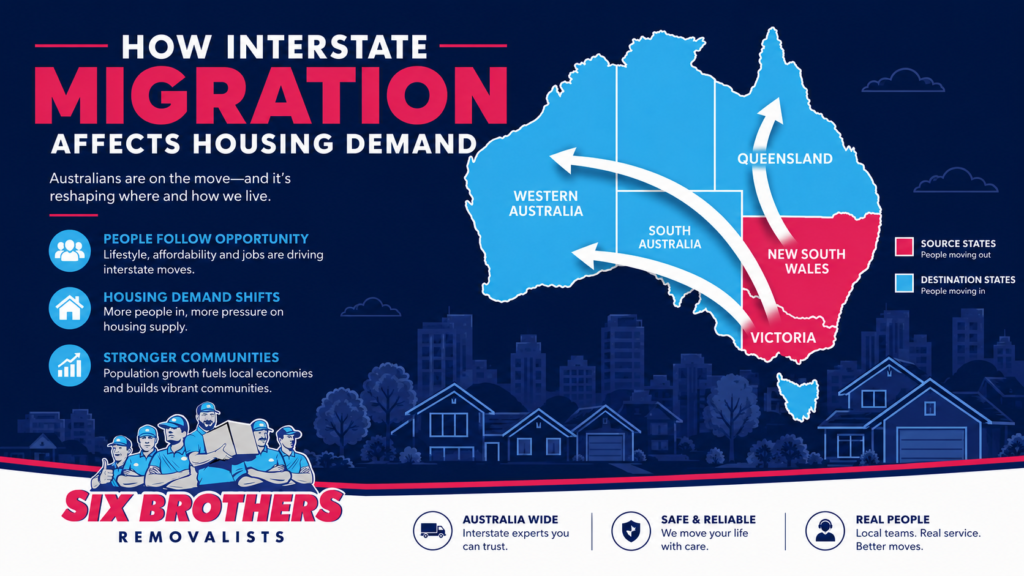
Interstate migration refers to the permanent movement of people from one Australian state or territory to another. It’s different from overseas immigration or temporary relocation. When someone changes their primary residence from New South Wales to Queensland, or from Victoria to Western Australia, that’s an interstate move captured in Australian Bureau of Statistics data.
This matters for housing because people need somewhere to live when they arrive. A single person moving to Brisbane needs a rental or a purchase. A family of four relocating from Melbourne to the Gold Coast needs a three-bedroom home. Multiply those individual decisions by tens of thousands each quarter, and you get measurable shifts in housing supply and demand across entire regions.
How the ABS Defines and Tracks Interstate Migration
The Australian Bureau of Statistics tracks interstate migration primarily through Medicare address changes, supplemented by census data collected every five years. When you update your Medicare enrolment to a new state, that change feeds into the ABS’s quarterly estimates of internal migration.
According to ABS regional internal migration data, these estimates capture the net flow between states, showing which jurisdictions gain residents and which lose them. The data is released quarterly with roughly a six-month lag, giving researchers, planners, and property analysts a reliable picture of population redistribution.
Census data provides a deeper snapshot every five years, capturing not just where people moved but their age, income, household composition, and employment status. Together, these datasets form the foundation for understanding how migration reshapes housing demand.
The Difference Between Net and Gross Interstate Migration
Gross migration counts every person who crosses a state border in either direction. Net migration is the difference between arrivals and departures. Both numbers matter, but they tell different stories.
A state might have high gross migration in both directions, meaning lots of people arriving and lots leaving, yet show a small net figure. That’s what happens in New South Wales. Thousands move to NSW each year for work and education, but thousands also leave for more affordable housing elsewhere. The net result has been a persistent outflow from NSW for over a decade.
Net figures reveal the overall population pressure on housing. Gross figures reveal the churn, which affects rental turnover, transaction volumes, and the types of properties in demand. A state losing young families but gaining retirees will see different housing pressures than the raw net number suggests.
Why Interstate Migration Is a Key Housing Demand Driver
Housing demand is fundamentally a population story. More people in a location means more demand for dwellings. Interstate migration is one of three population inputs alongside natural increase (births minus deaths) and overseas migration.
What makes interstate migration particularly impactful is its speed and concentration. Overseas migrants arrive through visa pipelines that can be adjusted by government policy. Natural increase is slow and predictable. But interstate migration can shift rapidly in response to housing affordability, job opportunities, lifestyle preferences, or events like a pandemic.
When a state gains 20,000 net interstate migrants in a year, that translates to roughly 8,000 to 10,000 additional households needing accommodation, assuming average household sizes. If the local construction pipeline can’t absorb that demand, prices and rents rise. This is exactly what happened in Queensland and Western Australia between 2020 and 2024.
Key Interstate Migration Trends Shaping Australia’s Housing Market
Australia’s internal migration patterns have shifted dramatically over the past five years. What was once a steady drift from south to north accelerated during the pandemic and has since settled into new patterns that continue to reshape housing markets.
Which States Are Gaining and Losing Residents
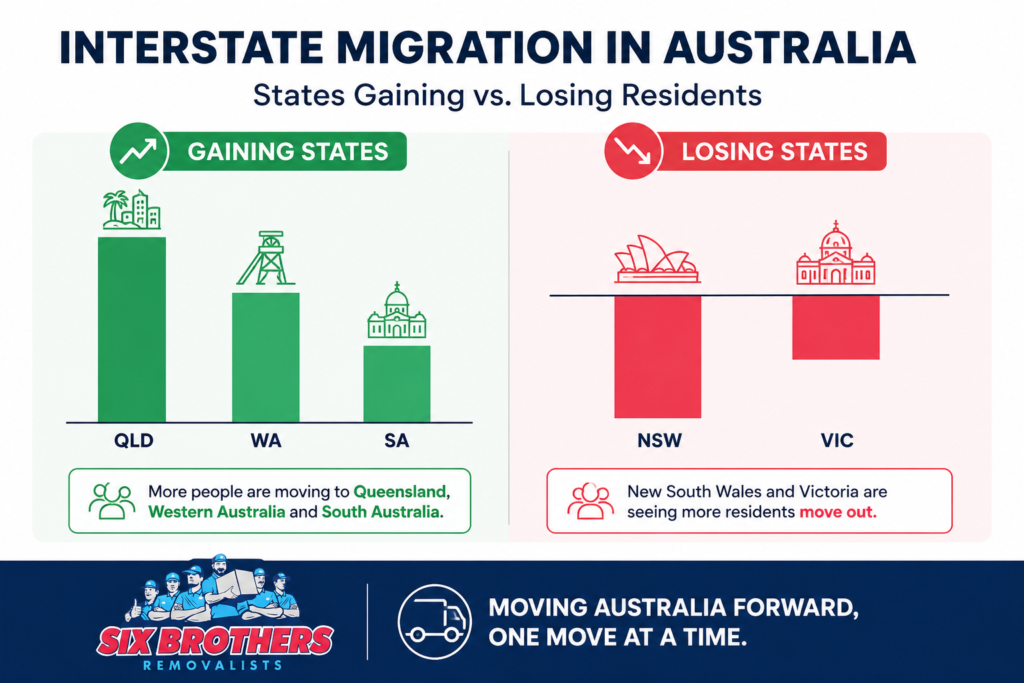
Queensland has been the standout winner of interstate migration for most of the past two decades, and that trend intensified from 2020 onward. ABS data shows Queensland gained the largest net interstate migration of any state in the year to June 2024, continuing a pattern that has added significant cumulative population pressure to South East Queensland in particular.
Western Australia has emerged as the second major destination, driven by mining sector employment, relative housing affordability compared to the eastern seaboard, and strong economic conditions. South Australia has also shifted from a net loser to a modest net gainer, with Adelaide attracting residents priced out of Sydney and Melbourne.
New South Wales and Victoria have been the primary source states. NSW has recorded net interstate migration losses in most years since 2013, with the outflow accelerating during 2020-2022. Victoria experienced a sharp reversal during Melbourne’s extended lockdowns, shifting from a net gainer to a net loser, though it has partially recovered since.
The Northern Territory and Tasmania show smaller but volatile patterns. Tasmania experienced a boom in arrivals during the remote-work period of 2020-2021, which has since moderated. The ACT remains relatively stable, with its migration patterns closely tied to federal government employment cycles.
Post-Pandemic Shifts in Migration Patterns
The COVID-19 pandemic didn’t create new migration trends so much as accelerate existing ones. The ability to work remotely removed the anchor that kept many workers in expensive capital cities. Suddenly, a software developer earning a Sydney salary could live on the Sunshine Coast. A Melbourne-based consultant could operate from Hobart.
This triggered a measurable surge in departures from Sydney and Melbourne during 2020 and 2021. Regional areas and smaller capitals saw unprecedented inflows. But as offices reopened and hybrid work settled into more structured patterns, some of that movement reversed or stabilised.
What didn’t reverse was the affordability-driven migration. People who moved to Queensland or regional NSW because they couldn’t afford Sydney didn’t come back when offices reopened. They’d already purchased homes, enrolled children in schools, and built new routines. The pandemic accelerated a structural shift that was already underway.
By 2024 and into 2025, the pattern has matured. Queensland and Western Australia continue to attract net arrivals, but the pace has moderated from the pandemic peak. The destinations have also shifted somewhat, with more migrants choosing established suburbs in Brisbane, Perth, and Adelaide rather than remote regional areas.
The Role of Remote Work and Lifestyle Migration
Remote and hybrid work fundamentally changed the relationship between where people earn money and where they live. Before 2020, your job largely dictated your city. Now, for a significant portion of the workforce, location is a choice rather than a constraint.
This has created a new category of interstate migrant: the lifestyle mover. These are typically higher-income professionals who relocate not for a specific job but for better weather, lower housing costs, proximity to beaches or nature, or simply more space. They bring purchasing power that can rapidly inflate housing markets in receiving areas.
The Sunshine Coast, Byron Bay hinterland, Gold Coast, and parts of regional Victoria all experienced this effect. Local residents found themselves competing with cashed-up arrivals from Sydney and Melbourne who could outbid them for properties. Rental markets tightened as some new arrivals rented while searching for homes to buy.
For the removalist industry, this trend has been transformative. Interstate moves that were once dominated by corporate relocations and young people chasing jobs now include a much broader demographic. Families, retirees, and self-employed professionals all contribute to sustained demand for long-distance moving services.
How Interstate Migration Directly Impacts Housing Demand
Understanding the mechanism by which migration translates into housing pressure is essential for anyone trying to make sense of property market movements. It’s not just about numbers. It’s about timing, location, and the type of housing people need.
Population Growth and Dwelling Demand
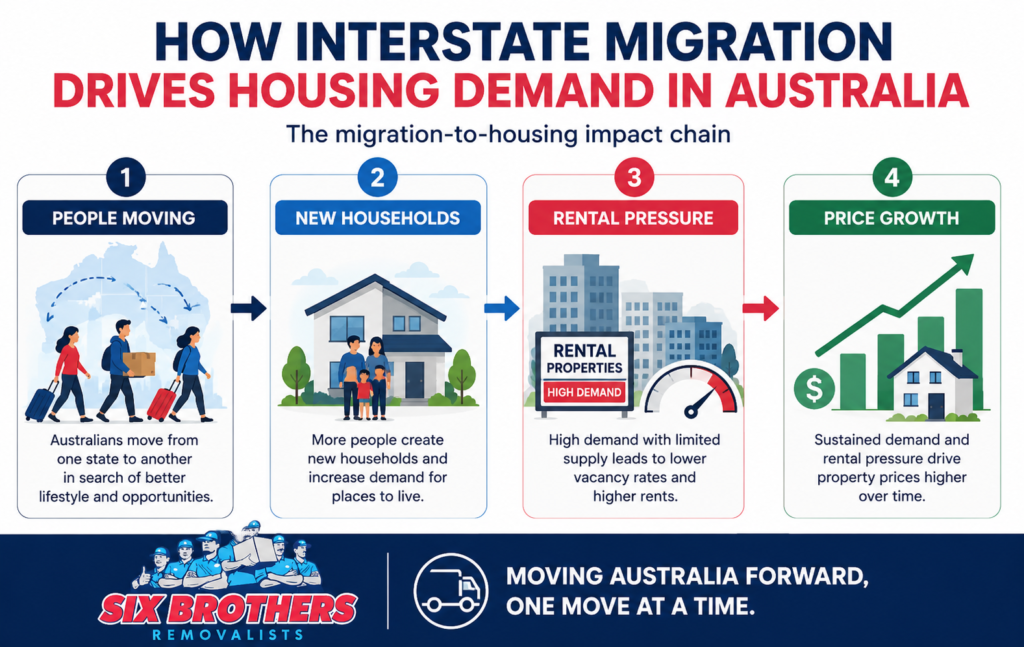
Every net interstate migrant needs a dwelling. The relationship is direct and measurable. Australia’s average household size sits at approximately 2.5 people, so every 2,500 net migrants to a state represent roughly 1,000 new households requiring accommodation.
But the impact isn’t evenly distributed. Migrants don’t spread uniformly across a state. They cluster in specific corridors, suburbs, and towns. In Queensland, the vast majority of interstate arrivals settle in South East Queensland, particularly Brisbane, the Gold Coast, and the Sunshine Coast. In Western Australia, Perth absorbs the lion’s share.
This concentration means that even modest net migration figures at the state level can create intense localised demand. A suburb that gains 500 new households in a year when only 200 new dwellings are completed will see prices and rents rise sharply. The mismatch between where people arrive and where housing gets built is one of the central tensions in Australian housing markets.
Rental Market Pressure in High-Migration Areas
Interstate migrants disproportionately enter the rental market first. Even those planning to buy typically rent for three to twelve months while they learn the local market, sell their previous property, or wait for settlement. This creates an immediate and measurable impact on rental vacancy rates.
SQM Research data has consistently shown that Brisbane’s rental vacancy rate dropped below 1% during the peak migration period of 2021-2023, a level that indicates extreme rental shortage. Perth experienced similar tightness. When vacancy rates fall that low, rents increase rapidly because landlords can be selective and tenants have few alternatives.
For renters already living in these areas, the effect is painful. Increased competition means higher rents, fewer options, and less bargaining power. Some existing renters are displaced to outer suburbs or forced to accept smaller or lower-quality accommodation. This ripple effect pushes demand outward from city centres into middle and outer ring suburbs.
Property Price Escalation Linked to Migration Corridors
The connection between interstate migration and property prices operates through basic supply and demand. More buyers competing for a limited number of properties pushes prices up. The effect is strongest in areas where new construction can’t keep pace with population growth.
Brisbane’s median house price increased substantially between 2020 and 2024, with interstate migration widely cited as a contributing factor alongside low interest rates and limited supply. Perth’s market, which had been flat or declining for years, turned sharply upward as Western Australia’s net interstate migration swung positive.
The price effect isn’t limited to the receiving state. In the source state, particularly NSW, the departure of residents can theoretically ease demand. However, Sydney’s housing market is influenced by so many factors, including overseas migration, investor activity, and supply constraints, that the interstate outflow hasn’t produced meaningful price relief. Instead, it has contributed to a compositional shift, with more overseas migrants and investors filling the gap left by departing residents.
Supply Constraints and Construction Lag
Australia’s housing construction industry cannot respond instantly to population shifts. From land acquisition to development approval to construction completion, the pipeline for new housing typically spans three to five years. When migration patterns shift rapidly, as they did during the pandemic, the construction sector is caught flat-footed.
States gaining population need more homes, but approvals, trades, and materials are finite. Housing Industry Association (HIA) data has shown that dwelling commencements in Queensland and Western Australia increased in response to demand, but not fast enough to close the gap created by sustained migration inflows.
Meanwhile, states losing population may see construction slow, but existing projects in the pipeline continue to completion. This can create temporary oversupply in some areas of Sydney or Melbourne even as Brisbane and Perth face acute shortages. The geographic mismatch between where homes are being built and where people are moving is a structural challenge that takes years to resolve.
Interstate Migration and Housing Demand in New South Wales
New South Wales occupies a unique position in Australia’s interstate migration story. It’s simultaneously the largest source of interstate departures and a major destination for overseas migrants. This creates complex and sometimes contradictory housing dynamics.
Why NSW Consistently Loses Residents to Other States
New South Wales has recorded net interstate migration losses in most years since the early 2010s. The primary driver is housing affordability. Sydney’s median house price remains the highest of any Australian capital, and the gap between Sydney and cities like Brisbane, Perth, and Adelaide has been wide enough to motivate relocation.
The typical NSW interstate leaver is a young family or couple in their late 20s to early 40s who have been priced out of home ownership in Sydney. They can sell a small apartment in Western Sydney and purchase a detached house with a yard in South East Queensland or regional NSW for the same money or less. The financial logic is compelling, especially when remote work reduces the career penalty of leaving Sydney.
Other factors include lifestyle preferences, particularly the appeal of warmer climates and less congestion, and employment opportunities in growing economies like Queensland’s and Western Australia’s. Some departures are also driven by retirees cashing out Sydney property equity and relocating to lower-cost areas.
Impact on Greater Western Sydney and Parramatta
Greater Western Sydney, including Parramatta, sits at the intersection of multiple migration forces. It loses some residents to interstate moves, particularly families seeking more affordable housing in Queensland. But it also gains residents from inner Sydney suburbs as people move west for more space, and from overseas migration, which disproportionately settles in Western Sydney.
The net effect on Parramatta and surrounding suburbs has been continued population growth despite interstate losses. The Greater Cities Commission and various NSW government planning documents identify Western Sydney as the primary growth corridor for the state, with infrastructure investments like the Western Sydney Airport and Sydney Metro West designed to support this expansion.
For housing demand, this means Parramatta remains a high-pressure market. Rental vacancy rates stay tight, new apartment developments are absorbed quickly, and competition for family homes in suburbs like Westmead, Merrylands, and Harris Park remains strong. The interstate migration outflow from NSW is real, but it hasn’t reduced demand in Western Sydney because other population sources fill the gap.
How Inbound Migration from Other States Affects NSW Housing
While NSW loses more residents interstate than it gains, it still receives significant inbound migration from other states. These arrivals tend to be younger, often moving for education or early-career employment in Sydney’s professional services, finance, and technology sectors.
Inbound interstate migrants to NSW typically enter the rental market in inner and middle-ring suburbs. They compete for apartments and share houses in areas with good public transport access to the CBD. This adds to rental demand in suburbs that are already among the most expensive in the country.
The compositional difference matters. NSW tends to lose families with children (who need houses) and gain young singles and couples (who need apartments). This shifts the demand profile and has implications for what type of housing should be built. It also means that the suburbs losing families, often in outer Western Sydney, may see different market dynamics than the inner-city areas gaining young professionals.
The Removalist Industry’s Role in Interstate Migration
Every interstate migration statistic represents a real household that needs to physically move their belongings from one state to another. The removalist industry is the operational backbone of this population redistribution.
How Migration Volumes Drive Demand for Interstate Removalists
When net interstate migration increases, so does demand for long-distance moving services. The relationship is direct. A household moving from Sydney to Brisbane needs a truck, a crew, packing materials, and potentially storage at one or both ends of the journey.
The pandemic-era migration surge created unprecedented demand for interstate removalists. Booking lead times stretched from the typical two to four weeks out to six or eight weeks during peak periods in 2021 and 2022. Prices increased as capacity was stretched thin, particularly on the Sydney-to-Brisbane and Melbourne-to-Brisbane corridors.
Even as migration volumes have moderated from their pandemic peak, demand for interstate removalist services remains elevated compared to pre-2020 levels. The structural shift toward greater population distribution across multiple states means ongoing, sustained demand for cross-border moving services.
Popular Interstate Moving Routes from NSW
The most heavily trafficked interstate moving routes from New South Wales reflect the broader migration patterns. Sydney to Brisbane and the Gold Coast is consistently the busiest corridor, driven by the affordability and lifestyle factors discussed earlier. Sydney to Melbourne remains high-volume in both directions, reflecting the economic ties between Australia’s two largest cities.
Sydney to Perth has grown significantly as Western Australia’s economy has strengthened. This is a particularly complex move due to the distance involved, typically requiring five to seven days for road transport or coordination with rail freight. Sydney to Adelaide has also increased as South Australia has become more attractive to NSW residents.
Regional routes matter too. Moves from Sydney to the NSW North Coast, particularly the Coffs Harbour to Byron Bay corridor, surged during the remote-work period. While technically intrastate, these moves reflect the same affordability and lifestyle motivations as interstate migration and require similar long-distance removalist services.
Backloading and Cost-Effective Interstate Moves
Backloading is a practical solution that emerges directly from migration flow imbalances. Because more people move from Sydney to Brisbane than from Brisbane to Sydney, trucks travelling southbound often have spare capacity. Removalists offer this return-trip space at reduced rates, making it a cost-effective option for budget-conscious movers.
The concept is straightforward. A full truckload travels from Sydney to Brisbane. Rather than returning empty, the removalist offers the truck space to someone moving in the opposite direction at a discounted price. The removalist covers fuel costs for the return trip, and the customer gets a cheaper move. Both parties benefit.
Backloading rates can be 30% to 50% lower than dedicated truck hire, depending on timing, flexibility, and the volume of goods. The trade-off is less control over exact pickup and delivery dates, since the backloading schedule depends on the primary load’s timing. For movers with flexible timelines, it’s one of the smartest ways to reduce interstate moving costs.
For a Parramatta-based removalist like Six Brothers Removalists, backloading is a core service offering. The high volume of moves from Western Sydney to Queensland and other states creates consistent opportunities to offer return-trip capacity to customers moving in the opposite direction.
Which Australian Regions Are Experiencing the Biggest Housing Demand Shifts
Not all regions are affected equally by interstate migration. Some areas are experiencing transformative growth, while others face stagnation or decline. Understanding these regional dynamics helps anyone planning a move or investment decision.
South East Queensland: The Biggest Winner
South East Queensland, encompassing Brisbane, the Gold Coast, the Sunshine Coast, Logan, Ipswich, and Moreton Bay, has absorbed the largest share of Australia’s interstate migrants over the past five years. The region’s combination of relative affordability, subtropical climate, improving infrastructure, and growing employment base has made it the default destination for Australians leaving Sydney and Melbourne.
The housing impact has been dramatic. Brisbane’s median house price, which historically sat well below Sydney and Melbourne, has closed the gap significantly. Suburbs that were considered affordable entry points five years ago have seen price increases of 40% to 60%. The rental market has been even more affected, with vacancy rates remaining critically low and rents increasing at double-digit annual rates through much of 2022-2024.
The Queensland government’s infrastructure pipeline, including the 2032 Olympic Games preparations, Cross River Rail, and various road upgrades, is both a response to and a driver of continued migration. These projects create jobs that attract more workers, who need more housing, in a self-reinforcing cycle.
Perth and Western Australia’s Resurgence
Western Australia’s housing market spent the better part of a decade in the doldrums following the end of the mining construction boom around 2014. Prices fell, population growth stalled, and the state recorded net interstate migration losses for several years.
That picture has reversed comprehensively. Strong commodity prices, particularly iron ore, have driven employment growth. Perth’s relative affordability compared to eastern capitals has attracted interstate migrants. And the state’s successful management of COVID-19 borders, while controversial at the time, created a perception of lifestyle quality that persisted after borders reopened.
Perth’s rental vacancy rate dropped to historic lows, and house prices have risen sharply from their post-boom trough. Regional Western Australia, particularly the Pilbara and South West, has also seen increased housing demand tied to mining employment and lifestyle migration respectively.
Regional Australia: Boom, Correction, and Stabilisation
Regional Australia experienced a remarkable housing boom during 2020-2022 as remote workers fled capital cities. Towns that had seen modest or flat price growth for years suddenly experienced double-digit annual increases. Rental markets that had been relaxed became impossibly tight.
The correction has been uneven. Some regional areas, particularly those within commuting distance of capital cities or with strong independent economies, have retained most of their gains. Others, especially smaller towns that attracted speculative buyers or short-term remote workers, have seen prices soften as some of those arrivals returned to cities.
The long-term outlook for regional housing demand depends heavily on the durability of remote work arrangements and continued infrastructure investment. Regions with reliable internet, healthcare, education, and transport connections are better positioned to retain their new residents than those lacking essential services.
What Interstate Migration Means for Homeowners, Renters, and Investors
The practical implications of interstate migration differ significantly depending on your position in the housing market. Whether you own, rent, or invest, these population shifts affect your financial decisions.
Implications for Homeowners Considering a Move
If you’re a homeowner in Sydney or Melbourne considering an interstate move, migration patterns work in your favour in some ways and against you in others. On the positive side, selling in a high-value market and buying in a lower-cost destination can free up significant equity. A homeowner selling a three-bedroom house in Parramatta for $1.2 million could purchase a comparable or larger property in Brisbane’s middle suburbs for $800,000 to $900,000, pocketing the difference or upgrading substantially.
The challenge is that you’re not the only one with this idea. High demand in destination markets means competition for desirable properties. You may face multiple-offer situations, properties selling above asking price, and limited stock in popular suburbs. Moving quickly and having finance pre-approved before you arrive gives you an advantage.
Timing your sale and purchase is also critical. Selling first and renting in the destination city while you search gives you certainty but adds the cost and disruption of two moves. Buying first with a bridging loan or simultaneous settlement reduces disruption but increases financial risk. Many interstate movers use short-term storage solutions to bridge the gap between selling and buying.
What Renters Need to Know About Migration-Driven Markets
Renters in high-migration destinations face the sharpest end of these trends. When thousands of new residents arrive in a city each quarter, and most of them enter the rental market first, competition for available properties intensifies rapidly.
Practical strategies for renters in tight markets include being prepared with documentation before inspections, offering longer lease terms for stability, considering suburbs slightly outside the most popular areas, and being realistic about what you can afford. In markets like Brisbane and Perth, where vacancy rates have been below 1%, flexibility on location and property type can make the difference between securing a home and missing out repeatedly.
For renters in source states like NSW, the picture is slightly more nuanced. While interstate departures theoretically reduce rental demand, Sydney’s rental market remains tight due to overseas migration, limited new supply, and strong underlying demand. The interstate outflow hasn’t translated into rental relief for most Sydney suburbs.
Investor Considerations in Migration Hotspots
Property investors closely watch interstate migration data because population growth is the most reliable predictor of long-term housing demand. Areas gaining residents consistently tend to see rising rents and property values, while areas losing population face the opposite risk.
The key consideration for investors is timing. By the time migration trends are widely reported in media, much of the price growth may have already occurred. The investors who benefited most from Queensland’s migration boom were those who purchased in 2018-2019, before the pandemic accelerated the trend. Those buying at the peak of media attention in 2022-2023 paid significantly more.
Investors should also consider the sustainability of migration flows. Are people moving to an area for structural reasons like affordability, employment, and infrastructure that will persist? Or are they responding to temporary factors like pandemic-era remote work flexibility that may fade? Areas with diversified economies and ongoing infrastructure investment present lower risk than those dependent on a single driver.
Planning an Interstate Move: Practical Considerations
Understanding migration trends is valuable context, but if you’re actually planning an interstate move, you need practical guidance on logistics, costs, and timelines.
How to Budget for an Interstate Relocation
Interstate moving costs vary significantly based on distance, volume of belongings, and the services you require. A basic interstate move from Sydney to Brisbane for a three-bedroom house typically ranges from $3,000 to $7,000 for transport alone, depending on whether you choose a dedicated truck or backloading service.
Additional costs to budget for include packing materials ($200 to $500 for a full house), professional packing services ($500 to $1,500), insurance coverage, storage if needed ($200 to $400 per month for a standard unit), and cleaning costs at your departure property. Don’t forget administrative costs like mail redirection, utility disconnection and reconnection, and vehicle registration transfer.
A realistic total budget for an interstate move from Sydney to Brisbane or Melbourne, including all ancillary costs, typically falls between $5,000 and $12,000 for a family home. Getting multiple quotes and understanding exactly what’s included in each quote is essential. The cheapest quote isn’t always the best value if it excludes services you’ll need.
Choosing the Right Removalist for Interstate Moves
Selecting a removalist for an interstate move requires more due diligence than a local move. The longer distance, multi-day timeline, and higher value at risk mean you need a company with genuine interstate experience, proper insurance, and reliable communication.
Key factors to evaluate include the company’s experience on your specific route, whether they use their own trucks or subcontract, what insurance coverage is included and what additional coverage is available, their process for handling delays or damage, and whether they provide a fixed quote or an estimate that can change.
Ask for references from recent interstate customers on your route. Check online reviews, but focus on detailed reviews that describe the actual moving experience rather than generic praise. A company that’s excellent at local moves in Parramatta may not have the logistics capability for a smooth interstate relocation.
Look for removalists who offer end-to-end service including packing, transport, and unpacking at the destination. Managing multiple providers for different parts of an interstate move adds complexity and creates gaps in accountability if something goes wrong.
Timeline and Logistics for Moving Between States
Interstate moves require more planning time than local relocations. A realistic timeline starts six to eight weeks before your moving date for booking a removalist, particularly during peak periods like the end of financial year (June-July) and the summer holiday period (December-January).
The physical move itself typically takes two to five days for east coast corridors like Sydney to Brisbane or Sydney to Melbourne. Perth moves from the eastern states take five to seven days by road. During transit, you’ll need accommodation and essentials packed separately in a suitcase or your car.
Administrative tasks should begin four to six weeks before the move. These include notifying your employer, transferring or finding new schools, updating your address with banks and government agencies, arranging utility connections at your new address, and transferring vehicle registration and driver’s licence to the new state.
If you’re moving with pets, research the logistics early. Interstate pet transport has its own requirements and costs. If you’re moving with plants, be aware that some states have quarantine restrictions on certain plant species.
Future Outlook: How Migration Trends May Shape Housing Demand
Looking ahead, several factors will influence whether current migration patterns continue, accelerate, or reverse. Understanding these drivers helps homeowners, renters, and investors make better decisions.
Infrastructure Projects Influencing Migration Decisions
Major infrastructure investments shape migration patterns by improving liveability and employment opportunities in specific regions. Queensland’s 2032 Olympic Games preparations are driving billions of dollars in transport, sporting, and urban renewal infrastructure across South East Queensland. This spending creates construction jobs in the short term and improved amenity in the long term, both of which attract migrants.
In New South Wales, the Western Sydney Airport at Badgerys Creek and the surrounding Aerotropolis development aim to create a new economic centre that could reduce the incentive for Western Sydney residents to leave the state. If the airport generates the employment growth projected, it may retain residents who would otherwise move interstate for affordability reasons.
Perth’s Metronet rail expansion and various urban infill projects are improving the city’s liveability and transport connectivity, supporting its attractiveness as a migration destination. Adelaide’s similar investments in health, defence, and education infrastructure underpin South Australia’s improved migration position.
Policy Changes That Could Shift Migration Patterns
Government policy at both state and federal levels influences migration patterns, sometimes intentionally and sometimes as an unintended consequence. Housing affordability policies, including stamp duty concessions, first home buyer grants, and planning reforms, can make specific states more or less attractive to potential migrants.
State-based incentives to attract workers in specific industries, such as Queensland’s efforts to recruit healthcare workers or Western Australia’s mining sector visa arrangements, directly influence who moves where. Federal immigration policy also matters because overseas migrants who initially settle in Sydney or Melbourne may subsequently move interstate, contributing to secondary migration flows.
Planning and zoning reforms that increase housing supply in high-demand areas could moderate price growth and reduce the affordability gap that drives interstate migration. Conversely, restrictive planning that limits new housing in popular destinations will intensify price pressures and potentially redirect migration to alternative locations.
Predicted Migration Corridors for the Next Five Years
Based on current trends, infrastructure pipelines, and economic fundamentals, several migration patterns are likely to persist through to 2030. Queensland will likely remain the primary destination for interstate migrants from NSW and Victoria, though the pace may moderate as Brisbane’s affordability advantage narrows.
Western Australia’s attractiveness will depend heavily on commodity prices and the mining sector’s labour needs. If iron ore and lithium demand remains strong, Perth will continue to attract workers and their families from eastern states. A significant commodity downturn could reverse this flow, as happened after 2014.
South Australia and Tasmania occupy interesting positions. Adelaide’s growing defence and technology sectors provide a more diversified economic base than in previous decades, potentially sustaining positive net migration. Tasmania’s appeal may be more cyclical, tied to lifestyle factors and remote work trends that could fluctuate.
For New South Wales, the critical question is whether infrastructure investment and housing supply reforms can slow the interstate outflow. The Western Sydney Airport, new metro lines, and increased housing targets represent a significant effort to improve liveability and affordability. Whether these investments are sufficient to change the migration calculus for families considering a move to Queensland remains to be seen.
Conclusion
Interstate migration is one of the most significant forces shaping housing demand across Australia. From the sustained outflow of residents from New South Wales to the population booms in Queensland and Western Australia, these movements directly determine rental availability, property prices, and the type of housing needed in every major region.
For anyone in Parramatta or Greater Western Sydney weighing up a local move, an interstate relocation, or simply trying to understand why their local housing market behaves the way it does, migration data provides essential context. The decisions thousands of households make each quarter ripple through every suburb, every rental listing, and every auction room.
At Six Brothers Removalists, we help families and businesses navigate these moves every day, whether it’s across Parramatta or across the country. If you’re planning a relocation and want a team that understands the logistics of interstate moving inside and out, get in touch for a straightforward quote and a stress-free experience from start to finish.
Frequently Asked Questions
How does interstate migration affect rental prices in Sydney?
Interstate migration from NSW reduces some rental demand, but Sydney’s rental market remains tight due to strong overseas migration and limited new supply. The net effect for most Sydney suburbs has been minimal rental relief despite tens of thousands of residents leaving the state each year.
Which Australian state is gaining the most residents from interstate migration?
Queensland has consistently gained the most net interstate migrants over the past five years, with South East Queensland absorbing the majority of arrivals. Western Australia is the second largest net gainer, driven by mining employment and relative affordability.
Does interstate migration make housing more affordable in the states people leave?
Not significantly in most cases. While departures theoretically reduce demand, source states like NSW and Victoria continue to receive overseas migrants and face supply constraints that keep prices elevated. The affordability benefit of interstate outflows is largely offset by other demand sources.
How long does an interstate move from Sydney to Brisbane typically take?
The physical transport of belongings from Sydney to Brisbane usually takes two to three days by road. The entire relocation process, including packing, transit, and unpacking, typically spans four to seven days depending on the volume of belongings and services booked.
What is backloading and how does it reduce interstate moving costs?
Backloading uses spare truck capacity on return trips to offer discounted moving rates. Because more people move from Sydney to Brisbane than the reverse, trucks heading south often have space available at 30% to 50% below standard rates. The trade-off is less flexibility on exact dates.
How does the 2032 Brisbane Olympics affect interstate migration to Queensland?
The Olympics are driving billions in infrastructure spending across South East Queensland, creating construction jobs and improving transport, sporting, and urban amenity. This investment attracts workers and enhances liveability, reinforcing Queensland’s position as the top interstate migration destination.
What should I budget for an interstate move from Parramatta to another state?
A realistic budget for a three-bedroom house move from Parramatta to Brisbane or Melbourne ranges from $5,000 to $12,000 including transport, packing materials, insurance, storage, and administrative costs. Getting detailed quotes from multiple removalists helps you plan accurately.
How far in advance should I book a removalist for an interstate move?
Book six to eight weeks ahead for standard periods and eight to twelve weeks during peak seasons like December to January and June to July. Interstate moves require more lead time than local relocations due to route scheduling and truck availability.
Does remote work still drive interstate migration in Australia?
Yes, though the effect has moderated from its 2020-2021 peak. Hybrid work arrangements continue to give many workers flexibility to live further from their employer’s office, supporting ongoing migration to more affordable or lifestyle-oriented locations.
How does interstate migration affect housing construction in receiving states?
Receiving states face pressure to increase housing supply, but construction typically lags population growth by three to five years. This mismatch between migration-driven demand and construction pipeline capacity is a primary reason prices and rents rise sharply in high-migration areas.