
Table of Contents
Moving to a new state is one of the biggest life transitions you can make, and the real work starts after the truck is unloaded. From transferring your driver’s licence and updating your address to finding a new GP and learning which bin goes out on which night, settling in takes deliberate planning across dozens of small but critical tasks.
Whether you’re relocating from Parramatta to Queensland or arriving in NSW from interstate, the weeks after your move determine how quickly your new place feels like home. Get the essentials sorted early and the rest falls into place faster than you’d expect.
This guide walks you through every stage of settling into a new state, covering admin, housing setup, community connections, employment, finances, healthcare, and the emotional side of starting fresh.
Why Settling Into a New State Feels Overwhelming
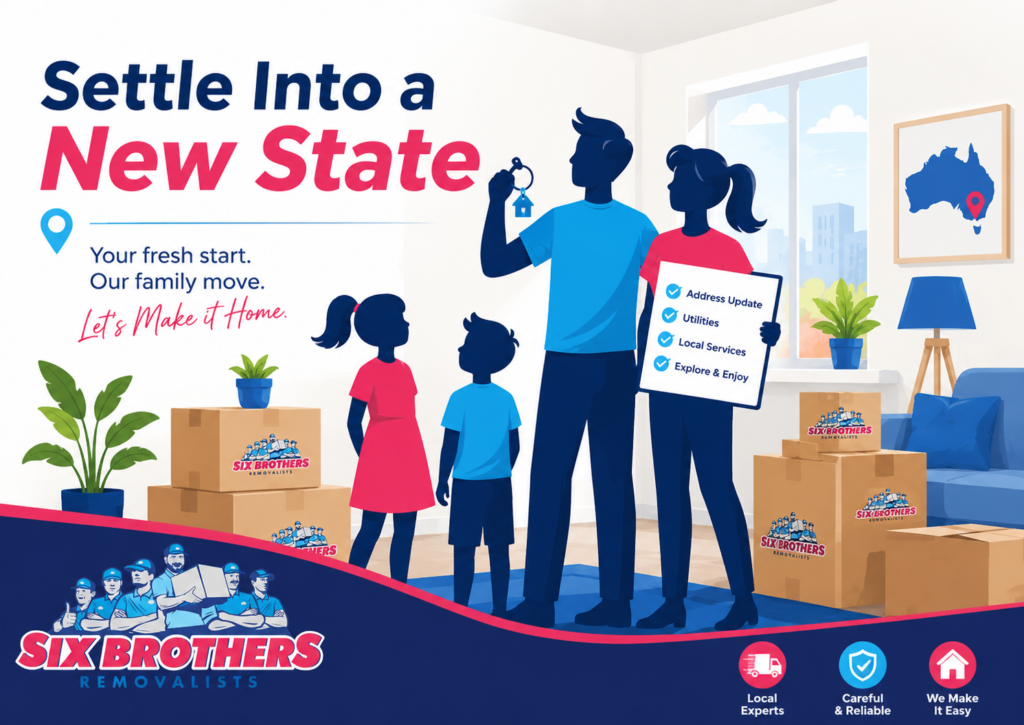
Moving interstate is not the same as shifting suburbs. When you cross a state border, almost everything resets. Your car registration, your electoral enrollment, your kids’ school zones, your healthcare providers, even your energy retailer. The sheer volume of tasks creates a kind of decision fatigue that catches most people off guard.
The Emotional Weight of Interstate Relocation
Leaving behind familiar streets, neighbours, and routines triggers a genuine grief response for many people. You might feel excited about the move one day and deeply unsettled the next. This is normal. Psychologists refer to it as relocation stress syndrome, and it affects adults just as much as children.
The loss of your social safety net hits hardest in the first few weeks. You don’t yet know who to call when something goes wrong, which mechanic is trustworthy, or where to grab a decent coffee. These micro-uncertainties accumulate.
Acknowledging the emotional weight does not mean the move was a mistake. It means you are human, adjusting to a significant change. Give yourself permission to feel unsettled while you work through the practical steps below.
Common Challenges When Moving to a Different State
Every interstate mover faces a predictable set of hurdles. Understanding them upfront helps you plan rather than react.
Administrative overload is the biggest one. Each Australian state and territory has its own rules for driver’s licences, vehicle registration, and certain professional licences. You typically have a limited window, often 14 to 90 days, to complete transfers before penalties apply.
Service disruption is another common pain point. Your internet, electricity, and gas providers may not operate in your new state. You will need to disconnect, reconnect, or switch entirely, and timing these transitions around your move date requires coordination.
Social isolation ranks consistently among the top stressors. Without an existing network, even simple tasks like finding a reliable dentist or a good school become research projects.
Financial surprises also catch people out. Stamp duty rates, insurance premiums, and even grocery prices vary between states. Your cost of living may shift in ways you did not budget for.
How Long Does It Typically Take to Feel Settled?
There is no single answer, but most research and anecdotal evidence points to a range. Basic administrative tasks, such as updating your licence, enrolling children in school, and setting up utilities, can be completed within two to four weeks if you stay organised.
Feeling socially connected takes longer. Many interstate movers report that it takes three to six months before they have a reliable local network. Feeling truly “at home,” where the new state feels like yours, often takes closer to 12 months.
The timeline shortens significantly when you are proactive. People who join local groups, explore their neighbourhood early, and establish routines tend to adjust faster than those who wait for connection to happen organically.
Preparing Before You Arrive in Your New State
The settling-in process actually begins before you leave. The more groundwork you lay in advance, the smoother your first weeks will be.
Researching Your New Location Thoroughly
Do not rely solely on a quick Google search. Spend time understanding the specific area you are moving to, not just the state in general.
Look into local council websites for information on waste collection schedules, parking permits, pet registration, and community facilities. Check public transport routes and frequency if you will be commuting. Research school catchment zones if you have children, as enrolment priority often depends on your residential address.
Study the local climate and how it differs from what you are used to. Moving from Sydney to Melbourne means preparing for genuinely different weather patterns. Moving from coastal NSW to inland Queensland means adjusting to heat, humidity, and potentially cyclone season.
Read local community forums and Facebook groups to get a feel for the neighbourhood. Residents will tell you things that no real estate listing ever will, from noise issues to the best weekend markets.
Sorting Out Housing and Lease Agreements
If you are renting, secure your lease as early as possible. Rental markets in Australian capital cities move fast, and interstate applicants sometimes face additional scrutiny from property managers who cannot easily verify references.
Prepare a rental application pack in advance. Include certified copies of identification, recent payslips or employment contracts, your rental history, and references from previous landlords or agents. Having this ready to submit immediately gives you an edge.
If you are buying, engage a local conveyancer or solicitor who understands the property laws in your new state. Contract conditions, cooling-off periods, and settlement processes differ between NSW, Victoria, Queensland, and other states.
For the interim period, consider short-term accommodation such as serviced apartments or Airbnb stays. This gives you a base while you finalise permanent housing without the pressure of making rushed decisions.
Creating a Pre-Move Checklist
A written checklist is not optional for interstate moves. It is essential. Break your tasks into three phases: before the move, during the first week, and during the first month.
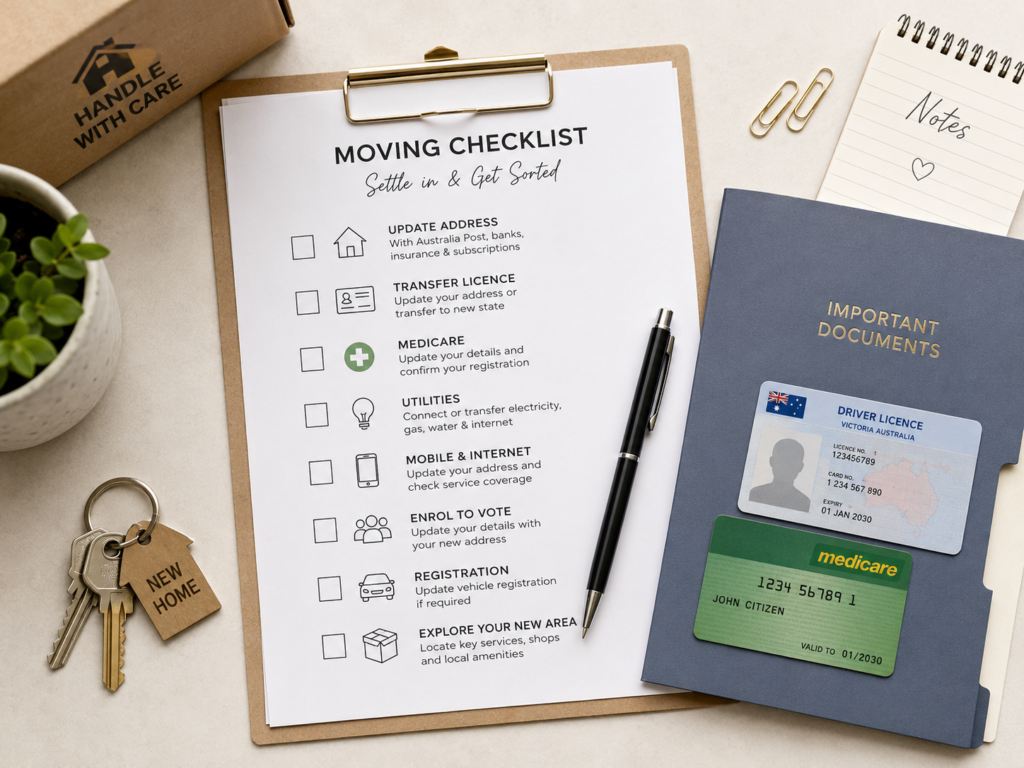
Before the move, notify your current utility providers, redirect your mail through Australia Post, inform your bank and insurance companies, and arrange for your belongings to be packed and transported.
During the first week, focus on immediate needs. Connect electricity, gas, water, and internet. Locate the nearest supermarket, pharmacy, and medical centre. Unpack essentials and set up sleeping and cooking areas first.
During the first month, tackle the administrative transfers. Update your driver’s licence, transfer vehicle registration, enrol children in school, register with a local GP, and update your electoral enrolment.
Keep this checklist visible, on your fridge or as a pinned note on your phone, and check items off as you go. The sense of progress helps counter the feeling of being overwhelmed.
Handling Administrative Tasks in Your New State
Administration is the least exciting part of settling in, but it is the most time-sensitive. Missing deadlines can result in fines, lapsed coverage, or legal complications.
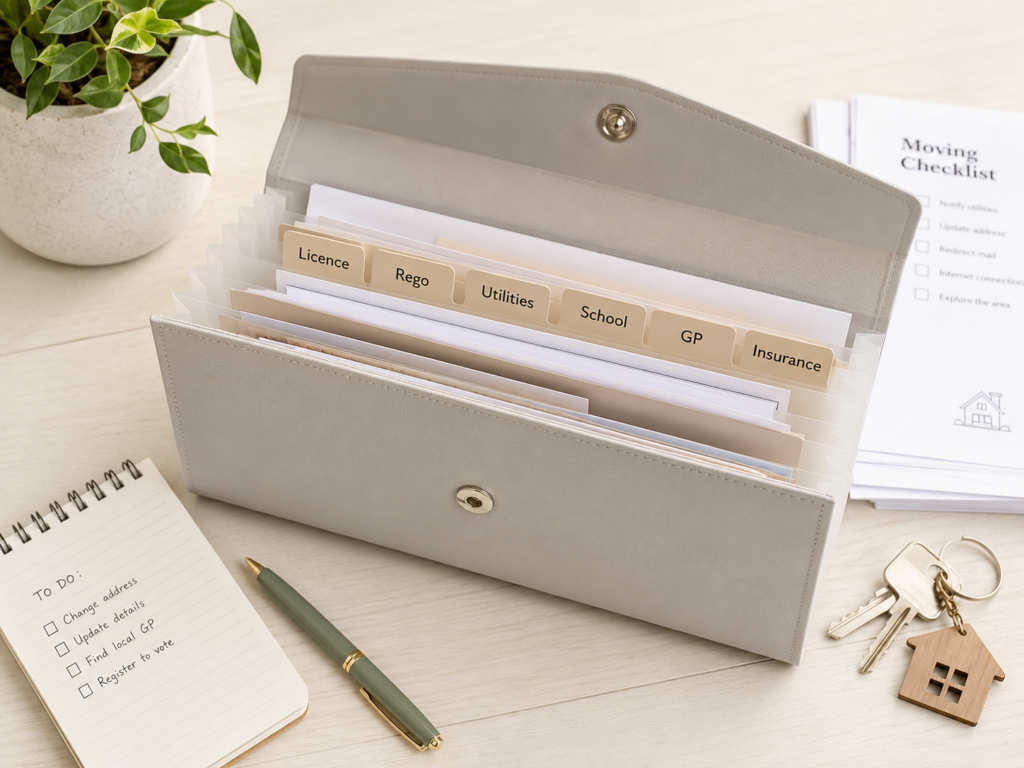
Updating Your Driver’s Licence and Vehicle Registration
Every Australian state requires you to transfer your driver’s licence within a set period after establishing residency. In NSW, you must apply for a NSW licence within three months of becoming a resident. Other states have similar windows.
Visit your local transport authority, such as Service NSW, VicRoads, or the Department of Transport in Queensland, with your current licence, proof of identity, and proof of your new address. You may need to pass a knowledge test or eyesight check depending on the state and your licence class.
Vehicle registration must also be transferred. This involves obtaining a safety inspection (pink slip, roadworthy certificate, or equivalent depending on the state), paying any applicable stamp duty, and surrendering your old registration plates. Budget for this cost, as it can run into several hundred dollars depending on your vehicle’s value.
Do not let this slide. Driving on an out-of-state licence beyond the grace period can result in fines, and your insurance may not cover you if your registration details are incorrect.
Enrolling to Vote and Updating Your Electoral Details
Updating your electoral enrolment is a legal requirement in Australia. Once you have lived at your new address for one month, you must update your details with the Australian Electoral Commission (AEC). You can do this online through the AEC website in a few minutes.
If you have moved interstate, your enrolment will shift to your new federal electorate and state electorate. This matters not only for federal elections but also for state and local government elections, which operate on different schedules and rules in each state.
Failing to update your enrolment can result in fines if you miss an election or vote in the wrong electorate.
Transferring Medical Records and Finding New Providers
Contact your current GP, dentist, specialist, and any allied health providers before you move. Request copies of your medical records, including vaccination history, ongoing prescriptions, referral letters, and any diagnostic imaging or test results.
In your new state, register with a local GP as soon as possible. Do not wait until you are sick. Use the government’s Health Direct service or ask neighbours for recommendations. If you have ongoing prescriptions, your new GP will need your medical history to continue them without interruption.
Check whether your private health insurance covers you in the new state. Most national funds provide coverage anywhere in Australia, but hospital agreements and preferred provider networks may differ. Contact your fund to confirm and update your address.
If you have children with specific medical or developmental needs, arrange specialist referrals early. Wait times for paediatricians, psychologists, and therapists can be long, and getting on a waitlist sooner makes a significant difference.
Setting Up Utilities and Essential Services
Contact electricity, gas, and water providers in your new state before your move date. In deregulated markets like NSW and Victoria, you can compare retailers through government comparison sites such as Energy Made Easy or the Victorian Energy Compare tool.
Arrange internet and phone connections at least two weeks before you move. NBN connections can take time, especially if the previous occupant disconnected the service. Check what NBN technology type is available at your new address, as this affects speed and provider options.
Set up mail redirection through Australia Post. A 12-month redirection covers most scenarios and ensures you do not miss important correspondence from banks, insurers, or government agencies during the transition.
Register with your local council for waste collection services. Some councils require you to register or request bins for your new property. This is also the time to learn the collection schedule and recycling rules, which vary between councils.
Getting Your New Home Set Up and Organised
Once the admin is underway, turn your attention to making your new house feel like a home. This is where the physical and emotional sides of settling in converge.
Unpacking Strategically Room by Room
Resist the urge to unpack everything at once. Start with the rooms that affect your daily functioning: kitchen, bathroom, and bedrooms. Having a functioning kitchen means you can cook meals instead of relying on takeaway. A made bed gives you a proper place to rest after long days of unpacking.
Label your boxes clearly during packing, or better yet, have your removalist team label them by room. This saves hours of searching and reduces the chaos of the first few days.
Set up one room completely before moving to the next. A fully unpacked kitchen surrounded by box-filled rooms feels more manageable than five half-unpacked rooms. Progress in one area creates momentum.
Leave decorative items, books, and non-essentials for last. These are the things that make a house feel personal, but they are not urgent. Focus on function first, comfort second, and aesthetics third.
Arranging Furniture and Making the Space Functional
Your old furniture layout will not necessarily work in your new home. Room dimensions, window placements, power outlet locations, and natural light patterns all differ. Spend time experimenting with arrangements before committing.
Prioritise flow. You should be able to move through main living areas without navigating around furniture. In bedrooms, ensure wardrobes and drawers are accessible without blocking doors.
If you are missing key pieces, do not rush to buy everything at once. Live in the space for a few weeks first. You will quickly learn what you actually need versus what you assumed you would need.
For home offices, position your desk near a window for natural light and ensure your internet router is within reasonable range. If you are working remotely, a functional workspace is not a luxury. It is a necessity from day one.
Checking Safety Features and Home Maintenance Needs
Before you fully settle in, walk through the property with a critical eye. Test all smoke alarms and replace batteries if needed. In most Australian states, working smoke alarms are a legal requirement, and landlords must ensure compliance.
Check that locks on all doors and windows function properly. If you are renting, report any issues to your property manager immediately. If you have bought the property, consider rekeying locks for security, as you do not know how many copies of the old keys exist.
Locate your meter box, water shut-off valve, and fuse box. Knowing where these are before an emergency saves time and stress. Test the hot water system and check for any leaks under sinks or around toilets.
If the property has outdoor areas, inspect fencing, gates, and any pool barriers. Pool fencing compliance is strictly enforced across Australian states, and non-compliance can result in significant fines.
Connecting With Your New Community
A house becomes a home when you know the people around it. Building community connections is the single most important factor in how quickly you feel settled.
Introducing Yourself to Neighbours
This step is simple but surprisingly effective. Knock on a few doors in your first week, introduce yourself, and have a brief chat. You do not need to bring gifts or make it a formal event. A friendly hello and a quick introduction is enough.
Neighbours are your most immediate source of local knowledge. They can tell you about parking rules, bin night, noise expectations, and which local businesses are worth supporting. They are also the people most likely to notice if something is wrong at your property while you are away.
If face-to-face introductions feel awkward, a note in the letterbox works too. Something brief: your name, that you have just moved in, and that you are happy to be in the neighbourhood.
Finding Local Groups, Clubs, and Social Activities
Every Australian community has a network of clubs, groups, and organisations. Sporting clubs, bushwalking groups, book clubs, volunteer organisations, parents’ groups, and cultural associations all provide structured ways to meet people.
Check your local council’s website for a community directory. Libraries often run free events and workshops. Neighbourhood centres and community halls host regular activities ranging from yoga classes to language exchanges.
If you have children, school communities become a natural social hub. Attend school events, volunteer for canteen duty or reading groups, and introduce yourself to other parents at drop-off and pick-up.
Online platforms like Meetup, Facebook community groups, and Nextdoor can also help you find local events and connect with people in your area. The key is to show up consistently. One-off attendance rarely leads to lasting connections.
Exploring Your Neighbourhood and Surrounding Areas
In your first few weeks, make a deliberate effort to explore. Walk or drive around your neighbourhood at different times of day. Visit the local shops, cafes, parks, and public spaces. Find your nearest library, post office, and emergency services.
Explore beyond your immediate area too. Identify the closest major shopping centre, hospital, and recreational facilities. If you are in a new city, spend weekends visiting different suburbs and landmarks. Familiarity breeds comfort, and the more you know your surroundings, the less foreign they feel.
Take note of what your new area offers that your old one did not. A nearby beach, a better park, a thriving cafe strip, a weekend farmers’ market. Focusing on what you have gained, rather than what you have left behind, helps shift your mindset.
Managing Finances After an Interstate Move
Moving interstate has financial implications that extend well beyond the cost of the move itself. Getting your finances sorted early prevents surprises down the track.
Updating Your Bank, Insurance, and Superannuation Details
Contact your bank to update your residential address. This affects where your statements are sent, which branch is your home branch, and potentially which ATM network you have fee-free access to. If your bank does not have branches in your new state, consider whether it is time to switch.
Update your address with every insurance provider: home and contents, car, health, life, and income protection. Your premiums may change based on your new location. Postcode-based risk factors affect car insurance in particular, so your premium could go up or down depending on where you have moved.
Notify your superannuation fund of your new address. While super is a national system, keeping your contact details current ensures you receive important correspondence about your retirement savings.
If you have investments, shares, or other financial products, update your details with each provider. The ATO also needs your current address for tax correspondence.
Understanding Cost of Living Differences Between States
The cost of living varies meaningfully between Australian states and even between cities within the same state. Housing is typically the biggest variable, but groceries, utilities, transport, and insurance also differ.
Research the average costs in your new area for rent or mortgage repayments, electricity and gas, public transport fares, childcare fees, and groceries. Government resources like the ABS Household Expenditure Survey provide useful benchmarks.
Adjust your budget accordingly. If you have moved from a lower-cost area to a higher-cost one, identify where you can offset the difference. If you have moved somewhere cheaper, resist the temptation to inflate your lifestyle immediately. Use the savings to build an emergency fund or pay down debt.
Be aware of state-specific taxes and charges. Stamp duty on property purchases, land tax thresholds, and vehicle registration costs all vary. These are not small differences. Stamp duty alone can vary by thousands of dollars between states for the same property value.
Budgeting for the Transition Period
The first three months after an interstate move are typically the most expensive. You are paying for connection fees, bond and advance rent, new furniture or appliances, and all the small purchases that come with setting up a new home.
Create a dedicated moving budget that covers these transition costs separately from your regular monthly expenses. Include a buffer of at least 10 to 15 percent for unexpected costs, because there will be unexpected costs.
Track your spending closely during this period. It is easy to lose sight of how much you are spending when everything feels like a necessary purchase. Use a budgeting app or a simple spreadsheet to stay on top of it.
If money is tight, prioritise spending on essentials and defer non-urgent purchases. You do not need to furnish and decorate your entire home in the first month. Settle in gradually and spread the cost over several months.
Employment and Career Considerations in a New State
If your move is not tied to a job transfer, finding employment in your new state is likely a top priority. Even if you are moving with a job, there are professional adjustments to navigate.
Job Searching Before and After the Move
Start your job search before you move. Update your resume with your intended new address or at least the city and state you are relocating to. Many employers filter applications by location, and an out-of-state address can work against you.
Use job platforms like Seek, Indeed, and LinkedIn to search for roles in your new area. Set up alerts for your target roles and industries. Research the local job market to understand which industries are strong in your new state and which are contracting.
Networking is particularly valuable for interstate job seekers. Connect with professionals in your industry who are based in your new city. Attend industry events, join local professional associations, and let your existing network know you are relocating.
If you are self-employed or run a business, research any state-specific licensing or registration requirements. Some professions, such as real estate agents, builders, and electricians, require state-based licences that do not automatically transfer.
Transferring Professional Licences and Registrations
Certain professions require state-specific registration or licensing. If you hold a professional licence in your current state, check whether it is recognised in your new state and what the transfer process involves.
Nationally recognised professions, such as medicine, nursing, and law, have mutual recognition frameworks that simplify the process. However, you may still need to notify the relevant board and update your registration details.
Trade licences, such as those for electricians, plumbers, and builders, often require a separate application in the new state. Contact the relevant state authority well before your move to understand the requirements and timeline.
Do not assume your qualifications will be automatically recognised. Start the transfer process early to avoid gaps in your ability to work legally in your new state.
Understanding Workplace Rights and State-Specific Regulations
While most employment law in Australia is governed by the federal Fair Work system, some state-specific regulations still apply. Public sector employees, for example, may be covered by state industrial relations systems rather than the national system.
Workers’ compensation is state-based. If you are injured at work, the scheme that covers you depends on which state you work in, not which state you live in. Familiarise yourself with the workers’ compensation authority in your new state.
Long service leave entitlements can also vary. Some states have portable long service leave schemes for certain industries, such as construction and cleaning. Check whether your accrued entitlements transfer or need to be claimed before you move.
Helping Your Family Adjust to the New State
If you are moving with a partner, children, or elderly family members, their adjustment is just as important as your own. A family that settles in together settles in faster.
Supporting Children Through the Transition
Children experience relocation differently depending on their age. Younger children may adapt quickly but need reassurance and routine. Teenagers often struggle more, particularly if they are leaving established friendships and social groups.
Involve children in the move as much as possible. Let them help choose the layout of their new room. Take them to visit their new school before the first day. Walk them through the neighbourhood and show them where the parks, shops, and other landmarks are.
Maintain routines from your old home. Bedtimes, meal routines, and family activities provide continuity during a period of significant change. If your child had regular activities like swimming lessons or music classes, find equivalent options in your new area as soon as possible.
Watch for signs of distress: changes in sleep patterns, appetite, behaviour, or school performance. Some adjustment difficulty is normal, but persistent issues may benefit from professional support. School counsellors and child psychologists can help children process the transition.
Helping Partners and Spouses Find Their Footing
If one partner initiated the move for work or personal reasons, the other partner may feel like they have less ownership of the decision. This imbalance can create resentment if it is not acknowledged and addressed.
Encourage your partner to pursue their own connections and interests in the new location. Support them in finding work, joining groups, or exploring the area independently. Their sense of belonging should not depend entirely on your social or professional network.
Make time for shared exploration. Visit new restaurants, explore local attractions, and establish new routines together. These shared experiences create positive associations with your new home and strengthen your relationship during a stressful period.
Communicate openly about how you are both feeling. Moving interstate puts pressure on even strong relationships. Regular check-ins, even informal ones, help you stay aligned and support each other through the adjustment.
Relocating With Pets to a New State
Pets are affected by moves too. Changes in environment, routine, and even climate can cause stress, anxiety, and behavioural changes in dogs, cats, and other animals.
Before you move, check whether your new state has any specific regulations regarding pet ownership. Some council areas have breed-specific legislation, cat containment policies, or limits on the number of pets per household.
Register your pet with your new local council as soon as you arrive. Update the microchip details with your new address and contact information. Find a local vet and transfer your pet’s medical records.
When you arrive, set up a familiar space for your pet with their bed, toys, and food bowls. Keep them confined to one area initially and gradually introduce them to the rest of the house and yard. Maintain their feeding and walking schedule as closely as possible to provide stability.
Healthcare and Wellbeing in Your New State
Your health infrastructure needs to be rebuilt in your new location. This is not just about finding a doctor. It is about establishing a complete support network.
Registering With a New GP and Specialists
Finding a good GP is one of the most important things you can do in your first few weeks. A GP is your gateway to the broader healthcare system, including specialist referrals, mental health plans, prescriptions, and preventive care.
Ask neighbours, colleagues, or local community groups for recommendations. Check the Healthdirect service finder for GPs accepting new patients in your area. Consider factors like bulk billing availability, opening hours, and proximity to your home.
If you see specialists regularly, ask your current specialists for referrals to colleagues in your new state. Specialist wait times vary significantly between states and regions, so get referrals in early.
Transfer your medical records, including imaging, pathology results, and treatment histories. Your new providers need this information to deliver continuity of care. Most practices can receive records electronically through My Health Record or secure transfer.
Accessing Mental Health Support During the Transition
The stress of an interstate move can trigger or exacerbate mental health conditions. Anxiety, depression, and adjustment disorders are all common responses to major life changes.
If you have an existing mental health plan, it remains valid in your new state. However, you will need a new GP to manage it going forward. If your plan is due for renewal, your new GP can create a new one.
Access to psychologists and counsellors varies by location. In metropolitan areas, you will generally have more options but may face longer wait times. In regional areas, telehealth services can fill the gap.
Do not wait until you are in crisis to seek support. If you are feeling persistently low, anxious, or unable to cope, reach out early. Beyond Blue, Lifeline, and headspace all offer immediate support and can help you find local services.
Maintaining Physical Health and Finding Fitness Options
Maintaining your physical health routine helps stabilise your mental health during the transition. If you had a gym membership, yoga class, or running group in your old state, find an equivalent in your new area.
Many gyms offer trial memberships or casual visit options, which are useful while you are still deciding where to commit. Local councils often run affordable fitness programs, and parks and recreation areas provide free options for walking, running, and cycling.
If you are moving to a different climate, adjust your exercise routine accordingly. Exercising in tropical heat requires different hydration and timing strategies than exercising in a temperate climate.
Check whether your private health insurance includes extras cover for gym memberships, physiotherapy, or other fitness-related services. Some funds offer discounts or rebates that can offset the cost of establishing new fitness routines.
Schooling and Education in a New State
If you have school-aged children, education is likely one of your top concerns. Each state has its own curriculum, enrolment processes, and school structures.
Understanding the Education System in Your New State
Australian states and territories each follow the Australian Curriculum, but implementation varies. Some states have additional requirements, different subject offerings, or alternative assessment methods, particularly in senior secondary years.
Research the differences before your move. If your child is in Years 11 or 12, the transition is more complex because each state has its own senior secondary certificate (HSC in NSW, VCE in Victoria, QCE in Queensland, etc.). Contact the relevant state education authority for guidance on credit transfers and subject equivalencies.
School structures also differ. Some states have middle schools (Years 7-9), while others run high schools from Year 7 to Year 12. Primary school may end at Year 6 in one state and Year 7 in another. Understanding these differences helps you choose the right school for your child’s year level.
Enrolling Children in Local Schools
Start the enrolment process as early as possible. Government schools typically have catchment zones, and your residential address determines which school your child is zoned for. Contact the school directly to confirm availability and enrolment requirements.
You will generally need proof of your new address, your child’s birth certificate, immunisation records, and previous school reports. Some schools also require a transfer certificate or statement from the previous school.
If you are considering private or independent schools, be aware that waiting lists can be long. Apply well in advance and be prepared for entrance assessments or interviews.
Visit potential schools before making a decision if possible. Meet the principal, tour the facilities, and ask about support services for students transitioning from interstate. A school that actively supports new students will make a significant difference to your child’s adjustment.
Supporting Continued Learning During the Transition
There is often a gap between leaving one school and starting another. Use this time productively without turning it into a stressful academic exercise.
Maintain reading habits and encourage your child to keep a journal about their move. This supports literacy skills while also helping them process the emotional aspects of the transition.
Libraries in your new area offer free programs, reading challenges, and holiday activities that provide both learning and social opportunities. Register for a library card in your first week.
If your child has specific learning needs or receives additional support, ensure that documentation is transferred to the new school. Individual education plans, disability provisions, and gifted and talented assessments should all be communicated to the new school before or during enrolment.
Building a New Routine and Establishing Normalcy
Routine is the antidote to the chaos of relocation. The sooner you establish predictable patterns, the sooner your new state starts to feel like home.
Creating Daily and Weekly Routines
Start with the basics. Set consistent wake-up times, meal times, and bedtimes. These anchor points give structure to days that might otherwise feel aimless or overwhelming.
Build in regular activities: a weekly grocery shop at the same store, a Saturday morning walk in a local park, a midweek coffee at a nearby cafe. These small rituals create familiarity and give you reasons to engage with your new environment.
If you are working from home, establish clear boundaries between work and personal time. Without the structure of a commute or office environment, it is easy for work to bleed into every hour. Set a start time, an end time, and a dedicated workspace.
For families, shared routines are especially important. Family dinners, weekend outings, and regular check-ins create a sense of unity and stability during a period of change.
Finding Your Go-To Local Spots
Every settled person has a mental map of their local area: their preferred supermarket, their regular cafe, their go-to takeaway, their favourite park. Building this map is part of settling in.
Try different options in your first few weeks. Visit multiple cafes, test different supermarkets, and explore various parks and walking trails. You are not just finding services. You are building a relationship with your neighbourhood.
Once you find places you like, return to them regularly. Becoming a familiar face at local businesses creates a sense of belonging. Staff start to recognise you, conversations happen naturally, and you begin to feel like part of the community.
Do not overlook practical spots either. Identify your nearest petrol station, hardware store, medical centre, and pharmacy. Knowing where to go for everyday needs reduces the friction of daily life.
Setting Short-Term and Long-Term Goals for Your New Life
Goal-setting gives your transition direction and purpose. Without goals, the settling-in period can feel like an endless to-do list with no clear endpoint.
Set short-term goals for your first month: complete all administrative transfers, unpack every room, meet at least three neighbours, and find a local GP. These are concrete, achievable targets that give you a sense of progress.
Set medium-term goals for your first three to six months: join a local club or group, establish a regular fitness routine, build a small social network, and feel confident navigating your new city without GPS.
Set long-term goals for your first year: feel genuinely at home, have a reliable local network, be financially stable in your new cost-of-living environment, and be able to recommend your area to others with genuine enthusiasm.
Write these goals down and review them periodically. Seeing how far you have come is one of the most effective ways to combat the feeling that you are not making progress.
What to Do If You Are Struggling to Adjust
Not every move goes smoothly, and not every person adjusts at the same pace. If you are finding it harder than expected, you are not alone and you are not failing.
Recognising Signs That You Need Extra Support
Persistent sadness, anxiety, irritability, or withdrawal that lasts beyond the first few weeks may indicate that you need professional support. Other signs include difficulty sleeping, loss of appetite, inability to concentrate, and a persistent feeling of not belonging.
Physical symptoms can also signal adjustment difficulties. Headaches, stomach problems, fatigue, and frequent illness can all be stress-related.
If you find yourself constantly comparing your new home unfavourably to your old one, or if you are seriously considering moving back despite having good reasons for the original move, it is worth talking to someone.
Practical Steps to Overcome Homesickness
Homesickness is not a sign of weakness. It is a natural response to losing familiar surroundings and social connections.
Stay in touch with friends and family from your old state, but set boundaries. Constant contact with your old life can prevent you from engaging with your new one. Schedule regular catch-ups rather than maintaining a continuous stream of communication.
Create new positive associations with your new home. Cook a favourite meal in your new kitchen. Start a new tradition that is specific to your new location. Take photos of things you like about your new area and share them with friends.
Focus on what you can control. You cannot control how quickly you make friends or how fast your new city feels familiar. You can control how often you leave the house, how many new things you try, and how much effort you put into building your new life.
Resources and Support Services for New Residents
Most Australian states offer settlement support services, particularly for people who have moved from overseas, but many resources are available to all new residents.
Local councils often have welcome packs or new resident information on their websites. These include details about local services, community groups, emergency contacts, and council facilities.
Community centres and neighbourhood houses run programs specifically designed to help people connect. These range from coffee mornings and craft groups to employment support and English language classes.
Online resources like the Services Australia website provide comprehensive information about government services available in your new state. State government websites also offer guides for new residents covering everything from driving rules to healthcare access.
How a Professional Removalist Makes Settling In Easier
The physical move itself sets the tone for everything that follows. A smooth, well-managed move means you arrive in your new state with energy and optimism rather than exhaustion and frustration.
Why Choosing the Right Moving Company Matters
The removalist you choose directly affects how your first days in your new home unfold. Damaged furniture, late deliveries, missing boxes, and hidden charges all create stress at exactly the moment you can least afford it.
A reliable removalist handles the logistics so you can focus on the emotional and administrative aspects of your move. They pack efficiently, transport carefully, and deliver on time. They communicate clearly about costs, timelines, and any potential issues.
For interstate moves, experience matters even more. Long-distance transport involves different trucks, different routes, and different logistical challenges than a local move. A removalist with genuine interstate experience knows how to manage these complexities.
How Packing and Storage Services Reduce Stress
Professional packing services eliminate one of the most time-consuming and physically demanding parts of any move. Trained packers know how to protect fragile items, maximise box space, and label everything for efficient unpacking.
If there is a gap between leaving your old home and moving into your new one, storage solutions bridge that gap. Climate-controlled storage protects your belongings from heat, humidity, and dust while you finalise your housing arrangements.
Short-term storage is also useful if your new home is smaller than your old one and you need time to decide what to keep, sell, or donate. Rather than cramming everything in and living in clutter, store the excess and sort through it gradually.
Interstate Backloading and Cost-Effective Moving Options
Backloading is one of the most cost-effective ways to move interstate. It works by sharing truck space with other customers moving in the same direction, which reduces the cost for everyone.
For moves between major routes, such as Sydney to Melbourne, Sydney to Brisbane, or Sydney to the Gold Coast, backloading options are frequently available. The trade-off is flexibility. Your delivery window may be broader than with a dedicated truck, but the savings can be substantial.
A good removalist will explain your options clearly: dedicated truck versus backloading, full packing versus partial packing, with storage or without. They will give you a transparent quote with no hidden fees and help you choose the option that best fits your budget and timeline.
Conclusion
Settling into a new state is a process that spans weeks and months, not days. From updating your licence and finding a GP to meeting neighbours and building routines, every step brings you closer to feeling at home. The key is to stay organised, be patient with yourself, and take it one task at a time.
The quality of your move sets the foundation for everything that follows. When your belongings arrive safely, on time, and without surprises, you start your new chapter with clarity instead of chaos. That is why choosing the right removalist is not just a logistics decision. It is a wellbeing decision.
We are Six Brothers Removalists, and we help families, individuals, and businesses across Parramatta and Greater Western Sydney move interstate with confidence. From packing and storage to backloading and full-service relocations, our team handles the heavy lifting so you can focus on settling in. Get in touch for a free quote and let us make your move the easiest part of starting fresh.
Frequently Asked Questions
How long does it take to feel settled after moving to a new state?
Most people complete essential administrative tasks within two to four weeks. Feeling socially connected typically takes three to six months, and feeling truly at home often takes closer to 12 months. Being proactive about meeting people and establishing routines shortens the timeline significantly.
What documents do I need to update when I move interstate in Australia?
You need to update your driver’s licence, vehicle registration, electoral enrolment, Medicare details, bank address, insurance policies, and superannuation contact information. Most of these have specific deadlines, so prioritise them in your first few weeks.
How do I transfer my driver’s licence to a new state?
Visit the transport authority in your new state with your current licence, proof of identity, and proof of address. You may need to pass an eyesight test or knowledge test. In NSW, you must transfer within three months of becoming a resident.
What is the best way to find a good GP in a new area?
Ask neighbours and local community groups for recommendations. Use the Healthdirect service finder to locate GPs accepting new patients near you. Consider bulk billing availability, opening hours, and whether the practice offers telehealth appointments.
How can I help my children adjust to moving to a new state?
Involve them in the process, maintain familiar routines, and help them explore their new neighbourhood. Enrol them in school and extracurricular activities as soon as possible. Watch for signs of distress and seek support from school counsellors if needed.
What should I do if I feel homesick after an interstate move?
Stay connected with friends and family from your old state, but also invest energy in building new relationships. Create positive associations with your new home through new routines and local exploration. If homesickness persists, consider speaking with a counsellor.
How do I enrol my child in a school in a new state?
Contact the school directly to confirm catchment zones and availability. You will need proof of address, your child’s birth certificate, immunisation records, and previous school reports. Start the process as early as possible, especially for private schools with waiting lists.
What is backloading and how does it save money on interstate moves?
Backloading shares truck space with other customers moving in the same direction, reducing transport costs for everyone. It is most cost-effective on popular routes like Sydney to Melbourne or Sydney to Brisbane. The trade-off is a broader delivery window compared to a dedicated truck.
How do I set up utilities when moving to a new state?
Contact electricity, gas, and water providers before your move date. Compare retailers through government comparison sites. Arrange internet connection at least two weeks in advance, as NBN setup can take time. Register with your local council for waste collection services.
Should I hire a professional removalist for an interstate move?
A professional removalist with interstate experience manages the logistics, protects your belongings, and delivers on schedule. This reduces physical strain and stress, allowing you to focus on administrative tasks and settling in. Look for transparent pricing, insurance coverage, and proven experience on your specific route.