


Table of Contents
An interstate move is one of the most emotionally demanding experiences a person can go through not because of the boxes or the truck, but because of everything those boxes represent. You’re not just relocating furniture. You’re leaving behind routines, relationships, and a version of your life that felt familiar and safe. That weight is real, and it deserves to be taken seriously.
Most moving guides focus entirely on logistics. This one doesn’t. Whether you’re moving from Parramatta to Brisbane, Sydney to Melbourne, or anywhere across NSW and beyond, the emotional side of an interstate relocation needs just as much planning as the practical side.
This guide walks you through the emotional stages of moving, how to prepare mentally before moving day, how to support your family through the transition, and how choosing the right removalist can take a significant amount of pressure off your plate.

Understanding the Emotional Stages of an Interstate Move
Moving interstate isn’t a single emotional event. It’s a process that unfolds in stages, and understanding those stages in advance makes them far easier to navigate when they arrive.
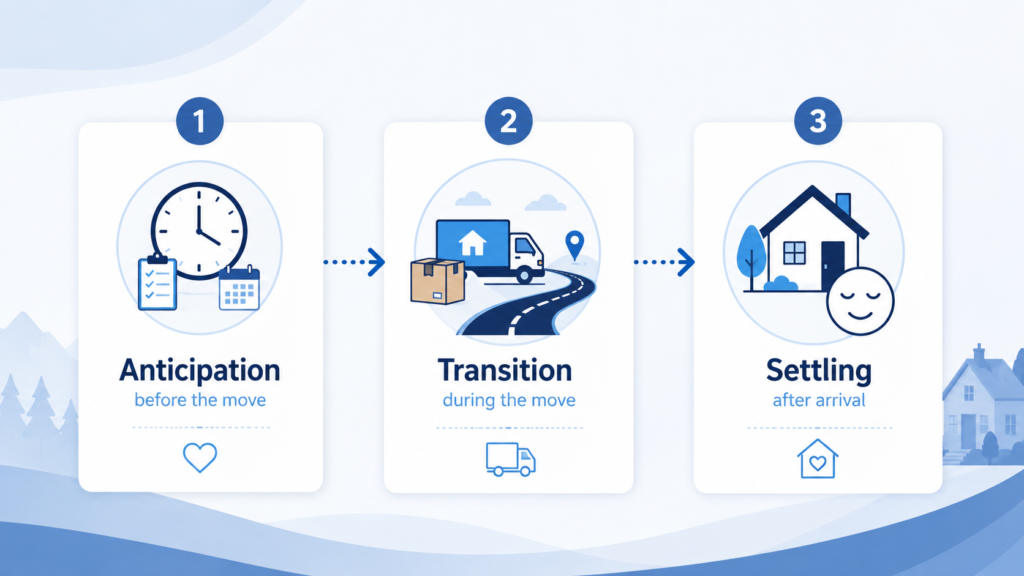
Most people experience a recognisable emotional arc across three distinct phases: the anticipation period before the move, the disorienting transition during and immediately after, and the gradual settling that follows. Each phase brings its own challenges, and each one is completely normal.
Knowing what to expect doesn’t eliminate the difficulty. But it does stop you from feeling like something is wrong with you when the emotions hit.
The Anticipation Phase: Excitement Mixed With Dread
The anticipation phase begins the moment the decision to move is made. For many people, this period is emotionally contradictory genuine excitement about a new chapter sitting alongside real anxiety about what’s being left behind.
You might feel motivated and energised one day, then overwhelmed and second-guessing everything the next. This emotional oscillation is not a sign of weakness or indecision. It’s a natural response to a major life change that carries both opportunity and loss simultaneously.
During this phase, the most useful thing you can do is resist the urge to suppress either emotion. Let the excitement exist. Let the grief exist. Both are valid, and both are telling you something true about how much this move matters.
The Transition Phase: When Reality Sets In
The transition phase covers the weeks immediately surrounding moving day itself. This is typically when emotional stress peaks. The familiar is disappearing in real time rooms emptying, keys being handed over, the drive away from a home you may have lived in for years.
Many people describe a strange emotional flatness during this period, even if they were excited beforehand. That flatness is often the mind’s way of managing an overload of change. It’s not depression. It’s adaptation in progress.
Practical chaos amplifies emotional strain during this phase. When you’re worried about whether the removalists will arrive on time, whether your belongings will arrive safely, and whether the new place will feel liveable, there’s very little emotional bandwidth left for processing the bigger feelings. This is exactly why having reliable logistics in place matters so much it frees up mental space for the emotional work.
The Settling Phase: Building Emotional Stability in a New Place
The settling phase begins once you’re physically in your new location. For some people this happens quickly. For others it takes months. There’s no correct timeline.
What most people experience during this phase is a gradual rebuilding of routine and familiarity. The new suburb starts to feel less foreign. You find a coffee shop you like. You learn which roads to avoid. Small anchors accumulate, and slowly, the new place begins to feel less like somewhere you’ve landed and more like somewhere you live.
The settling phase is also when loneliness tends to surface most clearly. The busyness of the move is over, and the absence of your established social network becomes more noticeable. Acknowledging this in advance and making deliberate efforts to build connection in your new location makes a meaningful difference.
How to Start Preparing Emotionally Before Moving Day
Emotional preparation for an interstate move isn’t about eliminating difficult feelings. It’s about creating the conditions that allow you to process those feelings without being overwhelmed by them.
The most effective emotional preparation happens before moving day, not during it. Once the logistics are in motion, there’s very little time or mental space for reflection. The weeks and months before the move are your window.
Give Yourself Permission to Grieve What You’re Leaving Behind
One of the most common emotional mistakes people make when moving interstate is treating grief as something to push through rather than something to process. There’s often an unspoken pressure to focus on the positives, to be excited, to look forward and while optimism is genuinely useful, it becomes harmful when it’s used to suppress legitimate loss.
Leaving a home, a neighbourhood, a community, or a city you’ve built a life in is a real loss. It deserves acknowledgment. Give yourself explicit permission to feel sad about it. Talk about it. Write about it if that helps. Don’t rush past it in the name of staying positive.
Grief that’s acknowledged tends to move through. Grief that’s suppressed tends to resurface later, often at inconvenient times and in disproportionate ways.
Set a Realistic Emotional Timeline Alongside Your Logistics Timeline
Most people create detailed logistics timelines for a move when to book the removalist, when to start packing, when to notify utilities. Very few people create an emotional timeline alongside it.
An emotional timeline doesn’t need to be complicated. It might simply mean identifying specific moments that will be emotionally significant the last dinner in your current home, the final walk through your neighbourhood, the goodbye with close friends and giving those moments the space and attention they deserve rather than letting them get swallowed by the chaos of logistics.
Planning for emotional milestones reduces the chance that they’ll catch you off guard. It also signals to yourself and your family that the emotional dimension of this move is being taken seriously.
Talk to the People Who Matter Before You Go
One of the most underrated forms of emotional preparation is simply having honest conversations with the people you’re leaving behind before you leave. Not just logistical conversations about staying in touch, but real conversations about what the friendship or relationship means, what you’ll miss, and how you intend to maintain the connection.
These conversations can feel uncomfortable to initiate. They require vulnerability. But they tend to leave both parties feeling more settled than a rushed goodbye at the airport or a final wave from a moving truck.
If there are relationships that feel unresolved or strained, the period before an interstate move is a meaningful opportunity to address them. Leaving with unfinished emotional business makes the transition harder. Leaving with a sense of closure even imperfect closure makes it easier.
Managing Anxiety and Stress During the Moving Process
Anxiety is one of the most commonly reported emotional experiences during an interstate move. It’s also one of the most misunderstood, because moving anxiety tends to come from multiple sources simultaneously, and treating it as a single problem makes it harder to address effectively.
Understanding where your anxiety is actually coming from is the first step toward managing it.

How to Separate Logistical Stress From Emotional Stress
Moving stress typically comes from two distinct sources: logistical uncertainty and emotional loss. These feel similar in the body both produce tension, disrupted sleep, and a sense of being overwhelmed but they respond to very different interventions.
Logistical stress responds to action. When you’re anxious about whether your belongings will arrive safely, booking a reputable removalist with a clear track record reduces that anxiety directly. When you’re worried about hidden costs, getting a detailed written quote eliminates the uncertainty. Logistical stress is solvable, and solving it is one of the most effective things you can do for your overall emotional state during a move.
Emotional stress responds to acknowledgment and time. You can’t solve grief by booking a truck. But you can create space for it, talk about it, and give it room to move through rather than building up.
Separating these two types of stress allows you to address each one appropriately rather than feeling like everything is one undifferentiated wall of overwhelm.
Daily Habits That Keep Anxiety in Check During a Move
The period surrounding an interstate move tends to disrupt the daily routines that normally regulate mood and stress. Sleep becomes irregular. Exercise gets skipped. Meals become erratic. Social connection drops off. These disruptions compound the emotional difficulty of the move itself.
Protecting even a small number of your normal daily habits during the moving period makes a significant difference. This doesn’t mean maintaining a perfect routine that’s not realistic. It means identifying two or three anchors that genuinely help you feel stable and protecting them deliberately.
For some people that’s a morning walk. For others it’s a consistent sleep time, a regular meal, or a daily phone call with someone they trust. The specific habit matters less than the consistency. Stability in small things creates resilience for the big ones.
When Moving Stress Becomes Something More Serious
For most people, moving anxiety is temporary and proportionate. It peaks around moving day and gradually reduces as the new environment becomes familiar. But for some people, the stress of an interstate move can trigger or worsen more serious mental health challenges, including anxiety disorders, depression, or adjustment disorder.
Signs that moving stress may have crossed into something that warrants professional support include: persistent low mood that doesn’t lift after several weeks in the new location, significant disruption to sleep or appetite that continues beyond the initial settling period, withdrawal from social contact, or a sense of hopelessness about the new situation.
If you recognise these signs in yourself or someone in your household, speaking with a GP or mental health professional is a practical and important step. Beyond Blue (beyondblue.org.au) and Lifeline (lifeline.org.au) both offer accessible support for Australians navigating difficult life transitions.
Helping Your Family Cope With an Interstate Relocation
An interstate move is rarely just one person’s emotional experience. When you move as a family, every member of the household is navigating their own version of the transition and those versions don’t always align.
Managing your own emotional preparation while also supporting the people around you requires deliberate attention and honest communication.
How to Talk to Children About Moving Interstate
Children’s responses to an interstate move vary enormously depending on age, temperament, and how the move is communicated to them. What remains consistent across ages is that children take their emotional cues from the adults around them. If the adults in the household are visibly anxious and avoidant about the move, children tend to mirror that anxiety.
The most effective approach is honest, age-appropriate communication that acknowledges both the difficulty and the opportunity. Avoid minimising their concerns (“You’ll make new friends in no time”) or catastrophising (“I know this is really hard”). Instead, validate what they’re feeling and give them as much agency as possible within the move letting them choose how their new room is arranged, involving them in researching the new area, or allowing them to have a say in what gets packed and what gets donated.
Maintaining as much routine as possible during the transition period consistent mealtimes, bedtimes, and family rituals provides children with the stability they need to process the change without feeling destabilised by it.
Supporting a Partner Who Is Struggling With the Move
Interstate moves frequently affect partners differently, particularly when the move is driven primarily by one person’s career or opportunity. The partner who initiated the move often feels excitement and purpose. The partner who followed may feel loss, displacement, and a lack of control — even if they agreed to the move willingly.
This asymmetry is one of the most common sources of relationship strain during interstate relocations. Recognising it explicitly, rather than assuming your partner feels the same way you do, is the starting point for genuine support.
Practical support matters: helping your partner rebuild their social network in the new location, ensuring they have time and space to pursue their own interests, and checking in regularly rather than assuming adjustment is happening. Emotional support matters equally: listening without immediately problem-solving, acknowledging the legitimacy of their feelings, and not treating their difficulty as a criticism of the decision to move.
Keeping Pets Calm and Settled During an Interstate Transition
Pets are often overlooked in the emotional planning of an interstate move, but they are genuinely affected by relocation. Dogs and cats in particular are highly attuned to changes in environment and routine, and the disruption of a move can produce visible anxiety in animals that are normally settled.
During the packing phase, try to maintain your pet’s normal feeding and exercise schedule as much as possible. On moving day, keeping pets in a quiet, familiar space away from the activity of loading reduces their stress significantly. If you’re travelling interstate by road, plan for regular stops, water, and familiar bedding.
In the new home, allow pets to explore gradually rather than giving them access to the entire space immediately. Familiar items their bed, their toys, their food bowls placed in consistent locations help them establish a sense of territory and safety more quickly.
Letting Go of Your Old Home Without Losing Your Sense of Self
For many people, the hardest emotional moment of an interstate move isn’t the arrival at the new place. It’s the departure from the old one. A home isn’t just a building. It’s a container for memory, identity, and belonging. Leaving it behind can feel like leaving part of yourself behind.
Understanding this and approaching the departure with intention rather than avoidance makes the transition significantly more manageable.
How to Say a Proper Goodbye to a Home You’ve Loved
A proper goodbye to a home doesn’t need to be elaborate. It needs to be intentional. Many people leave their old home in a rush of logistics and never get the chance to mark the departure in a way that feels meaningful. This tends to leave an emotional loose end that surfaces later.
Before you hand over the keys, take time to walk through the empty house alone or with your family. Acknowledge the memories attached to specific rooms. Let yourself feel whatever comes up. If it helps, take photographs of the empty spaces not for social media, but for yourself.
Some families create small rituals around departure: a final meal in the old kitchen, a walk around the neighbourhood, a moment of quiet acknowledgment before the door closes for the last time. These rituals don’t need to be solemn. They just need to be present.
What to Keep, What to Let Go, and Why It Matters Emotionally
The process of deciding what to take and what to leave behind is not purely logistical. Every item you sort through carries some degree of emotional weight, and the cumulative effect of making hundreds of these decisions can be genuinely exhausting.
A useful framework is to distinguish between items that hold genuine meaning and items that simply hold familiarity. Familiarity is comfortable, but it’s not the same as meaning. You don’t need to take everything that feels familiar. You do need to take the things that genuinely connect you to who you are and where you’ve been.
Letting go of objects that no longer serve you donating, selling, or discarding them can feel surprisingly liberating once the initial resistance passes. It creates physical and psychological space for the new chapter rather than dragging the weight of the old one into it.
Preserving Memories Without Being Held Back by Them
There’s a meaningful difference between honouring the past and being anchored to it. The goal of emotional preparation for an interstate move is not to forget where you’ve come from. It’s to carry what matters forward in a way that enriches your new life rather than preventing you from building it.
Practical memory preservation photo books, journals, keeping meaningful objects is genuinely useful. So is maintaining the relationships that defined your life in your previous location. Distance doesn’t have to mean disconnection, and the effort to stay genuinely connected to people who matter is worth making.
What’s less useful is treating the past as a standard against which the new place will always fall short. Every new location has its own version of the things you valued in the old one. Finding them takes time and deliberate effort, but they exist.
Building Emotional Resilience for the Road Ahead
Emotional resilience isn’t a fixed trait. It’s a capacity that can be built deliberately, and an interstate move as demanding as it is is also one of the most effective contexts for developing it.
People who navigate interstate relocations successfully tend to share a set of mental habits and practical approaches that make the transition more manageable. These aren’t complicated. But they do require intention.
How to Reframe the Move as an Opportunity, Not a Loss
Reframing is not the same as toxic positivity. It’s not about pretending the loss isn’t real. It’s about holding both the loss and the opportunity in view simultaneously, rather than allowing one to completely eclipse the other.
An interstate move is genuinely an opportunity to build a life that’s more aligned with who you are now, rather than who you were when you first settled in your previous location. It’s an opportunity to establish new routines, explore a new environment, and meet people you wouldn’t otherwise have encountered.
The reframe becomes more accessible once the grief has been acknowledged. Trying to jump straight to opportunity without processing the loss tends to produce a brittle optimism that collapses under pressure. But once the grief has been given its due, the opportunity becomes genuinely visible.
Creating a Sense of Home in an Unfamiliar Place
Home is not a location. It’s a feeling and that feeling is created through familiarity, routine, and connection. All three of these can be deliberately cultivated in a new place, even when the environment feels completely foreign.
Familiarity builds through repetition. The more you walk the same streets, visit the same shops, and interact with the same neighbours, the more the new environment begins to feel known. This process takes time, but it accelerates when you engage actively with your new surroundings rather than retreating into the familiar comfort of screens and delivery apps.
Routine provides structure when the environment is still disorienting. Establishing consistent daily patterns in your new home even simple ones creates a sense of predictability that the brain interprets as safety.
Connection is the most powerful home-builder of all. Finding even one or two genuine points of social connection in your new location a neighbour, a colleague, a local community group changes the emotional texture of the place entirely.
Practical Rituals That Help You Feel Grounded After Arrival
Grounding rituals are small, deliberate practices that signal to your nervous system that you are safe and settled. They’re particularly useful in the weeks immediately following an interstate move, when the environment is still unfamiliar and the brain is working hard to process the change.
Some effective grounding rituals for the post-move period include: unpacking and arranging your bedroom first so that you have at least one space that feels completely yours; establishing a consistent morning routine before the rest of the house is unpacked; cooking a familiar meal in the new kitchen; and taking a deliberate walk around your new neighbourhood with no agenda other than observation.
None of these are dramatic. That’s the point. Grounding works through consistency and repetition, not through grand gestures.
How Choosing the Right Removalist Reduces Emotional Load
The emotional difficulty of an interstate move is real and unavoidable. But a significant portion of the stress that people experience during relocation is not emotional in origin it’s logistical. And logistical stress is solvable.
Choosing the right interstate removalist is one of the highest-leverage decisions you can make for your overall wellbeing during a move. When the logistics are handled by people you trust, your emotional bandwidth is freed up for the things that actually require it.
Why Logistical Confidence Directly Reduces Emotional Stress
The relationship between logistical confidence and emotional wellbeing during a move is direct and well-established. When people feel uncertain about whether their belongings will arrive safely, whether the removalist will show up on time, or whether there will be hidden costs they haven’t budgeted for, that uncertainty generates a persistent background anxiety that compounds every other emotional challenge of the move.
Conversely, when people have a clear, detailed plan in place a confirmed booking, a transparent quote, a removalist with a genuine track record the logistical anxiety drops significantly. This doesn’t eliminate the emotional difficulty of the move, but it removes a major source of compounding stress and creates space for the emotional work to happen more cleanly.
The practical implication is straightforward: investing time in choosing the right removalist is not just a logistical decision. It’s an emotional one.
What to Look for in an Interstate Removalist From Parramatta
When comparing interstate removalists from Parramatta or Greater Western Sydney, there are several factors that directly affect both the quality of the move and your peace of mind during it.
Transparency in pricing is non-negotiable. A reputable removalist will provide a detailed written quote that covers all costs including fuel levies, tolls, packing materials, and any storage requirements without vague line items that expand after the job is booked. If a quote feels unclear or incomplete, ask for clarification before committing.
Experience with interstate routes matters. Moving from Sydney to Melbourne, Brisbane, or Adelaide involves different logistics, transit times, and handling requirements than a local move. A removalist with genuine interstate experience will have established processes for managing these variables.
Handling and protection standards are critical for long-distance moves. Ask specifically about how furniture is wrapped and secured, what insurance options are available, and how fragile items are managed during transit. The answers will tell you a great deal about the company’s professionalism.
Reviews and references from real customers particularly for interstate moves provide the most reliable signal of what the actual experience will be like.
How Six Brothers Removalists Supports a Smoother Emotional Transition
At Six Brothers Removalists, we’ve handled enough interstate moves from Parramatta and Greater Western Sydney to understand that the logistics and the emotions are inseparable. When people are worried about their belongings, they can’t focus on settling in. When the move runs smoothly, the emotional transition becomes significantly more manageable.
Our interstate removalist service covers everything from careful packing and furniture wrapping through to delivery and placement in your new home. We offer backloading options for cost-effective interstate moves, secure storage solutions for situations where the timing between properties doesn’t align perfectly, and transparent pricing with no hidden costs.
We’re a Parramatta-based team with deep roots in Western Sydney and genuine experience across NSW and interstate routes. When you book with us, you’re not dealing with a call centre. You’re dealing with people who understand what’s at stake and take the responsibility seriously.
Conclusion
An interstate move tests you emotionally in ways that no amount of practical preparation can fully prevent. The grief, the anxiety, the disorientation these are real, and they’re a sign that your life has genuine meaning and connection worth mourning. Acknowledging that, rather than pushing past it, is the foundation of a healthy transition.
The emotional and logistical sides of a move are more connected than most people realise. When the practical details are handled by people you trust, you recover faster, settle sooner, and build your new life from a more stable foundation.
If you’re planning an interstate move from Parramatta or anywhere across Greater Western Sydney, Six Brothers Removalists is ready to take the logistical weight off your shoulders. Call us today for a transparent quote and let’s get you moving with confidence.
Frequently Asked Questions
Is it normal to feel sad about moving interstate?
Yes, feeling sad about an interstate move is completely normal. You’re leaving behind familiar places, established routines, and meaningful relationships all of which represent real loss. Acknowledging that sadness rather than suppressing it is one of the healthiest things you can do during the transition.
How long does it take to emotionally adjust after an interstate move?
Most people begin to feel genuinely settled in a new location within three to six months, though the timeline varies significantly depending on individual circumstances, social connection, and how actively you engage with your new environment. The first four to eight weeks are typically the most emotionally demanding.
How do I help my child cope with moving to a new state?
Be honest with your child about the move in age-appropriate terms, validate their feelings without minimising them, and give them as much agency as possible in the process. Maintaining consistent routines during the transition and staying connected to their existing friendships through video calls and visits helps significantly.
What is the hardest part of moving interstate emotionally?
For most people, the hardest emotional moment is leaving the old home for the last time. The combination of physical departure and the loss of a familiar environment tends to produce the most intense emotional response. Planning a deliberate, intentional goodbye rather than leaving in a rush makes this moment more manageable.
How do I stop feeling anxious about my interstate move?
Separate logistical anxiety from emotional anxiety and address each one differently. Logistical anxiety responds to action booking a reliable removalist, getting a clear quote, creating a detailed moving plan. Emotional anxiety responds to acknowledgment, honest conversation, and time. Trying to solve emotional anxiety with logistics, or vice versa, tends to be ineffective.
Should I visit my new city before the move to feel more prepared?
Yes, visiting your new city before the move is one of the most effective ways to reduce anticipatory anxiety. Familiarity with the new environment even basic familiarity with the streets, the local shops, and the neighbourhood significantly reduces the sense of the unknown that drives much of pre-move anxiety.
How does hiring a professional removalist help with moving stress?
A professional removalist removes the logistical uncertainty that compounds emotional stress during a move. When you’re confident that your belongings are being handled carefully, that the truck will arrive on time, and that there are no hidden costs waiting for you, your mental bandwidth is freed up to focus on the emotional and personal dimensions of the transition.