


Moving interstate from Sydney is exciting. But the bill at the end? That bit can sting. You get a quote. You feel okay. Then on moving day, fees pop up like mushrooms after rain.
Stair fees. Long carry fees. Toll charges. Fuel surcharges. Wait time. Sound familiar? Here’s the good news. Most extra charges are predictable. And most are avoidable too. We move people across the country every week. So we’ve seen the traps. We know where the costs hide. This guide shows you how to plan, pack, book, and protect your move. No fluff. No filler. Just the stuff that saves real dollars.
Whether you’re heading from Parramatta to Perth or Sydney to Melbourne, the same rules apply. The earlier you plan, the cheaper your move gets. Ready to keep your money where it belongs? Let’s break it down.

Why Interstate Moves From Sydney Get Extra Charges
Interstate moves are not just bigger local moves. They’re a different beast. Long distances mean fuel, tolls, driver hours, overnight stops, and route planning.
A Sydney to Melbourne removalist run is about 880 km. Sydney to Brisbane is over 900 km. Sydney to Perth tops 4,000 km. Every kilometre adds cost. Then there’s the truck itself. Bigger truck, more fuel, more wear, more crew. Costs climb fast. But the real budget killers are the surprises. Things nobody tells you about until the invoice lands.
Here’s where most extra fees come from on a Sydney interstate move:
• Access issues at pickup or delivery, like stairs, narrow streets, or no parking.
• Items not packed properly, so the crew has to pack them.
• Last-minute add-ons, like extra boxes or furniture not on the quote.
• Delays at one end, so the truck waits and waiting costs money.
• Tolls, fuel surcharges, and GST not included in the original quote.
• Long carry charges when the truck cannot park close to your door.
Most of these fees are written into the fine print. Few people read the fine print. So the trick is simple. You learn the fees first. Then you plan around them. There’s an old saying around here. “A penny saved on moving day is a steak dinner in your new kitchen.” Cheesy? Yes. True? Also yes.
How to Plan and Book an Interstate Move Without Extra Costs
Planning saves more money than haggling ever will. Most extra charges start the moment you book. Lock the timing right and half your battle is done.
Book 6–8 Weeks Early
Last-minute bookings cost more. Trucks are tighter. Crews are stretched. Prices go up. Book at least 6 to 8 weeks ahead for an interstate move from Sydney.
You get better rates. You get pick of dates. You get the right size truck instead of whatever’s left. Early booking also gives you time to compare quotes properly. No rush, no regret.
Avoid Weekends and End of Month
Saturdays are gold for removalists. So they cost more. Same with the last few days of the month. Leases end. Everyone moves at once. Shift your date by a few days. Save real money. Easy win.
Avoid Peak Times
Summer is peak moving season in Australia. December and January are mad. School holidays push prices up too. So does the end of the financial year. If your dates flex, aim for autumn or winter. Rates drop. So does demand.
Move Mid-Week
Tuesday, Wednesday, or Thursday are the cheapest days to hire movers. Demand is lower. Crews want work. You’ll see better rates and faster service. Friday afternoons get hammered. So do Sundays before the new month.
Compare 3–5 Quotes
One quote is a guess. Five quotes is a benchmark. Get at least three to five interstate removalist quotes. Compare what’s included. Compare what’s extra. The cheapest is rarely the best. The most expensive is rarely worth it. The middle one with clear inclusions usually wins.
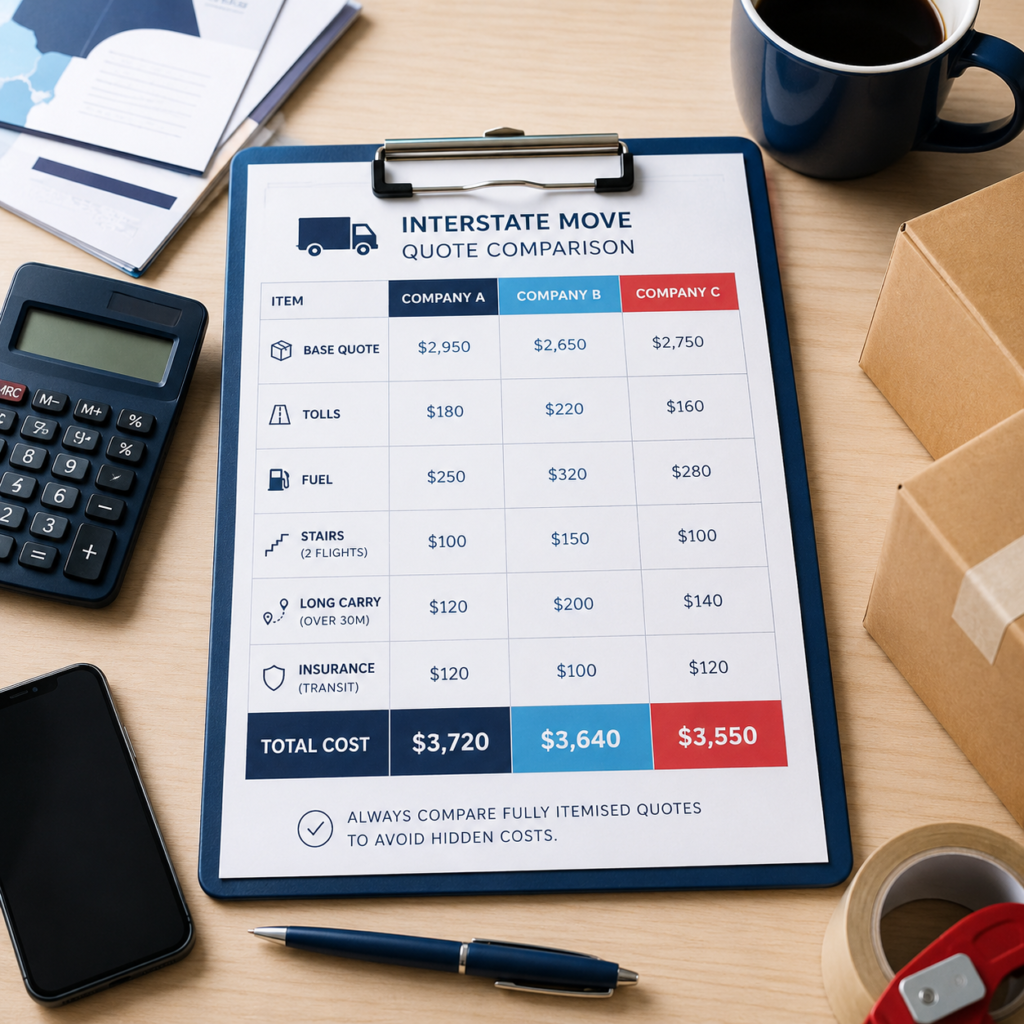
Ask each mover the same questions. Same furniture list. Same dates. Same pickup and delivery details. Then the numbers actually mean something. A quick way to size things up before you start ringing around is a moving home calculator. It gives you a rough volume estimate so quotes feel less like guesswork.
Get Everything in Writing
A verbal quote is worth nothing on moving day. Get the full quote in writing. Fixed price or hourly rate. Inclusions. Exclusions. Fuel. Tolls. GST. Insurance options.
If a charge is not on the written quote, you should not be paying it on the day. Also confirm the truck size, crew size, and arrival window. Lock it in. Sign it. Save the email.
How to Declutter and Pack to Avoid Extra Fees
Interstate moves are priced by volume or weight. Less stuff means a smaller bill. Think of it like packing a suitcase for a flight. Every kilo costs. Every cubic metre costs more.
Declutter Ruthlessly
Start six weeks out. Room by room. Be ruthless. If you haven’t used it in a year, you probably won’t in the next one either.
Sell what you can on Marketplace or Gumtree. Donate the rest. Bin the broken stuff. Old mattresses, dead appliances, mystery boxes from the last move. Let them go. Every box you don’t pack is money you don’t pay to ship 900 km.
DIY Packing
Packing services are convenient. They’re also one of the most expensive add-ons. For a full house, pro packing can add hundreds, sometimes over a thousand, to your interstate quote. Do it yourself for everything except the fragile or weird stuff. Save the pros for the piano, the artwork, and the antique mirror.
Pack Your Own Boxes
Pack one room at a time. Label every box on two sides. Mark which room it belongs in. Use bubble wrap or old towels for fragile items. Newspaper works in a pinch. Heavy stuff on the bottom, light stuff on top. Never half-fill a box, it crushes the lower ones. A clean, labelled, well-packed box loads faster. Faster loading means less truck time. Less truck time means less cost.
Source Free Boxes
New boxes from the hardware store add up. So get clever. Free or cheap boxes are everywhere if you look:
• Local supermarkets, especially the bottle shop and the produce section.
• Bookshops and chemists toss strong, small boxes daily.
• Facebook Marketplace and Gumtree often list free used moving boxes.
• Friends or coworkers who moved recently usually want to get rid of theirs.
For fragile items, buy proper double-walled boxes. The rest can be scavenged.
Pack Heavy Items Small
Books, tools, tinned food. Heavy stuff goes in small boxes. A small box of books is liftable. A large box of books is a back injury. Linen, pillows, soft toys, those go in big boxes. Light and bulky, big box. Heavy and dense, small box.
Why does this matter for cost? Because crew injuries cause delays. Delays cause wait fees. Smart packing keeps the day moving.
Hidden Access and Labour Charges to Watch for in Interstate Moves
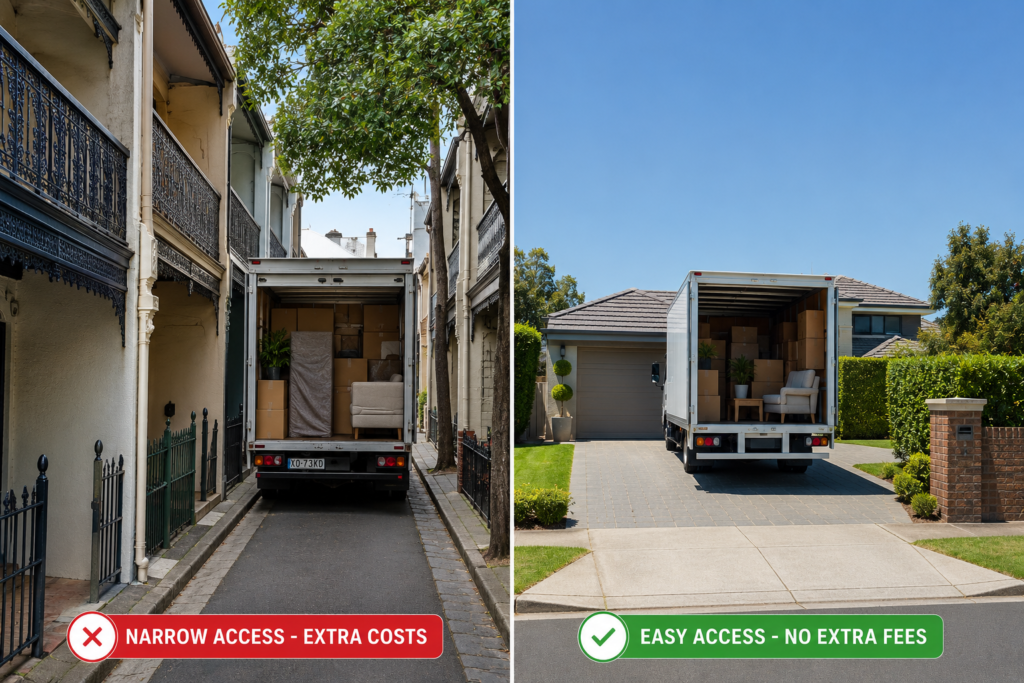
Some of the biggest surprise fees come from access. Where the truck parks. How far the crew walks. How many stairs there are. These charges feel sneaky. But they’re usually in the quote, just buried in the fine print.
Stair and Lift Fees
Stairs cost extra. Most movers charge per flight after the first one or two. Apartment buildings without lift access can add a real chunk. Even with a lift, if it’s not booked or it breaks down, the crew has to use the stairs.
Tell your removalist exactly how many flights, at both pickup and delivery. No guessing. They’ll quote properly and you avoid a surprise.
Long Carry Charges
If the truck can’t park close to the door, the crew carries your stuff further. That’s called a long carry charge. Anything past 15 to 20 metres often triggers an extra fee. Narrow streets, tight driveways, body corporate restrictions. They all add distance. They all add cost.
Walk the route from where the truck will park to your front door. Be honest about it when you book.
Furniture Assembly and Disassembly
Beds, wardrobes, dining tables. They might need to come apart to fit in the truck. Some movers include basic disassembly. Some charge by the hour or per item. Read the quote. If assembly is not included, do it yourself the night before. Bag the screws, tape them to the frame, label the parts. Easy.
Wait Times
Crew arrives, you’re not ready. Boxes aren’t packed. Keys are with the agent. The truck waits. The meter runs. Wait time fees can be brutal on a long-distance move because the driver is on a schedule. Be ready before they arrive. All boxes packed. All furniture cleared of loose items. All paperwork sorted.
Clear Access
Clear the path from your front door to where the truck will park. Move the bins. Move the car. Move the pot plants. Same at the new place. Make sure there’s a clear run to the front door. It sounds basic but you’d be surprised how often this trips people up.
Reserve Parking
If you’re in an apartment block or on a busy street, reserve a parking spot for the truck. Some councils issue temporary parking permits. Some buildings have loading bays you can book.
No parking close by? That’s a long carry charge waiting to happen.
Check Your Interstate Removalist Quote Carefully
The quote tells you everything. If you read it properly. Two quotes can look the same on the surface and end up hundreds apart. Here’s what to check before you sign anything.
Fixed Price
A fixed price means one number for the whole job, no matter how long it takes. Good for budgeting. Good for peace of mind. Better for interstate moves where time can stretch.
But fixed price quotes assume your inventory is accurate. Add a couch on moving day and the price changes fast.
Hourly Rate
Hourly rates work for short, simple moves. For interstate, they can blow out. Traffic, weather, unexpected delays. All eat into your wallet.
If you do go hourly, ask for a cap. Or ask for a fixed quote with a clear inventory.
Travel Time
Some movers charge travel time from depot to your pickup, and from your delivery back to depot. Others build it into the fixed price.
Ask. Get it in writing. A two-hour travel charge on an hourly rate adds up quickly.
Fuel Charges
Fuel surcharges are common on interstate moves. Sometimes they’re a flat fee. Sometimes a percentage. A fuel surcharge on a Sydney to Perth move can be hundreds of dollars. Always ask if fuel is included or extra.
Toll Fees
Sydney has plenty of tolls. So does Melbourne and Brisbane. A long interstate run might rack up dozens of toll points. Some movers include them. Some bill you after. Confirm before you book.
GST Included
A quote without GST looks 10 percent cheaper than one with it. That’s not a saving, that’s a misread. Check if the price you’re comparing includes GST. Always compare like for like.
Deposit Terms
Most reputable movers ask for a deposit to lock in your date. That’s normal. But a deposit of more than 25 percent for a quote a few weeks out is a red flag. Walk away if a mover asks for cash upfront with no paperwork.
Cancellation Fees
Plans change. Settlements get delayed. Life happens. Check the cancellation policy before you book. Look for clear terms, sliding scales based on notice, and a refundable deposit if you cancel early enough.
A bad cancellation policy can cost you the whole deposit. A good one protects you when things wobble.
Know if Your Interstate Move Uses a Dedicated or Shared Truck
There are two ways to move your stuff interstate. Dedicated truck, or shared truck. A dedicated truck is yours alone. The crew picks up, drives straight to the delivery address, and unloads. Fast, predictable, more expensive. A shared truck, often called backloading, carries your goods along with other customers’ goods on the same run. Cheaper, but slower and less precise on timing.
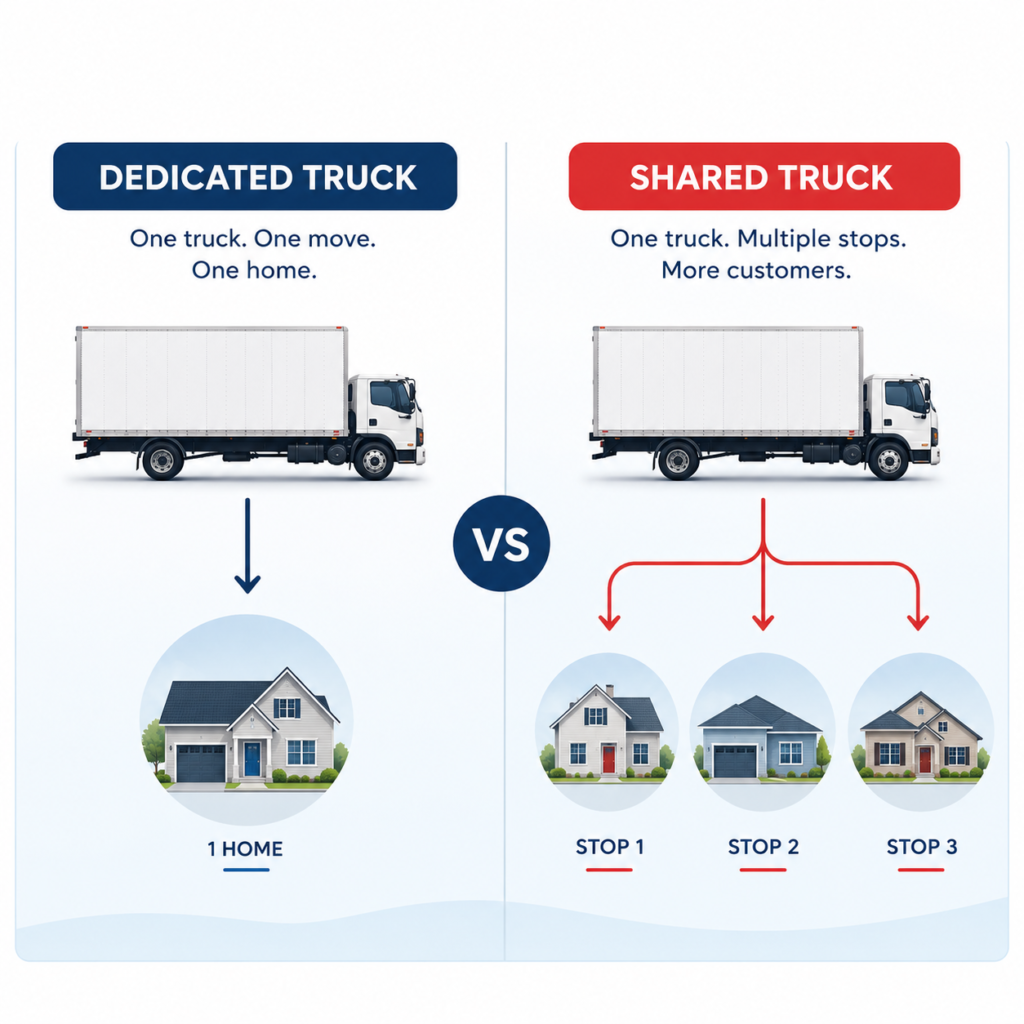
Which one’s right for you?
• Got a tight deadline? Dedicated.
• Got time and a tight budget? Shared or backloading.
• Big family home with lots of furniture? Dedicated is usually cheaper per cubic metre at that volume.
• Studio apartment or small one-bedder? Shared truck wins almost every time.
The price gap between the two can be significant. Sometimes 30 to 50 percent for the same job.
Ask your mover for both options. Then choose based on time and budget, not assumptions.
One more thing worth knowing. Shared trucks often deliver within a window, not on a fixed day. The window might be three to seven days. Sometimes longer for remote routes like Sydney to Darwin or Sydney to Cairns. If you’re renting a place from a specific date, make sure the delivery window doesn’t leave you sleeping on the floor for a week.
Confirm Who Is Responsible for Each Part of the Interstate Move
Interstate moves involve handovers. Especially with backloading. Your stuff might get loaded by one team, transferred to a depot, then delivered by another team in another state. Every handover is a chance for damage. Every handover is a chance for missed items. Every handover is a chance for someone to say “not my problem.”
Before you book, ask:
• Who loads the truck at pickup?
• Does the same truck go all the way, or are goods transferred?
• Who is responsible if items are damaged or lost in transit?
• Is removalist insurance included? If so, what’s the limit and what’s excluded?
• Who is my point of contact during the move?
A reliable interstate removalist will answer all of these clearly. If you get vague answers, find someone else. The ACCC moving services guidance is also worth a read before you sign anything substantial.
Reduce Extra Moving Charges by Reducing Variables
Every variable on moving day is a chance for the bill to grow. Fewer variables means fewer surprises. Fewer surprises mean fewer fees.
How do you reduce variables?
• Lock dates early. No date changes if you can help it.
• Lock inventory early. No last-minute “oh, and these boxes too.”
• Pack everything before the crew arrives. Not while they’re standing there.
• Hand over keys at both ends well in advance. Confirm with agents or new owners.
• Disconnect appliances the night before. Defrost the fridge. Drain the washing machine.
• Confirm parking, lift bookings, and access permissions in writing.
Think of moving day like a relay race. Every dropped baton costs you minutes. Every minute costs you money. And here’s a tiny truth nobody mentions. The calmer moving day is, the cheaper it ends up.
Alternative Transport Options That Can Lower Interstate Moving Costs
A full removalist truck is not your only option. Sometimes it’s the most expensive one. For smaller moves or tight budgets, there are cheaper ways to move interstate. Each has trade-offs.
Backloading
Backloading uses the empty space on a truck that’s already heading your direction. A truck delivers from Sydney to Brisbane. Instead of driving back empty, the company fills it with goods heading back to Sydney. You ride along for cheap.
Best for moves where you’re flexible on dates. Worst if you need exact delivery on a specific day. Backloading interstate removals can save 30 to 60 percent compared to a dedicated truck. The catch is timing flexibility and shared truck space.
Self-Pack Containers
A company drops a shipping container at your home. You load it at your pace. They pick it up and ship it interstate. You unload at the other end. Cheaper than a full-service mover. More work for you. Great for people with time and strong backs.
Watch the size though. A small container might mean two trips and two sets of fees.
Compare Backloading, Containers, and Trucks for Interstate Moves
Which transport option fits your move best? Quick comparison. Honest version.
Best For Small Moves
Backloading wins. Studio apartments, one-bedroom units, or just a few rooms of furniture. You only pay for the space you use.
Best For Families
Dedicated truck. Three or four bedroom homes have too much stuff for shared space. A full truck, one crew, one trip, done.
Best For Flexible Dates
Backloading or containers. Both reward people who can wait a few extra days for the right route.
Best For Tight Access
Dedicated truck with a smaller vehicle, or a moving company that owns a fleet of different truck sizes. Containers need clear access for delivery and pickup, which doesn’t always work for inner-city homes.
Best For Fixed Delivery
Dedicated truck. If you need your stuff at the new place by Friday, you book a dedicated truck. Period.
Interstate Moving Logistics and Admin Costs That Add Up
The truck is just one part of the bill. The other costs sneak up on you in the weeks before and after the move. Plan these in. They’re part of the real cost of moving interstate.
Utility Connection Fees
Power, gas, internet, water. Each one usually charges a connection fee at the new place. And many charge a disconnection or final reading fee at the old place too. Across all your utilities, expect $100 to $400 in connection and disconnection costs.
Update Utilities Early
Book connections two weeks before you move in. Especially internet. Lead times can be brutal in some areas. Same with disconnections. Don’t pay for power at an empty house for three weeks because you forgot to call.
Vehicle Registration
Moving interstate means transferring your car registration. Every state has different rules and different fees. Each state’s transport authority lists the timeframes and current costs.
You usually have 14 to 90 days to re-register depending on the state. Miss the window and you cop a fine. Factor in rego, CTP, and possibly a roadworthy inspection in your new state.
Temporary Accommodation
Sometimes pickup and delivery don’t line up. You might need a hotel or short-stay for a night or two. Book early. Get a place close to your new home so you’re not driving all over the city with kids and a half-packed car. Add accommodation, meals, and any pet boarding into your moving budget.
Manage Cleaning
End-of-lease cleaning at the old place. Bond cleaning at the new place if it wasn’t done properly. A bond clean for a three-bedroom home in Sydney runs $400 to $700 depending on condition.
Get it done yourself or hire pros. Either way, budget for it.
Pre-Pack a Day 1 Box
Pack a box, or a suitcase, with everything you’ll need for the first 24 hours in the new place. Toothbrush, phone charger, kettle, mugs, tea bags, fresh undies, a change of clothes, basic toiletries, important documents, snacks.
Why does this save money? Because the alternative is going to the shops at 9pm on moving day to buy stuff you already own. Wasted dollars. Wasted time. A pre-packed day one box is a small move-day mercy. It also stops you living out of takeaway containers for a week.
Wrapping It All Up
Interstate moves from Sydney don’t have to break your budget. They just need a bit of strategy. Book early. Pick the right day. Get multiple quotes. Read the fine print. Pack smart. Declutter hard. Reserve parking. Confirm everything in writing. Do that and you’ll dodge most of the surprise charges that catch people off guard.
A few more habits that pay you back on moving day:
• Walk the truck route the day before. Mark the spot. Move obstacles.
• Keep a folder with quotes, contracts, and insurance papers in one place.
• Photograph every room before pickup and after delivery. Damage claims need proof.
• Tip the crew if they smashed it out. Not because you have to, but because good crews remember kind clients.
And when in doubt, ask. A good removalist would rather explain a fee in advance than argue about it on the day. Want a fixed-price, no-surprises move with a crew that knows the long-haul routes inside out?
Six Brothers Removalists has been handling interstate backloading and full-service interstate moves for Sydney families for years. Get a no-pressure quote at 1300 764 372 or send the details to info@sixbrothersremovalist.com.au. You can also stop by Suite 1 Level 5/58-60 Macquarie St, Parramatta NSW 2150.
Less stress. Fewer surprise charges. More money for your new kitchen. That’s the kind of move worth booking.
FAQs
How much does it cost to move interstate from Sydney?
Costs depend on home size, distance, and service type. A small one-bedroom backload might run from $1,000 to $2,500. A full four-bedroom dedicated truck Sydney to Perth can cross $10,000. Always get multiple quotes with the same inventory.
What is the cheapest way to move interstate in Australia?
Backloading is usually the cheapest option for small to medium moves. You share a truck heading your direction and only pay for the space you use. Flexibility on dates is the trade-off.
How far in advance should I book an interstate removalist?
Six to eight weeks ahead is the sweet spot. You get better rates, better availability, and time to compare quotes without rushing.
Is interstate removalist insurance worth it?
For long-distance moves with high-value items, yes. Standard public liability covers the truck and crew, not your stuff. Transit insurance is a small add-on that protects you if anything is damaged or lost between states.
Why do interstate movers charge extra fees?
Extra fees usually come from access issues, last-minute changes, wait times, fuel, tolls, stairs, or long carry distances. Most are avoidable with proper planning and an accurate quote upfront.