
Table of Contents
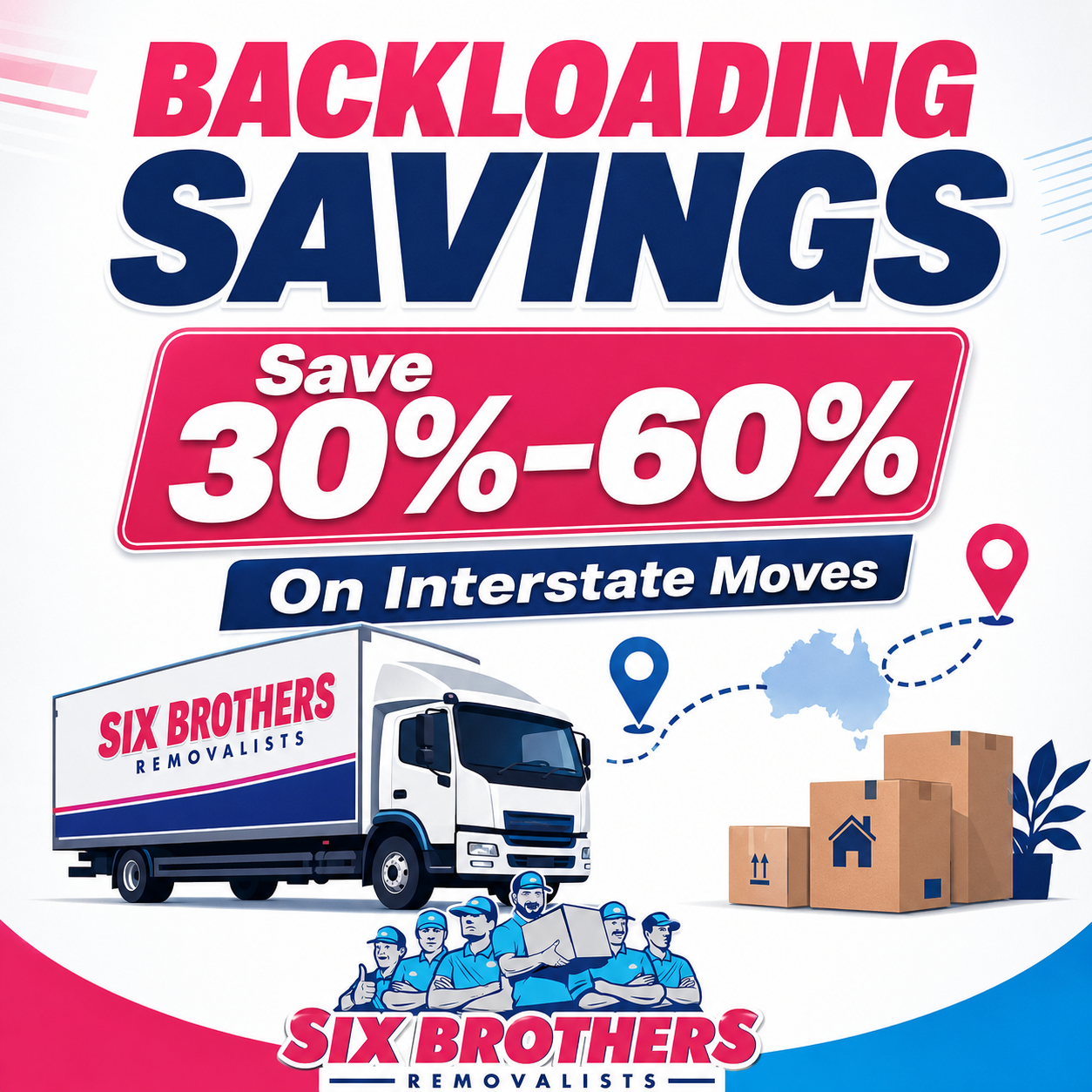
Backloading can save you anywhere from 30% to 60% on the cost of an interstate move, depending on your route, load size, and how flexible you are with timing. For a Parramatta household moving to Melbourne, that difference can mean thousands of dollars back in your pocket.
Most people don’t realise they have this option. When you book a full truck, you pay for the entire vehicle regardless of how much space you use. Backloading changes that equation entirely.
This guide breaks down exactly how backloading works, what it costs on common NSW interstate routes, how much you can realistically save, and what trade-offs to weigh before you book.
What is backloading and how does it work on interstate moves?
Backloading is a freight and removalist arrangement where you share truck space with other customers on an existing interstate route. Instead of hiring an entire truck for your belongings alone, your items are loaded alongside other consignments heading in the same direction, and you pay only for the cubic metres your load occupies.
The term comes from the logistics industry. When a removalist truck completes a delivery interstate and needs to return to its home base, that return journey is called the “back run.” Rather than driving back empty, the removalist fills available space with other customers’ goods. Both parties benefit: the removalist recovers fuel and labour costs on the return leg, and the customer gets a significantly reduced rate.
This is not a budget shortcut that compromises service quality. Reputable removalists use the same trucks, the same trained crews, and the same care standards for backloading jobs as they do for full truck hires. The difference is purely in how the truck space is allocated and priced.
How removalists fill empty truck space on return routes
When a removalist company completes an interstate delivery, say from Parramatta to Brisbane, the truck needs to return to Sydney. That return journey represents a real operating cost: fuel, driver wages, tolls, and time. A backloading customer in Brisbane who needs to move to Sydney effectively subsidises that return run, paying a fraction of what a dedicated truck would cost.
The removalist coordinates multiple smaller loads heading in the same direction, consolidates them into one truck, and delivers each consignment to its destination. Your furniture travels with other customers’ goods, but it is packed, wrapped, and secured separately. A professional removalist will inventory every item, wrap furniture in moving blankets, and use load restraints to prevent shifting during transit.
Which interstate routes commonly offer backloading from Parramatta?
Backloading availability depends on truck movement patterns between major cities. From Parramatta and Greater Western Sydney, the most consistently available backloading routes include:
- Sydney to Melbourne (and Melbourne to Sydney): The highest-frequency corridor in Australia, with multiple trucks moving in both directions daily
- Sydney to Brisbane (and Brisbane to Sydney): A busy route with strong backloading availability, particularly for northbound moves
- Sydney to Adelaide: Less frequent than the eastern seaboard routes but regularly available through established removalist networks
- Sydney to Gold Coast and Sunshine Coast: High demand, especially for residential moves
- Sydney to Canberra: Short-haul interstate with frequent truck movements
Less common but available routes include Sydney to Perth and Sydney to regional centres like Albury, Wagga Wagga, and Dubbo, though these may require longer wait times to coordinate a suitable truck.
How much does backloading actually cost compared to a full truck hire?
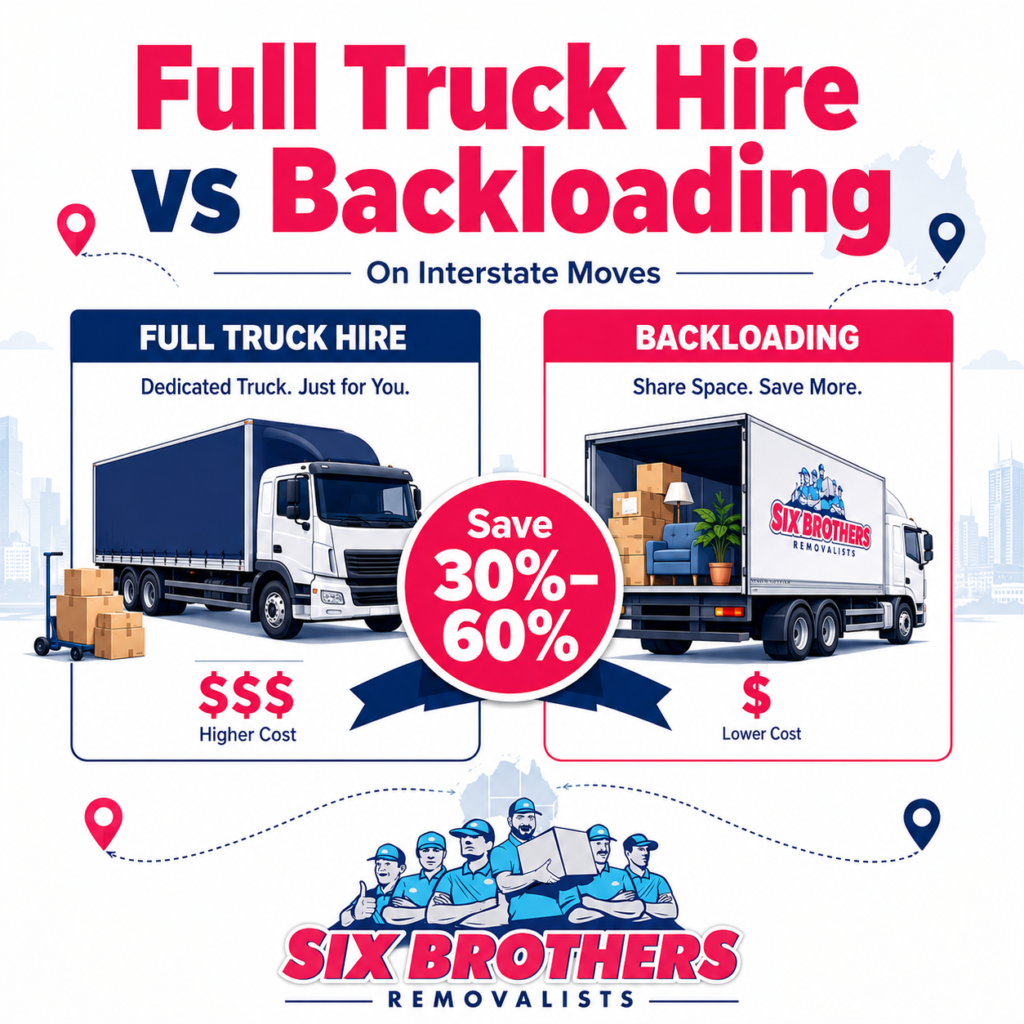
Understanding the cost difference between backloading and a full truck hire requires looking at how each is priced. Full truck interstate removals are quoted as a flat rate for the entire vehicle, regardless of how much space your belongings occupy. Backloading is priced per cubic metre (m³), so you pay in direct proportion to your load size.
This pricing structure is what creates the savings opportunity. A typical two-bedroom home in Parramatta might require 20–30 m³ of truck space. A full truck holds 60–80 m³. If you book a full truck, you are paying for 60–80 m³ whether you use it or not.
Average backloading costs for common interstate routes from NSW
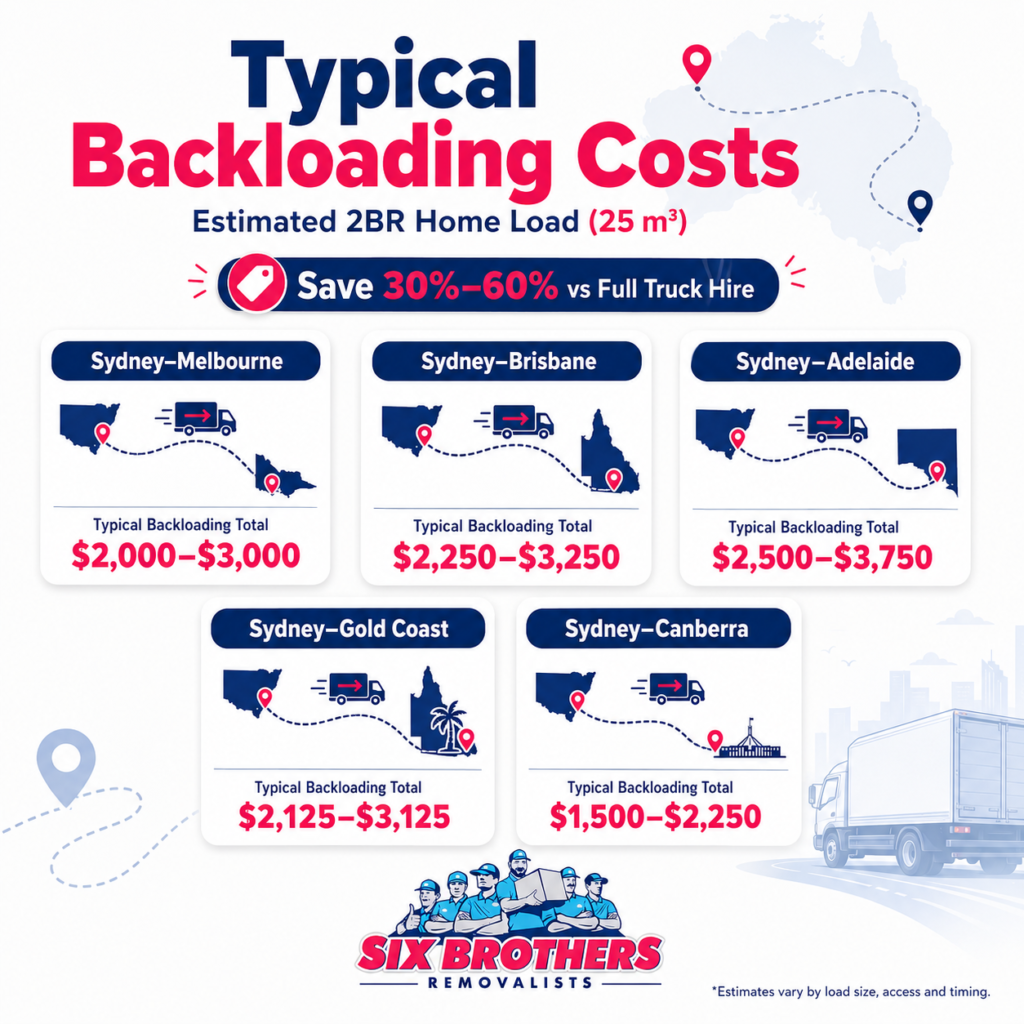
The following figures represent typical market rates for backloading from Sydney/Parramatta as of 2024–2025. Prices vary between providers, seasons, and specific load requirements.
| Route | Backloading Cost (per m³) | Typical 2BR Home Load (25 m³) | Estimated Backloading Total |
| Sydney to Melbourne | $80–$120/m³ | 25 m³ | $2,000–$3,000 |
| Sydney to Brisbane | $90–$130/m³ | 25 m³ | $2,250–$3,250 |
| Sydney to Adelaide | $100–$150/m³ | 25 m³ | $2,500–$3,750 |
| Sydney to Gold Coast | $85–$125/m³ | 25 m³ | $2,125–$3,125 |
| Sydney to Canberra | $60–$90/m³ | 25 m³ | $1,500–$2,250 |
These are estimates for a standard residential load. Prices shift based on the specific items being moved, access conditions at pickup and delivery addresses, packing requirements, and whether you need storage at either end.
What does a full truck interstate removal cost by comparison?
A dedicated full truck interstate removal from Parramatta typically costs:
- Sydney to Melbourne: $4,500–$8,000+
- Sydney to Brisbane: $5,000–$9,000+
- Sydney to Adelaide: $5,500–$10,000+
- Sydney to Gold Coast: $4,500–$8,500+
- Sydney to Canberra: $2,500–$4,500+
These figures include the truck, crew, fuel, and standard insurance. The wide range reflects differences in home size, access, packing services, and whether the move is time-sensitive. A large four-bedroom home with difficult access will sit at the upper end of these ranges.
The comparison is stark. On a Sydney to Melbourne move for a two-bedroom home, backloading at $2,000–$3,000 versus a full truck at $4,500–$8,000 represents a potential saving of $1,500 to $5,000 on a single move.
What factors affect the final price of a backloading job?
Several variables influence your final backloading quote beyond the base per-cubic-metre rate:
- Total volume of your load: More cubic metres means a higher total cost, though the per-m³ rate may decrease for larger loads
- Distance of the route: Longer routes carry higher per-m³ rates due to fuel and driver time
- Access at pickup and delivery: Stairs, narrow driveways, lifts, and long carries add labour time and cost
- Specific items requiring special handling: Pianos, pool tables, antiques, and fragile artwork may attract surcharges
- Packing services: If you need the removalist to pack your belongings, this is charged separately
- Storage requirements: If your delivery address isn’t ready, short-term storage at the destination adds cost
- Timing and flexibility: Urgent or time-specific deliveries may reduce or eliminate the backloading discount
- Insurance level: Basic transit cover is usually included; full replacement value insurance is an optional upgrade
Getting an accurate quote requires providing your removalist with a detailed inventory of items, both addresses, and any access challenges upfront.
How much can you realistically save by choosing backloading?
The honest answer is that backloading typically saves between 30% and 60% compared to a full truck interstate removal for the same route and load. The exact saving depends on your specific circumstances, but for most one- and two-bedroom moves, the savings are substantial and real.
The key variable is load size. Backloading savings are most pronounced when your load is significantly smaller than a full truck. If you are moving a five-bedroom home with 70+ m³ of furniture, you may find that a full truck quote is competitive with backloading because you are filling most of the truck anyway. For smaller loads, the gap is dramatic.
Typical savings percentage on a Sydney to Melbourne backload
Sydney to Melbourne is Australia’s busiest interstate moving corridor, which means backloading availability is high and competition between providers keeps rates competitive. For a standard two-bedroom home (approximately 20–30 m³):
A full truck removal on this route typically costs $4,500–$7,000. A backloading quote for the same load runs $2,000–$3,000. That is a saving of $1,500 to $4,000, or roughly 35% to 55% off the full truck price.
For a one-bedroom apartment or a single person moving with minimal furniture (10–15 m³), the savings are even more pronounced. A backloading quote might come in at $800–$1,500, compared to $4,500+ for a full truck. In this scenario, backloading is not just cheaper it is the only sensible option.
Savings on Sydney to Brisbane and Sydney to Adelaide routes
Sydney to Brisbane: This route sees strong truck movement in both directions. Backloading rates of $90–$130/m³ compare favourably against full truck quotes of $5,000–$9,000. A two-bedroom home moving north can expect to save $2,000–$5,000 by choosing backloading over a dedicated truck.
Sydney to Adelaide: The longer distance means higher per-m³ rates, but full truck quotes on this route are also higher. Backloading a two-bedroom home to Adelaide at $2,500–$3,750 versus a full truck at $5,500–$10,000 still represents a saving of $2,000–$6,000. The percentage saving holds consistent at 35%–55%.
When does backloading deliver the biggest savings?
Backloading delivers the most significant savings in these specific situations:
- Small to medium loads (under 30 m³): The smaller your load relative to a full truck, the greater the proportional saving
- Flexible delivery windows: If you can accept a 3–10 day delivery window rather than a fixed date, you qualify for the best backloading rates
- Popular routes with high truck frequency: Sydney-Melbourne, Sydney-Brisbane, and Sydney-Gold Coast have the most backloading options, which keeps prices competitive
- Off-peak moving periods: Mid-week and mid-month moves attract lower rates than weekend and end-of-month moves
- Advance booking: Booking 2–4 weeks ahead gives removalists time to coordinate loads efficiently, which can reduce your rate
What are the trade-offs of backloading you need to know before booking?
Backloading is not the right choice for every move. The cost savings are real, but they come with genuine trade-offs that you need to understand before committing. Being clear-eyed about these limitations will help you decide whether backloading suits your specific situation.
Flexible delivery windows and transit time expectations
The most significant trade-off with backloading is delivery timing. Because your belongings are travelling with other customers’ goods, the truck follows a consolidated route that may include multiple pickups and deliveries. This means your furniture will not necessarily arrive the day after pickup.
On a Sydney to Melbourne backload, transit time typically ranges from 2 to 7 days. Sydney to Brisbane can take 3 to 8 days. Sydney to Adelaide may take 5 to 10 days. These are not delays caused by poor service — they reflect the logistics of coordinating multiple loads on a shared vehicle.
If you need your belongings delivered on a specific date because your lease starts on a particular day or you have work commitments, backloading may not be suitable unless your removalist can confirm a delivery window that works for your timeline. Some providers offer priority backloading at a slightly higher rate, which narrows the delivery window.
The practical implication: plan to have essentials (clothing, toiletries, work equipment, bedding) travel with you separately, and arrange temporary accommodation or a furnished rental for the first few days at your destination if needed.
Volume and item restrictions on shared truck loads
Backloading works best for loads that fit within the available space on an existing truck run. If your load is very large (40+ m³), finding a backloading slot that accommodates everything in one truck becomes more difficult, and you may end up splitting your load across two trucks or waiting longer for a suitable vehicle.
Certain items also require special consideration on shared loads. Very large or awkwardly shaped items, vehicles, and items requiring climate control may not be suitable for standard backloading arrangements. Discuss your full inventory with your removalist before booking to confirm everything can be accommodated.
How to protect your belongings on a backloading move
Your belongings are handled by professional removalists on a backloading job, but because they share space with other customers’ goods, proper packing and protection is especially important. A reputable removalist will wrap furniture in moving blankets, use load restraints, and pack the truck to prevent shifting. You should also:
- Confirm that transit insurance is included in your quote and understand what it covers
- Consider upgrading to full replacement value insurance for high-value items
- Ensure fragile items are packed in double-walled boxes with adequate internal padding
- Label all boxes clearly with your name, destination address, and handling instructions
- Create a detailed inventory of everything being moved before pickup
A professional removalist will provide a consignment note listing every item. Keep a copy and check it against your delivery when items arrive.
Who is backloading best suited for?
Backloading is not a one-size-fits-all solution, but it is the right choice for a significant portion of interstate movers. Understanding who benefits most helps you make a confident decision.
Renters and individuals moving with smaller loads
Renters moving out of a one- or two-bedroom apartment are the ideal backloading customer. Their loads are typically 10–30 m³, well within the range where backloading delivers maximum savings. They often have more flexibility around delivery timing than homeowners with strict settlement dates. And the cost difference potentially $2,000–$4,000 in savings is meaningful when you are also paying bond, rent in advance, and moving costs simultaneously.
Single people relocating for work, couples moving interstate for the first time, and students transitioning between cities all fall into this category. If you are not moving a full household of furniture and you have a few days’ flexibility on delivery, backloading is almost always the more economical choice.
Small businesses relocating interstate on a budget
Small businesses moving office equipment, stock, or workspace furniture interstate face the same cost structure as residential movers. A small office with 15–25 m³ of desks, chairs, filing cabinets, and IT equipment can save $2,000–$4,000 on an interstate backload compared to a dedicated truck.
For businesses, the flexibility trade-off is worth considering carefully. If your operations depend on having equipment available from day one at the new location, a tighter delivery window may be worth paying for. But for non-urgent relocations, or where staff are working remotely during the transition, backloading offers genuine budget relief without compromising the quality of the move.
Is backloading the right option for my interstate move from Parramatta?
If your load is under 35 m³, your timeline has some flexibility, and you are moving on one of the major eastern seaboard routes, backloading is very likely the right choice. If you need a guaranteed delivery date, have a very large load, or are moving to a less-serviced destination, a full truck hire may serve you better. The sections below help you act on whichever option suits your situation.
How to get the best backloading deal for your interstate move
Knowing backloading can save you money is one thing. Getting the best possible rate and avoiding common pitfalls is another. A few practical steps make a significant difference to both the price you pay and the experience you have.
How far in advance should you book a backload?
Booking 2 to 4 weeks ahead of your preferred pickup date gives you the best combination of price and availability. This lead time allows your removalist to coordinate your load with other consignments heading in the same direction, which is how they keep backloading rates competitive.
Booking less than a week out is possible on busy routes like Sydney to Melbourne, but your options narrow and prices may be higher. Booking more than 6 weeks ahead can also be tricky because truck schedules are not always confirmed that far in advance.
If your move date is fixed and non-negotiable, communicate this clearly when requesting quotes. Some removalists offer a “priority backload” service at a modest premium that guarantees pickup within a specific window and narrows the delivery timeframe.
Questions to ask your removalist before confirming a backload
Before you sign anything or pay a deposit, get clear answers to these questions:
- What is the estimated pickup window and delivery window for my route?
- Is transit insurance included, and what does it cover per item?
- How is my load inventoried and what documentation will I receive?
- Will my items be stored at any point during transit, and if so, where?
- What happens if my delivery address is not ready when the truck arrives?
- Are there any items on my list that cannot travel on a shared load?
- What is your process if items are damaged during transit?
- Is the quote fixed or subject to change based on actual volume?
A removalist who answers these questions clearly and without hesitation is one you can trust. Vague answers or reluctance to put things in writing are warning signs.
How to compare backloading quotes without getting caught out
Not all backloading quotes are structured the same way, which makes direct comparison tricky. When you receive multiple quotes, check:
- Whether the price is per cubic metre or a fixed total (and whether the cubic metre estimate is realistic for your load)
- What is included: labour, fuel, tolls, insurance, packing materials
- Whether there are additional charges for stairs, long carries, or difficult access
- The payment terms: a reputable removalist will not ask for full payment upfront
- Whether the company is a licensed removalist or a broker passing your job to a third party
The cheapest quote is not always the best value. A quote that excludes insurance, charges extra for every flight of stairs, and uses a vague cubic metre estimate can end up costing more than a slightly higher quote that includes everything.
What should you pack and prepare for a backloading move?
Preparation makes a direct difference to how smoothly a backloading move goes. Because your belongings share truck space with other customers’ goods, packing standards matter more than they might on a dedicated truck where your items are the only load.
Packing standards required for shared truck transport
Professional removalists have minimum packing requirements for backloading jobs. Meeting these standards protects your belongings and ensures the truck can be loaded efficiently:
- Boxes: Use new or near-new double-walled cardboard boxes. Weak or damaged boxes collapse under weight and create problems for the entire load
- Fragile items: Wrap individually in packing paper or bubble wrap, fill void space in boxes with packing peanuts or crumpled paper, and mark boxes clearly as fragile
- Furniture: Removalists will wrap furniture in moving blankets, but you should disassemble flat-pack furniture and remove legs from tables and chairs where possible to reduce volume and risk of damage
- Electronics: Original packaging is ideal. If unavailable, wrap in bubble wrap and pack in a box with adequate padding
- Mattresses: Use mattress bags or covers to protect against dust and moisture during transit
- Labelling: Every box should have your name, destination address, and a brief description of contents on at least two sides
Should you use professional packing services for a backload?
Professional packing is worth considering for interstate backloading moves, particularly for fragile, valuable, or awkwardly shaped items. A removalist who packs your items takes on greater responsibility for their condition during transit, which strengthens your position if a damage claim arises.
Full packing services add cost typically $300–$800 for a two-bedroom home depending on the volume of fragile items — but they save significant time and reduce the risk of damage. Partial packing, where the removalist handles only fragile items and you pack everything else, is a cost-effective middle ground that many customers choose.
If you are packing yourself, ask your removalist for a packing checklist and confirm whether they supply boxes and materials or whether you need to source them independently.
How Six Brothers Removalists handles interstate backloading from Parramatta
Six Brothers Removalists operates interstate backloading services from Parramatta across all major NSW routes, including Sydney to Melbourne, Sydney to Brisbane, Sydney to Adelaide, and Sydney to the Gold Coast. As a Parramatta-based company, we understand the specific logistics of moving from Western Sydney the access challenges, the traffic patterns, and the routes that work best for our customers.
Our backloading service uses the same fully equipped trucks and trained crews as our full truck interstate removals. Every item is inventoried at pickup, wrapped in moving blankets, and secured with load restraints. We provide a consignment note for every job and carry transit insurance on all loads.
We are transparent about delivery windows upfront. We will tell you the realistic timeframe for your route before you book, not after. If your timeline is tight, we will tell you whether backloading can meet it or whether a dedicated truck is the better option for your situation.
What to expect when you book a backload with Six Brothers
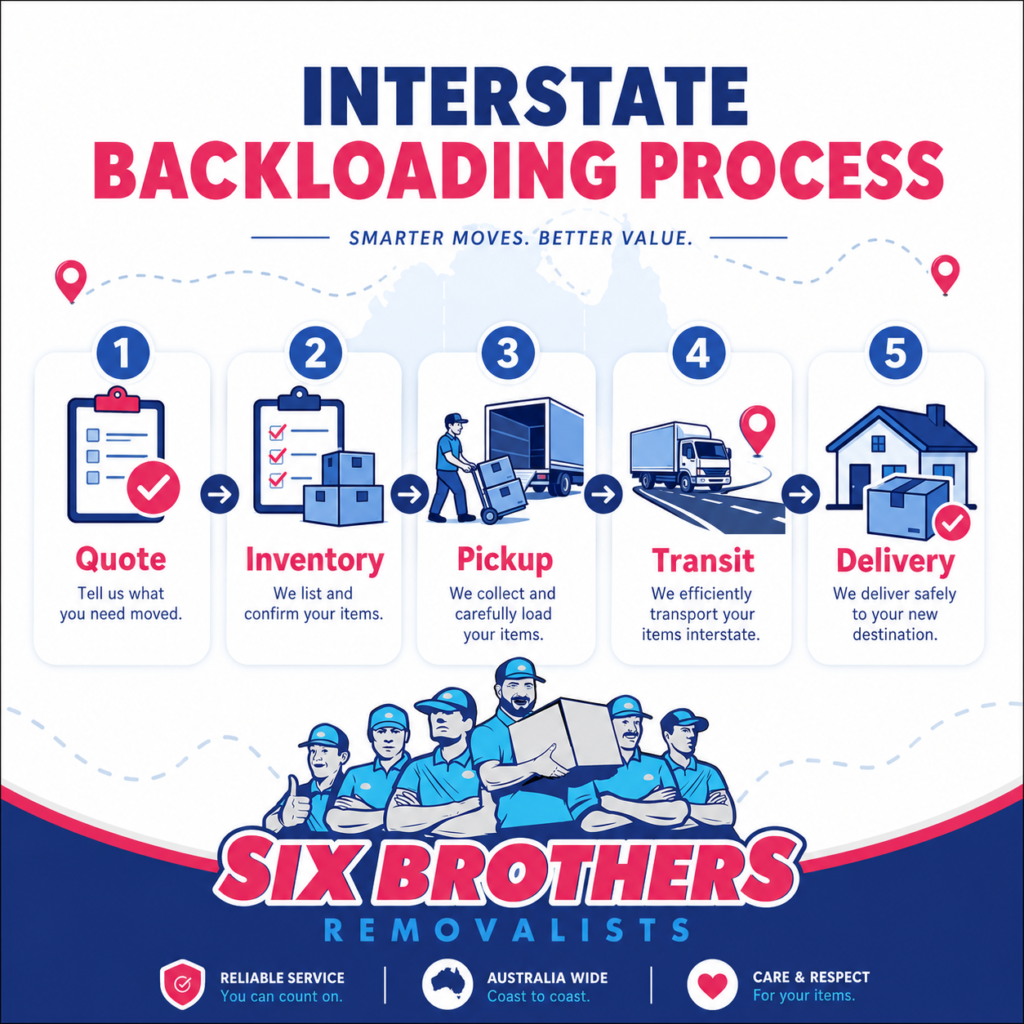
When you contact Six Brothers Removalists for a backloading quote, here is what the process looks like:
You provide us with your pickup address in Parramatta or Greater Western Sydney, your delivery address, and a list of items to be moved. We assess the cubic metre volume, check our upcoming truck schedule for your route, and provide a fixed quote that includes labour, transit insurance, and all standard charges.
On pickup day, our crew arrives at the agreed time, wraps and loads your items, and provides you with a signed inventory. You receive an estimated delivery window for your destination. When the truck arrives at your delivery address, our crew unloads and places items in the rooms you specify.
If you have questions at any point during transit, you can contact us directly. We do not use call centres or third-party brokers you deal with the same team from quote to delivery.
Conclusion
Backloading is one of the most practical ways to reduce the cost of an interstate move without compromising on service quality. For most one- and two-bedroom moves from Parramatta on major routes like Sydney to Melbourne or Sydney to Brisbane, the savings range from 30% to 60% compared to a full truck hire, often translating to $2,000–$5,000 back in your pocket.
The trade-offs are real but manageable. Flexible delivery windows, packing standards, and load size limits are factors worth understanding before you book, and the right removalist will walk you through all of them honestly before you commit to anything.
At Six Brothers Removalists, we have helped hundreds of Parramatta households and businesses move interstate through backloading, and we are straightforward about when it is the right option and when it is not. If you are planning an interstate move and want to know exactly what backloading would cost for your specific load and route, contact Six Brothers Removalists today for a clear, itemised quote with no hidden charges.
Frequently Asked Questions
What is the average cost of backloading from Sydney to Melbourne?
Backloading from Sydney to Melbourne typically costs $80–$120 per cubic metre. For a standard two-bedroom home load of around 25 m³, the total usually falls between $2,000 and $3,000, compared to $4,500–$7,000 for a full truck hire on the same route.
How long does a backloading move take to deliver interstate?
Delivery times on backloading moves are longer than dedicated truck hires because the truck coordinates multiple loads. Sydney to Melbourne typically takes 2–7 days, Sydney to Brisbane 3–8 days, and Sydney to Adelaide 5–10 days from pickup.
Is backloading safe for fragile and valuable items?
Yes, provided your removalist uses proper packing and load restraint practices. Fragile items should be individually wrapped and packed in double-walled boxes. Confirm that transit insurance is included in your quote and consider upgrading to full replacement value cover for high-value belongings.
Can I choose a specific delivery date with backloading?
Standard backloading comes with a delivery window rather than a fixed date. Some removalists offer priority backloading at a slightly higher rate, which narrows the window. If a specific delivery date is essential, a dedicated full truck hire gives you more control over timing.
How much notice do I need to book a backloading service?
Booking 2 to 4 weeks ahead is ideal for most interstate backloading routes from Parramatta. This lead time allows the removalist to coordinate your load with other consignments efficiently. Last-minute bookings within a week are possible on busy routes but may carry higher rates.
Is backloading cheaper than hiring a full truck for a large home?
For large homes with 40+ m³ of furniture, the cost difference between backloading and a full truck hire narrows significantly. Backloading delivers the greatest savings for smaller loads under 30 m³. For very large moves, get quotes for both options and compare the total cost against the delivery flexibility each provides.
Does backloading insurance cover all my belongings?
Most backloading services include basic transit insurance, which covers loss or damage caused by the removalist’s negligence. This is not the same as full replacement value insurance. Review the policy details with your removalist before booking and consider upgrading cover for antiques, electronics, artwork, or other high-value items.