

Table of Contents
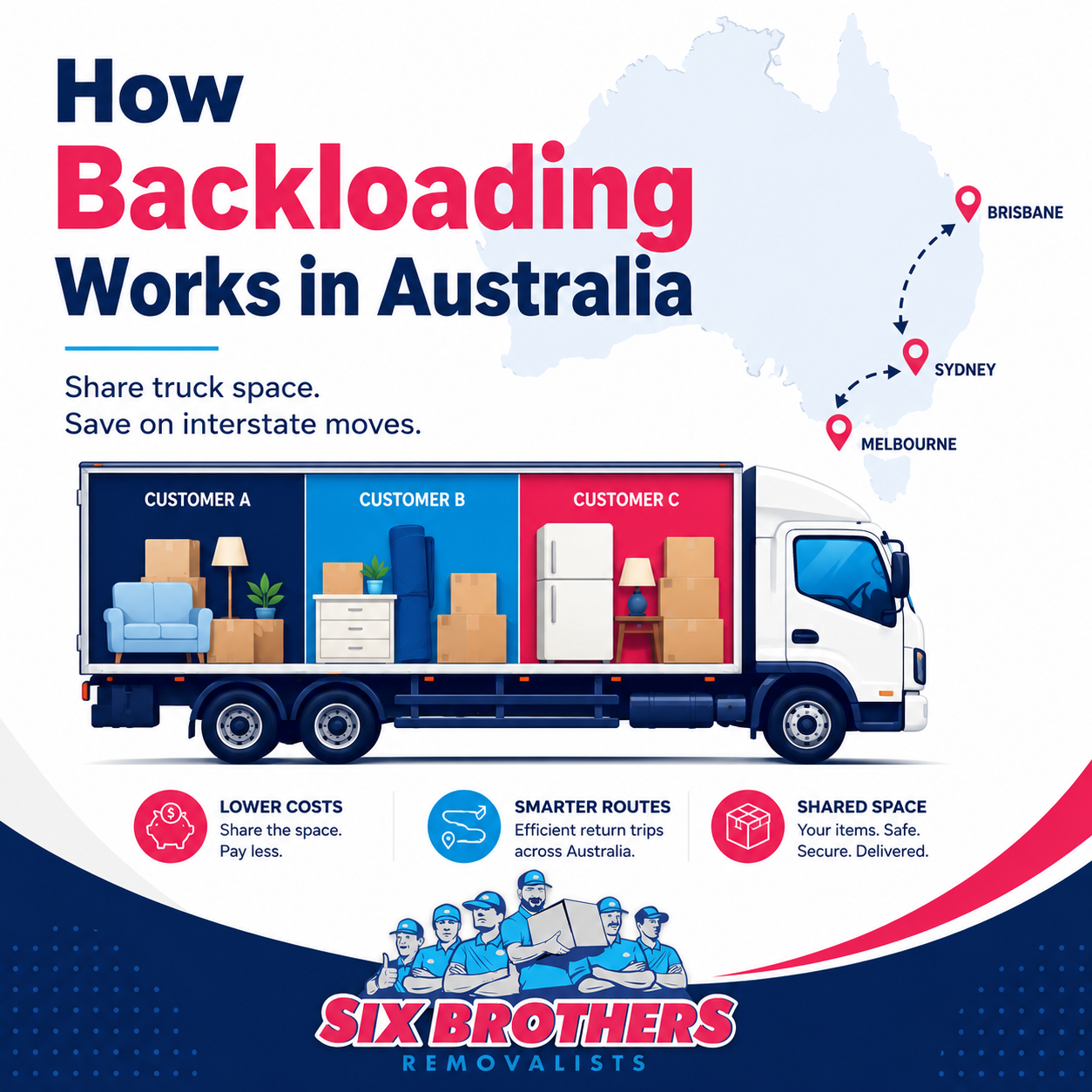
Backloading lets you share space on a removal truck that’s already heading to your destination, cutting interstate moving costs by up to half compared to a dedicated service. It’s one of the smartest options available to anyone relocating between Australian cities, yet most people don’t fully understand how it works or when it makes sense.
This guide breaks down the entire backloading process from how removalists coordinate shared loads and what it actually costs, to how long deliveries take and what to watch out for when booking. Whether you’re moving from Parramatta to Melbourne or Brisbane to Sydney, you’ll know exactly what to expect.
What Is Backloading and How Does It Work?
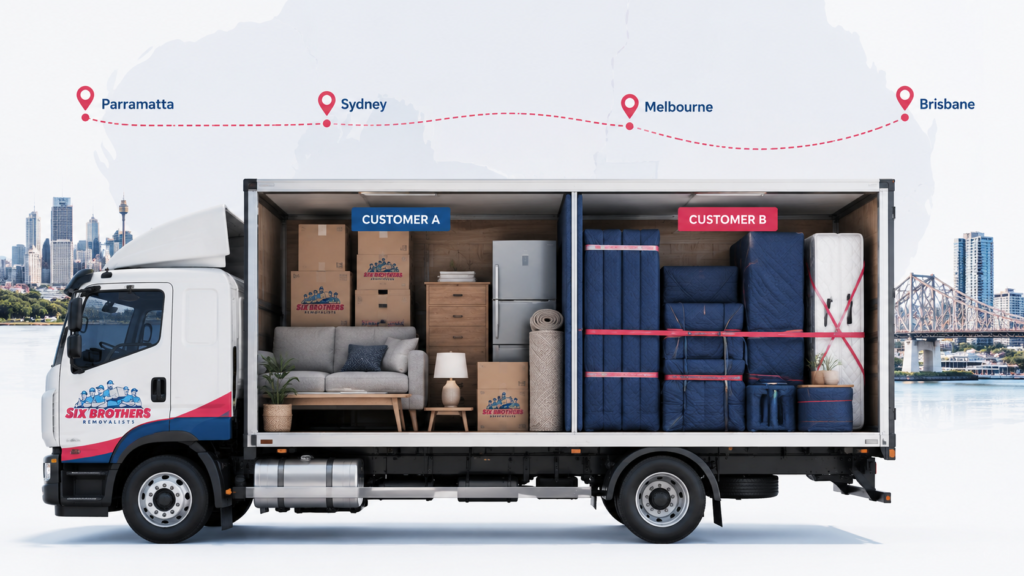
Backloading is a freight-sharing arrangement where your belongings travel on a removal truck that would otherwise return partially empty after completing another job. Instead of paying for an entire truck, you pay only for the space your items occupy on a vehicle already scheduled to travel your route.
Here’s the basic scenario. A removalist company delivers a full load from Sydney to Brisbane. Rather than driving the truck back to Sydney empty, they pick up a new customer’s goods in Brisbane for the return trip. That return-trip customer is using a backloading service.
The concept works because removal companies run trucks between major Australian cities constantly. Every empty return trip is lost revenue. Backloading turns that dead mileage into a discounted service for customers and additional income for the removalist.
The Step-by-Step Backloading Process
The process starts when you request a quote from a removalist that offers backloading services. You’ll provide your pickup location, delivery destination, an inventory of items, and your preferred dates.
The removalist checks their upcoming schedule for trucks travelling your route. Once they identify a truck with available space, they confirm your booking. Your items are loaded alongside or after the primary customer’s goods.
During transit, your belongings share the truck with other shipments. Professional removalists use blankets, straps, and dividers to keep each customer’s load separate and secure. At the destination, the driver delivers each load to the correct address, typically in the order that makes the most efficient route.
Why Removal Trucks Have Empty Space on Return Trips
Moving patterns across Australia aren’t evenly balanced. More people might move from Sydney to Melbourne in a given week than the reverse. This creates a natural imbalance where trucks heading in one direction are full and trucks heading back have spare capacity.
Seasonal trends amplify this. During peak periods like the end of the financial year or the start of the school year, certain routes see heavy one-directional demand. Removalists would rather fill that return space at a discount than earn nothing on the drive back.
Even on balanced routes, it’s rare for a removalist to have perfectly timed full loads in both directions. Backloading fills those gaps.
Backloading vs. Dedicated Removalist Services
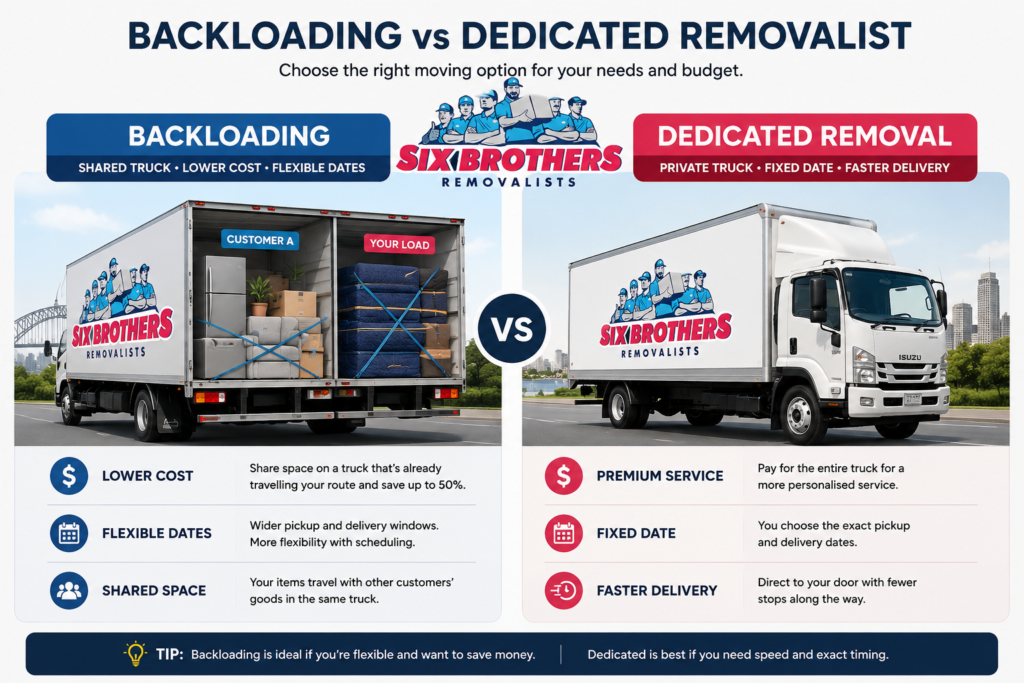
With a dedicated service, you hire the entire truck. It arrives at your door, loads only your belongings, drives directly to your new address, and unloads. You control the schedule, and your items are the only ones on board.
With backloading, you share the truck. This means less control over exact pickup and delivery times. Your move depends on the primary booking’s schedule. Delivery windows are broader often spanning several days rather than a specific time.
The trade-off is straightforward. Dedicated moves offer precision and speed. Backloading offers significant savings with more flexibility required on timing. For many interstate moves, especially when you’re not under a tight deadline, backloading delivers excellent value.
How Much Does Backloading Cost in Australia?
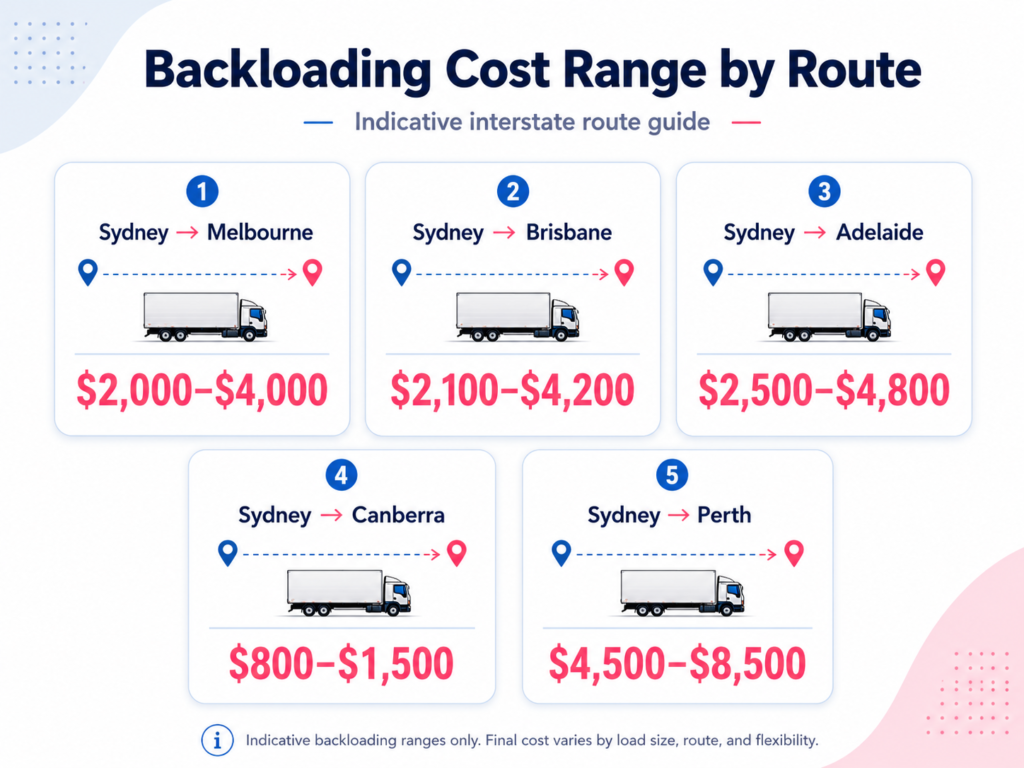
Backloading typically costs between 30% and 50% less than a full dedicated removal service on the same route. The exact price depends on several factors, but the savings are consistent enough that backloading has become one of the most popular budget-friendly options for interstate moves.
For a one-bedroom apartment moving interstate, backloading might cost between $800 and $1,500. A three-bedroom house on a major route like Sydney to Melbourne could range from $2,000 to $4,000 via backloading, compared to $4,000 to $7,000 for a dedicated truck.
These figures vary based on volume, distance, timing, and the specific removalist. Always get itemised quotes from multiple providers.
Factors That Affect Backloading Prices
Volume of goods is the primary cost driver. Backloading is priced by the cubic metres your items occupy on the truck. More furniture and boxes means more space, which means a higher price.
Distance matters, but not as dramatically as with dedicated services. Since the truck is already making the trip, the per-kilometre cost is spread across multiple customers.
Route popularity influences pricing. High-demand corridors like Sydney–Melbourne or Sydney–Brisbane tend to have more backloading availability and competitive pricing. Less common routes say, Parramatta to Darwin may have fewer options and higher costs.
Timing and flexibility directly affect your quote. If you can offer a wide pickup and delivery window, removalists can slot you into whichever truck has space. Rigid dates limit options and may increase the price.
Seasonal demand plays a role too. Moving during peak periods means more competition for backloading spots. Off-peak months like March through May often yield the best rates.
Comparing Backloading Quotes: What to Look For
Not all backloading quotes are structured the same way. Some removalists quote a flat rate based on your inventory list. Others charge per cubic metre. A few quote by the hour for loading and unloading, plus a flat transit fee.
When comparing quotes, check whether the price includes insurance or transit protection. Ask if there are additional charges for stairs, long carries from the truck to your door, or weekend delivery. Some companies advertise a low base rate but add surcharges that inflate the final cost.
Request an itemised breakdown. A trustworthy removalist will clearly list what’s included: loading labour, transit, unloading, blankets and straps, and any insurance coverage. If a quote feels vague, ask for specifics before committing.
Get at least three quotes. This gives you a realistic range for your route and volume, and helps you spot outliers — both suspiciously cheap and unnecessarily expensive.
Which Interstate Routes Are Best for Backloading?
Backloading works best on routes where removal trucks travel frequently. The more trucks running a corridor, the more backloading spots become available, and the more competitive the pricing.
Australia’s busiest interstate moving routes form the backbone of the backloading network. If your move falls on one of these corridors, you’ll find more options, shorter wait times, and better rates.
Sydney to Melbourne Backloading
This is Australia’s most popular interstate moving route. Trucks run between Sydney and Melbourne daily, making backloading availability almost constant. The roughly 880-kilometre journey typically takes one to two days for delivery via backloading.
For Parramatta residents, this route is particularly convenient. Most removalists operating Sydney–Melbourne services include Greater Western Sydney in their pickup zones. Competition on this corridor keeps prices sharp.
Sydney to Brisbane Backloading
The Sydney–Brisbane corridor is another high-frequency route. The distance is around 920 kilometres, and backloading deliveries usually arrive within one to three days of pickup.
This route sees strong demand in both directions, which means good availability year-round. Removalists often combine pickups across Sydney’s suburbs including Parramatta, Penrith, and Liverpool before heading north.
Sydney to Adelaide and Other Major Routes
Sydney to Adelaide covers approximately 1,380 kilometres. Backloading is available on this route, though with slightly less frequency than the Melbourne or Brisbane corridors. Delivery windows tend to be wider — three to five days is common.
Other routes like Sydney to Perth (around 3,930 kilometres) and Sydney to Canberra (approximately 280 kilometres) also support backloading. Perth routes have longer transit times and fewer weekly departures, so flexibility is especially important. Canberra, being close, often sees same-week delivery.
For less common routes such as moves to regional centres like Townsville, Hobart, or Alice Springs backloading is still possible but may require more lead time. Removalists sometimes consolidate regional deliveries, picking up multiple backloads and delivering them in a single regional run.
How Route Popularity Affects Availability and Pricing
On high-traffic routes, backloading spots open up regularly. You might request a quote on Monday and have your items on a truck by Wednesday. Pricing stays competitive because multiple removalists are vying for your business.
On quieter routes, you may need to wait a week or more for a truck heading your way. Fewer options mean less price competition. If your move is time-sensitive on a low-frequency route, a dedicated service might be worth the extra cost.
The general rule: the more trucks running your route, the cheaper and faster your backloading experience will be.
What Can You Move Using a Backloading Service?
Backloading can handle most household and office items that fit safely on a shared truck. Standard furniture, boxed belongings, white goods, and office equipment are all commonly moved via backloading.
The key consideration is how your items interact with other customers’ goods on the same truck. Everything needs to be securely packed, stackable where possible, and able to withstand the minor shifts that occur during transit.
Household Items and Furniture
Beds, couches, dining tables, wardrobes, bookshelves, and desks are all standard backloading items. Mattresses should be wrapped in protective covers. Glass-topped tables and mirrors need blanket wrapping and edge protection.
White goods like fridges, washing machines, and dryers travel well via backloading when properly secured. Fridges should be transported upright and given 24 hours to settle before being switched on at the new address.
Boxes of clothing, kitchenware, books, and personal items make up the bulk of most backloads. Properly packed boxes sealed, labelled, and not overfilled stack efficiently and maximise your use of the allocated space.
Items That May Not Be Suitable for Backloading
Extremely fragile or high-value items deserve careful consideration. Grand pianos, large artworks, antique furniture with delicate finishes, and irreplaceable heirlooms may be better suited to a dedicated service where they receive individual attention throughout transit.
Hazardous materials including paint, gas bottles, cleaning chemicals, and flammable liquids cannot travel on any removal truck, backloading or otherwise. This is an Australian transport regulation, not a backloading-specific restriction.
Perishable goods, plants, and live animals are also excluded. If you’re moving interstate, check state quarantine rules for plants and food items regardless of your moving method.
Very large or awkwardly shaped items like pool tables, spas, or ride-on mowers can sometimes be accommodated but may require special arrangements. Discuss these with your removalist during the quoting process.
How to Pack Items for a Backloading Move
Packing for backloading follows the same principles as any move, with extra emphasis on durability. Your boxes will share space with other loads, so they need to withstand being stacked and positioned around other items.
Use strong, double-walled moving boxes rather than old grocery cartons. Fill boxes completely to prevent crushing use packing paper or bubble wrap to fill gaps. Seal every box with quality packing tape on both top and bottom.
Wrap furniture in moving blankets or padded covers. Removalists typically provide blankets, but confirm this when booking. Disassemble flat-pack furniture where possible to save space and reduce the risk of damage.
Label every box on at least two sides with your name, destination address, and contents. This helps the driver organise the truck and ensures your items end up at the right address.
How Long Does Backloading Take?
Backloading delivery times are longer than dedicated services. This is the primary trade-off for the lower cost. Understanding realistic timeframes helps you plan your move without unnecessary stress.
The transit time depends on the route distance, the number of other deliveries the truck is making, and how quickly a suitable truck becomes available after you book.
Typical Delivery Timeframes by Route
Sydney to Melbourne or Melbourne to Sydney: One to three days from pickup. This route runs so frequently that delays are uncommon.
Sydney to Brisbane or Brisbane to Sydney: Two to four days is typical. Some removalists offer next-day backloading on this corridor during busy periods.
Sydney to Adelaide: Three to five days. The longer distance and slightly lower truck frequency extend the window.
Sydney to Perth: Seven to fourteen days. This is Australia’s longest major moving route, and trucks may make stops along the way in Adelaide or other centres.
Sydney to Canberra: One to two days. The short distance means quick turnaround once your items are on a truck.
These are general guides. Your removalist will provide a specific delivery window based on their current schedule.
Why Backloading Takes Longer Than Dedicated Moves
Three factors extend backloading delivery times compared to a dedicated truck.
First, your items wait for a truck with available space heading your direction. If a truck leaves tomorrow, great. If the next available truck is in four days, you wait.
Second, the truck makes multiple stops. The driver may pick up or deliver other backloads along the route. A Sydney-to-Melbourne truck might stop in Canberra or Albury to collect or drop off another customer’s goods.
Third, loading order matters. If your items are loaded first, they come off last. The driver delivers in the most efficient sequence, not necessarily in the order customers booked.
Tips for Managing Backloading Delivery Windows
Build buffer time into your moving plan. If your backloading delivery window is three to five days, don’t schedule your internet installation or furniture assembly for day three. Plan for the later end of the window.
Pack an essentials bag with everything you need for the first few days at your new place: toiletries, a change of clothes, phone chargers, medications, basic kitchen items, and bedding. This way, a delayed delivery doesn’t leave you stranded.
Communicate with your removalist. Most companies provide tracking updates or at least a phone number to check on your delivery status. Don’t hesitate to call for an update as your window approaches.
If you have a hard deadline like a lease starting on a specific date, mention this when booking. Some removalists can prioritise your load or suggest a hybrid option where time-critical items go on a faster service.
Is Backloading Safe for Your Belongings?
Safety is the most common concern people have about backloading. Sharing a truck with strangers’ belongings raises understandable questions about damage, loss, and accountability.
The short answer: backloading is safe when you use a reputable, experienced removalist. The risks are manageable and largely the same as any professional move.
How Removalists Protect Items During Shared Loads
Professional removalists use several methods to keep backloaded items secure and separated.
Moving blankets and padded wraps protect furniture surfaces from scratches and scuffs. Ratchet straps secure items against the truck walls and prevent shifting during transit. Dividers or partitions separate different customers’ loads within the truck.
Each customer’s items are grouped together and clearly marked. The driver knows which items belong to which delivery address. Experienced removalists load trucks strategically, placing heavier items at the bottom and fragile items where they won’t bear weight.
The loading process for backloading isn’t fundamentally different from a dedicated move. The same care, equipment, and techniques apply. The main difference is that the truck contains more than one customer’s goods.
Transit Insurance and Liability for Backloading
Insurance coverage varies between removalists, and this is one of the most important details to clarify before booking.
Some removalists include basic transit insurance in their backloading price. This typically covers loss or damage caused by accidents, fire, or theft during transit. The coverage amount may be capped — often at a declared value per item or a total limit.
Other removalists offer insurance as an optional add-on. If you decline, your items may travel at your own risk, meaning the company’s liability for damage is limited or nonexistent.
Ask your removalist these specific questions: What insurance is included? What does it cover? What’s the maximum payout? Is there an excess? Can I purchase additional cover? Get the answers in writing.
For high-value items, consider whether your home and contents insurance policy covers goods in transit. Some policies do, some don’t. Check before your move.
Red Flags to Watch For When Choosing a Backloading Provider
Not every company offering cheap backloading rates delivers reliable service. Watch for these warning signs.
No physical address or ABN. Legitimate removalists have a registered business and a verifiable location. A company operating only through a mobile number and a Facebook page may not be accountable if something goes wrong.
No written quote or contract. If a removalist won’t put the price, inclusions, and delivery window in writing, walk away. Verbal agreements offer no protection.
Unusually low prices. If a quote is dramatically cheaper than every other option, question why. It might indicate no insurance, subcontracted labour, or hidden fees that appear after your items are on the truck.
No reviews or references. Check Google reviews, product review sites, and ask for references from past backloading customers. A company with no online presence or consistently negative feedback is a risk.
Vague delivery windows. “We’ll get it there when we can” isn’t a delivery window. A professional removalist provides a realistic timeframe and communicates proactively if delays occur.
How to Book a Backloading Service in Australia
Booking backloading is straightforward, but a few steps taken early in the process save time and prevent problems later.
When to Book: Lead Times and Flexibility
Book as early as possible. Two to four weeks before your move is ideal for most interstate routes. This gives the removalist time to match your load with an appropriate truck and gives you time to compare quotes.
Last-minute backloading is possible on busy routes like Sydney–Melbourne, but your options narrow and prices may increase. On quieter routes, short notice might mean no availability at all.
Flexibility is your biggest advantage when booking backloading. If you can offer a pickup window of three to five days rather than a single date, the removalist has more trucks to choose from. This often translates to a lower price and faster service.
What Information You Need to Provide
Your removalist will need the following to generate an accurate backloading quote:
Pickup address and delivery address, including floor level and access details. Stairs, narrow driveways, and long walks from the truck to the door all affect the job.
A detailed inventory list. List every major item: number of beds and sizes, couches, tables, appliances, and an estimate of the number of boxes. The more accurate your list, the more accurate your quote.
Preferred dates and flexibility. State your ideal pickup date and how much flexibility you have. Be honest if you absolutely must be out by a certain date, say so.
Any special items. Mention anything fragile, unusually heavy, oversized, or valuable. This helps the removalist plan the load and advise on packing requirements.
Questions to Ask Before Confirming Your Booking
Before you lock in a backloading booking, get clear answers to these questions:
What exactly is included in the quoted price? Loading, transit, unloading, blankets, straps?
What’s the delivery window? Is it a guaranteed range or an estimate?
What insurance coverage is included? What’s the claims process if something is damaged?
Are there any additional charges I should know about? Stairs fees, long-carry fees, weekend surcharges, storage fees if delivery is delayed?
Who will be handling my items? Are the movers employees of the company or subcontractors?
Can I track my delivery? Will I receive updates on the truck’s progress?
What happens if the delivery is delayed beyond the quoted window?
Getting these answers upfront prevents surprises and helps you choose a provider you can trust.
Backloading Tips for Parramatta and Greater Western Sydney Residents
Parramatta sits in an ideal position for backloading. As a major hub in Greater Western Sydney, it’s well-connected to the motorway network that removal trucks use for interstate routes. Most removalists servicing Sydney include Parramatta in their standard pickup and delivery zones without additional charges.
Local Pickup and Access Considerations
If you’re in an apartment complex in Parramatta CBD, Harris Park, or Rosehill, check whether your building requires a loading dock booking. Many newer apartment buildings have specific time slots for removalist access, and missing your slot can delay the entire backloading schedule.
For houses in suburbs like North Parramatta, Westmead, or Toongabbie, ensure the truck can access your street. Some residential streets have low-hanging trees, narrow turns, or parking restrictions that affect large removal trucks. Let your removalist know about any access issues when booking.
If you’re moving from a unit with no lift and your apartment is above ground floor, mention the number of flights of stairs. This affects the time required for loading and may incur an additional charge.
Combining Backloading with Storage Solutions
Sometimes your move-out date and move-in date don’t align perfectly. If there’s a gap, you may need short-term storage.
Some removalists offer storage as part of their backloading service. Your items are collected, stored in a secure warehouse, and then loaded onto a backloading truck when one becomes available for your route. This can actually work in your favour the removalist has more flexibility to find the best-priced truck when your items are already in their warehouse.
If your removalist doesn’t offer storage, look for a facility near your pickup location. Having your items in storage close to a major transport hub like Parramatta makes it easier for the removalist to collect them when a truck is ready.
Making Backloading Work for Office and Business Moves
Backloading isn’t limited to household moves. Small to medium office relocations can also benefit from shared truck space, particularly for interstate moves.
Office furniture desks, chairs, filing cabinets, and shelving packs efficiently on a shared truck. IT equipment needs extra protection but is otherwise suitable for backloading.
The key consideration for business moves is timing. If your office needs to be operational by a specific date, the flexible delivery windows of backloading may not suit. However, if you’re relocating a satellite office, moving archived files, or shifting equipment that isn’t immediately needed, backloading offers substantial savings.
Common Backloading Mistakes and How to Avoid Them
Even experienced movers make errors when using backloading for the first time. Knowing the common pitfalls helps you avoid them.
Underestimating Your Load Size
The most frequent mistake is underestimating how much space your belongings will take up on the truck. People forget about items in the garage, garden shed, or under the stairs. They undercount boxes or misjudge furniture dimensions.
An inaccurate inventory leads to an inaccurate quote. On moving day, if your load is larger than quoted, the removalist may not have enough space on the truck. You’ll either need to leave items behind, pay a surcharge, or arrange a second shipment.
Do a thorough walkthrough of every room, cupboard, and storage area. Use an online cubic metre calculator to estimate your total volume. When in doubt, round up.
Not Reading the Fine Print
Backloading contracts sometimes contain clauses about liability limits, delay provisions, and additional charges. Read the terms before signing.
Pay particular attention to what happens if the removalist can’t deliver within the quoted window. Some contracts allow unlimited delays with no compensation. Others provide a specific remedy, like a partial refund or free storage.
Check the damage claims process. How long do you have to report damage? What evidence is required? Is there an excess on claims? Understanding this before your move is far better than discovering it after something breaks.
Being Too Rigid on Dates
Backloading rewards flexibility. If you insist on a specific pickup date and a narrow delivery window, you’re working against the system that makes backloading affordable.
The more flexible you are, the more options the removalist has. More options mean better pricing and faster matching with an available truck. If your schedule allows, offer a pickup window of at least three days and a delivery window of at least five days.
Conclusion
Backloading works by sharing space on removal trucks already travelling your route, delivering genuine savings on interstate moves across Australia. Understanding the process from how pricing is calculated and which routes offer the best availability, to how items are protected and what to ask before booking puts you in control of a smarter, more affordable relocation.
For Parramatta residents and businesses planning an interstate move, backloading is one of the most practical ways to reduce costs without sacrificing the safety of your belongings. The key is choosing an experienced removalist who communicates clearly, provides written quotes, and carries proper insurance.
We offer interstate backloading services across all major Australian routes, backed by years of hands-on experience in Greater Western Sydney. Contact Six Brothers Removalists for a free backloading quote and let us match your move with the right truck at the right price.
Frequently Asked Questions
How much cheaper is backloading compared to a full removal service?
Backloading typically costs 30% to 50% less than hiring a dedicated removal truck for the same route. The exact savings depend on your load size, the route, and how flexible you are with dates. On popular corridors like Sydney to Melbourne, the discounts tend to be strongest due to high truck frequency.
Can I backload just a few items instead of a full house?
Yes. Backloading is ideal for partial loads. Whether you’re moving a single piece of furniture, a few boxes, or half a household, you only pay for the space your items occupy. This makes it a cost-effective option for small shipments that don’t justify a full truck.
How far in advance should I book a backloading service?
Two to four weeks is recommended for most interstate routes. Popular routes like Sydney–Melbourne may accommodate shorter notice, but booking early gives you more truck options and often better pricing. Last-minute bookings on quieter routes may have limited availability.
Is my furniture safe sharing a truck with other people’s belongings?
Yes, when you use a reputable removalist. Professional movers use blankets, straps, and dividers to separate and secure each customer’s load. The handling techniques are the same as a dedicated move. Always confirm that your removalist carries transit insurance for added peace of mind.
What happens if my backloading delivery is delayed?
Delays can occur if the primary load takes longer than expected or if the truck encounters issues on the route. A good removalist will communicate proactively and provide updated timeframes. Check your contract for delay provisions before booking, and always plan for the later end of your delivery window.
Can I use backloading for an office move?
Backloading works well for small to medium office relocations, especially when the equipment isn’t needed immediately at the new location. Desks, chairs, filing cabinets, and boxed files all travel efficiently on shared trucks. For time-critical office moves, a dedicated service may be more appropriate.
Do backloading removalists pack my items for me?
Some removalists offer packing as an add-on service, while others expect items to be packed and ready for loading. If you need packing assistance, ask when requesting your quote. Professional packing adds cost but ensures your items are protected to the standard required for shared transit.
What items can’t be moved via backloading?
Hazardous materials like paint, gas bottles, and flammable liquids are prohibited on all removal trucks. Perishable food, live plants, and animals also cannot be transported. Extremely fragile or irreplaceable items may be better suited to a dedicated service where they receive individual handling throughout the journey.
Does backloading work for moves to regional areas?
Yes, though availability is more limited than on major city-to-city routes. Removalists sometimes consolidate regional deliveries, collecting multiple backloads and delivering them in a single run. This means longer delivery windows, but the cost savings still apply. Book early and be flexible with dates for the best results.
How do I get an accurate backloading quote?
Provide a detailed inventory of every item you’re moving, including furniture dimensions and box counts. Mention your pickup and delivery addresses with access details like stairs or narrow driveways. State your preferred dates and how much flexibility you have. The more accurate and complete your information, the more reliable your quote will be.