


Moving interstate is hard at any age but some life stages make it significantly harder than others. Teenagers, in particular, face the steepest emotional and social challenges during relocation, though toddlers, seniors, and families in their 30s and 40s each carry their own distinct pressures.
Understanding which age group faces the most difficulty helps you plan smarter, communicate better, and choose the right support. Whether you’re moving from Parramatta to Brisbane, Melbourne, or anywhere across Australia, the age of the people in your household shapes everything from your timeline to your packing strategy.
This guide breaks down every major life stage, explains why each one presents unique challenges, and gives you practical steps to make the transition as smooth as possible, no matter who’s making the move.

Why Age Matters More Than You Think When Moving Interstate
Most people focus on the logistics of an interstate move: the truck, the boxes, the cost, the distance. What gets underestimated is how differently people experience relocation depending on where they are in life.
A 45-year-old professional moving for a career opportunity processes that change very differently from a 15-year-old who’s leaving their entire social world behind. A 70-year-old downsizing from a family home of 40 years carries a weight that has nothing to do with cubic metres of furniture.
Age determines emotional resilience, social dependency, physical capacity, and the ability to adapt to new environments. It shapes how long the adjustment takes, how much support is needed, and how the move is remembered years later. Ignoring the age factor when planning an interstate relocation is one of the most common mistakes families make.
The Physical Demands of Interstate Relocation at Different Life Stages
Interstate moves are physically demanding in ways that local moves simply aren’t. You’re not just lifting boxes, you’re managing long travel days, sleeping in unfamiliar places, and rebuilding daily routines from scratch in a new city.
Young children need consistent sleep environments and feeding schedules that long-distance travel disrupts. Teenagers may be physically capable but emotionally exhausted. Adults in their 30s and 40s are often managing the physical labour of the move while simultaneously handling work deadlines and children’s needs. Seniors may face genuine health risks from overexertion, dehydration during travel, or the stress of disrupted medication routines.
Recognising these physical realities early means you can plan rest stops, book appropriate accommodation, and engage professional removalists who handle the heavy lifting, so your energy goes toward your family, not your furniture.
How Emotional Readiness Shifts Across Age Groups
Emotional readiness for an interstate move is not linear. It doesn’t simply increase with age. A 7-year-old may adapt faster than a 16-year-old. A 35-year-old may struggle more than a 65-year-old who has moved before.
What changes across age groups is the nature of the emotional challenge. Toddlers experience disruption to attachment and routine. School-age children grieve friendships and familiar environments. Teenagers face identity-level disruption. Adults manage grief alongside responsibility. Seniors confront loss of community and independence.
Each of these emotional experiences is real and valid. Planning an interstate move well means acknowledging them not minimising them.
The Hardest Age Groups to Move Interstate — Ranked and Explained
There is no single “hardest age” that applies universally to every family or every move. But research into child development, psychology, and relocation stress consistently points to certain life stages as more vulnerable than others. Here’s an honest breakdown.
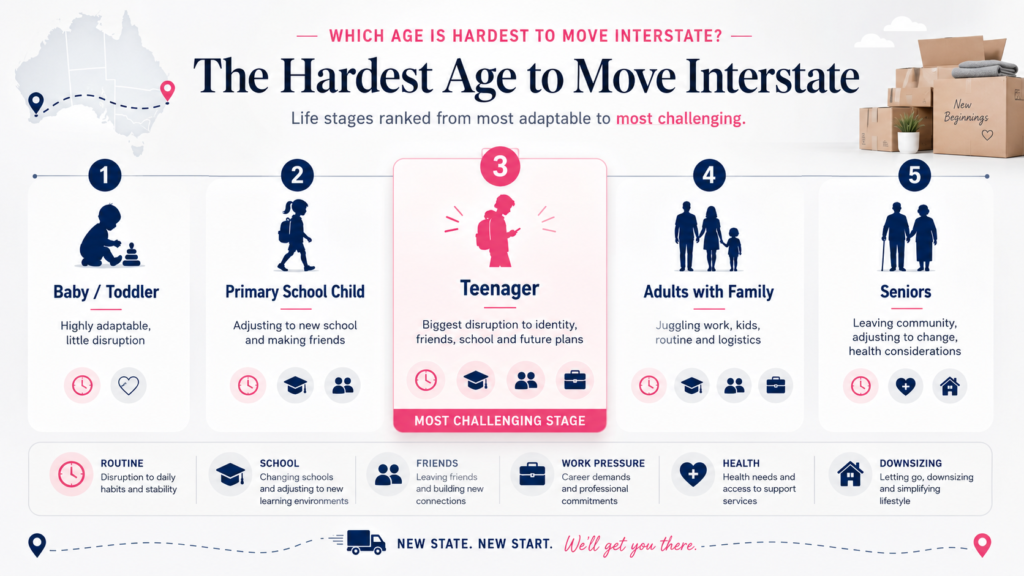
Moving with Babies and Toddlers (Ages 0–3): Disrupted Routines and Sleep Schedules
Babies and toddlers don’t understand what’s happening, and that’s precisely what makes moving with them so exhausting for parents. They can’t be reasoned with, prepared, or reassured through conversation. What they respond to is routine, familiarity, and the emotional state of their caregivers.
Long travel days, unfamiliar sleeping environments, and the chaos of unpacking disrupt the routines that young children depend on for security. Sleep regression is common after a move. Feeding schedules get thrown off. Separation anxiety can spike.
The good news is that toddlers are also highly adaptable once routines are re-established. The challenge is almost entirely on the parents — managing the move while keeping a small child calm, safe, and on schedule. Professional removalists who handle packing and transport take a significant load off parents during this stage.
Moving with Primary School-Age Children (Ages 5–12): Friendships, Schools, and Stability
Primary school-age children are old enough to understand what’s happening and young enough to feel powerless about it. They’ve formed genuine friendships, developed attachments to teachers and classrooms, and built a sense of identity around their school and neighbourhood.
An interstate move at this age means leaving all of that behind. Research into childhood relocation consistently identifies this age range as one of the most emotionally disruptive, particularly for children aged 7 to 12 who have established peer groups and school routines.
The key factors here are school enrolment timing, maintaining contact with old friends, and giving children meaningful involvement in the new home — choosing their bedroom layout, exploring the new neighbourhood, joining local sports teams or activities.
Moving as a Teenager (Ages 13–17): Identity, Social Roots, and Resistance
This is widely regarded as the most difficult age to move interstate, and for good reason. Adolescence is the developmental stage during which identity is formed through peer relationships, social belonging, and independence from parents. An interstate move at this age doesn’t just change a teenager’s address — it dismantles the social infrastructure their identity is built on.
Teenagers are also old enough to feel genuine anger and resentment about a decision they had no part in making. Unlike younger children who adapt relatively quickly once routines are restored, teenagers can carry the emotional weight of a forced relocation for years.
The resistance is real. The grief is real. And the impact on academic performance, mental health, and family relationships during the transition period can be significant.
Moving in Your 30s and 40s with a Family: Career, Kids, and Competing Priorities
Adults in their 30s and 40s are often managing the most complex version of an interstate move. They’re coordinating children’s school transitions, managing career changes or remote work arrangements, selling or leasing property, and handling the financial pressure of a major relocation — all simultaneously.
The challenge here isn’t emotional vulnerability in the way it is for teenagers or toddlers. It’s the sheer volume of competing responsibilities. Decision fatigue is real. The risk of overlooking important details — insurance, school enrolment deadlines, utility connections — is high when you’re managing everything at once.
This is the life stage where professional removalist support, clear timelines, and detailed checklists make the biggest practical difference.
Moving as a Senior (Ages 65+): Health, Downsizing, and Leaving Long-Term Homes
Moving interstate as a senior carries a unique emotional weight. Many seniors are leaving homes they’ve lived in for decades — homes where children were raised, where memories are embedded in every room. The physical act of downsizing can feel like dismantling a life.
There are also genuine practical challenges: managing medications during travel, physical limitations around packing and lifting, and the health risks associated with the stress of major life transitions. Social isolation in a new city is a real concern for seniors who are leaving established community networks.
The adjustment period for seniors is often longer than for younger adults, and the need for a carefully managed, unhurried move is greater. Rushing a senior’s interstate relocation is one of the most common mistakes adult children make when organising a parent’s move.
Why Teenagers Are Widely Considered the Hardest Age to Move Interstate
Across psychology research, parenting literature, and the lived experience of families who’ve relocated, teenagers consistently emerge as the age group most negatively affected by interstate moves. Understanding why helps parents approach the situation with more empathy and better strategies.
The Psychology Behind Teen Resistance to Relocation
Adolescent development is fundamentally social. Between the ages of 13 and 17, peer relationships are not just important — they are developmentally central. Friendships, romantic relationships, group belonging, and social status are the building blocks of teenage identity during this period.
An interstate move severs those connections abruptly. Unlike adults who can maintain professional networks remotely or children who adapt to new classrooms relatively quickly, teenagers lose the social context in which they understand themselves. The result is often a profound sense of grief, anger, and disorientation.
Teenagers are also acutely aware of the permanence of the move in a way younger children are not. They understand that their old friendships will change, that their social standing in a new school starts from zero, and that the life they knew is genuinely over. That awareness, combined with the developmental intensity of adolescence, makes the emotional impact of interstate relocation particularly acute at this age.
How to Support a Teenager Through an Interstate Move
Supporting a teenager through an interstate move requires honesty, involvement, and patience — not reassurance that everything will be fine.
Give them as much notice as possible. Involve them in decisions where you genuinely can — the new suburb, the school options, the layout of their new room. Acknowledge that their anger or sadness is legitimate. Don’t minimise the loss of their social world.
Help them maintain connections with old friends through regular visits or video calls. Encourage them to find new social environments through sport, music, or other interests rather than forcing school friendships. And give them time. The adjustment period for teenagers is longer than for younger children, and expecting rapid adaptation creates additional pressure.
How to Make an Interstate Move Easier at Any Age
Regardless of who’s in your household, the quality of your planning determines the quality of your move. These practical strategies apply across age groups and significantly reduce the stress of interstate relocation.
Planning Timelines That Work for Families with Children
For families with children, the timing of an interstate move relative to the school calendar is one of the most important decisions you’ll make. Moving at the end of a school year allows children to complete their current year with their existing friends and start fresh at a new school from day one rather than arriving mid-term as the new kid.
For most NSW families, this means planning a move between November and January. Booking your removalist 8 to 12 weeks in advance for an interstate move is strongly recommended, particularly during peak periods. Last-minute bookings during school holiday periods are difficult to secure and often more expensive.
Choosing the Right Time of Year for an Interstate Move from NSW
Interstate moves from Parramatta and Greater Western Sydney peak during December and January, when school holidays align with the end of the financial year and many employment contracts. This creates high demand for removalist services on major routes including Sydney to Melbourne, Sydney to Brisbane, and Sydney to Adelaide.
If your timeline is flexible, moving in February, March, or September offers better availability, more competitive pricing, and less competition for removalist bookings. Avoiding public holiday periods also reduces travel time and accommodation costs during the transit phase.
What to Tell Kids of Different Ages About Moving Interstate
How you communicate the move matters as much as when you communicate it. Toddlers need minimal advance notice, a week or two is enough, with simple, concrete language about the new house. Primary school-age children benefit from 4 to 6 weeks of preparation, with honest answers to their questions and involvement in age-appropriate decisions.
Teenagers should be told as early as possible ideally before the decision is finalised if there is any genuine flexibility. Being told after the fact, with no opportunity for input, significantly increases resentment and resistance. Even if the move is non-negotiable, involving teenagers in the conversation early demonstrates respect for their experience.
So you understand the emotional and logistical challenges of moving interstate at different ages. The next question most families ask is: how do we actually manage the practical side of this without it falling apart?
Practical Steps to Reduce Moving Stress for Every Age Group
The emotional challenges of an interstate move are real, but they’re made significantly worse when the logistics are chaotic. A well-managed move, with clear timelines, professional support, and the right services in place, creates the stability that every age group needs during the transition.

Using Professional Removalists to Protect Your Family During the Transition
Engaging a professional removalist for an interstate move is not a luxury, it’s a practical decision that protects your belongings, your timeline, and your family’s energy. When you’re managing children’s emotional needs, school transitions, and the administrative complexity of relocating interstate, the last thing you need is to be physically exhausted from loading and driving a truck.
Six Brothers Removalists provides fully managed interstate removalist services from Parramatta and across Greater Western Sydney. Our team handles packing, loading, transport, and delivery so your focus stays on your family, not your furniture. We work with families moving to Melbourne, Brisbane, Adelaide, and all major interstate destinations, with careful handling of everything from fragile items to large furniture.
Choosing a removalist with genuine interstate experience means your belongings arrive safely, your timeline is respected, and you’re not dealing with damage claims or delays on top of everything else.
Interstate Backloading as a Cost-Effective Option for Families on a Budget
Interstate backloading is one of the most practical cost-saving options available to families relocating from NSW. Rather than booking an entire truck exclusively for your move, backloading shares truck space with other loads travelling in the same direction significantly reducing the cost of interstate transport.
For families moving from Parramatta to Melbourne or Brisbane, backloading can reduce removalist costs by a substantial margin compared to a dedicated truck booking. The trade-off is flexibility on delivery dates, as backloading schedules depend on truck availability and route timing.
Six Brothers Removalists offers interstate backloading services on major routes from Sydney, making professional interstate moving accessible for families working within a tighter budget. If your timeline has some flexibility, backloading is worth serious consideration.
Storage Solutions That Give Families Flexibility During an Interstate Move
Not every interstate move is a clean, same-day transition from one home to another. Settlement dates don’t always align. New rentals aren’t always available immediately. Families sometimes need to stay with relatives for a few weeks while the new home is prepared.
Short-term storage solutions bridge that gap. Rather than rushing a move to meet an arbitrary deadline or paying for accommodation while your belongings sit in a truck, storage allows you to move at a pace that works for your family.
Six Brothers Removalists provides secure storage options for interstate moves, giving families the flexibility to separate the physical move from the settlement timeline. This is particularly valuable for families with young children or seniors who need a stable, unhurried transition into their new home.
Conclusion
Moving interstate is genuinely hard at every age but the challenges look different depending on where you are in life. Teenagers face the steepest social and emotional disruption. Toddlers demand constant routine management. Seniors carry the weight of leaving long-established homes. Families in their 30s and 40s juggle all of it simultaneously. Understanding these differences is the first step toward planning a move that actually works for everyone in your household.
The practical side of an interstate move becomes far more manageable when you have the right support in place. Professional removalists, smart timing, honest communication with your kids, and flexible services like backloading and storage all reduce the pressure that makes relocation feel overwhelming.
At Six Brothers Removalists, we’ve helped hundreds of Parramatta and Western Sydney families navigate interstate moves at every life stage. If you’re planning a move and want a team that handles the logistics carefully and efficiently, contact us today for a quote and let’s get your family settled.
Frequently Asked Questions
What is the hardest age for a child to move interstate?
Teenagers between 13 and 17 are widely considered the hardest age for children to move interstate. At this developmental stage, peer relationships and social belonging are central to identity, and relocation severs those connections abruptly. The emotional impact can be significant and longer-lasting than for younger children.
Is it harder to move interstate as a teenager or as a young child?
Moving interstate is generally harder for teenagers than for young children. Toddlers and primary school-age children adapt more quickly once routines are re-established, while teenagers experience deeper social and identity-level disruption that takes longer to resolve. That said, the challenge for parents of toddlers is managing the physical and logistical demands of the move itself.
How do I help my teenager cope with an interstate move?
Give your teenager as much notice as possible and involve them in decisions where you genuinely can. Acknowledge their grief and anger as legitimate rather than minimising it. Help them maintain connections with old friends and find new social environments through sport or other interests. Expect the adjustment to take time — rushing it creates additional pressure.
What age is easiest to move with children?
Children under 5 and children in the early primary school years (ages 5 to 7) tend to adapt most quickly to interstate moves, provided their routines are re-established promptly in the new home. Very young children don’t have the social complexity that makes relocation so difficult for older children and teenagers.
How do seniors manage interstate moves?
Seniors benefit most from a carefully paced, professionally managed interstate move that minimises physical exertion and allows time for emotional adjustment. Engaging a full-service removalist who handles packing and transport is particularly important at this life stage. Planning well in advance and avoiding rushed timelines significantly reduces the health and emotional risks associated with senior relocation.
How far in advance should I book a removalist for an interstate move?
For interstate moves from Parramatta or Greater Western Sydney, booking 8 to 12 weeks in advance is strongly recommended. During peak periods — December through January and school holiday periods — demand for interstate removalist services is high and last-minute bookings are difficult to secure. Earlier booking also gives you more flexibility on dates and pricing.
Can Six Brothers Removalists help with interstate moves from Parramatta?
Yes. Six Brothers Removalists provides fully managed interstate removalist services from Parramatta and across Greater Western Sydney, covering major routes including Sydney to Melbourne, Sydney to Brisbane, and Sydney to Adelaide. We offer packing, transport, backloading, and storage solutions to suit different budgets and timelines. Contact us for a quote tailored to your move.