
Table of Contents
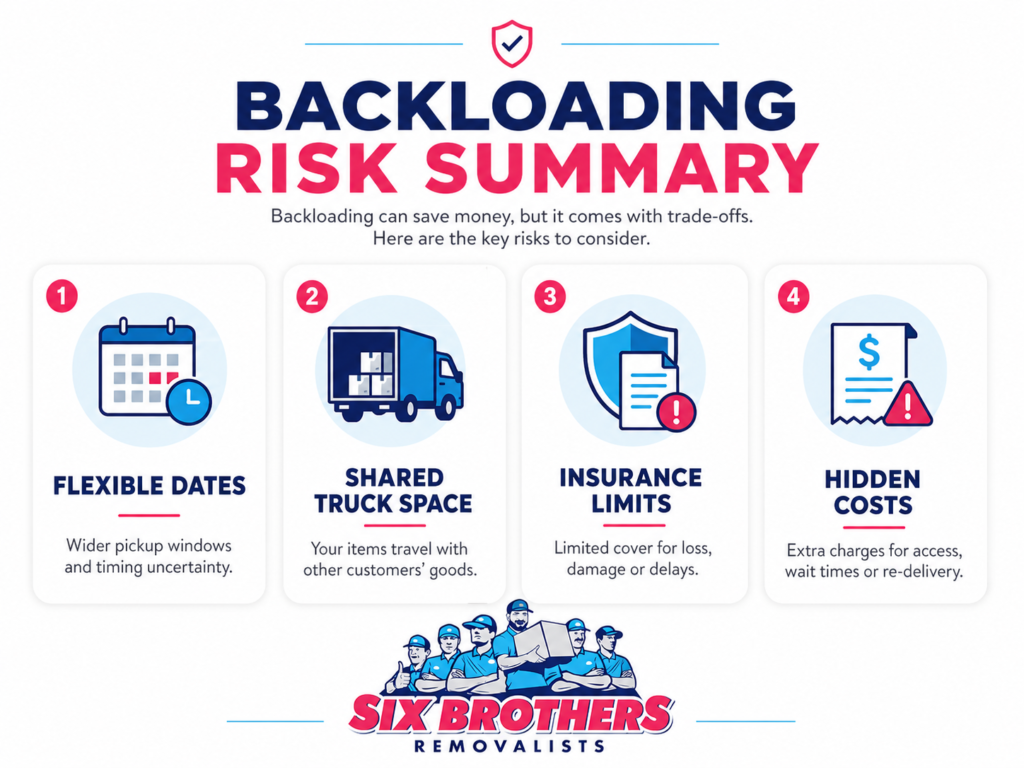
Backloading can save money on interstate moves, but it comes with real trade-offs most people don’t discover until after they’ve booked. Flexible delivery windows, shared truck space, limited insurance, and pricing that can shift after confirmation are all part of the picture.
For anyone moving from Parramatta or Greater Western Sydney, understanding these risks before committing to a backloading service can save you from a stressful, costly experience.
This guide covers every downside of backloading honestly, compares it against dedicated removalist options, and explains when each approach actually makes sense for your move.
What Is Backloading and How Does It Work?
Backloading is a freight and removalist arrangement where your belongings share space on a truck that is already travelling to your destination. Instead of hiring a truck exclusively for your move, you pay only for the cubic metres your items occupy in a vehicle that would otherwise return empty after completing a primary delivery.
The concept is straightforward: a removalist truck completes a job in Sydney, then picks up your load in Parramatta on its way back to Melbourne, Brisbane, or Adelaide. You pay a fraction of what a dedicated truck would cost because you are splitting the operational expense with the truck’s primary booking.
This model works well in theory. In practice, the logistics create a series of limitations that affect your timeline, your belongings, and your budget in ways that are not always obvious upfront.
How Backloading Differs From a Dedicated Removalist Truck
A dedicated removalist truck is booked exclusively for your move. The crew arrives at your address on a confirmed date, loads only your belongings, and delivers them directly to your new home. You control the schedule, the packing process, and the delivery window.
Backloading operates on the truck operator’s schedule, not yours. The truck departs when it is full or when the primary job is complete. Your items may be loaded alongside furniture, boxes, and equipment belonging to other customers. The delivery happens when the route allows it, not when you need it.
The core difference is control. With a dedicated truck, you have it. With backloading, you largely give it up in exchange for a lower price.
Who Typically Uses Backloading Services?
Backloading suits people with flexible timelines and smaller loads. Students moving interstate, individuals relocating with minimal furniture, or people sending a partial household ahead of a full move are common users.
It also appeals to anyone on a tight budget who can tolerate uncertainty around delivery dates. The savings can be meaningful on long-distance routes like Sydney to Melbourne or Sydney to Brisbane, where dedicated truck hire represents a significant expense.
However, families moving an entire household, business owners relocating office equipment, or anyone with a fixed settlement date or lease start date will often find backloading’s limitations outweigh its cost advantages.
What Are the Main Downsides of Backloading?
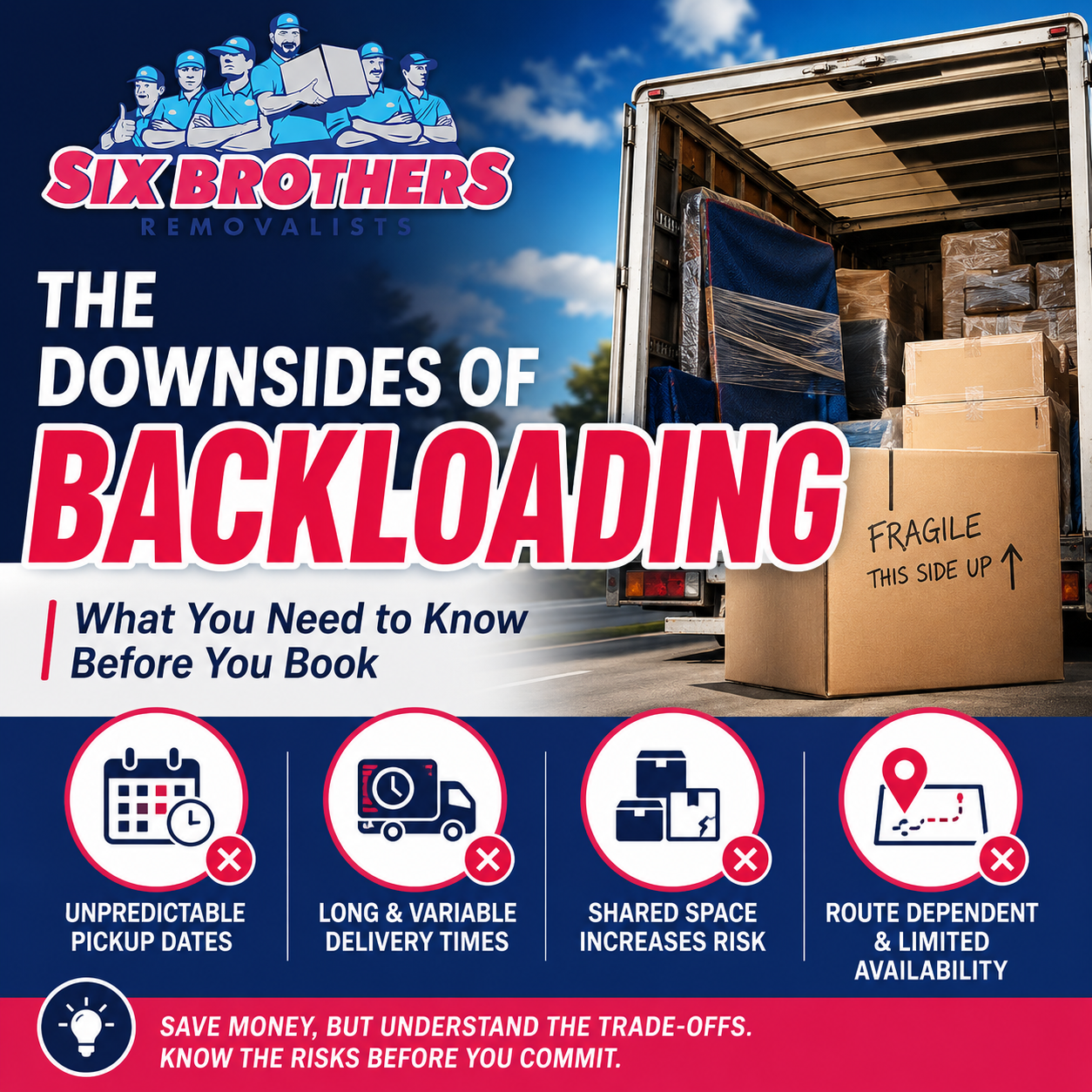
The downsides of backloading fall into four categories: scheduling inflexibility, extended delivery timelines, shared space risks, and route-dependent availability. Each of these affects your move in a different way, and together they represent a meaningful set of trade-offs compared to booking a dedicated removalist.
You Lose Control Over Your Moving Date and Time
When you book a backloading service, you are not booking a specific date. You are booking a slot on a truck that will travel your route when the operator has enough load to make the trip viable. That distinction matters enormously when you have a lease ending, a settlement date approaching, or a new job starting.
Backloading operators typically offer a date range rather than a confirmed pickup day. That range might be three to seven days wide. If the truck fills up quickly, your pickup could happen at the early end of that window. If bookings are slow, it shifts toward the later end, or beyond it.
For anyone with hard deadlines, this uncertainty creates real problems. You may need to arrange temporary accommodation, extend a lease, or store belongings at short notice, all of which add costs that erode the savings backloading was supposed to deliver.
Delivery Windows Can Stretch Days or Even Weeks
The pickup uncertainty is only half the problem. Delivery timelines in backloading arrangements are equally unpredictable. A truck travelling from Sydney to Brisbane might make multiple stops along the route to pick up or drop off other customers’ loads. Your furniture could sit in a depot overnight, or longer, while the operator coordinates the full route.
On major interstate routes, standard backloading delivery windows range from two to fourteen days after pickup. Some operators quote even wider windows depending on the route and season. During peak moving periods, such as end-of-month dates, school holidays, and the December to January period, delays extend further.
If you are moving into a new home and need your bed, kitchen equipment, and work setup on a specific day, a two-week delivery window is not a minor inconvenience. It is a significant disruption that requires planning, expense, and flexibility most people do not have.
Your Belongings Share Space With Other People’s Items
A backloading truck carries multiple customers’ belongings simultaneously. Your dining table sits next to a stranger’s wardrobe. Your boxes are stacked alongside someone else’s appliances. The loading crew must arrange all of these items efficiently to maximise the truck’s capacity, which means your furniture may be repositioned, stacked under heavier items, or secured in ways that prioritise space over care.
This shared environment increases the risk of contact damage. Items can shift during transit, particularly on long interstate routes with multiple stops. Vibration, road conditions, and the weight distribution of a mixed load all contribute to wear on furniture, frames, and fragile items.
Professional backloading operators use blankets, straps, and padding to minimise this risk. But the fundamental reality of shared space means your belongings are not handled with the same individual attention they would receive in a dedicated truck loaded and unloaded by a single crew focused entirely on your move.
Limited Availability on Popular Routes and Dates
Backloading depends entirely on truck availability along your specific route. If you need to move from Parramatta to Melbourne on a particular date range, a backloading slot only exists if a truck is already travelling that route during your window.
On high-traffic routes like Sydney to Melbourne or Sydney to Brisbane, availability is generally reasonable. On less common routes, or during quieter periods, finding a backloading truck that matches your timeline can be difficult. Some customers wait weeks for a suitable slot to open.
This availability constraint also affects pricing. When demand for a particular route is high, backloading rates rise. The cost advantage that makes backloading attractive can narrow significantly during peak periods, sometimes to the point where a dedicated truck becomes comparably priced once you factor in the flexibility it provides.
Hidden Costs and Pricing Risks in Backloading
The advertised price of a backloading service rarely reflects the total cost of your move. Several factors can push the final invoice above the initial quote, and understanding these risks before you book is essential.
How Backloading Quotes Can Change After Booking
Most backloading quotes are based on an estimated volume of goods, measured in cubic metres. You provide a list of items, the operator calculates an approximate space requirement, and a price is generated from that estimate.
The problem is that estimates are rarely precise. Furniture dimensions vary, packing adds volume, and items that seemed small on a list often occupy more space than expected when physically loaded. If your actual load exceeds the quoted cubic metres, the operator charges for the additional space at the per-cubic-metre rate, which can add hundreds of dollars to your bill.
Some operators also apply fuel levies, toll charges, or after-hours fees that are not included in the initial quote. Reading the terms and conditions carefully before signing is not optional. These additional charges are often buried in the fine print and only become visible when the final invoice arrives.
What Happens When Your Load Exceeds the Estimated Space?
If your belongings take up more space than quoted, you have two options: pay the additional charge or leave items behind. Neither is ideal when you are mid-move with a truck already at your door.
In some cases, if the truck is already near capacity with other customers’ loads, there may not be additional space available at any price. Items that do not fit get left behind, requiring you to arrange a separate delivery at full cost, which eliminates the savings backloading was supposed to provide.
Accurate measurement before booking is the best protection against this scenario. Measure large furniture pieces, count boxes realistically, and add a buffer to your estimate. If an operator’s quote seems unusually low, it may be based on an optimistic volume calculation that will not survive contact with your actual belongings.
Damage and Insurance Risks With Backloading
Damage during a backloading move is more likely than during a dedicated truck move, and the insurance arrangements that apply are often less comprehensive than customers expect.
Why Shared Truck Loads Increase the Risk of Damage
The mechanics of a shared load create multiple damage scenarios that do not exist in a dedicated truck. Items from different customers must be loaded together efficiently, which means your furniture may be positioned to suit the overall load rather than to protect your specific pieces.
Long interstate routes subject everything in the truck to extended vibration, temperature variation, and the physical stress of multiple loading and unloading cycles at intermediate stops. Each time the truck is opened and items are rearranged to access another customer’s delivery, your belongings are at risk of contact, shifting, or accidental impact.
Fragile items, antiques, artwork, and electronics are particularly vulnerable in shared load environments. These categories of items are better suited to dedicated transport with individual packing, custom crating, and a crew that handles them exclusively from origin to destination.
What Insurance Cover Do Backloading Companies Actually Provide?
This is one of the most important questions to ask before booking any backloading service, and the answer varies significantly between operators.
Most backloading companies carry transit insurance, but the coverage limits, exclusions, and claims processes differ widely. Some policies cover damage only if it results from a vehicle accident, not from handling or shifting during transit. Others apply per-item limits that may not reflect the replacement value of your furniture or electronics.
Transit insurance is not the same as comprehensive goods-in-transit cover. Before booking, ask the operator specifically what their insurance covers, what the per-item and total claim limits are, whether fragile or high-value items require separate declaration, and what the claims process involves if something is damaged.
If the operator cannot answer these questions clearly, that is itself a warning sign. Reputable removalists are transparent about their insurance arrangements because it is a core part of the service they provide.
Backloading vs Dedicated Removalist: Which Is Right for You?
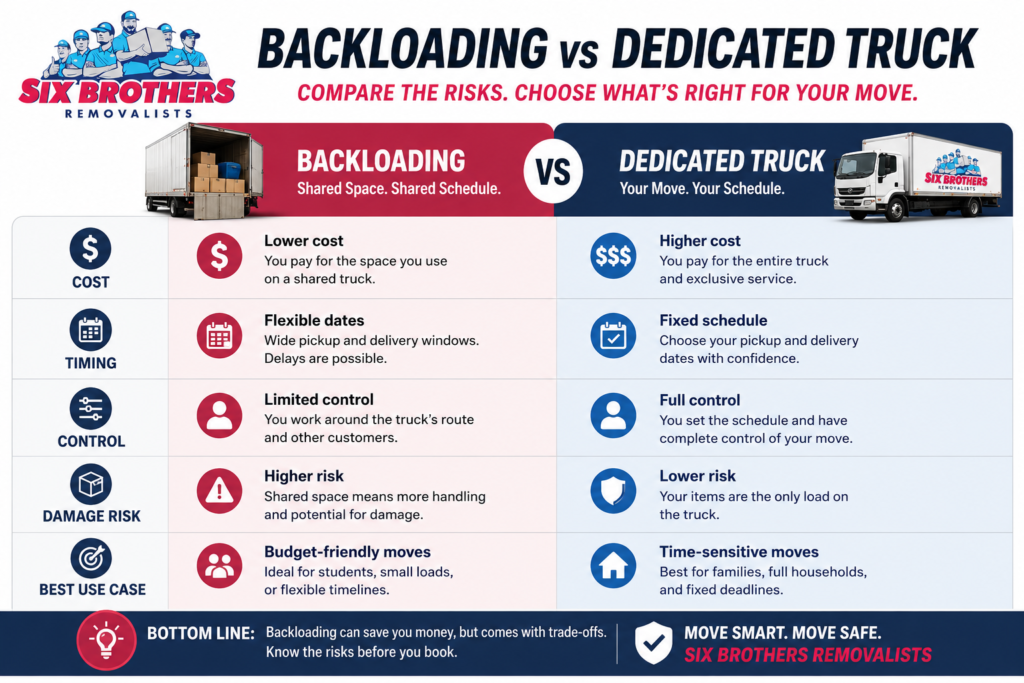
The choice between backloading and a dedicated removalist comes down to three factors: your timeline flexibility, the volume and fragility of your load, and your total budget when all costs are considered.
When Backloading Makes Sense for Interstate Moves
Backloading is a reasonable choice when you have a small load, a flexible timeline, and no hard delivery deadline. If you are moving a studio apartment’s worth of belongings from Sydney to Melbourne and can accept delivery anytime within a two-week window, backloading can deliver genuine savings.
It also works well as a supplementary option when you are moving in stages. Sending non-essential items ahead via backloading while keeping daily necessities with you until the dedicated truck arrives is a practical approach some movers use to manage costs on large interstate relocations.
When a Dedicated Truck Is the Better Choice
A dedicated removalist truck is the right choice when your move has a fixed date, a full household load, fragile or high-value items, or a business relocation where downtime has a direct cost.
Families moving into a new home with a settlement date, business owners relocating office equipment and IT infrastructure, and anyone moving antiques, artwork, or specialist equipment should not rely on backloading’s variable timelines and shared space arrangements.
The peace of mind that comes from knowing your belongings are on a truck that goes directly from your old address to your new one, handled by a crew focused entirely on your move, has real value that does not appear in a price comparison spreadsheet.
How to Compare Backloading Quotes With Full-Service Removalist Costs
A genuine cost comparison between backloading and a dedicated removalist must account for all costs, not just the headline quote.
Add to the backloading price: any storage costs if delivery is delayed, temporary accommodation if you cannot access your new home on time, the cost of replacing or repairing damaged items, and any additional charges for volume overruns or after-hours delivery.
Compare that total against a dedicated removalist quote that includes packing materials, insurance, and a confirmed delivery date. In many cases, particularly for full household moves, the gap between the two options is smaller than the initial quotes suggest.
How to Reduce the Risks If You Do Choose Backloading
If backloading is the right option for your situation, there are practical steps you can take to reduce the risks associated with shared loads, variable timelines, and pricing uncertainty.
Questions to Ask Before Booking a Backloading Service
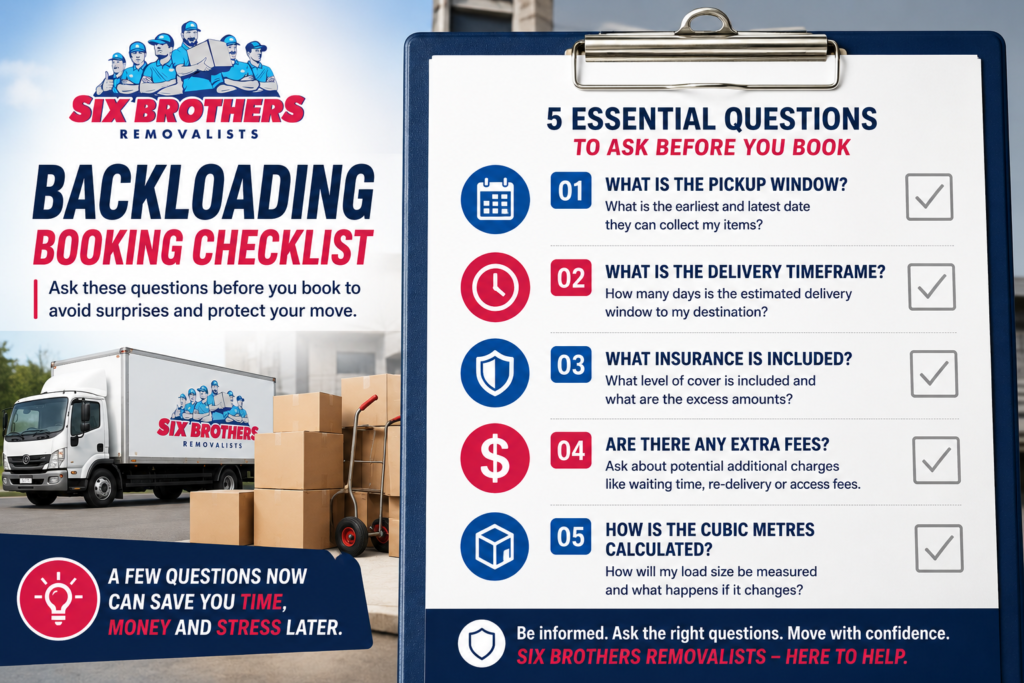
Before committing to any backloading operator, get clear answers to these questions:
What is the confirmed pickup date range, and what happens if the truck is delayed beyond that window? How is the cubic metre estimate calculated, and what is the per-cubic-metre rate for any overrun? What does the transit insurance cover, and what are the per-item and total claim limits? Are there any additional charges not included in the quote, such as fuel levies, tolls, or depot fees? What is the delivery window at the destination, and will you receive advance notice before the truck arrives?
An operator who answers these questions clearly and in writing is demonstrating the transparency that separates professional services from unreliable ones.
Packing Strategies That Protect Your Items in a Shared Load
Packing for a backloading move requires more care than packing for a dedicated truck, because your items will be handled multiple times and share space with other loads.
Use double-walled boxes for anything fragile. Wrap individual items in packing paper or bubble wrap before placing them in boxes, and fill any empty space in boxes with packing material to prevent internal movement. Label every box clearly on multiple sides, including a fragile designation where relevant.
Disassemble furniture where possible to reduce the surface area exposed to contact damage. Wrap furniture legs, corners, and glass surfaces with moving blankets or thick padding. For high-value items, consider whether the savings from backloading justify the risk, or whether dedicated transport is the more sensible investment.
How to Pack for an Interstate Move…….Read more
Is Backloading Worth It for Interstate Moves From Sydney?
This is the question that sits at the centre of every backloading decision. The honest answer is: it depends entirely on your specific circumstances.
Interstate Backloading From Parramatta and Western Sydney
For residents and businesses in Parramatta and Greater Western Sydney, interstate moves are a regular reality. The region’s population growth and the frequency of relocations to Melbourne, Brisbane, Adelaide, and regional centres mean that backloading routes from Western Sydney are well-established.
Common Backloading Routes From NSW
The most active backloading routes from NSW run between Sydney and Melbourne, Sydney and Brisbane, and Sydney and Adelaide. These corridors carry enough freight volume that backloading slots are generally available, though timing and pricing fluctuate with demand.
Less common routes, such as Sydney to Perth or Sydney to Darwin, have significantly fewer backloading opportunities. On these routes, the wait for a suitable truck can extend to several weeks, and the cost advantage over dedicated transport narrows considerably due to the distance involved.
For moves within NSW, such as Sydney to Newcastle, Sydney to Wollongong, or Sydney to regional centres, backloading is less commonly available because the distances do not generate the same return-trip economics that make interstate backloading viable.
How Six Brothers Removalists Handles Interstate Moves Differently
At Six Brothers Removalists, we offer interstate backloading as one option within a broader range of moving services, not as a one-size-fits-all solution. Our team takes the time to understand your timeline, your load, and your priorities before recommending an approach.
For customers who need flexibility and have a smaller load, we can connect them with reliable backloading options on major NSW routes. For customers with full household moves, fixed settlement dates, or fragile items, we recommend dedicated truck hire with our fully managed removalist service, which includes packing, loading, transit, and delivery handled by our experienced crew.
The difference is that we give you an honest assessment of both options rather than defaulting to whichever is easiest to sell. Our reputation in Parramatta and across Western Sydney is built on that kind of straightforward advice.
Storage Solutions When Backloading Timelines Don’t Align
One of the practical consequences of backloading’s variable delivery windows is the gap it can create between when you vacate your old property and when your belongings arrive at your new one. Storage solutions bridge that gap.
Short-Term and Long-Term Storage Options During Your Move
Short-term storage is the most common need in backloading scenarios. If your delivery window extends beyond your move-in date, or if your new property is not ready to receive your belongings, a secure storage facility provides a holding point that keeps your items safe and accessible.
Six Brothers Removalists offers storage solutions that integrate directly with our moving services. Rather than arranging separate storage through a third party, your belongings can move from our truck into secure storage and then be delivered to your new address when the timing aligns. This removes the coordination complexity that makes storage during a move stressful.
Long-term storage is relevant for customers who are downsizing, renovating, or managing a staged relocation. Items that will not be needed immediately at the new property can be stored securely while you settle in, then delivered when you are ready for them.
Conclusion
Backloading offers real cost savings on interstate moves, but those savings come with genuine trade-offs: unpredictable timelines, shared truck space, variable insurance cover, and pricing that can shift after booking. Understanding these downsides before you commit is the difference between a smooth move and an expensive, stressful one.
For Parramatta and Western Sydney residents, the right choice depends on your load size, your timeline flexibility, and what you can realistically afford to risk. A small, flexible move may suit backloading well. A full household relocation with a fixed date rarely does.
At Six Brothers Removalists, we help you make that call with clear, honest advice. Whether you need a dedicated truck, a managed interstate move, or secure storage to bridge a timing gap, contact us today and let our team build a moving plan that actually works for your situation.
Frequently Asked Questions
Is backloading cheaper than hiring a dedicated removalist truck?
Backloading is generally cheaper upfront, but the total cost depends on your specific move. Once you factor in potential storage costs, delays, and volume overruns, the price gap often narrows significantly compared to a dedicated removalist service.
How long does backloading delivery take for interstate moves?
Delivery windows for backloading typically range from two to fourteen days after pickup, depending on the route and the operator’s schedule. During peak moving periods, delays can extend beyond that range, so a flexible timeline is essential.
Can my furniture get damaged during a backloading move?
Yes, damage risk is higher in backloading because your items share space with other customers’ belongings and are handled multiple times during transit. Proper packing with double-walled boxes, padding, and furniture wrapping significantly reduces but does not eliminate this risk.
What insurance do backloading companies provide?
Most backloading operators carry transit insurance, but coverage varies widely. Some policies only cover damage from vehicle accidents, not handling damage. Always ask for written details of coverage limits, exclusions, and the claims process before booking.
Can I choose my pickup and delivery date with backloading?
No. Backloading operates on the truck operator’s schedule, not yours. You are typically given a date range for pickup, and delivery timing depends on the route and other customers’ stops. Fixed dates are not guaranteed with standard backloading arrangements.
What happens if my belongings take up more space than quoted?
If your load exceeds the estimated cubic metres, you will be charged for the additional space at the operator’s per-cubic-metre rate. In some cases, if the truck is already full, items may not fit at all, requiring separate transport arrangements at additional cost.
Is backloading a good option for moving a full household interstate?
For most full household moves, a dedicated removalist truck is the better choice. The volume of a full household load, combined with the need for a confirmed delivery date and careful handling of furniture and fragile items, makes backloading’s limitations more costly than its savings justify.