


Table of Contents
Moving to another Australian state involves far more than loading a truck and driving. From understanding the real cost of interstate removals and choosing a licensed removalist to navigating biosecurity rules, updating your licence, and deciding whether backloading suits your situation, every decision you make before moving day shapes how smoothly the whole process goes.
This guide covers everything Parramatta residents, Western Sydney homeowners, renters, and business owners need to know before relocating interstate. Whether you’re moving to Queensland, Victoria, South Australia, or anywhere else across the country, the considerations are the same: plan early, understand your costs, and work with a removalist you can trust.
Six Brothers Removalists has helped hundreds of families and businesses move out of NSW. Here’s exactly what you need to think through before your move.
Understanding the True Cost of Interstate Moving in Australia
Cost is the first thing most people want to know, and it’s also the area where most people get caught off guard. Interstate moving costs vary significantly depending on the volume of your belongings, the distance, the service type, and the time of year. Getting a clear picture of what you’ll actually spend before you commit to anything is one of the most important steps in planning an interstate relocation.
What Does It Cost to Move Interstate from NSW?
The cost of moving interstate from NSW depends on several variables: how much you’re moving, where you’re going, and whether you choose a dedicated truck or a backloading service.
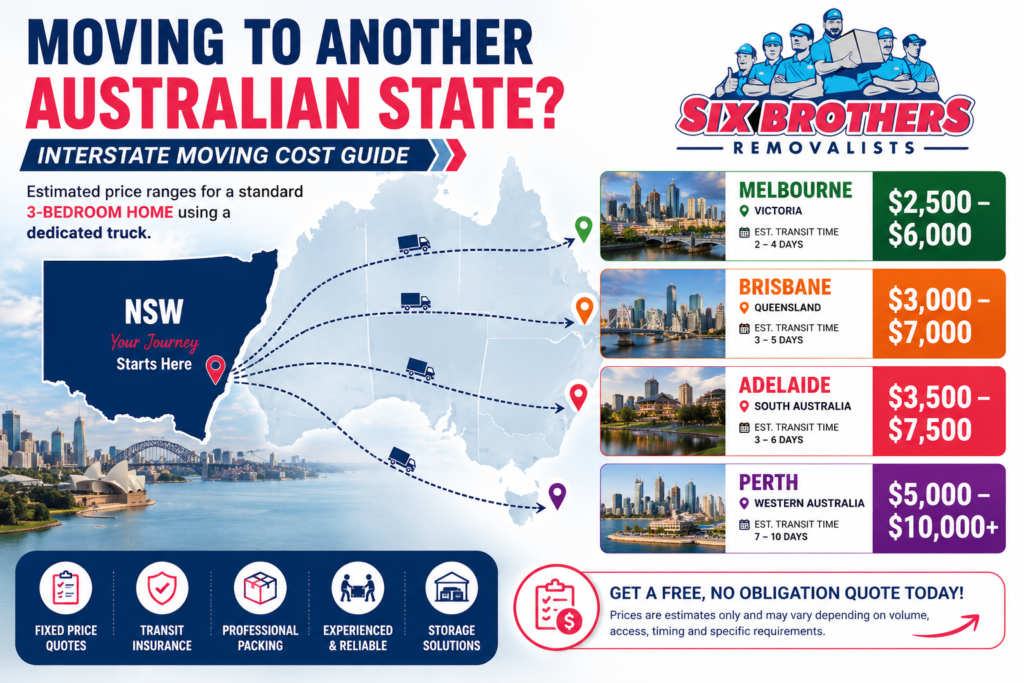
As a general guide, a full house move from Sydney or Parramatta to Melbourne typically ranges from $2,500 to $6,000 for a standard three-bedroom home using a dedicated truck. Moving to Brisbane or the Gold Coast can range from $3,000 to $7,000 depending on volume and timing. Moves to Perth, which involve significantly longer distances, often start from $5,000 and can exceed $10,000 for larger homes.
These figures are estimates. The only way to get an accurate number is to request a detailed, itemised quote from a licensed interstate removalist who has assessed your actual inventory.
Hidden Costs Most People Don’t Budget For
The quoted price is rarely the final price if you haven’t asked the right questions upfront. Several costs catch people off guard during interstate moves.
Packing materials are often not included in base quotes. Boxes, bubble wrap, packing tape, mattress covers, and furniture blankets add up quickly, especially for a full house. If you’re using professional packers, that’s an additional labour cost on top of the transport fee.
Stair and lift fees apply when removalists need to carry items up or down stairs or use a lift at either end of the move. Long carry fees apply when the truck cannot park close to your front door. Disassembly and reassembly of large furniture items like bed frames, wardrobes, and desks may also be charged separately.
Storage is another cost that many people don’t anticipate. If your new home isn’t ready when your belongings arrive, you’ll need somewhere to store them. Short-term storage fees can range from $150 to $400 per week depending on volume and facility.
Transit insurance is worth budgeting for separately. Basic liability coverage from a removalist may not cover the full replacement value of your belongings. Comprehensive transit insurance for an interstate move typically costs between $200 and $600 depending on the declared value of your goods.
How to Compare Interstate Removalist Quotes Accurately
Comparing quotes from multiple removalists is smart, but only if you’re comparing like for like. A quote that looks cheaper on the surface may exclude services that another quote includes.
When requesting quotes, provide every removalist with the same detailed inventory list. Include the number of rooms, large furniture items, appliances, boxes, and any specialty items like pianos, artwork, or gym equipment. Ask each company to specify exactly what is and isn’t included in their price.
Check whether the quote covers packing materials, disassembly and reassembly, transit insurance, and any access fees. Ask whether the price is fixed or subject to change based on actual weight or volume. A fixed-price quote gives you certainty; a variable quote can lead to unexpected charges on moving day.
Three quotes is a reasonable minimum. If one quote is significantly lower than the others, ask why. It may reflect a backloading service, a smaller truck, or simply a company cutting corners on insurance and equipment.
Choosing the Right Interstate Removalist for Your Move
The removalist you choose will have your entire life packed into their truck for days. Choosing based on price alone is a risk. The right company combines proper licensing, adequate insurance, transparent pricing, and a track record of reliable interstate work.
What Licences and Insurance Should Your Removalist Have?
In Australia, removalists are not required to hold a specific national licence, but they must comply with relevant state transport and business regulations. Any company operating a heavy vehicle for commercial purposes must hold the appropriate heavy vehicle licences under the Heavy Vehicle National Law (HVNL), which applies across NSW, Queensland, Victoria, South Australia, Tasmania, and the ACT.
Beyond licensing, insurance is the critical factor. A reputable interstate removalist should carry public liability insurance, which covers damage to property at your home or destination, and goods in transit insurance, which covers your belongings while they’re being transported.
Always ask for proof of insurance before signing any contract. If a company cannot provide documentation, that’s a serious warning sign.
Questions to Ask Before Booking an Interstate Moving Company
Before you commit to any removalist, ask these questions directly:
How long have you been operating interstate routes from NSW? Experience on specific routes matters. A company that regularly moves between Sydney and Brisbane will know the logistics, timing, and potential complications far better than one doing it occasionally.
Do you use your own trucks and staff, or do you subcontract? Subcontracting isn’t automatically a problem, but you should know who will actually be handling your belongings. If the company subcontracts, ask whether the subcontractor carries the same insurance.
What happens if something is damaged during the move? Ask about their claims process, timeframes, and what documentation they require. A company with a clear, fair claims process is one that takes responsibility seriously.
Is the quote fixed or variable? As discussed above, a fixed price gives you certainty. If the quote is variable, understand exactly what could cause the price to change.
Can you provide references from recent interstate moves? A confident, reputable company will have no hesitation providing references or directing you to verified reviews.
Red Flags to Watch for When Hiring Removalists
Some warning signs are easy to miss when you’re focused on price and logistics. Watch for these:
A company that asks for a large cash deposit upfront before any contract is signed. Legitimate removalists typically require a reasonable deposit, but not the full amount before the move.
No physical address or ABN listed on their website or quote. Any legitimate Australian business operating commercially must have an ABN. You can verify any ABN through the Australian Business Register.
Vague or verbal-only quotes with no written breakdown. Every legitimate quote should be provided in writing with a clear itemisation of what’s included.
Extremely low prices that don’t align with market rates. If a quote is 40 to 50 percent below every other quote you’ve received, the company is either cutting corners on insurance, using inadequate equipment, or planning to add charges later.
No online presence, no reviews, and no verifiable history. In 2025, any established removalist company should have a traceable online presence with genuine customer reviews.
Planning Your Interstate Move Timeline and Logistics
Good planning is what separates a smooth interstate move from a stressful one. The logistics of moving between states are more complex than a local move, and the timeline needs to reflect that.
How Far in Advance Should You Book an Interstate Removalist?
For interstate moves, booking at least six to eight weeks in advance is strongly recommended. During peak periods, including summer school holidays, the end of the financial year, and the January to March period when many people relocate for work or study, availability fills up quickly. Some interstate routes from Sydney can be booked out four to six weeks ahead during these periods.
Booking early also gives you time to get multiple quotes, confirm insurance details, and make any necessary arrangements at your destination, including storage if your new home isn’t ready.
If you’re flexible on dates, you may be able to secure a better price by moving mid-week or during off-peak months. Removalists are often busier on weekends and at the end of the month when leases typically expire.
What to Do in the Weeks Before Your Interstate Move
The six weeks before your move should follow a structured plan. Start by decluttering. Every item you don’t take reduces your volume, which reduces your cost. Sell, donate, or dispose of anything you haven’t used in the past year.
Four weeks out, confirm your booking with your removalist and finalise your inventory list. Begin sourcing packing materials if you’re packing yourself, or confirm the packing schedule if you’ve engaged professional packers.
Three weeks out, start packing non-essential items: books, seasonal clothing, decorative items, and anything you won’t need before moving day. Label every box clearly with its contents and destination room.
Two weeks out, notify relevant government bodies and service providers of your change of address. This includes Medicare, the ATO, your bank, your super fund, and your state’s roads authority for your driver’s licence and vehicle registration.
One week out, confirm all logistics with your removalist: pickup time, access arrangements, parking, and contact details. Pack an essentials box with everything you’ll need for the first 48 hours at your new address: phone chargers, toiletries, a change of clothes, important documents, and basic kitchen items.
How Long Does an Interstate Move from NSW Take?
Transit times for interstate moves from NSW vary by destination. Sydney or Parramatta to Melbourne typically takes one to two days by road. Sydney to Brisbane is generally one to two days. Sydney to Adelaide is two to three days. Sydney to Perth is the longest common interstate route and typically takes five to seven days by road.
These are transit times for the truck. Your actual moving day, including loading, travel, and unloading, will add time at both ends. For a full house move, allow a full day for loading and a full day for unloading, in addition to transit time.
If you’re using a backloading service, transit times may be longer because the truck is completing other deliveries along the route. Your removalist should give you an estimated delivery window, not just a single date.
What to Know About Backloading for Interstate Moves
Backloading is one of the most cost-effective options for interstate moves, and it’s widely used across Australia. Understanding how it works helps you decide whether it’s the right choice for your situation.
How Does Backloading Work for Interstate Removals?
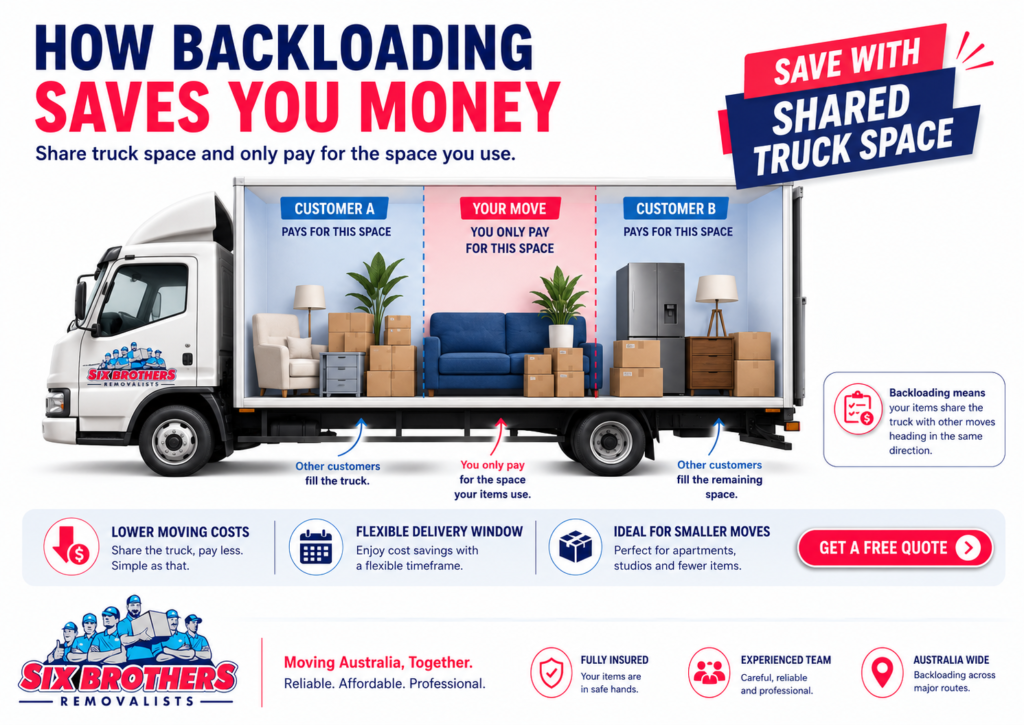
Backloading means your belongings share space on a truck that is already travelling to your destination. When a removalist completes a delivery in, say, Melbourne, the truck would otherwise return to Sydney empty. By filling that return space with another customer’s goods, the removalist can offer a significantly lower price because the base cost of the trip is already covered.
You pay only for the space your belongings occupy on the truck, measured in cubic metres. A one-bedroom apartment might require 10 to 15 cubic metres. A three-bedroom house typically requires 30 to 45 cubic metres.
The trade-off is flexibility. With backloading, you work around the truck’s existing schedule rather than setting your own moving date. Delivery windows are typically broader, sometimes spanning several days, rather than a guaranteed single-day delivery.
Is Backloading Right for Your Interstate Move?
Backloading suits people who have flexibility on their moving date and delivery window, are moving a smaller volume of goods, and want to reduce their interstate moving cost significantly.
It’s less suitable if you have a fixed settlement date on a property, need your belongings delivered on a specific day, or are moving a large volume that would fill most of a truck anyway. In those cases, a dedicated truck gives you more control over timing and is often more cost-effective per cubic metre at higher volumes.
Backloading can reduce interstate moving costs by 30 to 50 percent compared to a dedicated truck for the same volume. For a one or two-bedroom move, the savings can be substantial.
Backloading Routes from Sydney and Parramatta
Sydney and Parramatta are well-serviced backloading hubs because of the high volume of interstate traffic moving in and out of NSW. Common backloading routes from Parramatta include Sydney to Melbourne, Sydney to Brisbane, Sydney to Adelaide, and Sydney to the Gold Coast.
Less frequent but available routes include Sydney to Perth, Sydney to Hobart (via Melbourne), and Sydney to Darwin. For less common routes, availability may be more limited and lead times longer.
When booking a backloading service, ask your removalist how frequently trucks run on your specific route and what the realistic delivery window is. A reputable company will give you an honest answer rather than an optimistic one.
Packing for an Interstate Move — What You Need to Know
Packing for an interstate move is different from packing for a local move. Your belongings will be in transit for longer, loaded and unloaded multiple times, and subject to more movement and vibration. How you pack directly affects whether your belongings arrive intact.
Should You Pack Yourself or Use Professional Packers?
Packing yourself saves money but takes significant time and requires the right materials and technique. Professional packers are faster, use industry-standard materials, and pack in a way that maximises protection and space efficiency. They also typically take responsibility for items they’ve packed if damage occurs during transit.
For interstate moves, professional packing is worth considering for fragile items, high-value items, and large or awkward pieces even if you pack the rest yourself. A hybrid approach, where you pack books, clothing, and non-fragile items and leave the rest to professionals, is a practical middle ground.
If you’re packing yourself, allow more time than you think you’ll need. Most people underestimate how long packing takes. A three-bedroom house typically takes two to three full days to pack properly.
What Packing Materials Are Best for Long-Distance Moves?
For interstate moves, quality packing materials are not optional. The vibration and movement over hundreds of kilometres will expose any weak packing.
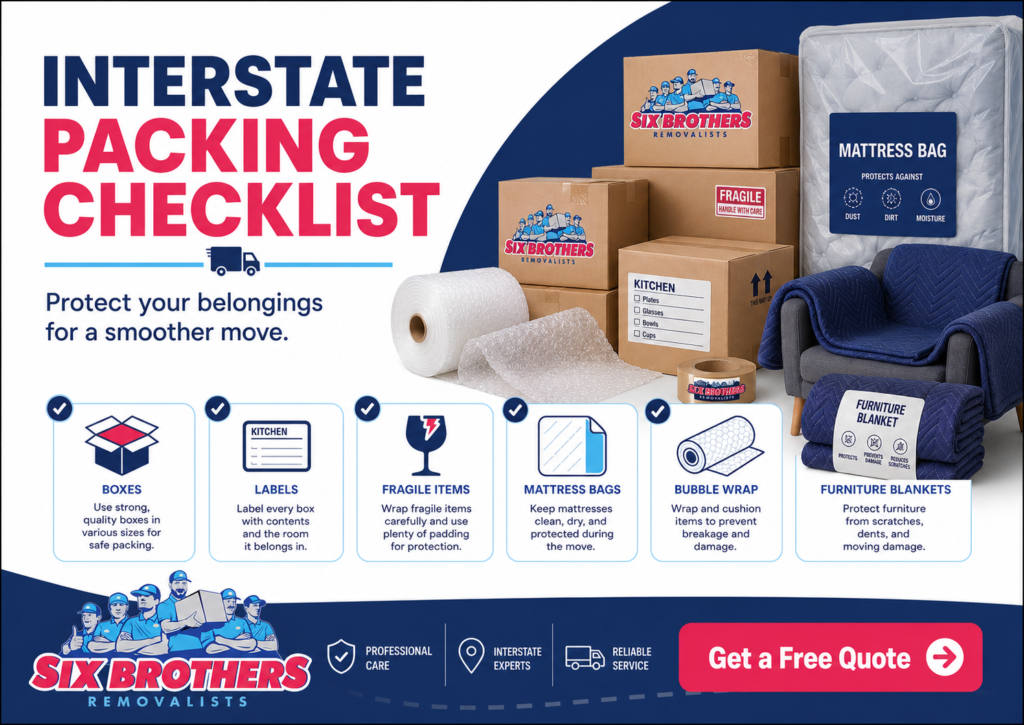
Use double-walled cardboard boxes for heavy items like books and kitchen equipment. Standard single-wall boxes are adequate for lighter items. Avoid using old, previously used boxes for interstate moves as they lose structural integrity.
Bubble wrap is essential for fragile items. Packing paper (unprinted newsprint) is useful for wrapping individual items and filling void space in boxes. Foam packing peanuts or foam sheets provide additional cushioning for delicate items.
Furniture blankets protect large items from scratches and impact during loading and transit. A reputable removalist will supply these, but confirm this when booking. Mattress bags protect mattresses from moisture and dirt during long-distance transport.
Packing tape should be heavy-duty. Reinforce the bottom of every box with two strips of tape in a cross pattern before loading anything into it.
How to Pack Fragile and High-Value Items for Interstate Transport
Fragile items need individual wrapping, adequate cushioning, and clearly labelled boxes. Wrap each fragile item individually in bubble wrap, securing it with tape. Place a layer of packing paper or foam at the bottom of the box before adding items. Fill all void space so items cannot shift during transit.
Never pack fragile items in boxes that are too large. Movement inside the box is what causes breakage. A snug fit with adequate cushioning is the goal.
For high-value items such as artwork, antiques, electronics, and jewellery, consider specialist packing. Custom crating is available for particularly valuable or fragile pieces. For jewellery and important documents, carry these with you rather than putting them on the truck.
Clearly label every fragile box on all four sides and the top. Mark which side is up. Inform your removalist of any boxes requiring special handling.
Storage Solutions When Moving Between Australian States
Storage is a practical necessity for many interstate moves. Settlement dates don’t always align, new homes aren’t always ready, and sometimes you need time to decide what goes where before committing to a full delivery.
When Do You Need Storage During an Interstate Move?
The most common reason people need storage during an interstate move is a gap between vacating their current home and gaining access to their new one. If your settlement date is delayed, if you’re renting and your new lease doesn’t start immediately, or if you’re doing renovations before moving in, storage bridges that gap.
Storage is also useful if you’re downsizing and need time to sort through belongings before deciding what to keep. Some people use storage to stage a property for sale, removing excess furniture to make rooms appear larger.
For business relocations, storage provides a buffer when office fit-outs are incomplete or when equipment needs to be staged before installation.
Short-Term vs Long-Term Storage Options for Interstate Movers
Short-term storage typically covers periods of one to eight weeks. It’s designed for the transition period between homes and is usually priced by the week. Mobile storage units, which are delivered to your home, loaded, and then transported to a storage facility, are a convenient option for short-term needs.
Long-term storage covers periods of two months or more. It’s typically priced by the month and is more cost-effective per week than short-term options. Long-term storage suits people who are travelling, working overseas temporarily, or in the process of a longer property transaction.
When comparing storage options, consider access hours, security features, climate control (important for electronics, artwork, and wooden furniture), and whether the facility is insured. Ask whether your removalist offers integrated storage as part of their interstate service, which can simplify logistics and reduce handling.
How to Choose a Secure Storage Facility
Security is the primary consideration when choosing a storage facility. Look for facilities with 24-hour CCTV surveillance, individual unit alarms, secure perimeter fencing, and controlled access using PIN codes or key cards.
Climate control matters for certain items. Timber furniture, electronics, musical instruments, and artwork can be damaged by extreme heat, humidity, or moisture. NSW summers can push temperatures in storage facilities well above 40 degrees Celsius without climate control.
Check whether the facility’s insurance covers your goods or whether you need to arrange separate contents insurance for stored items. Many standard home and contents policies do not cover goods in commercial storage.
Ask about access arrangements. Can you access your unit at any time, or only during business hours? For short-term storage during a move, flexible access is important.
Changing Your Address and Updating Records When Moving States
Updating your address when moving interstate is more involved than a local move because some records are state-specific. Missing a notification can lead to missed correspondence, fines, or complications with government services.
Which Government Bodies Do You Need to Notify?
When moving to another Australian state, you need to notify both federal and state government bodies.
At the federal level, notify the Australian Taxation Office (ATO), Medicare, Centrelink (if applicable), the Australian Electoral Commission, your superannuation fund, and the Department of Home Affairs if you hold a visa.
At the state level, you need to update your driver’s licence and vehicle registration with the roads authority in your new state. You should also update your enrolment on the state electoral roll, notify your new state’s health authority if you hold a healthcare card, and update any state-based concession cards.
The ATO’s online services allow you to update your address directly through myGov, which also updates Medicare and Centrelink simultaneously if your accounts are linked.
Updating Your Driver’s Licence and Vehicle Registration Interstate
Each Australian state and territory has its own roads authority, and you are required to transfer your driver’s licence and vehicle registration to your new state within a set period after establishing residency. In most states, this period is three months.
In NSW, the relevant authority is Transport for NSW. If you’re moving to Victoria, it’s VicRoads. Queensland uses the Department of Transport and Main Roads. South Australia uses Service SA.
When transferring your licence, you’ll need to surrender your current licence and pass any applicable knowledge or eyesight tests required by your new state. Vehicle registration transfer requires a roadworthy certificate in some states, so check the specific requirements for your destination state before moving.
Redirecting Mail and Updating Financial and Utility Accounts
Australia Post offers a mail redirection service that forwards mail from your old address to your new one for a set period. This is a useful safety net while you update your address with individual organisations. Redirection periods of three or six months are available, and the service can be set up through the Australia Post website.
Beyond mail redirection, update your address directly with your bank, credit card providers, insurance companies, superannuation fund, and any subscription services. Update your address with your employer’s payroll department and with any professional associations or licensing bodies relevant to your occupation.
Notify your current utility providers of your move-out date and arrange connections at your new address. Electricity, gas, internet, and water accounts all need to be transferred or cancelled and re-established.
Understanding State-Specific Rules and Differences in Australia
Australia’s states and territories operate with significant autonomy, and moving between them involves navigating differences in regulations, laws, and costs that can affect your move and your life after it.
Quarantine and Biosecurity Rules for Interstate Moves
Australia has strict biosecurity rules to protect agricultural industries and native ecosystems from pests and diseases. These rules apply not just to international arrivals but to movement between states.
Western Australia has the most stringent interstate biosecurity requirements. The Western Australian Department of Primary Industries and Regional Development maintains checkpoints on major entry roads and at Perth Airport. Items commonly restricted or requiring declaration include fresh fruit and vegetables, honey, certain plants and plant material, and some soil-contaminated items.
South Australia also has biosecurity checkpoints on its borders, particularly focused on fruit fly host material. Queensland restricts the movement of certain plants, soil, and agricultural products.
Before moving, check the biosecurity requirements for your destination state. Declare any items you’re unsure about. Failing to declare restricted items can result in fines, and in some cases, items will be confiscated and destroyed.
Differences in Tenancy Laws Between Australian States
Tenancy laws vary between Australian states and territories, and if you’re renting at your destination, understanding the local rules before you arrive is important.
Bond amounts, notice periods, grounds for eviction, and tenant rights differ by state. In NSW, residential tenancy is governed by the Residential Tenancies Act 2010. In Victoria, it’s the Residential Tenancies Act 1997. Queensland operates under the Residential Tenancies and Rooming Accommodation Act 2008.
Key differences include the maximum bond amount (in NSW it’s four weeks rent for most properties; in Victoria it’s one month’s rent), notice periods for ending a tenancy, and the process for bond disputes. Familiarise yourself with the tenancy authority in your new state before signing a lease.
Cost of Living and Housing Market Differences by State
The cost of living varies meaningfully between Australian states, and understanding these differences helps you budget accurately for life after your move.
Housing is typically the largest variable. Sydney and Parramatta have some of the highest property prices and rents in Australia. Moving to Brisbane, Adelaide, or Perth may offer significantly lower housing costs, though this gap has narrowed in recent years as interstate migration has driven up prices in those markets.
Everyday costs including groceries, utilities, and transport are broadly similar across major Australian cities, though regional areas often have higher costs for some goods due to transport distances. Petrol prices vary by state and region.
State taxes and charges also differ. Stamp duty rates on property purchases vary by state, and some states offer first home buyer concessions that differ from NSW. Research the specific costs in your destination state before finalising your financial planning.
Moving Your Business Interstate — Key Considerations
Relocating a business interstate adds a layer of complexity beyond a residential move. Operational continuity, legal compliance, and staff considerations all need to be managed alongside the physical logistics of the move.
Planning an Office or Commercial Relocation Interstate
A commercial interstate relocation requires a detailed project plan that addresses both the physical move and the operational transition. Start planning at least three to four months before your intended move date.
Identify your critical assets: servers, specialist equipment, client files, and any items that require specialist handling or transport. Work with your removalist to understand how these items will be packed, transported, and reinstalled at your new premises.
Coordinate your IT infrastructure separately. Server migration, phone system setup, and internet connectivity at your new premises need to be arranged in advance to minimise downtime. Many businesses use the interstate move as an opportunity to upgrade their IT infrastructure.
Communicate the move to clients, suppliers, and partners well in advance. Update your business address on your website, Google Business Profile, and all marketing materials as soon as your new address is confirmed.
Updating Business Registrations and ABN Details When Moving States
When your business moves to another state, you need to update your registered business address with the Australian Business Register. This can be done through the ABR website using your myGovID credentials.
If your business is registered as a company with ASIC, update your registered office address through the ASIC Connect portal. Failure to maintain an accurate registered address with ASIC can result in compliance issues.
Update your address with the ATO for GST, PAYG, and other tax obligations. If you hold any state-based licences or permits relevant to your industry, check whether these need to be transferred or reapplied for in your new state. Some professional licences are nationally recognised; others are state-specific.
Minimising Downtime During a Business Interstate Move
Downtime during a business relocation costs money. The goal is to keep your operations running as close to normal as possible throughout the transition.
A phased move, where non-essential items and equipment are moved first while core operations continue, can reduce the period of full shutdown. If your business can operate remotely during the transition, arrange for staff to work from home during the physical move.
Schedule the physical move over a weekend or during a low-activity period if possible. Have your new premises fully set up and tested before the final move of critical equipment. This means IT infrastructure, phone lines, and internet connectivity should be operational before the last items leave your old premises.
Brief your staff thoroughly on the move plan, their roles during the transition, and the timeline for resuming normal operations. Clear communication reduces confusion and keeps the move on schedule.
Settling Into Your New State — What Comes After the Move
The physical move is only part of the transition. Settling into a new state takes time, and knowing what to expect in the weeks and months after your move helps you manage the adjustment.
How to Find Schools, Healthcare, and Services in a New State
Finding essential services in a new state is one of the first practical tasks after moving. For families with children, enrolling in a new school is a priority. Each state’s education department manages school enrolments differently. In NSW, the NSW Department of Education manages public school enrolments. In Victoria, it’s the Victorian Department of Education. Contact the relevant department in your new state to understand the enrolment process and catchment area rules.
For healthcare, register with a new GP as soon as possible after arriving. Medicare is a federal program and transfers automatically when you update your address through myGov. If you hold private health insurance, notify your insurer of your new address and check whether your current hospital cover applies in your new state.
Use the healthdirect service finder to locate GPs, specialists, pharmacies, and hospitals near your new address.
Building a Support Network After Relocating Interstate
Moving interstate often means leaving behind established social and professional networks. Building new connections takes deliberate effort, particularly for adults who don’t have the natural social structures that children find through school.
Community groups, sporting clubs, and local volunteer organisations are practical ways to meet people with shared interests. Platforms like Meetup and Facebook Groups can help you find local communities relevant to your interests or profession.
For professional networking, update your LinkedIn profile with your new location and connect with local industry groups or chambers of commerce. Many industries have state-based associations that host regular events.
Give yourself time. Most people find that it takes six to twelve months to feel genuinely settled in a new city or state. The adjustment period is normal, and the discomfort of being new somewhere is temporary.
What to Expect in the First Month After an Interstate Move
The first month after an interstate move is typically the most logistically intense. You’ll be unpacking, setting up utilities, registering with new services, and navigating an unfamiliar area simultaneously.
Prioritise the essentials first: beds, kitchen, bathroom, and a functional workspace if you work from home. Leave non-essential unpacking for later rather than trying to do everything at once.
Expect some administrative delays. Updating your address with all relevant organisations takes time, and some correspondence will still arrive at your old address for weeks. Your mail redirection service will catch most of this.
Be patient with yourself and your household. Interstate moves are significant life events, and the emotional adjustment of being in a new place is real. Acknowledge the disruption, focus on the practical tasks, and give yourself permission to settle in gradually.
Conclusion
Moving to another Australian state is one of the most significant logistical undertakings most people will face. The decisions you make before moving day, from choosing the right removalist and understanding your true costs to planning your timeline and knowing the rules in your new state, determine how smoothly the entire process goes. Every consideration covered in this guide exists because it has caught someone off guard before.
At Six Brothers Removalists, we’ve helped hundreds of families and businesses move out of Parramatta and Greater Western Sydney to every corner of Australia. We understand the stress points, the hidden costs, and the questions people don’t know to ask until it’s too late. Our job is to make sure none of that catches you off guard.
If you’re planning an interstate move from Parramatta or anywhere across Western Sydney, contact Six Brothers Removalists for a detailed, transparent quote. We’ll walk you through every aspect of your move, from backloading options and packing services to storage solutions and delivery timelines, so you can move with confidence.
Frequently Asked Questions
How much does it cost to move interstate in Australia?
Interstate moving costs from NSW typically range from $2,500 to $10,000 or more depending on the volume of your belongings, your destination, and the service type. A one-bedroom apartment move to Melbourne using backloading can cost as little as $1,200 to $2,000, while a full house move to Perth with a dedicated truck can exceed $10,000. Always request itemised written quotes from at least three licensed removalists to compare accurately.
How far in advance should I book an interstate removalist?
Book your interstate removalist at least six to eight weeks before your intended move date. During peak periods such as summer school holidays, January to March, and end-of-financial-year, availability fills up four to six weeks in advance on popular routes from Sydney. Booking early also gives you time to compare quotes, confirm insurance, and arrange storage if needed.
What is backloading and is it cheaper than a full truck move?
Backloading means your belongings share space on a truck already travelling to your destination, rather than hiring a dedicated truck. It can reduce interstate moving costs by 30 to 50 percent compared to a dedicated truck for the same volume. The trade-off is less control over your exact moving and delivery dates, as you work around the truck’s existing schedule. It suits people with flexible timelines moving smaller volumes.
Do I need to update my driver’s licence when I move to another state?
Yes. You are required to transfer your driver’s licence and vehicle registration to your new state within three months of establishing residency in most Australian states. Each state has its own roads authority: Transport for NSW, VicRoads, the Department of Transport and Main Roads in Queensland, and Service SA in South Australia. Some states require a knowledge test or roadworthy certificate as part of the transfer process.
Can I move plants and food between Australian states?
Some plants, fresh produce, and food items are restricted or prohibited from crossing certain state borders due to biosecurity rules. Western Australia and South Australia have the strictest requirements, with checkpoints on major entry roads. Fresh fruit and vegetables, honey, certain plants, and soil-contaminated items are commonly restricted. Check the biosecurity requirements for your destination state before packing these items, as undeclared restricted goods can be confiscated and fines may apply.
Should I use a professional packer for an interstate move?
Professional packing is worth considering for interstate moves, particularly for fragile, high-value, or awkward items. Removalists who pack your goods typically take responsibility for damage to items they’ve packed, which provides additional protection. If budget is a concern, a hybrid approach works well: pack books, clothing, and non-fragile items yourself and use professional packers for the rest. Allow two to three full days if you’re packing a three-bedroom house yourself.
How long does it take to move from NSW to another state?
Transit times from Sydney or Parramatta vary by destination. Sydney to Melbourne is typically one to two days by road. Sydney to Brisbane is one to two days. Sydney to Adelaide is two to three days. Sydney to Perth is five to seven days. These are truck transit times only. Add a full day for loading at your origin and a full day for unloading at your destination. Backloading services may have longer delivery windows as the truck completes other deliveries along the route.