


Table of Contents
Feeling at home after moving interstate rarely happens the moment the truck pulls away. For most people, it takes deliberate action across the first few weeks not just unpacking, but rebuilding the rhythms, connections, and comfort that made your last place feel like yours.
That disorientation is real, and it affects nearly everyone who relocates across state lines. The good news is that it’s temporary, and there are specific, practical steps that accelerate the process.
This guide covers everything from setting up essential rooms first and rebuilding daily routines to handling NSW admin, connecting with your new neighbourhood, and supporting kids and pets through the change.

Why Interstate Moves Feel So Disorienting at First
Moving interstate is categorically different from moving across town. You’re not just changing your address you’re changing your entire environmental context. The streets are unfamiliar. The shops are different. Your support network is hours away. Your brain, which relies heavily on environmental cues to feel safe and oriented, has to rebuild its entire map from scratch.
This isn’t weakness. It’s neuroscience. Humans are deeply place-attached creatures, and that attachment doesn’t transfer automatically just because your furniture arrived.
The Emotional Weight of Leaving a Familiar Place
Place attachment — the emotional bond between a person and a location is a well-documented psychological phenomenon. When you leave a home you’ve lived in for years, you’re not just leaving a building. You’re leaving the coffee shop that knew your order, the route you could drive half-asleep, the neighbours whose names you knew.
That loss is real, even when the move was entirely your choice and entirely positive. Grief and excitement can coexist. Acknowledging the emotional weight of leaving rather than pushing through it — is actually the first step toward feeling settled in the new place.
Give yourself permission to miss what you left. It doesn’t mean you made the wrong decision.
How Long Does It Take to Feel at Home After Moving Interstate?
Most people begin to feel genuinely comfortable in a new interstate location within three to six months. The first two to four weeks are typically the hardest everything feels temporary, unfamiliar, and slightly wrong. By the six-week mark, daily logistics start to feel more automatic. By three months, most people have established enough routine and local connection to feel genuinely settled.
That timeline shortens significantly when you take active steps: setting up your home intentionally, exploring your neighbourhood early, rebuilding routines quickly, and completing the administrative tasks that make a place feel permanent. Passive waiting just hoping it gets better extends the adjustment period considerably.
Set Up Your Essential Spaces First
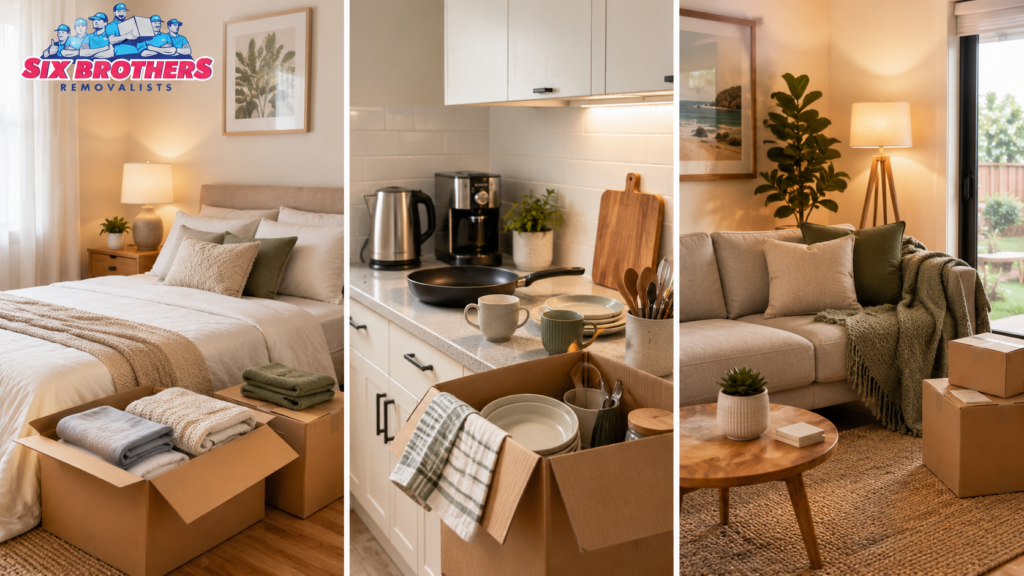
The fastest way to make a new house feel like a home is to make it functional before you make it beautiful. Resist the urge to unpack everything at once or to start decorating before the basics are in place. Instead, focus on the three spaces that most directly affect your daily comfort and wellbeing.
Start With the Bedroom — Sleep Restores Everything
Your bedroom should be the first room you fully set up after an interstate move. Not partially fully. Bed assembled, linen on, curtains or blinds in place, phone charger accessible. The reason is simple: poor sleep amplifies every other difficulty of adjustment. When you’re rested, the unfamiliarity of a new place feels manageable. When you’re exhausted, it feels overwhelming.
Before you touch another box, make sure you can sleep properly that first night. If your bed frame is still in pieces and your linen is buried in a box somewhere, that’s the problem to solve first everything else can wait until morning.
Get the Kitchen Functional Before Anything Else
The kitchen is the second priority. Not because cooking is more important than sleeping, but because a functional kitchen eliminates the daily friction of eating out or ordering in which gets expensive fast and adds to the sense of impermanence.
You don’t need every pot unpacked. You need: a kettle or coffee maker, one good pan, basic utensils, plates and cups for everyone in the household, and access to your pantry staples. That’s enough to cook simple meals and make the mornings feel normal. The rest of the kitchen can be organised over the following week.
Create One Comfortable Living Area Immediately
The third space to prioritise is one comfortable living area a couch, a rug, a lamp, something that makes the space feel inhabited rather than staged. This becomes your anchor point. It’s where you decompress at the end of the day, where the household gathers, where the new place starts to feel like it belongs to you.
It doesn’t need to be perfect. It just needs to be comfortable enough that you want to spend time in it.
Unpack With a System, Not Just Speed
The instinct after a big interstate move is to unpack everything as fast as possible to get it done, to feel less chaotic. That instinct is understandable but counterproductive. Rushing unpacking leads to things being put in the wrong places, which means reorganising later, which means the house never quite feels right.
A better approach is systematic unpacking: room by room, priority by priority, with intention.
How to Prioritise Boxes After an Interstate Move
Use a simple three-tier priority system for unpacking after an interstate move:
Tier 1 — Unpack immediately (Day 1-2): Bedroom essentials, bathroom basics, kitchen fundamentals, children’s comfort items, pet supplies, medications, phone chargers, and work equipment if you’re returning to work within days.
Tier 2 — Unpack within the first week: Remaining kitchen items, clothing, living room furniture and soft furnishings, home office setup, children’s bedrooms fully.
Tier 3 — Unpack when you know where things belong: Decorative items, books, hobby equipment, seasonal items, anything that requires a decision about where it lives permanently.
The Tier 3 category is where most people go wrong they unpack everything into the first available space, then spend months moving things around. Better to leave those boxes stacked neatly until you’ve lived in the space long enough to know where things actually belong.
What to Leave Packed Until You Know the Space
Certain items genuinely benefit from a waiting period before they’re unpacked. Wall art, for example, is worth leaving boxed until you’ve lived in the space for at least a week you’ll have a much clearer sense of which walls need what, and you’ll avoid unnecessary holes. The same applies to decorative shelving, extra furniture pieces, and anything that requires a permanent decision about placement.
Storage solutions shelving units, drawer organisers, wardrobe systems are also worth delaying. Every home has different storage quirks, and buying or installing solutions before you understand the space often means buying the wrong things.
Using Labelled Boxes and Room-by-Room Unpacking
If your removalist labelled your boxes by room (which any professional interstate removalist should do), use that system. Unpack one room completely before moving to the next. This creates visible progress a fully functional bedroom feels far more settling than four rooms that are each 25% done.
If boxes weren’t labelled clearly, spend 30 minutes sorting them by room before you start unpacking anything. The time investment pays back immediately in reduced chaos and faster progress.
Make Your New Neighbourhood Feel Familiar
Familiarity with your neighbourhood is one of the most powerful contributors to feeling at home. The faster you build a mental map of your local area where things are, what’s nearby, which streets lead where the faster the disorientation fades.
This doesn’t happen automatically. It requires deliberate exploration, especially in the early weeks when the instinct is often to stay inside and keep unpacking.
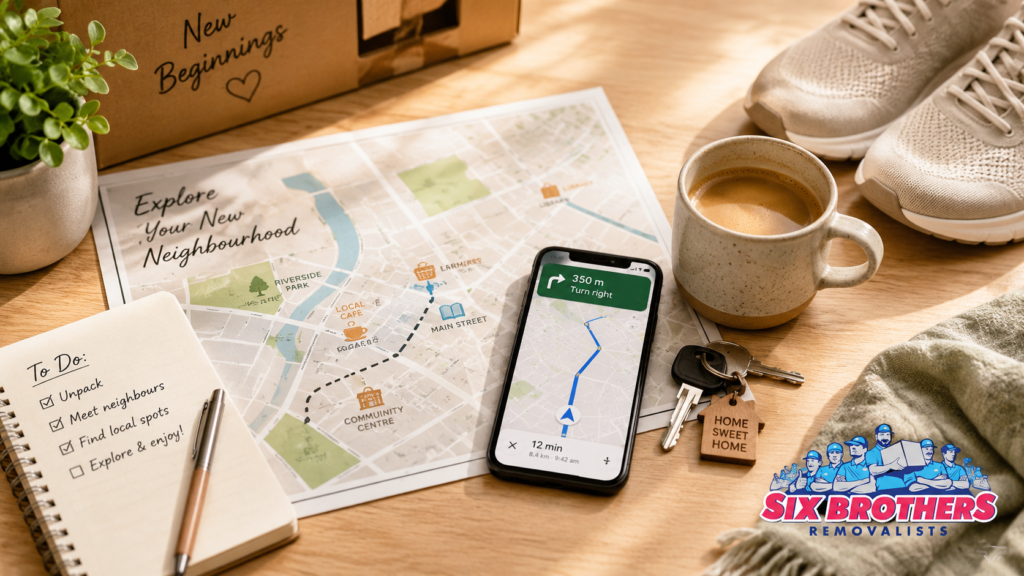
Explore Local Streets, Shops, and Services Early
Within the first three days of arriving, take a deliberate walk or drive around your immediate neighbourhood. Not to accomplish anything specific just to look. Note where the nearest supermarket is, where the local park is, which streets are quiet and which are busy, where the closest petrol station sits.
This kind of low-stakes exploration builds the environmental familiarity your brain needs to feel oriented. It also surfaces useful information: the bakery two streets over, the quiet walking path behind the school, the hardware store that’s closer than Google Maps suggested.
Do it again a week later. You’ll notice things you missed the first time.
Find Your Nearest Essentials: GP, Supermarket, Pharmacy
Practical familiarity matters as much as geographic familiarity. Within your first week, identify and locate your nearest GP (and register as a new patient this often has a wait time), pharmacy, supermarket, dentist, and any specialist services your household regularly uses.
In NSW, you can find bulk-billing GPs through the HealthDirect GP finder, which filters by location and bulk-billing status. Getting this sorted early means you’re not scrambling to find a doctor when someone in the household actually needs one.
How to Meet Neighbours and Build Local Connections
Neighbours are one of the most underrated resources after an interstate move. A good neighbour relationship provides practical support (someone to take in a parcel, someone who knows the local area), social connection, and a sense of belonging that’s hard to manufacture any other way.
Introduce yourself within the first week a simple knock on the door, a wave over the fence, a brief conversation when you cross paths. Most people respond warmly to a new neighbour who makes the first move. You don’t need to become best friends; you just need to establish a friendly, familiar presence.
Beyond neighbours, look for local community groups, sporting clubs, volunteer organisations, or interest-based meetups in your area. Apps like Meetup and local Facebook community groups are practical starting points for finding people with shared interests in a new location.
Rebuild Your Daily Routine in a New State
Routine is the architecture of comfort. When your daily rhythms are disrupted as they inevitably are during and after an interstate move everything feels harder, more effortful, and more uncertain. Re-establishing routine is not a luxury; it’s a practical strategy for accelerating your adjustment.
Why Routine Matters More After a Big Move
Routine reduces the number of decisions you have to make each day. When you know where you’re going for coffee, which route you’re taking to work, and what you’re doing on Saturday morning, your cognitive load drops significantly. That freed-up mental energy goes toward processing the new environment rather than managing daily logistics from scratch.
Research in environmental psychology consistently shows that behavioural routines are one of the primary mechanisms through which people develop place attachment. In simple terms: doing the same things in the same places, repeatedly, is how a new place starts to feel like yours.
Re-establishing Morning and Evening Habits
Start with your morning and evening routines these bookend the day and have the most influence on how settled you feel. If you had a morning walk at your previous home, find a route for that walk in the new neighbourhood within the first week. If you had an evening ritual a particular show, a particular meal, a particular way of winding down maintain it.
The specific content of the routine matters less than its consistency. Familiar patterns in an unfamiliar environment create a bridge between the old place and the new one, giving your nervous system something reliable to anchor to.
Finding Local Gyms, Cafes, and Community Spots
The third layer of routine involves the places outside your home that become part of your regular life the gym, the cafe, the park, the library, the market. These “third places” (spaces that are neither home nor work) are critical for social connection and local identity.
Make it a deliberate project in your first month: find your local cafe and go back twice. Try the nearest gym or fitness class. Visit the weekend market if there is one. These repeated visits build the kind of low-level familiarity that accumulates into genuine belonging.
Handle the Practical Admin That Makes a Place Feel Real
There’s a category of tasks after an interstate move that nobody enjoys but everyone needs to complete the administrative work of officially becoming a resident of a new state. These tasks matter not just practically but psychologically: completing them signals to your brain that the move is real, permanent, and settled.
Update Your Address With Government and Financial Institutions
Address updates after an interstate move should be completed within four weeks of arrival. The priority list includes:
- Australian Electoral Commission (update your enrolment at aec.gov.au)
- Australian Taxation Office (via myGov)
- Medicare and any private health insurance
- Your bank and any financial institutions
- Superannuation funds
- Centrelink (if applicable)
- Your employer’s HR records
- Australia Post (set up mail redirection while updates are in progress)
Mail redirection through Australia Post can be set up for three, six, or twelve months and costs a modest fee it’s worth doing immediately to catch anything that slips through during the update process.
Transfer Utilities, Internet, and Subscriptions
Utilities and internet should ideally be connected before you arrive, but if they weren’t, this becomes an immediate priority. In NSW, electricity and gas providers include AGL, Origin Energy, EnergyAustralia, and a range of smaller retailers you can compare plans through the NSW Government’s Energy Made Easy comparison tool.
Internet connection timelines vary significantly depending on your address and provider. NBN connections in established areas are typically activated within five to ten business days of ordering. If you’re in a new development or a building with older infrastructure, allow more time and have a mobile data backup plan.
Don’t forget subscription services: streaming platforms, magazine subscriptions, online shopping accounts, and any services that send physical mail all need address updates.
Transfer Utilities Moving Interstate……Read More
Register Your Vehicle and Update Your Driver’s Licence in NSW
If you’ve moved to NSW from another state, you’re legally required to transfer your driver’s licence and register your vehicle in NSW within three months of becoming a resident. This is a commonly overlooked step that can create problems if you’re involved in an accident or pulled over.
Driver’s licence transfers are handled through Service NSW you can book an appointment at a Service NSW centre or, for some licence classes, complete the process online at service.nsw.gov.au. Vehicle registration transfer requires a pink slip (safety inspection) if your current registration is from another state, and the process is also managed through Service NSW.
Personalise Your New Home to Reflect You
A house becomes a home when it reflects the people who live in it. This sounds obvious, but it’s a step many people delay indefinitely living out of boxes, treating the space as temporary, waiting until everything is “sorted” before they make it feel personal. That delay extends the adjustment period significantly.
Personalisation doesn’t require a renovation budget or a decorator. It requires intention.
Hang Familiar Items and Arrange Furniture Intentionally
Familiar objects photographs, artwork, books, meaningful items are powerful anchors. They signal continuity between your old life and your new one, and they make a space feel inhabited rather than occupied. Hang your favourite photograph within the first week. Put your books on a shelf. Display the things that matter to you.
Furniture arrangement also matters more than most people realise. The way furniture is positioned affects how a room feels to move through, how natural light falls, and how the space functions for the people using it. Take time to arrange furniture intentionally rather than just placing it where it fits move things around until the room feels right, not just functional.
Introduce Scent, Light, and Texture to Create Comfort
Three sensory elements that are often overlooked in the settling-in process: scent, light, and texture. These work below the level of conscious awareness to make a space feel comfortable or uncomfortable.
Scent is particularly powerful a familiar candle, a diffuser with a scent you associate with comfort, or simply cooking familiar food fills a new space with olfactory cues that signal safety and home. Lighting matters enormously: harsh overhead lighting makes spaces feel clinical; warm lamps and layered lighting make them feel inhabited. Texture rugs, cushions, throws, curtains adds the tactile softness that distinguishes a home from a hotel room.
None of these require significant expense. A rug from a discount homewares store, a lamp from a second-hand shop, a candle you already own these small additions have outsized effects on how a space feels.
Give Each Room a Purpose Before Decorating
Before you start decorating, give each room a clear purpose. This sounds obvious for bedrooms and kitchens, but it matters most for the ambiguous spaces the spare room, the study nook, the sunroom, the garage. Spaces without a clear purpose tend to become dumping grounds, which creates visual clutter and a persistent sense of incompleteness.
Decide what each space is for. Then set it up for that purpose before you add anything decorative. A room that functions well for its intended purpose feels settled even before it looks beautiful.
Support Children and Pets Through the Transition
Interstate moves are hardest on the household members who had the least say in the decision: children and pets. Both experience the disruption of familiar environments acutely, and both benefit significantly from deliberate support during the adjustment period.
How to Help Kids Adjust After Moving Interstate
Children’s adjustment to an interstate move depends heavily on age, temperament, and how the move is handled by the adults around them. Across all ages, a few principles apply consistently:
Involve them in the process where possible et them choose how their bedroom is arranged, give them age-appropriate tasks during unpacking, take them to explore the new neighbourhood with you. Agency reduces anxiety.
Maintain familiar routines as much as possible, especially around meals, bedtime, and weekend activities. The content of the routine can adapt to the new location; the structure should stay as consistent as possible.
Acknowledge their feelings without dismissing them. “I know you miss your friends” is more helpful than “You’ll make new friends soon.” Both things can be true, but the first one validates the child’s experience rather than rushing past it.
For school-age children, connecting with the new school before the first day visiting the campus, meeting the teacher, joining any orientation programs significantly reduces first-day anxiety. Most NSW public schools have transition programs for new students; contact the school office to ask what’s available.
Settling Pets Into a New Home Environment
Pets particularly cats and dogs are highly sensitive to environmental change. Dogs typically adjust within two to four weeks, though some anxious dogs take longer. Cats, being more territorial, often take longer and can show stress behaviours (hiding, reduced appetite, inappropriate elimination) for several weeks after a move.
For dogs: maintain your regular walk schedule from day one, even if the routes are unfamiliar. The routine of the walk matters more than the familiarity of the route. Keep feeding times consistent and give them time to sniff and explore the new space at their own pace.
For cats: confine them to one or two rooms initially rather than giving them access to the whole house immediately. This allows them to establish a secure base before expanding their territory. Use familiar bedding and litter trays, and don’t wash their bedding immediately after the move the familiar scent is reassuring.
Stay Connected With People You Left Behind
One of the most significant challenges of interstate relocation is the distance it creates from established relationships. Friends, family, and community connections that were part of daily life become logistically complicated. Managing that distance well is an important part of feeling settled in a new place.
Maintaining Long-Distance Friendships and Family Bonds
The relationships that matter most require deliberate maintenance after an interstate move. Proximity made them easy before; distance makes them effortful. That effort is worth making.
Schedule regular contact rather than relying on spontaneous connection. A weekly video call with close friends, a monthly catch-up with family, a group chat that stays active these structures keep relationships alive across distance in a way that “we should catch up sometime” never does.
Be honest with the people you care about that the adjustment is hard. Most people who haven’t moved interstate significantly underestimate how disorienting it is. Letting people know you’re finding it challenging invites support rather than the assumption that everything is fine.
When to Visit and When to Let the New Place Grow on You
There’s a tension in the early months of an interstate move between visiting the people and places you left behind and giving the new place a genuine chance to feel like home. Both matter, but the timing matters too.
Visiting too soon within the first few weeks can reset the adjustment process. You return to the new place having just been reminded of everything you left, and the disorientation starts again. Most relocation counsellors suggest waiting at least six to eight weeks before the first visit back, to give the new environment time to establish itself as your primary home.
After that initial period, regular visits are healthy and important. The goal isn’t to sever connection with your previous life, it’s to build a new one that’s strong enough to stand alongside it.
How Six Brothers Removalists Makes the Interstate Move Easier
Feeling at home after an interstate move starts well before you arrive at the new address. The quality of the move itself, how carefully your belongings are handled, how smoothly the logistics are managed, how much stress you carry into the first week has a direct impact on how quickly you settle in.
A chaotic, stressful move leaves you arriving exhausted, anxious, and already behind. A well-managed move leaves you arriving with energy to focus on what actually matters: making the new place feel like home.
Fully Managed Interstate Removalist Services From Parramatta
Six Brothers Removalists operates interstate removalist services from Parramatta and across Greater Western Sydney, covering moves to Queensland, Victoria, South Australia, and beyond. Our fully managed service handles every stage of the move: professional packing, careful loading, interstate transport, delivery, and unpacking assistance if required.
Every interstate move we handle is managed by an experienced crew that understands the specific challenges of long-distance relocation from protecting furniture across hundreds of kilometres of road to coordinating delivery windows that work around your schedule at the other end.
We use purpose-built moving trucks with appropriate tie-down systems, furniture blankets, and protective wrapping for fragile items. Your belongings arrive in the same condition they left which means you’re unpacking into your new home, not dealing with damage claims.
Backloading Options for Cost-Effective Interstate Moves
Interstate backloading is one of the most cost-effective ways to move a household across state lines, and it’s a service Six Brothers Removalists offers regularly on established routes between NSW and other states.
Backloading works by sharing truck space with other customers whose moves are travelling the same route. Instead of paying for an entire truck, you pay for the space your belongings actually occupy. For households with flexible timing, the savings are substantial often 40 to 60 percent compared to a dedicated truck.
The trade-off is flexibility on delivery dates. Backloading moves operate on the truck’s schedule rather than yours, which means delivery windows rather than specific times. For most households that can plan around a two to three day delivery window, it’s an excellent option.
Contact Six Brothers Removalists to ask about current backloading availability on your specific route schedules change regularly, and availability on popular routes like Sydney to Melbourne or Sydney to Brisbane is often better than people expect.
Packing, Storage, and Delivery — All in One Place
One of the most stressful aspects of interstate moving is managing multiple service providers a packing company, a removalist, a storage facility, a delivery service. Six Brothers Removalists eliminates that complexity by offering all of these services under one roof.
Our packing service uses quality materials double-walled boxes, packing paper, bubble wrap, wardrobe boxes, and specialty packaging for fragile items and our crew knows how to pack efficiently for long-distance transport, which is different from local packing. Items packed for interstate moves need to withstand vibration, temperature variation, and extended transit times.
If your new home isn’t ready when your belongings need to leave, our secure storage facilities in Parramatta hold your goods safely until delivery is possible. Short-term and long-term storage options are available, with flexible access arrangements.
Conclusion
Feeling at home after moving interstate is a process built from small, deliberate actions: setting up essential rooms first, unpacking systematically, rebuilding daily routines, exploring your neighbourhood, completing the administrative tasks that make a move feel permanent, and personalising your space to reflect who you are. None of these steps are complicated, but together they compress months of disorientation into weeks of genuine settling.
The quality of your move shapes everything that follows. Arriving with your belongings intact, your energy preserved, and your logistics handled means you can focus on building your new life rather than recovering from the move itself.
When you’re ready to plan your interstate relocation, Six Brothers Removalists is here to make it as smooth as possible. Call our Parramatta team to discuss your move, get a clear quote, and find out how our fully managed interstate services, backloading options, and storage solutions can take the stress out of the process from start to finish.
Frequently Asked Questions About Feeling at Home After Moving Interstate
How long does it realistically take to feel at home after moving interstate?
Most people feel genuinely settled within three to six months of an interstate move. The first four to six weeks are typically the hardest, with disorientation and homesickness peaking around weeks two and three. Active steps establishing routine, exploring the neighbourhood, completing admin tasks, and personalising your space significantly shorten this timeline compared to passive waiting.
What should I unpack first after an interstate move?
Unpack your bedroom first, completely, so you can sleep properly from night one. Then prioritise the kitchen for basic meal preparation, followed by one comfortable living area. Everything else can follow a systematic room-by-room approach over the first week. Decorative items and non-essentials are best left until you’ve lived in the space long enough to know where things belong.
How do I update my address after moving interstate to NSW?
Update your address with the Australian Electoral Commission, ATO via myGov, Medicare, your bank, superannuation funds, and your employer within four weeks of moving. Set up Australia Post mail redirection immediately to catch anything that slips through. For NSW-specific requirements, transfer your driver’s licence and vehicle registration through Service NSW within three months of becoming a NSW resident.
Is it normal to feel sad or anxious after moving interstate even if the move was your choice?
Yes, completely normal. Place attachment is a genuine psychological phenomenon, and leaving a familiar environment creates real grief even when the move is positive and chosen. Feelings of sadness, anxiety, and homesickness in the first weeks after an interstate move are experienced by the vast majority of people who relocate. Acknowledging these feelings rather than suppressing them is part of a healthy adjustment process.
How can I help my children adjust after moving interstate?
Involve children in age-appropriate decisions about the new home, maintain familiar routines especially around meals and bedtime, acknowledge their feelings without rushing past them, and connect with the new school before the first day. For younger children, keeping familiar toys and comfort objects accessible during the transition is particularly important. Most NSW public schools have transition support for new students contact the school office to ask what’s available.
What is backloading and is it a good option for interstate moves?
Backloading means sharing truck space with other customers travelling the same interstate route, paying only for the space your belongings occupy rather than an entire truck. It’s significantly cheaper than a dedicated truck often 40 to 60 percent less and works well for households with flexible delivery timing. The trade-off is that delivery happens within a window rather than on a specific day. Six Brothers Removalists offers backloading on established NSW interstate routes.
How do I make a rental property feel like home after moving interstate?
Focus on what you can control: furniture arrangement, soft furnishings, lighting, scent, and personal items. Rugs, lamps, cushions, and artwork transform a rental space without requiring permanent changes. Hang familiar photographs and display meaningful objects early. Establish your daily routine in the new space quickly, and explore the neighbourhood to build local familiarity. The rental status of the property matters far less to your sense of belonging than the habits and connections you build around it.