

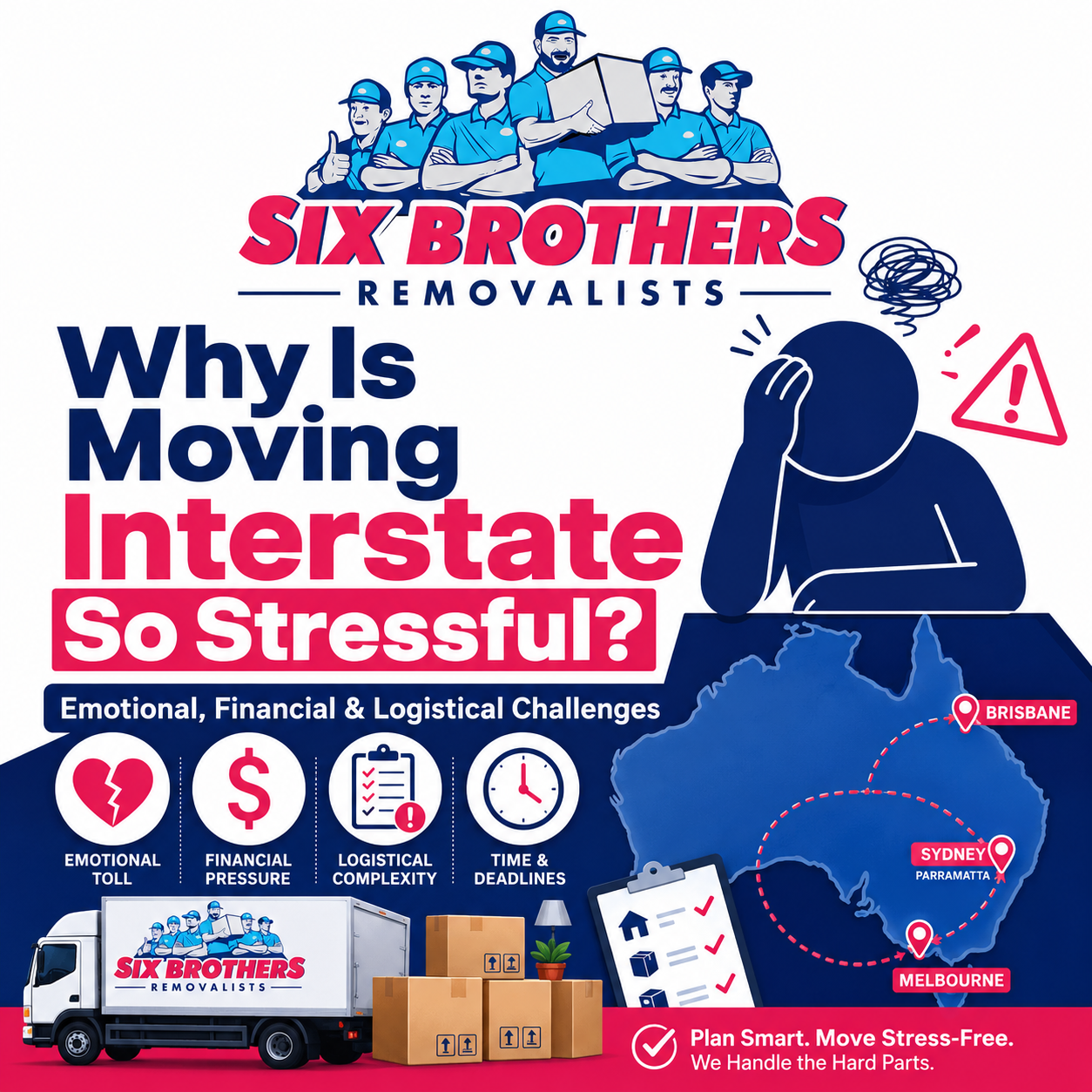
Interstate moving ranks among life’s most stressful events because it combines emotional upheaval, financial pressure, physical exhaustion, and complex logistics all compressed into tight deadlines across unfamiliar distances. You’re not just changing addresses. You’re coordinating dozens of service providers, making hundreds of decisions, lifting thousands of kilograms, and investing thousands of dollars while managing work, family, and the anxiety of leaving everything familiar behind.
This stress is completely normal and widely underestimated. Most Parramatta residents planning moves to Melbourne, Brisbane, or beyond discover the reality only after they’ve started: interstate relocation demands far more than local moves, with state regulations, extended transit times, and the inability to easily return if something goes wrong.
This guide explains exactly why interstate moving creates such exceptional stress, which factors you can control, and how professional removalists eliminate the pressure points that overwhelm most people. Understanding these stressors helps you prepare mentally and make informed decisions about managing your move.

It’s an Emotional Rollercoaster You Can’t Prepare For
The emotional weight of interstate moving catches most people off guard. You’re leaving behind a home filled with memories the kitchen where your kids learned to cook, the backyard where you hosted summer barbecues, the neighbors who became genuine friends. Research shows relocation ranks among the top five most stressful life events, comparable to divorce or job loss, because it disrupts your sense of identity and belonging.
This isn’t just sentimentality. Your brain has formed deep neural pathways connecting specific places to comfort, routine, and safety. Walking familiar streets, knowing which café makes your coffee right, recognizing faces at the local shops these small certainties provide psychological stability. Interstate moving strips away this entire support structure simultaneously.
The anxiety intensifies because you’re facing complete unfamiliarity. You don’t know the new area’s rhythms, which suburbs are family-friendly, where to find reliable tradespeople, or how long your commute will actually take. You’re making one of life’s biggest decisions where to live with incomplete information and no safety net of local knowledge.
Family members experience this transition differently, creating additional strain. Your partner might be excited about career opportunities while you’re grieving the loss of your support network. Kids resist leaving friends and schools. Elderly parents worry about accessing familiar healthcare. Managing these conflicting emotions while organizing the practical move becomes exhausting.
Even exciting interstate moves carry emotional weight. The pressure to feel grateful or enthusiastic when you’re actually anxious and overwhelmed creates internal conflict. You’re allowed to feel stressed about positive changes. The emotional complexity of interstate relocation is real, valid, and significantly underestimated by most people until they’re in the middle of it.
The Logistics Are More Complex Than You Think

You’re not just moving boxes you’re coordinating a complex operation involving removalists, utility companies, real estate agents, cleaners, internet providers, postal services, insurance companies, and potentially vehicle transporters and pet relocators. Each service provider operates on different timelines with different requirements, and they all need to align perfectly on moving day.
According to Australian removalist industry data, the average interstate move involves coordinating 8-12 separate service providers across a 4-8 week timeline. Miss one deadline and the cascade effect begins: your removalist arrives but settlement delays by three days, so now you need emergency storage, temporary accommodation, time off work you hadn’t planned, and you must reschedule every subsequent service.
Interstate moves add layers of complexity local moves don’t face. You’re arranging utility disconnections in NSW and connections in Victoria or Queensland different companies, different systems, different lead times. Electricity might connect in five business days, but internet installation takes three weeks. You’re coordinating these remotely, often before you’ve even seen the new property in person.
The simultaneous responsibilities compound the stress. You’re managing this logistical puzzle while maintaining your job performance, caring for family, keeping the current house presentable for inspections, and somehow finding time to pack every item you own. Each evening after work becomes a project management session: confirming bookings, chasing quotes, updating spreadsheets, making decisions.
State-to-state regulations create unexpected complications. Queensland has quarantine restrictions on certain plants and honey. Vehicle registration transfers require different documentation in each state. Some strata buildings restrict moving to specific days or hours. You’re learning these rules while executing the move, discovering requirements you didn’t know existed until they become urgent problems.
The coordination stress peaks when you realize one person’s delay affects everyone else’s schedule. Your removalist is booked for Friday, but if settlement shifts to Monday, you’re not just rescheduling one service you’re rescheduling everything, often paying cancellation fees and premium rates for short-notice rebooking. This lack of control over interconnected timelines creates persistent anxiety throughout the entire moving period.
The Financial Pressure Builds Quickly
You budget $5,000 for removalists, then realize that’s just the beginning. Interstate moving costs in NSW typically range from $3,000 to $8,000+ for professional removal services, but total relocation expenses often reach $10,000-$15,000 when you account for everything actually required.
The upfront costs hit hard. For a three-bedroom house moving from Parramatta to Melbourne, expect removalist quotes between $4,000-$7,000 depending on volume and service level. Parramatta to Brisbane runs $3,500-$6,500. Parramatta to Adelaide jumps to $5,500-$8,000+ due to the 1,400km distance. These are just transport costs the visible part of the financial iceberg.
Hidden expenses accumulate rapidly. Your new property requires a bond or deposit: $2,000-$8,000 depending on rental or purchase price. Utility connection fees add $200-$500. If you’re packing yourself, quality materials cost $300-$800 (boxes, tape, bubble wrap, furniture blankets). Transit insurance runs $150-$400. Temporary accommodation while waiting for settlement or delivery: $150-$300 per night. Professional cleaning for both properties: $300-$600 total. Vehicle transport if you’re not driving: $500-$1,200. Pet transport with quarantine compliance: $200-$800.
The quote comparison process creates its own stress. One Parramatta removalist quotes $4,000, another quotes $7,500 for seemingly the same move. Why the massive difference? One includes packing materials and insurance, the other charges extra. One calculates by weight, another by cubic meters. One offers binding estimates, another warns prices may increase on moving day. Comparing these varying structures while exhausted and time-pressured leads to decision paralysis.
Financial anxiety intensifies because you’re making this investment while simultaneously paying for two properties (overlap period), potentially taking unpaid leave, and facing setup costs at the new location (furniture for different layout, window coverings, garden equipment). The cheap-versus-reliable trade-off haunts you: save $500 on removalists but risk $2,000 in damaged furniture? The stakes feel impossibly high.
Industry research indicates that 68% of interstate movers exceed their initial budget by 20-40% due to unexpected costs discovered during the process. This budget creep creates ongoing financial stress as you watch expenses climb beyond what you’d planned and approved with your partner or family.
It’s Physically Exhausting in Ways You Don’t Expect
Most people think moving day is the hard part. The real exhaustion starts weeks earlier and never really stops until you’re fully unpacked in the new location.
Packing a three-bedroom house means 2-3 weeks of nightly and weekend labor. You’re sorting every item you own thousands of individual objects deciding keep, sell, donate, or discard. Then you’re wrapping, boxing, labeling, and stacking. The average three-bedroom home requires 50-80 boxes, each weighing 10-20kg when packed. You lift each box multiple times: packing it, moving it to staging area, loading it eventually, then unpacking.
The repetitive strain accumulates. Your back aches from bending over boxes. Shoulders burn from reaching into cupboards. Knees protest from kneeling to pack low shelves. You’re doing this after full work days, sacrificing sleep to stay on schedule, eating poorly because the kitchen is half-packed. The physical degradation happens gradually, then suddenly you can barely move.
Moving day itself is 8-12 hours of continuous heavy lifting. Furniture disassembly requires strength and problem-solving while exhausted. Navigating stairs, narrow doorways, and tight corners with a couch or mattress tests physical limits. Loading the truck efficiently becomes Tetris under pressure, in whatever weather conditions the day brings scorching Western Sydney heat or unexpected rain.
Safe Work Australia reports that moving-related injuries spike during peak season, with back injuries, crushed fingers, trips, and falls being most common. Without professional equipment proper dollies, ramps, furniture straps, protective blankets you’re improvising with inadequate tools, increasing injury risk with every heavy item.
The cumulative effect destroys your resilience. You’re already physically exhausted from weeks of packing when moving day arrives. You still need to work, care for children, maintain the house. Sleep suffers from stress and physical discomfort. By the time you reach the new property, you’re running on empty but facing weeks more of unpacking, furniture assembly, and setup.
Physical exhaustion directly impacts mental capacity. Your decision-making ability plummets. Emotional regulation fails small frustrations trigger disproportionate reactions. You become more accident-prone. The physical demands of interstate moving aren’t just tiring; they undermine every other aspect of managing the transition successfully.
You’re Racing Against Deadlines You Can’t Control
You receive your settlement date: four weeks from today. The clock starts ticking on deadlines you cannot negotiate or extend.
Property settlement dates are fixed. Lease end dates carry financial penalties for overstaying. New job start dates are non-negotiable. School term starts matter for kids’ education continuity. These external deadlines create immovable pressure points around which everything else must align.
Service provider lead times compound the time pressure. Good removalists need 2-4 weeks’ notice for booking, and during peak season (November-January in Parramatta), that extends to 6-8 weeks. Utility connections require 5-10 business days. Internet installation takes 2-4 weeks in many areas. Vehicle transport needs 1-2 weeks advance booking. Storage facilities may have limited immediate availability.
According to moving industry standards, properly planning an interstate move requires 6-8 weeks minimum: four weeks for research, quotes, and booking removalists, plus 2-4 weeks for packing, utilities, and logistics. But many Parramatta residents have only 2-3 weeks between receiving settlement confirmation and moving day.
Work constraints limit your available time. You can’t take two weeks off. Moving during the work week means using precious annual leave. Weekend moves often carry premium pricing. Interstate moves mean you can’t easily return if you forget something critical, so the pressure to get everything right the first time intensifies.
School and family timing adds complexity. You’re trying to minimize disruption to children’s education, coordinate with your partner’s work schedule, and manage elderly parents’ healthcare continuity. Everyone’s needs must align with that fixed settlement date, creating a coordination puzzle with no flexibility.
Rushed decisions have consequences. You book the first available removalist instead of the best one. You pay premium rates for short notice. Inadequate packing time increases damage risk. You forget important tasks mail redirection, insurance updates, address changes discovering them too late. The compressed timeline forces compromises you wouldn’t otherwise make.
The time pressure creates persistent anxiety. You’re constantly calculating: “If I pack two boxes every evening, will I finish in time?” “What if the removalist cancels?” “What happens if settlement delays?” The lack of buffer time means any unexpected problem becomes a crisis.
Interstate Distance Adds Unique Complications
Moving 800km from Parramatta to Brisbane isn’t just a longer drive it’s a fundamentally different category of complexity with challenges local moves never face.
State-to-state regulations create administrative burdens. Vehicle registration must transfer to your new state within three months, but each state has different requirements and processes. Driver’s license transfers follow different rules in Queensland versus Victoria. Interstate quarantine regulations restrict certain plants, foods, honey, and soil crossing borders. Pet transport requires specific microchipping standards and vaccination records that vary by state.
The unfamiliarity stress is substantial. You don’t know the new area intimately. Which suburbs are actually family-friendly versus just marketed that way? Where are reliable tradespeople, doctors, schools? What’s the real commute time during peak hour? You’re making housing decisions worth hundreds of thousands of dollars with limited firsthand knowledge, often based on a single inspection visit or virtual tour.
You can’t easily visit beforehand to thoroughly inspect the property, meet neighbors, or explore the area. You’re relying on photos, Google Maps street view, and real estate agent descriptions. The climate might be significantly different packing for Brisbane’s humidity versus Melbourne’s cold requires different wardrobes and household items.
Extended transit times mean 1-3 days (or longer with backloading) where you have zero access to your belongings. You need to pack separate “essentials” bags, arrange accommodation at both ends, and coordinate delivery when you might not be at the new property yet. Weather delays during transit are possible. Tracking and communication with removalists becomes crucial but sometimes difficult.
Remote coordination creates practical challenges. You’re arranging utility connections, internet installation, and service deliveries for a property you’re not physically at. Time zone differences between NSW and Queensland add minor but annoying complications to phone calls and scheduling. If something goes wrong, you can’t quickly drive over to fix it.
The inability to return easily for forgotten items creates pressure. Local moves allow quick trips back. Interstate moves mean if you forget your grandmother’s jewelry or important documents, retrieving them requires another 900km round trip or expensive courier services. This finality demands more thorough planning and creates anxiety about missing something critical.
Different building regulations, strata rules, and local requirements catch people off guard. Some Queensland buildings restrict moving to specific hours. Parking permits work differently. Waste collection schedules and recycling rules vary. You’re learning a new area’s systems while simultaneously trying to settle in.
Decision Fatigue Sets In Fast
You’ll make more decisions in four weeks of moving preparation than most people make in six months of normal life. The sheer volume of choices major and minor depletes your mental energy until you can barely decide what to eat for dinner.
Major decisions demand significant research and carry high stakes. Which removalist company from the 10+ options with varying prices and services? Full-service packing or self-pack to save money? What insurance level provides adequate protection? Storage: yes or no, and if yes, for how long and which facility? What furniture fits the new space versus what to sell or discard? Vehicle transport or drive yourself? When exactly to book everything, balancing availability against price?
The minor decisions accumulate relentlessly. Every single item in your house requires a decision: keep, sell, donate, or discard. You’re making this choice for thousands of objects. Which box size for which items? What labeling system? Which room to pack first? What packing order ensures you can still function while half-packed? Which utility providers at the new location—electricity, gas, internet companies all have multiple options? Clean yourself or hire professionals? How long for mail redirection? What goes in the car versus the truck? What constitutes your “first night essentials” box?
Research fatigue compounds decision fatigue. You’re reading dozens of removalist reviews on Google, Facebook, and ProductReview. Comparing quotes with different inclusions makes direct comparison nearly impossible. Researching the new area schools, services, suburbs requires hours of investigation. Understanding state regulations you’ve never needed to know. Learning about services like backloading and vehicle transport you’ve never used. Conflicting advice online creates confusion rather than clarity.
Psychological research on decision fatigue shows that decision quality degrades as mental energy depletes. Your early decisions involve careful research and consideration. Later decisions devolve into “just pick something, I don’t care anymore.” You experience regret and second-guessing. Sometimes you reach complete paralysis—too overwhelmed to decide at all, so nothing gets done.
The comparison paralysis is real. Three removalist quotes: $4,200, $5,800, and $7,100. The cheapest has concerning reviews. The expensive one seems overpriced. The middle option feels safe but maybe you’re overpaying? You spend hours analyzing, calculating, worrying about making the wrong choice and regretting it for the entire move.
Decision fatigue compounds when you’re already emotionally drained from leaving your home, physically exhausted from packing, financially stressed about costs, and time-pressured by deadlines. Your capacity for good decision-making is at its lowest exactly when you need it most. This creates a vicious cycle: poor decisions due to fatigue lead to problems that create more stress and more decisions.
How Professional Removalists Reduce These Stress Factors
Understanding why moving is stressful is the first step. The second is knowing which stressors you can eliminate entirely by choosing the right help.
Professional removalists directly address each major stress factor through expertise, equipment, and systematic processes. Emotional stress doesn’t disappear, but professionals handle the logistics that consume mental energy, freeing you to focus on the emotional processing your family needs. Instead of coordinating eight service providers while packing, you have a single point of contact managing the physical move.
Logistical complexity reduces dramatically. Experienced removalists coordinate timing, understand state regulations, know which routes work best, and have solved problems you haven’t encountered yet. They bring established systems rather than you inventing processes from scratch under pressure.
Financial uncertainty decreases with transparent, itemized quotes that specify exactly what’s included versus additional costs. Quality removalists provide binding estimates—the price won’t suddenly increase on moving day. Insurance coverage protects against the damage costs that terrify most people. The upfront investment often costs less than the hidden expenses of DIY moves: time off work, injury-related medical costs, damaged belongings, and stress-related health impacts.
Physical exhaustion essentially disappears. Professional packing services mean you’re not spending three weeks lifting boxes every evening. Trained crews with proper equipment—commercial dollies, furniture ramps, protective straps and blankets handle the heavy lifting safely. You’re not risking back injuries or crushed fingers. The crew arrives fresh on moving day, not already depleted from weeks of preparation.
Time pressure eases because efficient processes and experienced crews work faster than DIY attempts. What takes you three weeks to pack, professionals complete in one or two days. They know how to load trucks for optimal space and safety. Their established schedules and systems reduce the coordination chaos.
Interstate complications become manageable with removalists who specialize in your specific route. Parramatta-based companies like Six Brothers Removalists understand Western Sydney to Melbourne, Brisbane, and Adelaide routes intimately. They know state regulations, typical transit times, and how to handle quarantine requirements. Their experience means they’ve already solved the problems you’re just discovering.
Decision fatigue reduces when you’re making fewer decisions with expert guidance. Instead of researching everything yourself, you’re asking professionals who’ve done thousands of moves: “What do you recommend for this situation?” Fewer decisions, better information, less mental depletion.
The cost-benefit perspective matters. Professional services cost more upfront but save money on injuries, damaged belongings, time off work, and stress-related health impacts. Your time and health have value too. The $2,000-$3,000 difference between DIY and full-service often costs less than the hidden expenses and consequences of doing it yourself while managing everything else in your life.
What’s Actually Included in Full-Service Interstate Removals
Full-service doesn’t mean the same thing to every removalist. Here’s what it should include and what typically costs extra.
Pre-move consultation provides the foundation. Quality removalists conduct in-home or detailed virtual assessments, calculating accurate volume (cubic meters), discussing special items, and creating a realistic timeline. This isn’t a quick phone quote it’s a thorough planning session that identifies potential challenges before moving day.
Packing materials should be included in full-service quotes: boxes in various sizes, packing paper, bubble wrap, tape, mattress covers, and furniture blankets. You’re not buying supplies from Bunnings and hoping you bought enough. Professional-grade materials protect belongings better than consumer options.
Professional packing means trained crews pack your entire home systematically. They work room by room with clear labeling systems. Fragile items receive proper wrapping. Heavy items go in smaller boxes. They know how to pack efficiently and safely skills developed over hundreds of moves, not learned from YouTube videos the night before.
Furniture disassembly handles beds, dining tables, shelving units, and other items that won’t fit through doorways assembled. Professionals track hardware in labeled bags so reassembly is straightforward. They know which furniture should be disassembled versus moved whole.
Loading uses proper lifting techniques and commercial equipment. Dollies, ramps, and furniture straps protect both your belongings and the crew’s health. Truck loading follows strategic patterns—heavy items low and centered, fragile items secured, weight distributed properly. This isn’t random stacking; it’s engineered for safe interstate transport.
Secure transport means interstate-rated trucks maintained to commercial standards, GPS tracking so you know where your belongings are, and experienced drivers who understand long-distance hauling. The truck is your belongings’ home for 1-3 days it needs to be reliable.
Insurance coverage includes transit insurance and public liability as standard. Quality removalists offer additional coverage options for high-value items. You’re protected if something goes wrong, not left arguing about liability after damage occurs.
Unloading and placement means items go into designated rooms, not just dumped in the garage. Professionals place furniture where you direct, making the new house immediately more functional. You’re not spending days dragging heavy items from room to room.
Furniture reassembly puts beds, tables, and shelving back together in the new location. The same crew that disassembled knows how everything goes back together. You’re sleeping in your bed the first night, not on a mattress on the floor surrounded by hardware bags.
Basic unpacking (included in comprehensive full-service) means boxes are unpacked and items placed appropriately dishes in kitchen cupboards, clothes in wardrobes. Some removalists offer this as optional; others include it in premium packages.
Waste removal takes packing materials off your property. You’re not left with a mountain of cardboard and bubble wrap to dispose of while trying to settle into a new area.
What’s typically NOT included in standard full-service (transparency matters): disconnecting and reconnecting appliances like washing machines and dryers (plumbing/electrical work), dismantling and installing wall-mounted items (TVs, shelves, artwork), packing personal valuables (jewelry, documents, medications you should handle these), cleaning services for either property, storage fees (separate service), and specialty items like pianos, pool tables, or safes (usually quoted separately due to special equipment needs).
Service level comparison helps clarify options. Full-service includes everything listed above. Partial service typically covers loading, transport, and unloading only—you handle all packing yourself. Basic service provides transport only you pack, load, and unload, they just drive the truck.
Common misconceptions need addressing. Full-service doesn’t mean removalists make decisions about what to keep or discard—that’s still your responsibility. You should still pack personal valuables yourself for security and peace of mind. Full-service saves enormous time but you still need to be present for property access, answering questions, and directing placement.
Six Brothers Removalists’ full-service includes comprehensive packing, all materials, furniture handling, secure interstate transport, insurance, and professional unloading with placement. We’re transparent about what’s included versus additional services, so you know exactly what you’re paying for without surprise charges on moving day.
Understanding Interstate Moving Costs and Value
Interstate moving costs from NSW vary widely. Here’s why, and what you should actually expect to pay from Parramatta.
Volume is the primary pricing factor, measured in cubic meters rather than just bedroom count. A minimalist two-bedroom apartment might be 25 cubic meters while a cluttered two-bedroom house reaches 40 cubic meters. Standard estimates: one-bedroom (15-25 cubic meters), two-bedroom (25-40 cubic meters), three-bedroom (40-60 cubic meters), four-bedroom (60-80+ cubic meters). Removalists calculate costs based on actual volume because that determines truck space and labor time.
Distance directly affects fuel costs, driver time, and vehicle wear. Longer distances mean higher base costs. The difference between 875km to Melbourne and 1,400km to Adelaide significantly impacts pricing.
Service level creates major price variations. Full-service with professional packing costs 40-60% more than basic transport-only service, but you’re paying for 2-3 weeks of labor you don’t have to do yourself plus materials and expertise.
Access difficulty affects quotes. Apartments with elevators differ from third-floor walk-ups. Long carries from truck to door, parking restrictions, and narrow staircases all increase labor time and therefore cost.
Timing matters significantly. Peak season (November-January, end of month) costs 20-30% more than off-peak periods due to demand. Mid-week moves often cost less than weekend moves.
Insurance level varies. Basic transit insurance is typically included, but comprehensive coverage for high-value items costs extra usually $150-$400 depending on declared value.
Realistic NSW interstate cost ranges from Parramatta (2025 pricing):
Parramatta to Melbourne (875km):
- Two-bedroom: $3,500-$5,500
- Three-bedroom: $4,500-$7,000
- Four-bedroom: $6,000-$9,000
Parramatta to Brisbane (920km):
- Two-bedroom: $3,200-$5,000
- Three-bedroom: $4,000-$6,500
- Four-bedroom: $5,500-$8,500
Parramatta to Adelaide (1,400km):
- Two-bedroom: $4,500-$6,500
- Three-bedroom: $5,500-$8,000
- Four-bedroom: $7,000-$10,000+
These ranges reflect full-service professional removals. Basic service (transport only) runs 30-40% less. Premium service with full packing and unpacking runs 20-30% more.
Quote variations confuse most people. Why does one company quote $4,000 and another $7,500 for seemingly identical moves? Different companies calculate cubic meters differently some measure conservatively, others generously. Some include packing materials in the base quote, others charge separately. Insurance levels vary. Some quote by weight instead of volume. Binding estimates guarantee the price; non-binding estimates can increase if actual volume exceeds the estimate.
Backloading can reduce costs by 30-50% compared to dedicated truck service. Shared truck space on return routes means $6,000 dedicated moves might cost $3,500-$4,000 via backloading. The trade-off is flexible timing—you need pickup and delivery windows rather than exact dates. (More details in the next section.)
Value versus price thinking prevents costly mistakes. The cheapest quote isn’t always the best value. Consider insurance coverage, company experience, equipment quality, and reviews. Saving $500 on removalists but losing $2,000 in damaged furniture isn’t actually a saving. Your time has value taking three days off work to DIY pack and move costs more than professional packing services when you calculate lost wages.
Injury risk carries real costs. Safe Work Australia data shows moving-related back injuries can mean weeks off work, medical expenses, and long-term health impacts. Professional removalists with proper equipment and training eliminate this risk.
According to consumer research, 68% of people who chose the cheapest removalist quote experienced problems (damage, delays, hidden fees), while 82% who chose mid-range quotes based on value reported satisfaction. The middle ground often provides the best balance of cost and quality.
Six Brothers Removalists provides transparent, itemized quotes explaining exactly what’s included and what’s additional. We calculate cubic meters accurately during in-home assessments, so our binding estimates reflect reality. Our Parramatta-based pricing is competitive for Western Sydney residents moving interstate, with no hidden costs surprising you on moving day.
How Backloading Can Save You Money on Interstate Moves
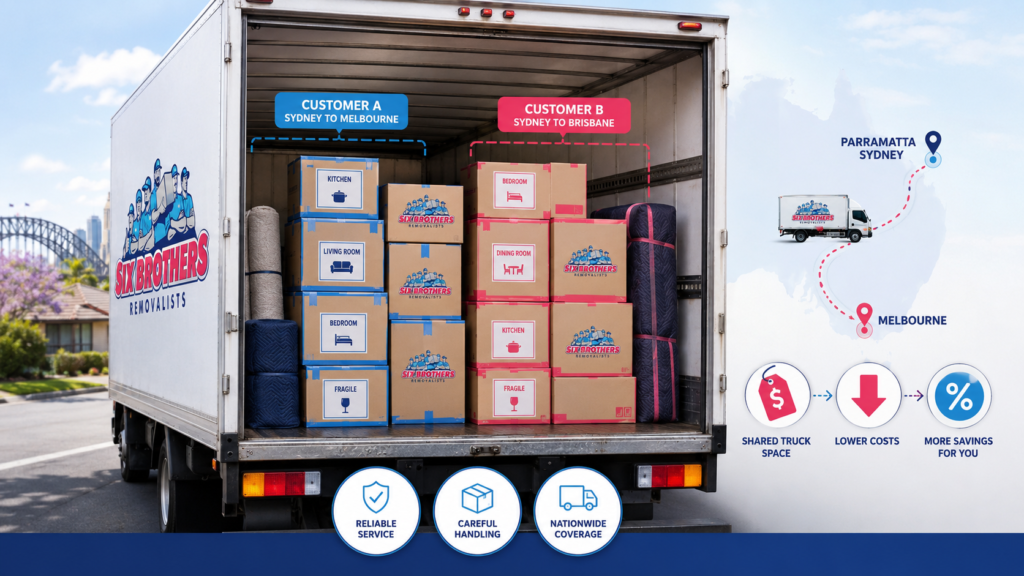
Backloading is the removalist industry’s best-kept cost-saving secret, potentially reducing your interstate moving costs by 30-50% without sacrificing service quality.
What backloading actually is: Removalist trucks travel interstate routes regularly on scheduled runs. A truck delivers furniture from Sydney to Melbourne, then returns to Sydney. That return trip often has empty or partially-filled space. Instead of running empty, removalists fill available space with another customer’s belongings heading Sydney-bound (or wherever the truck is returning). Both customers share fuel, driver, and truck costs, significantly reducing individual expenses.
How it works in practice: You book backloading service with a removalist who runs regular routes. They provide a pickup window for example, “week of May 15-22” rather than a specific date. When truck space becomes available on their schedule, your items are loaded. Delivery happens within a window too, typically 1-2 weeks after pickup, depending on route and truck filling. The timing is less precise than dedicated truck service, but the service quality and care are identical.
Cost savings are substantial. A dedicated truck from Parramatta to Melbourne for a three-bedroom house might cost $6,000. The same move via backloading could cost $3,500-$4,000 a saving of $2,000-$2,500. Savings increase with distance. Parramatta to Adelaide dedicated service at $8,000 might be $4,500-$5,500 via backloading.
The savings come from efficiency, not reduced quality. Your belongings receive the same professional packing, careful handling, and insurance coverage. The truck is the same commercial-grade vehicle. The difference is simply shared transport costs rather than you paying for an entire truck yourself.
Timing flexibility is the trade-off. Backloading requires flexible move dates. You receive pickup and delivery windows, not exact dates. Typical timeline: 1-2 weeks from pickup to delivery, though popular routes (Sydney-Melbourne, Sydney-Brisbane) often move faster. The removalist confirms specific dates as the truck fills and the schedule solidifies.
When backloading works well:
- Flexible move timeline (not fixed settlement date)
- Moving into storage first, then to final property
- Rental with flexible start date
- Budget-conscious moves where savings matter
- Smaller loads (one to two-bedroom) that fit shared space easily
- Popular routes with regular truck schedules (Sydney-Melbourne-Brisbane)
When to avoid backloading:
- Fixed settlement date with no flexibility
- Tight work start date requiring immediate arrival
- School term start deadline for children
- Need immediate access to all belongings
- Very large loads that may not fit available shared space
- Uncommon routes with infrequent truck schedules
Common concerns addressed: Your items are secure and fully insured, identical to dedicated moves. Backloading doesn’t mean lower quality or less care it means shared transport. Professional removalists track all loads and provide regular communication about timing updates. Your belongings don’t sit in warehouses for weeks; they’re in transit on established schedules.
Six Brothers Removalists offers backloading on major NSW interstate routes, maintaining regular Sydney-Melbourne-Brisbane schedules. We provide the same careful, professional service whether you choose dedicated or backloading options the difference is purely timing flexibility versus cost. We track all loads with GPS and communicate timing updates throughout the process, so you’re never wondering where your belongings are.
For Parramatta residents with flexible timelines, backloading provides genuine savings without compromising on service quality, equipment, or care. The $2,000-$3,000 saved often makes the difference between DIY stress and professional peace of mind.
When You Need Storage During an Interstate Move
Your lease ends June 15. Your new property settles June 29. Where do your belongings go for two weeks? This common scenario is exactly when storage becomes essential rather than optional.
Common storage scenarios during interstate moves include timing gaps when settlement or lease dates don’t align sometimes by days, sometimes by weeks. Downsizing to a smaller property means you need time to sell furniture that won’t fit, but you can’t keep it in the old house past moving day. Renovations at the new property might require storage until work completes and you can safely move in.
Using backloading for cost savings creates storage needs because flexible delivery windows mean you might arrive at the new location before your belongings do. Staged moves sending some items now, others later require temporary holding. Staying with family or in temporary accommodation while house-hunting means your furniture needs somewhere to wait.
Business relocations often involve overlap periods where the new office isn’t quite ready but the old lease is ending. Storage bridges these timing mismatches that are common in complex interstate transitions.
Storage types serve different needs. Short-term storage (days to three months) handles temporary gaps. Long-term storage (three months plus) suits extended transitions or downsizing decisions. Self-storage facilities give you 24/7 access to pack and retrieve items yourself. Removalist storage means the moving company stores your belongings and delivers them when you’re ready you don’t access the storage yourself. Container storage provides portable containers delivered to your property for loading, then stored at a facility or kept on-site. Climate-controlled storage protects sensitive items like wooden furniture, electronics, documents, and artwork from humidity and temperature extremes.
Costs in Parramatta and Western Sydney typically range from $150-$400 per month depending on size and features. Small units (10-15 cubic meters) cost $150-$200 monthly. Medium units (20-30 cubic meters) run $200-$300 monthly. Large units (40+ cubic meters) cost $300-$400+ monthly. Climate-controlled storage adds $50-$100 monthly to these rates. First-month discounts are common, and some facilities offer better rates for longer commitments.
Security and access matter significantly. Quality facilities provide 24/7 security monitoring, CCTV coverage, individual unit locks, and insurance requirements. Self-storage facilities have specific access hours (often 6am-10pm daily). Removalist storage requires scheduling delivery when you’re ready. Understanding access terms before committing prevents frustration when you need something urgently.
Storage reduces stress by eliminating the panic of mismatched dates. Instead of desperately trying to negotiate lease extensions or paying premium rates for rushed settlement, storage provides breathing room. It allows you to make furniture decisions thoughtfully rather than under pressure. Storage enables backloading savings without timing stressyour belongings arrive when they arrive, and you’re not homeless waiting for them.
The buffer for unexpected delays proves invaluable. Settlement delays happen. Renovations run over schedule. Having storage already arranged means these common problems don’t become crises requiring emergency solutions at premium prices.
Six Brothers Removalists offers secure warehouse storage in Parramatta, providing integrated service: we pack your belongings, store them in our facility, and deliver when your new property is ready. One company managing the entire process means less coordination stress, clearer communication, and accountability. You’re not arranging separate storage, coordinating pickup and delivery with different companies, and hoping timing aligns.
Planning advice for storage: Book early, especially during peak moving season (November-January) when facilities fill quickly. Calculate volume accurately underestimating means scrambling for additional space at the last minute. Understand access terms and restrictions before signing. Check insurance coverage your contents insurance may not cover items in storage, or may require specific facility standards. Plan for longer than your minimum estimate buffer time prevents stress if things take longer than expected.
Storage transforms timing mismatches from major stressors into manageable logistics. The $150-$400 monthly cost is small compared to the stress, rushed decisions, and potential financial penalties of trying to force perfect timing alignment in complex interstate moves.
Planning Your Interstate Move Timeline
The best interstate moves start eight weeks before moving day. Here’s how to use that time effectively, and what to do if you have less.
8 weeks before moving day:
Research removalist companies thoroughly. Request quotes from 3-5 companies, providing accurate volume estimates and service requirements. Research your new area—suburbs, schools, local services so housing decisions are informed. Start decluttering systematically, selling or donating items you won’t move. The less you move, the lower your costs and the simpler your packing. Notify your employer of the move, especially if changing jobs or requesting leave. Research schools if you have children, as enrollment processes and waiting lists vary.
6 weeks before:
Book your removalist. Good companies need 2-4 weeks’ notice minimum, and during peak season (November-January), that extends to 6-8 weeks. Waiting until the last minute means limited choices and premium pricing. Book storage if needed facilities fill up, especially at month-end. Arrange vehicle transport if you’re not driving. Start collecting packing materials if self-packing. Notify your landlord or real estate agent if renting, following proper notice periods. Research utility providers in your new location electricity, gas, internet options vary by area.
4 weeks before:
Notify utilities of disconnection dates. Arrange new utility connections, which can take 5-10 business days for electricity and gas, and 2-4 weeks for internet installation. Update your address with employer, banks, insurance companies, subscriptions, electoral roll, Medicare, and Centrelink. Arrange Australia Post mail redirection (minimum 3 months recommended). Book professional cleaners for both properties. Start packing non-essentials: seasonal items, books, decorative objects, spare linens.
2 weeks before:
Confirm removalist booking and all details—date, time, address, special requirements. Pack most items, leaving only daily essentials. Defrost and clean your freezer. Use up perishable food rather than moving or wasting it. Arrange pet transport if needed, ensuring quarantine compliance. Confirm new property access details keys, codes, timing. Pack your “first night essentials” box: toiletries, change of clothes, phone chargers, important documents, medications, basic kitchen items, bedding.
1 week before:
Complete final packing, leaving only items you’ll use in the last few days. Confirm all bookings: removalist, cleaners, utilities, storage. Prepare appliances for moving washing machine, dryer, refrigerator. Take meter readings at your current property for final bills. Do a final declutter pass anything you haven’t packed by now, do you really need it? Arrange childcare or pet care for moving day so you can focus on coordinating the move.
Moving day:
Be present when removalists arrive for property access and questions. Conduct a final walkthrough of every room, cupboard, and storage area—it’s easy to forget items in garages, sheds, or high cupboards. Hand over keys to landlord or real estate agent. Take final meter readings. Begin travel to your new location, timing arrival to meet the removalist delivery.
After arrival:
Supervise unloading and direct furniture placement. Check inventory against the list from pickup. Begin unpacking essentials immediately—bed, bathroom, kitchen basics. Connect utilities and confirm everything works. Within three months, update your driver’s license and vehicle registration to your new state (legal requirement in most states).
Compressed timelines (2-3 weeks only):
If you only have 2-3 weeks, focus on critical path items. Book removalist immediately—check availability before assuming you can get your preferred date. Consider full-service packing, which saves 1-2 weeks of evening and weekend labor. Prioritize utility connections since they have the longest lead times. Declutter ruthlessly you don’t have time for careful consideration, so when in doubt, don’t move it. Accept that you’ll pay premium pricing for short notice on most services.
Service booking lead times to remember:
- Removalists: 2-4 weeks (peak season: 6-8 weeks)
- Utility connections: 5-10 business days
- Internet installation: 2-4 weeks
- Vehicle transport: 1-2 weeks
- Storage facilities: 1 week (availability dependent)
- Professional cleaners: 1-2 weeks
Early planning equals more choices, better prices, and dramatically less panic. Each week of advance planning reduces stress exponentially. You’re making better decisions when not rushed, getting better prices when not desperate, and sleeping better knowing everything is organized.
Compressed timelines are possible but require full-service professional help. You simply cannot pack a three-bedroom house, coordinate all services, maintain work performance, and care for family in two weeks without professional packing and logistics support.
Six Brothers Removalists recommends booking 3-4 weeks ahead for best availability and pricing. We offer full-service packing for compressed timelines, transforming 2-3 weeks of your labor into 1-2 days of professional work. Our Parramatta team provides local area guidance for Western Sydney residents unfamiliar with interstate moving requirements.
What to Look for in an Interstate Removalist
Choosing the right removalist is the single biggest factor in whether your interstate move is smooth or stressful. Here’s how to evaluate companies and avoid costly mistakes.
Licensing and insurance (non-negotiable):
Verify proper business registration with a current ABN. Confirm public liability insurance of at least $10-20 million—this protects you if their truck damages property or causes accidents. Check that transit insurance is included in quotes, covering your belongings during transport. Ensure workers compensation insurance covers their crew—if an uninsured worker is injured on your property, you could be liable. Ask for proof of all insurance and verify it’s current, not expired.
Interstate experience matters:
Specific experience with your route (Parramatta to Melbourne, Brisbane, Adelaide) means they know the roads, timing, and potential issues. Companies with 5+ years in business have proven reliability and systems. Interstate specialization differs from local moving different trucks, different regulations, different logistics. Knowledge of state-specific regulations (vehicle restrictions, quarantine rules) prevents delays and problems. Established routes and regular schedules indicate consistent business and reliable service.
Equipment and resources:
Modern, well-maintained trucks are essential for 800-1,400km interstate journeys. Proper moving equipment—commercial dollies, furniture ramps, securing straps, protective blankets—protects your belongings and indicates professionalism. GPS tracking should be available so you know where your belongings are during transit. Adequate crew size for your move volume ensures efficiency and safety. Professional-grade packing materials (not consumer-grade boxes from Bunnings) provide better protection.
Transparent pricing:
Detailed, itemized quotes specify exactly what’s included versus additional costs. Clear explanations of what’s covered eliminate surprise charges. Binding estimates guarantee the price won’t change if volume is accurately assessed. No hidden fees for stairs, long carries, or other common situations. Payment terms should be clear deposit requirements, final payment timing, accepted methods.
Reviews and reputation:
Recent Google reviews (within the last 6-12 months) with 4+ star average indicate consistent quality. Facebook recommendations from real people provide social proof. Industry association membership (AFRA – Australian Furniture Removers Association) shows professional standards. Local reputation in Parramatta and Western Sydney matters established community presence indicates accountability. Read how companies respond to negative reviews—professional, solution-focused responses indicate good customer service.
Communication quality:
Responsiveness to initial inquiries predicts communication during your move. Clear explanations without jargon show they value customer understanding. Professional demeanor in all interactions—phone, email, in-person assessments. Written confirmation of all details prevents misunderstandings. Accessibility during the move—can you reach someone if problems arise?
Service flexibility:
Range of service options (full-service, partial, basic) lets you choose what fits your budget and needs. Storage options available when timing doesn’t align perfectly. Backloading offered if you have flexible timing and want cost savings. Accommodation of special items (pianos, artwork, antiques) with appropriate expertise. Flexible scheduling that works with your timeline constraints.
Red flags to avoid immediately:
- No physical business address (only mobile number)
- Cash-only payment demands
- Quotes 30%+ below all other quotes (too cheap indicates problems)
- Cannot provide insurance or licensing proof
- Pressure tactics (“book now or lose this price”)
- No written quote or contract
- Poor communication or unprofessional behavior
- No reviews or only very old reviews (pre-2023)
- Vague about what’s included in pricing
- No proper equipment visible (just a ute and trailer)
Questions to ask every removalist:
“How long have you been doing interstate moves?” (Experience matters) “How many moves have you completed on this specific route?” (Route familiarity) “What exactly is included in your quote?” (Clarity on services) “What insurance coverage is provided, and what are the limits?” (Protection) “What happens if there’s damage to my belongings or property?” (Claims process) “What’s your cancellation or rescheduling policy?” (Flexibility) “Will the same crew handle pickup and delivery?” (Continuity) “How do you handle delays weather, traffic, mechanical issues?” (Problem management) “Can I track my belongings during interstate transit?” (Visibility) “Do you offer storage if my timing doesn’t align perfectly?” (Additional services)
Quote comparison strategy:
Get 3-5 quotes for meaningful comparison. Compare like-for-like services—ensure all quotes include the same services. The cheapest quote isn’t always the best value when you factor in insurance, experience, and equipment quality. Mid-range quotes often provide the best balance of cost and quality. If quotes vary by 40%+ for seemingly identical services, ask why—different volume calculations, different inclusions, or different quality levels.
Consumer research shows that 68% of people who chose the cheapest removalist experienced problems (damage, delays, hidden fees), while 82% who chose mid-range quotes based on value reported satisfaction.
Trust your instincts. If something feels off during initial interactions vague answers, pressure tactics, unprofessional communication it won’t improve during your move. Local, established companies are often more accountable than fly-by-night operators. Personal recommendations from friends or family who’ve used the company carry significant weight.
Don’t rush the decision due to time pressure. Spending 3-4 hours researching and comparing removalists can save you thousands of dollars and enormous stress. A quality removalist is an investment in peace of mind, not just a service purchase.
Six Brothers Removalists is Parramatta-based with years of interstate moving experience on major NSW routes. We’re fully licensed and insured with transparent, itemized pricing. Our reputation in Western Sydney is built on reliability, careful handling, and honest communication. We specialize in interstate removals and understand the specific needs of Parramatta residents moving to Melbourne, Brisbane, Adelaide, and beyond. Our equipment is commercial-grade, our crews are trained and experienced, and our pricing includes no hidden surprises.
Conclusion
Interstate moving stress is real and significant, combining emotional upheaval, financial pressure, logistical complexity, physical exhaustion, time constraints, distance challenges, and decision overload simultaneously. Understanding these factors helps you prepare mentally and practically for what’s ahead.
Professional removalists eliminate most stressors through expertise, proper equipment, and efficient systems. Proper planning, realistic timelines, and choosing experienced interstate specialists transform overwhelming moves into manageable transitions. The investment in quality help pays returns in reduced stress, protected belongings, and preserved health.
Six Brothers Removalists brings Parramatta-based reliability and years of interstate experience to your move. Contact us for a transparent quote and stress-free relocation across NSW and beyond we handle the logistics so you can focus on your family’s transition.
Frequently Asked Questions
Is moving interstate more stressful than local moving?
Yes, interstate moving is significantly more stressful than local moves. You’re dealing with state-to-state regulations, unfamiliarity with the new location, extended transit times without access to belongings, and the inability to easily return for forgotten items. The distance compounds every challenge logistics, costs, and emotional adjustment.
How much does it cost to hire removalists for an interstate move from Parramatta?
Interstate removalist costs from Parramatta range from $3,000-$8,000+ depending on distance and volume. Parramatta to Melbourne averages $4,500-$7,000 for a three-bedroom house, while Parramatta to Brisbane costs $4,000-$6,500. Full-service with packing costs 40-60% more than basic transport-only service.
Can I reduce moving stress by hiring professional packers?
Professional packing dramatically reduces stress by eliminating 2-3 weeks of nightly labor, preventing physical exhaustion, and ensuring items are packed safely with proper materials. You avoid the decision fatigue of packing thousands of items while maintaining work and family responsibilities. The cost often equals what you’d spend on materials plus time off work.
What’s the biggest mistake people make when moving interstate?
The biggest mistake is underestimating the timeline and trying to organize everything in 2-3 weeks. Quality removalists need 2-4 weeks’ notice, utilities require 5-10 days for connection, and proper packing takes 2-3 weeks. Rushing leads to poor decisions, premium pricing, inadequate packing, and overwhelming stress.
How long does interstate moving take from Parramatta to Melbourne?
Transit time from Parramatta to Melbourne is typically 1-2 days for dedicated truck service. Backloading with flexible timing takes 1-2 weeks from pickup to delivery. Total moving timeline including planning, packing, and settling should be 6-8 weeks for a stress-managed move.
Do I need insurance for interstate moves?
Yes, insurance is essential for interstate moves. Basic transit insurance should be included in removalist quotes, covering damage during transport. Consider additional coverage for high-value items. Your home contents insurance may not cover items during interstate transit, so verify coverage and purchase appropriate protection.
What is backloading and is it reliable?
Backloading is when removalists fill unused truck space on return trips, sharing costs between customers and reducing prices by 30-50%. It’s completely reliable with the same professional service and insurance the only difference is flexible timing (1-2 week delivery window) instead of exact dates. Perfect for budget-conscious moves with flexible schedules.
Should I move during peak season or off-peak?
Off-peak moving (February-October, mid-month) costs 20-30% less than peak season (November-January, month-end) and offers better removalist availability. If your timeline is flexible, off-peak reduces both cost and stress. Peak season requires booking 6-8 weeks in advance versus 2-4 weeks off-peak.
How do I choose between removalist quotes that vary significantly?
Compare what’s actually included—packing materials, insurance level, service scope. Verify the company’s experience, licensing, and reviews. Mid-range quotes often provide the best value. Quotes 30%+ below others indicate potential problems. Ask specific questions about why prices differ and what’s included versus additional costs.
What can’t removalists transport interstate?
Removalists typically cannot transport hazardous materials (fuels, chemicals, ammunition), perishable food, plants restricted by quarantine regulations, pets (require specialized transport), or items of exceptional value without special arrangements. Some states restrict certain plants, honey, and soil. Verify restrictions for your specific route before packing.