
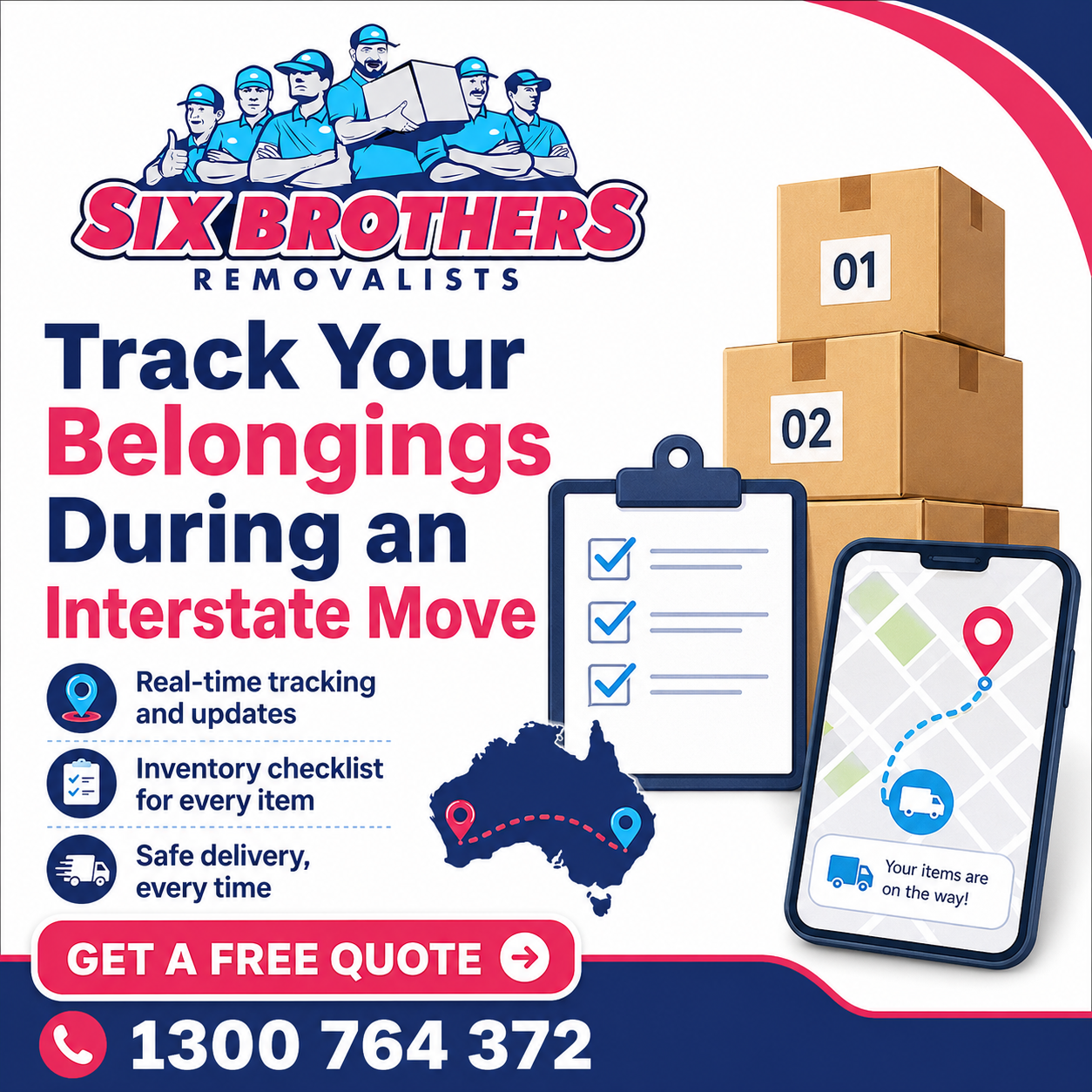
Tracking your belongings during an interstate move starts before a single box is packed. A detailed inventory, a clear labelling system, and the right tracking tools give you full visibility from your Parramatta home to your new address whether that’s Melbourne, Brisbane, or Perth.
Without a tracking plan, items go missing, boxes end up in the wrong rooms, and damage goes unnoticed until weeks later. For homeowners, renters, and business owners moving interstate, knowing exactly where every item is at every stage removes the biggest source of moving stress.
This guide covers everything from building a master inventory and choosing colour-coded labels to using GPS tracking, moving apps, and working with your removalist to maintain a clear chain of custody across state lines.
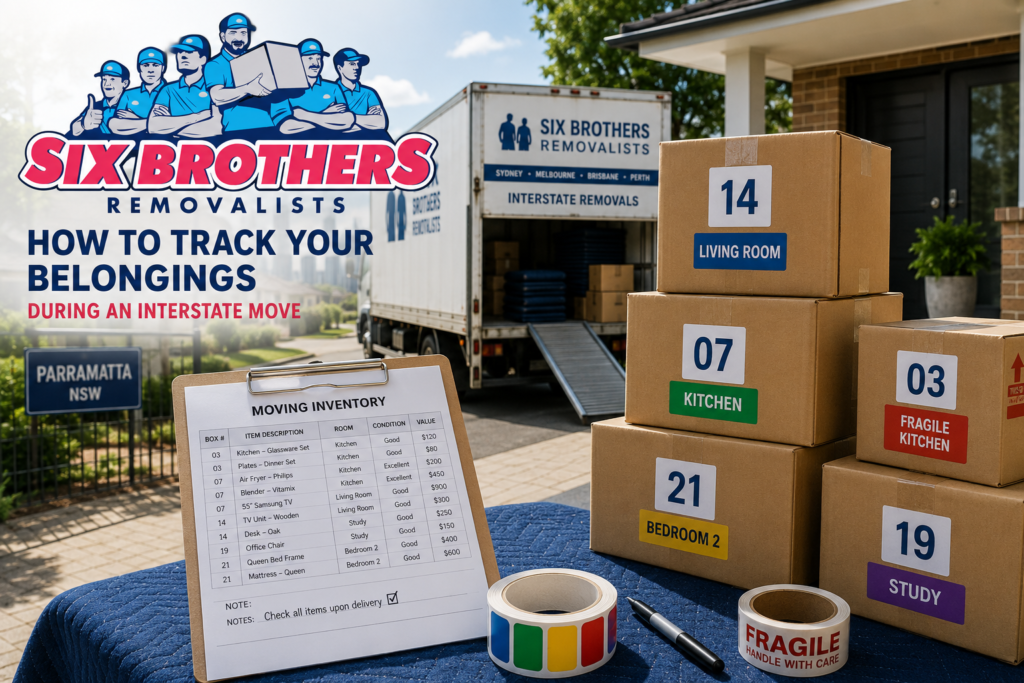
Why Tracking Your Belongings Matters During an Interstate Move
An interstate move is not the same as shifting across Parramatta. Your belongings might travel thousands of kilometres over multiple days, potentially changing trucks during backloading or passing through warehouse storage. The longer the distance and the more handling points involved, the higher the risk of items being misplaced, damaged, or delivered out of sequence.
Tracking matters because it gives you proof. If a box arrives damaged or a piece of furniture doesn’t show up, a documented inventory with photos and numbered labels is the difference between a successful insurance claim and a frustrating dead end.
The Risks of Not Having a Tracking System
Moving without a tracking system means relying entirely on memory. Most people underestimate how many individual items they own. The average Australian household contains thousands of objects, and during the chaos of packing, it’s easy to lose track.
Without documentation, you won’t know something is missing until you unpack — which could be weeks after delivery. By then, proving what was loaded onto the truck becomes nearly impossible. Disputes with removalists, failed insurance claims, and permanent loss of sentimental items are all common outcomes when no tracking system exists.
Fragile items are especially vulnerable. A box of glassware that was packed without being logged might be stacked under heavy furniture. Without labels indicating contents and handling instructions, damage is almost guaranteed.
How Tracking Reduces Stress and Disputes
A clear tracking system turns a chaotic process into a manageable one. When every box has a number, every item has a line on your inventory, and every room has a colour code, you can check deliveries against your list in real time.
This also protects your relationship with your removalist. Professional movers like Six Brothers Removalists use their own documentation processes, but when you bring your own records to the table, both parties have a shared reference point. If something is dented or scratched, you can identify exactly when and where it happened based on your condition notes and photos.
For business owners relocating offices, tracking is even more critical. IT equipment, client files, and specialised machinery all need to arrive at the right location in the right order. A tracking system ensures your business can resume operations quickly rather than spending days searching for essential items.
How to Create a Master Inventory Before You Pack
Your inventory is the foundation of your entire tracking system. Every other method, labels, apps, GPS builds on top of a complete and accurate list of what you own and what’s being moved.
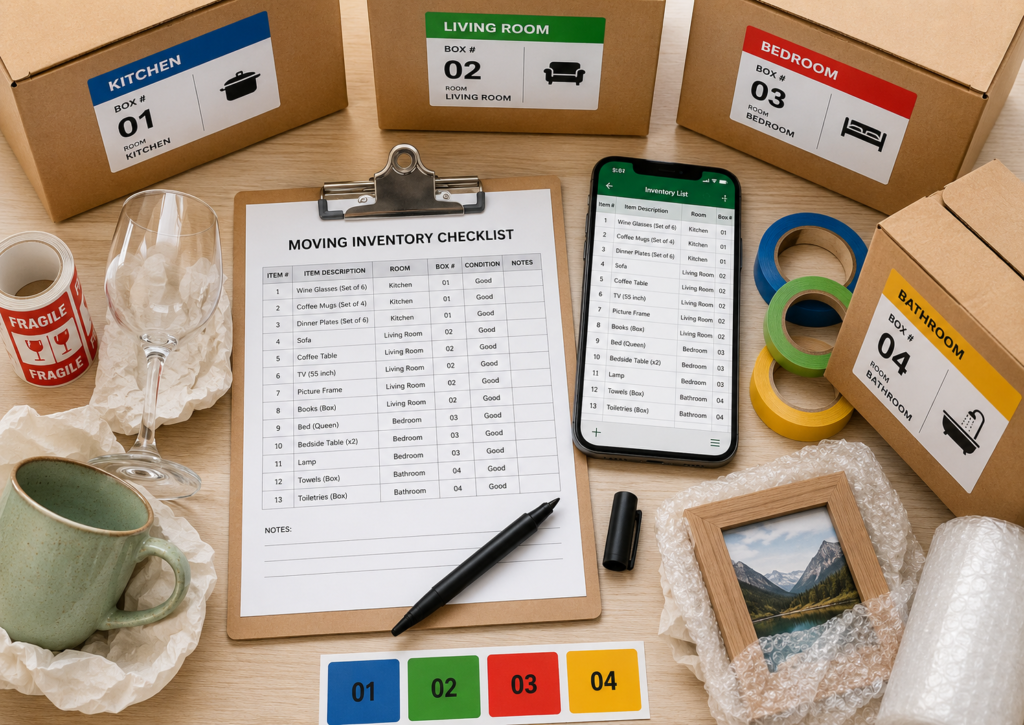
What to Include in Your Moving Inventory
A useful moving inventory goes beyond just listing “kitchen stuff” or “bedroom boxes.” Each entry should include:
- Item description — Be specific. “Samsung 55-inch TV” is useful. “TV” is not.
- Condition notes — Scratches, dents, chips, stains. Note anything that already exists before packing.
- Estimated value — Particularly important for insurance purposes and high-value items.
- Box or container number — Every box gets a unique number. Every item gets assigned to that number.
- Room destination — Where this item should end up at your new address.
For furniture and appliances, include serial numbers and model numbers. For artwork, antiques, or collectibles, include photographs and any appraisal documentation you have.
Room-by-Room Inventory Walkthrough
The most efficient way to build your inventory is to work through your home one room at a time. Start with the room you use least — a spare bedroom or garage — and finish with the kitchen and bathroom, which you’ll need until the last day.
In each room, open every drawer, cupboard, and shelf. Photograph the contents before you start packing. Then list each item as you place it into a box, recording the box number as you go.
This room-by-room approach prevents the common mistake of packing items from multiple rooms into one box. When everything from the study goes into boxes 14 through 19, unpacking at the other end becomes dramatically faster.
For a typical three-bedroom home in Western Sydney, expect to generate an inventory of 200 to 400 line items. It takes time, but this single document becomes your most valuable tool for the entire move.
Digital vs. Paper Inventory Lists
Paper lists work. A clipboard, a printed spreadsheet, and a pen are reliable, require no battery, and can be handed directly to your removalist crew on moving day. The downside is that paper can be lost, damaged, or difficult to search through when you’re looking for a specific item.
Digital inventories offer searchability, cloud backup, and the ability to attach photos directly to each entry. A simple Google Sheet or Excel spreadsheet shared between household members means everyone has access to the same list in real time.
The best approach for most interstate moves is both. Maintain your master list digitally, but print a copy for moving day. Keep the printed version with you — not on the truck — so you can check items off as they’re loaded and again as they’re unloaded.
Best Labelling Systems for Interstate Moving Boxes
Labels are the visual layer of your tracking system. A well-labelled box tells the removalist crew, and you, exactly what’s inside, where it goes, and how it should be handled — all at a glance.
Colour-Coded Labels by Room
Assign a colour to each room in your new home. Blue for the master bedroom. Green for the kitchen. Red for the living room. Yellow for the kids’ room. Use coloured stickers, coloured tape, or coloured markers on every box assigned to that room.
When the truck arrives at your new address, the crew can place boxes in the correct rooms without asking you about every single one. This saves hours during unloading and means you’re not standing in a hallway directing traffic while trying to manage everything else.
Buy your colour-coded supplies before packing begins. A roll of coloured electrical tape for each room costs very little and makes an enormous difference. Place the colour on at least two sides of each box and on the top so it’s visible regardless of how boxes are stacked.
Numbering Every Box and Cross-Referencing Your Inventory
Every box gets a unique number. Write it clearly on all four sides and the top using a thick black marker. This number corresponds to your master inventory, where you’ve listed every item inside that box.
A simple sequential system works best. Box 1 through Box 85, or however many you end up with. Some people prefer a room-based prefix — K-1 for the first kitchen box, BR-3 for the third bedroom box — which adds another layer of organisation.
The cross-reference is what makes this powerful. When box 47 arrives at your new home, you check your inventory, see that it contains your stand mixer, recipe books, and spice rack, and confirm everything is present. If box 47 doesn’t arrive, you know exactly what’s missing and can report it immediately.
Fragile, Heavy, and Priority Labels
Beyond room colours and numbers, certain boxes need additional labels:
- FRAGILE — For glassware, ceramics, electronics, artwork. This tells the crew to place these boxes on top, never underneath heavy items.
- HEAVY — For books, tools, small appliances. Alerts movers to use proper lifting technique and place these at the bottom of stacks.
- THIS SIDE UP — For boxes containing liquids, plants, or items that must remain upright.
- OPEN FIRST — For your essentials box containing toiletries, phone chargers, medications, kettle, and basic kitchen supplies. This box should be last on the truck and first off.
Professional removalists expect and appreciate clear labelling. It helps them do their job better and reduces the chance of accidental damage during loading, transit, and unloading.
Using Technology and Apps to Track Your Move
Technology has transformed how people manage interstate relocations. From inventory apps to GPS tracking, digital tools give you visibility that wasn’t possible even five years ago.
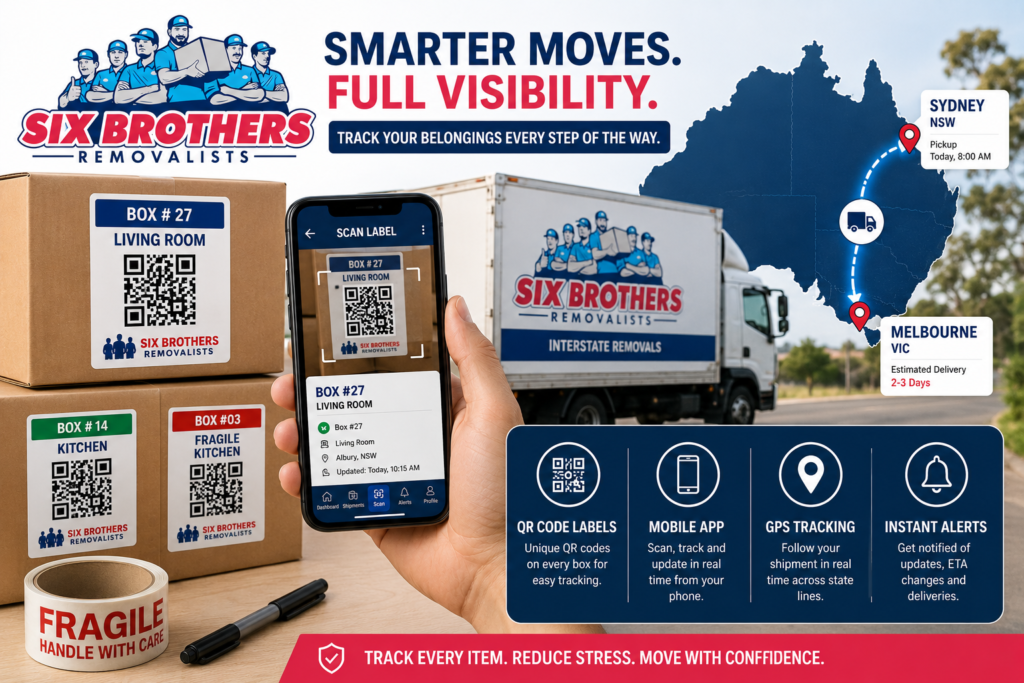
Moving Inventory Apps Worth Using
Several apps are designed specifically for moving inventory management. Sortly lets you photograph items, assign them to boxes, add labels, and generate QR codes. Encircle is popular for creating visual inventories with time-stamped photos, which is particularly useful for insurance documentation.
For a simpler approach, Google Sheets or Apple Notes with photo attachments works well for most household moves. The key is choosing a tool you’ll actually use consistently. A sophisticated app that you abandon after the first room is less useful than a basic spreadsheet you complete for the entire house.
Whichever tool you choose, make sure it syncs to the cloud. Your phone could be lost or broken during the move. Cloud backup means your inventory survives regardless.
QR Codes and Barcode Scanning for Boxes
QR codes take box labelling to the next level. Print a unique QR code for each box and tape it to the outside. When scanned with your phone, the code links directly to that box’s inventory entry — showing you every item inside, the room destination, handling instructions, and condition photos.
Apps like Sortly generate these codes automatically. You can also create them for free using online QR generators linked to your spreadsheet rows.
The practical benefit is speed. Instead of flipping through pages of inventory or scrolling through a long spreadsheet, you scan the code and instantly see what’s in box 34. During unloading, this lets you verify contents in seconds rather than minutes.
For business relocations involving dozens or hundreds of boxes, QR codes are almost essential. They allow multiple team members to scan and verify simultaneously, dramatically speeding up the process.
GPS Tracking and Real-Time Updates from Your Removalist
Many professional removalist companies now offer GPS tracking on their trucks. This lets you see where your belongings are at any point during the interstate journey. For a move from Parramatta to Melbourne or Brisbane, knowing your truck is currently in Albury or on the Pacific Highway provides genuine peace of mind.
Six Brothers Removalists keeps clients informed throughout the transit process with updates on pickup, departure, estimated arrival, and delivery confirmation. This communication chain means you’re never left wondering where your belongings are or when they’ll arrive.
If your removalist doesn’t offer GPS tracking, ask for scheduled check-in calls or text updates at key milestones — departure, halfway point, and one hour before arrival. Most reputable companies are happy to provide this level of communication.
How to Photograph and Document Belongings Before the Move
Photos are your insurance policy within your insurance policy. They provide undeniable evidence of an item’s condition before it was packed and loaded.
Photographing High-Value and Fragile Items
Focus your photography effort on items that are expensive, irreplaceable, or easily damaged. Furniture, electronics, artwork, musical instruments, and antiques should all be photographed from multiple angles.
For furniture, capture close-ups of corners, legs, and surfaces where scratches or dents would be most visible. For electronics, photograph the screen, casing, and any existing marks. For artwork, photograph the frame, glass, and the piece itself.
Include a reference object in your photos — a coin or ruler — to show scale. And make sure your phone’s date and time stamp is accurate, as this metadata becomes important if you need to file a claim.
Documenting Serial Numbers and Condition Reports
For electronics and appliances, record serial numbers and model numbers. These are usually found on a sticker on the back or underside of the item. This information is essential for insurance claims and for proving ownership if items go missing.
Create a simple condition report for each high-value item. Note any pre-existing damage in writing, not just in photos. “Small scratch on top-left corner of dining table, approximately 5cm long” is the kind of detail that protects you later.
Store these records separately from your belongings. Email them to yourself, save them to cloud storage, or keep a USB drive in your personal bag. If your records travel on the truck with everything else, they’re useless if the truck is delayed or items are damaged.
Storing Documentation Safely During Transit
Your moving documentation — inventory lists, condition reports, photos, insurance papers, contracts — should travel with you, not on the moving truck.
Keep a dedicated folder (physical or digital) containing:
- Master inventory with box numbers
- Condition photos and reports
- Insurance policy details and contact numbers
- Removalist contract and quote
- Contact details for your moving coordinator
- Floor plan of your new home with room labels matching your colour codes
If you’re flying to your new city while your belongings travel by road, make sure everything is backed up to cloud storage accessible from any device. Google Drive, Dropbox, or iCloud all work. The goal is redundancy — multiple copies in multiple locations.
Working with Your Removalist to Maintain a Chain of Custody
Your tracking system works best when it integrates with your removalist’s own processes. Professional movers have their own documentation, and aligning your systems creates a seamless chain of custody from door to door.
What to Expect from a Professional Removalist’s Tracking Process
Reputable interstate removalists maintain their own inventory records. At pickup, the crew will typically walk through your home, note the items being loaded, and record their condition on a manifest or job sheet. You should receive a copy of this document.
This manifest is a legal record of what was handed over to the removalist’s care. Check it carefully before signing. Make sure every item is listed and that condition notes are accurate. If the crew writes “good condition” next to your dining table but there’s already a scratch, correct it before you sign.
Six Brothers Removalists provides clear documentation at every stage — from the initial quote through to final delivery confirmation. This paperwork protects both parties and ensures accountability throughout the journey.
Communicating Your Tracking System to the Moving Crew
On moving day, take five minutes to walk the crew leader through your system. Show them your colour codes, explain your numbering, and point out any boxes marked fragile or priority.
Most experienced removalists will appreciate a well-organised client. It makes their job easier and faster. Hand them a printed summary of your colour code system and a copy of your room layout at the new address.
If you have specific requirements — certain items must be loaded last so they’re unloaded first, or particular boxes need to stay upright — communicate these clearly before loading begins. Don’t assume the crew will notice your labels in the rush of a busy moving day. A brief verbal walkthrough reinforces what your labels say.
Checking Items Off During Loading and Unloading
This is where your preparation pays off. Station yourself where you can see items being carried to the truck. As each box or piece of furniture is loaded, check it off your inventory. Note the time if possible.
At the other end, repeat the process during unloading. Check each item against your list. Inspect furniture and fragile boxes for new damage before the crew leaves. Once the truck drives away, proving that damage occurred during transit becomes much harder.
If you notice damage or a missing item, document it immediately. Photograph the damage, note it on the delivery manifest, and inform the crew leader before they leave. This creates a contemporaneous record that supports any subsequent claim.
For large moves, consider having a second person help with the checking process — one person at the truck, one person inside directing placement and verifying contents.
Tracking Belongings During Backloading and Shared Truck Moves
Backloading is a popular cost-saving option for interstate moves from Parramatta, but it introduces additional tracking considerations because your belongings share truck space with other customers’ items.
How Backloading Affects Visibility of Your Items
In a dedicated move, the entire truck carries only your belongings. In a backloading arrangement, your items occupy available space on a truck already making the journey — often alongside one or two other households’ possessions.
This means your belongings may be loaded and unloaded multiple times as the truck makes stops along the route. Each handling point is an opportunity for items to be misplaced or damaged, which makes your labelling and inventory system even more important.
The trade-off is significant cost savings. Backloading from Sydney to Melbourne or Brisbane can cost 30 to 50 percent less than a dedicated truck. But you need to be more diligent about tracking.
Extra Precautions for Shared Loads
When your items share a truck, clear identification becomes critical. Every single box and piece of furniture should have your name, phone number, and destination address clearly marked. Use a distinctive colour of tape that’s different from standard brown packing tape so your items are visually distinct from other customers’ belongings.
Ask your removalist how your items will be separated from others on the truck. Professional companies use dividers, blankets, or designated sections. Six Brothers Removalists manages backloading logistics carefully, ensuring each customer’s belongings are clearly separated and documented throughout the journey.
Take extra photos of how your items are arranged on the truck before departure. If items shift during transit, these photos help identify what belongs to whom and how things were originally positioned.
Confirming Delivery Completeness After a Backload
When your backloaded items arrive, take extra time with the unloading check. Count every box against your inventory before the truck leaves for its next stop. The crew may be on a schedule, but a thorough check at delivery is your last opportunity to identify missing items while the truck and crew are still present.
If your delivery is part of a multi-stop route, understand that the crew needs to move on. Be prepared with your checklist ready and a clear system for rapid verification. Having your inventory sorted by box number makes this process much faster than searching through a disorganised list.
What to Do If Something Goes Missing During an Interstate Move
Even with the best tracking system, things occasionally go wrong. Knowing what to do immediately gives you the best chance of recovering missing items or receiving fair compensation.
Immediate Steps When You Notice a Missing Item
First, check your inventory thoroughly. Confirm the item was actually packed and loaded. It’s surprisingly common to discover that a “missing” item was left behind at the old address, placed in a different box than expected, or stored in a section of the new home you haven’t unpacked yet.
If the item is genuinely missing, contact your removalist immediately. Provide the item description, box number, and any identifying details from your inventory. The sooner you report it, the better the chance of recovery — especially with backloading, where the item may still be on the truck heading to another delivery.
Document the missing item with a written notice to your removalist, including the date you noticed it missing and all relevant inventory details. Keep a copy for your records.
How Your Inventory Helps with Insurance Claims
This is where your preparation becomes invaluable. An insurance claim for a missing or damaged item requires proof of ownership, proof of condition before the move, and proof of value.
Your inventory provides all three. The item description and serial number prove ownership. Your condition photos prove the item was undamaged before packing. Your estimated value, supported by receipts or appraisals, establishes the claim amount.
Without this documentation, insurance claims are often denied or settled for far less than the item’s actual value. The Australian Competition and Consumer Commission (ACCC) advises consumers to document valuable items before any move and to understand their removalist’s liability terms before signing a contract.
Most removalist insurance covers items based on weight rather than value unless you’ve arranged additional cover. Review your removalist’s terms carefully and consider separate transit insurance for high-value items.
Understanding Your Removalist’s Liability and Dispute Process
Australian removalists operate under consumer protection laws, but liability terms vary between companies. Some offer basic cover included in the moving price. Others offer tiered insurance options at additional cost.
Before your move, ask your removalist:
- What is included in standard liability cover?
- What is the claims process and timeframe?
- Is there an option for full replacement value cover?
- What documentation is required to file a claim?
Six Brothers Removalists is transparent about liability terms and works with clients to resolve any issues promptly. Having clear documentation from both sides — your inventory and the removalist’s manifest — makes dispute resolution straightforward and fair.
If a dispute cannot be resolved directly, NSW Fair Trading provides a free mediation service for consumer complaints related to moving services.
Tracking Belongings When Using Storage During Your Move
Many interstate moves involve a storage period — whether you’re waiting for your new home to settle, downsizing temporarily, or staggering your move across weeks. Storage adds another stage where tracking is essential.
Inventory Management for Items Going Into Storage
When splitting your belongings between immediate delivery and storage, create two separate inventory lists — or clearly mark which items on your master list are going to storage and which are going directly to the new address.
Label storage-bound boxes with a distinct marker. A large “S” in addition to your regular numbering system works well. This prevents storage boxes from being accidentally unloaded at your new home and vice versa.
Record the storage facility name, unit number, and access details alongside your storage inventory. If you’re using your removalist’s warehouse storage, get written confirmation of what’s been placed in storage and the expected retrieval date.
Keeping Records Accessible While Items Are in Storage
Items in storage can sit for weeks or months. During that time, you may need to retrieve specific items or check what’s stored. A digital inventory accessible from your phone means you can review your storage contents anytime without visiting the facility.
Organise your storage unit strategically. Place items you might need to access first near the front. Keep your storage inventory updated if you add or remove items. And photograph the unit after loading so you have a visual reference of how items are arranged.
Six Brothers Removalists offers secure storage solutions with clear documentation of stored items, giving you confidence that your belongings are accounted for throughout the storage period.
Interstate Move Tracking Checklist
Use this checklist to ensure your tracking system is complete before moving day.
Two to Four Weeks Before the Move:
- Complete room-by-room inventory with item descriptions and values
- Photograph all high-value and fragile items
- Record serial numbers for electronics and appliances
- Purchase colour-coded labels, markers, and packing supplies
- Set up your digital inventory tool or spreadsheet
- Review your removalist’s liability terms and insurance options
One Week Before the Move:
- Finalise box numbering and cross-reference with inventory
- Print colour code guide for the moving crew
- Print floor plan of new home with room labels
- Back up all documentation to cloud storage
- Prepare your essentials box marked “OPEN FIRST”
- Confirm communication plan with your removalist for transit updates
Moving Day — Loading:
- Walk the crew through your labelling and colour code system
- Check off each item as it’s loaded onto the truck
- Photograph the loaded truck before departure
- Sign the manifest only after verifying accuracy
- Keep all documentation with you, not on the truck
Delivery Day — Unloading:
- Check off each item as it’s unloaded
- Inspect furniture and fragile boxes for damage before the crew leaves
- Note any damage or missing items on the delivery manifest immediately
- Photograph any damage with the item and manifest visible
- Confirm delivery completeness with the crew leader before they depart
Conclusion
Tracking your belongings during an interstate move comes down to preparation, documentation, and communication. A master inventory, clear labelling, condition photos, and the right digital tools give you complete visibility from your current home to your new one no matter how far the journey.
The effort you invest before packing day pays off at every stage. It speeds up loading, simplifies transit monitoring, makes unloading efficient, and protects you if anything goes wrong. Whether you’re moving a family home from Parramatta to Brisbane or relocating an office to Melbourne, a solid tracking system turns uncertainty into confidence.
We handle interstate moves across Australia every week, and we know how much peace of mind comes from knowing exactly where your belongings are. Contact Six Brothers Removalists for a free quote and let our experienced crew manage your move with the care and accountability your belongings deserve.
Frequently Asked Questions
What is the best way to track my belongings during an interstate move?
The most effective method combines a numbered master inventory, colour-coded box labels, condition photos of valuable items, and a digital spreadsheet or moving app backed up to the cloud. Cross-reference every item with its box number so you can verify deliveries against your list during unloading.
Should I use a moving inventory app or a spreadsheet?
Either works well. Apps like Sortly offer features like QR codes and photo attachments built in, while a Google Sheet is free, shareable, and easy to customise. Choose whichever tool you’ll use consistently for every room and every box.
How do I track my belongings if they’re on a backloading truck with other people’s items?
Mark every box and furniture piece with your name, phone number, and destination address. Use a distinctive tape colour so your items are visually separate. Ask your removalist how items are divided on the truck, and count every box against your inventory at delivery before the truck leaves.
Can I get GPS tracking on my moving truck?
Many professional removalists offer GPS tracking or regular transit updates. Ask your moving company before booking whether they provide real-time location tracking or scheduled check-in calls during the journey. Six Brothers Removalists keeps clients informed with updates throughout the interstate transit.
What should I photograph before an interstate move?
Photograph all furniture from multiple angles, focusing on corners, surfaces, and legs. Capture close-ups of electronics, artwork, and fragile items. Include a reference object for scale and ensure your phone’s date stamp is accurate. These photos are essential for insurance claims if damage occurs.
How do I prove an item was damaged during the move and not before?
Your pre-move condition photos with date stamps, written condition notes on your inventory, and the removalist’s signed manifest all serve as evidence. Note any new damage on the delivery paperwork before the crew leaves and photograph it immediately.
What do I do if a box is missing when my interstate move is delivered?
Check your inventory to confirm the box was loaded. Contact your removalist immediately with the box number, contents description, and any identifying labels. For backloaded moves, the box may still be on the truck heading to another stop. File a written notice the same day.
How does transit insurance work for interstate moves in Australia?
Most removalists include basic liability cover calculated by weight, not item value. For valuable belongings, ask about full replacement value cover or arrange separate transit insurance. Review the policy terms, excess amounts, and claims process before your move, and keep all documentation accessible.
Should I create separate inventories for storage and delivery items?
Yes. Clearly mark which items on your master inventory are going to storage and which are being delivered directly. Label storage boxes with a distinct marker and keep a separate list of stored items with the facility name, unit number, and expected retrieval date.
How far in advance should I start my moving inventory?
Start your inventory two to four weeks before moving day. Begin with rooms you use least and work toward the kitchen and bathroom last. A three-bedroom home typically generates 200 to 400 inventory line items, so allow enough time to be thorough without rushing.