


Moving house is already a headache. Then the tax stuff hits.
You buy a new place. The old one hasn’t sold yet. Now you’re sitting on two homes, two sets of bills, and one big question. Does the tax office treat both as your main home? Or does one get slapped with capital gains tax?
That’s where the 6 month rule for property comes in. It’s the ATO’s little window of grace for people stuck mid-move. As Aussies say, you can’t cross the river in two boats. But for six months, the tax office lets you try.
This guide breaks it all down. What the rule means. Who qualifies. How it works in Sydney. And what happens if you blow past the six-month mark. Let’s get into it.

What People Mean by the 6 Month Rule for Property
The 6 month rule for property is an ATO exemption. It lets you treat two homes as your main residence at the same time. But only for up to six months.
Here’s the short version. You buy a new home. You haven’t sold the old one yet. Normally, only one property can be your main residence for tax purposes. The other one cops capital gains tax (CGT) on any profit.
The 6 month rule says, “Hold up. We get it. Moving takes time.” So both homes get the main residence tag for that overlap period.
Why it matters: no CGT on either home during those six months, if you meet the rules.
Most folks mix this up with the 6 year rule. They’re not the same. The 6 year rule is for when you rent out your old home. The 6 month rule is for when you’re literally moving between two homes you own.
Got it? Good. Let’s dig deeper.
Core Purpose of the 6 Month Property Rule
The whole point of this rule is fairness. Life happens. Settlements drag. Buyers fall through. The ATO built in a buffer so honest movers don’t get taxed for bad timing.
Main Residence Rule
Your main residence is the home you live in. The ATO calls it your Principal Place of Residence (PPOR). You can only have one at a time.
When you sell your PPOR, you usually pay zero CGT. That’s the main residence exemption. It’s one of the biggest tax breaks in Australia.
But here’s the catch. The rule says one home. So what if you’re between homes? That’s the problem the 6 month rule solves.
6-Month Overlap Period
During the move, both homes count as your PPOR. That’s the overlap. You get six months max. The clock starts when you buy the new one. It ends when you sell the old one.
Think of it as a grace window. The tax office gives you room to breathe while contracts settle and boxes get packed.
Purpose of the Exemption
Why does this rule even exist? Simple. To stop punishing people for normal life events.
Nobody sells their old home the same day they buy a new one. Settlements lag. Buyers pull out. Banks take forever. The rule protects real people doing real moves. It’s not a loophole. It’s common sense baked into the tax code.
Eligibility Conditions for the 6 Month Property Rule in Sydney
Not every mover gets the exemption. The ATO has rules. Miss one, and the deal’s off.
The New Home
The new home must become your main residence. Not a holiday house. Not an investment flip. Your actual home.
You need to move in. Your stuff needs to be there. Your mail too. The ATO looks at proof you’re really living there. If you buy a place and rent it out straight away, this rule doesn’t help you.
The Old Home
The old home must have been your main residence for at least three months in the 12 months before you moved out. You also must not have used it to earn income in that same 12-month window.
In plain English? You lived there. It was your home. You didn’t Airbnb it or rent it out the year before selling.
Income Restriction
Here’s a big one. You can’t have earned income from the old home for the 12 months before you moved to the new one.
Rented a room on Airbnb last year? That’s income. Leased it to a mate? Still income. The ATO sees through it. Keep the old home clean of rental income, and you’re good.
Key Requirements of the 6 Month Property Rule
Eligibility gets you in the door. Requirements keep you inside.
Income Usage
During the six-month overlap, you still can’t earn income from the old home. No renting, no short-stay listings, no leasing. If you do, the exemption falls apart. The ATO calls that “using it to produce income.” Game over.
Occupancy
You’ve got to actually move into the new home. Not next month. Not “when the reno is done.” As soon as practical.
The ATO looks for things like utility bills, your address on the electoral roll, and where your kids go to school. No occupancy, no exemption. Full stop.
New Property Usage
The new home has to be your main residence too. Lived in. Furnished. Used as home.
Bought the new place to flip? This rule isn’t for you. It’s built for genuine movers, not property traders.
How the 6 Month Property Rule Applies in Sydney
Sydney’s property game is its own beast. Tight settlements. Long chains. High stakes.
Many Sydney movers run into the 6 month rule without knowing it. You buy in Parramatta, sell in Penrith, and suddenly the ATO’s watching. Here’s how it plays out locally.
Exemption Limit
Six months. That’s your cap on the CGT side.
If your old home sells in five months? You’re sweet. Both homes stay exempt.
If it drags to seven? The overlap beyond six months counts for CGT. You might owe tax on a slice of the old home’s gain.
Will it ever feel like enough time? In Sydney, sometimes barely.
Land Tax Exemption
Capital gains tax isn’t the only tax that bites. NSW also has land tax. And there’s a separate six-month concession for that too.
Revenue NSW gives you a land tax break if you own two homes during a move. The two homes will be exempt for the same tax year if the former home was the owner’s exempt residence on the taxing date or the previous taxing date, and the new home became owned within the period of 6 months preceding the taxing date and the new home is used and occupied as the owner’s principal place of residence by the taxing date for the next tax year.
The taxing date in NSW is 31 December. The former home has to be sold within six months of that date to keep the exemption clean.
Two different taxes. Two different six-month windows. Don’t mix them up.
6 Month Rule vs 6 Year Rule for Property

People confuse these two rules all the time. They sound similar. They’re not.
Moving House
The 6 month rule is for active moves. You’ve bought a new home. You’re selling the old one. You live in both (briefly) during the changeover.
This rule says: both homes are exempt from CGT for up to six months.
Temporary Absence
The 6 year rule is different. It’s for when you move out of your home and rent it out.
Under this rule, you can treat a rented-out former home as your main residence for up to six years. You just can’t claim another property as your PPOR at the same time.
Big win for expats and people on long work contracts.
Which One Fits
Ask yourself two questions.
Am I selling the old home or renting it out? If selling, 6 month rule. If renting, 6 year rule.
Do I want to claim a new home as PPOR too? That affects which rule you can use.
Both rules can’t run at once for the same period. Pick one. Or get advice from a tax accountant. Seriously.
What Happens If You Exceed the 6 Month Property Rule?
Life doesn’t always stick to tax deadlines. What if your old home doesn’t sell in time?
Final 6-Month Exemption
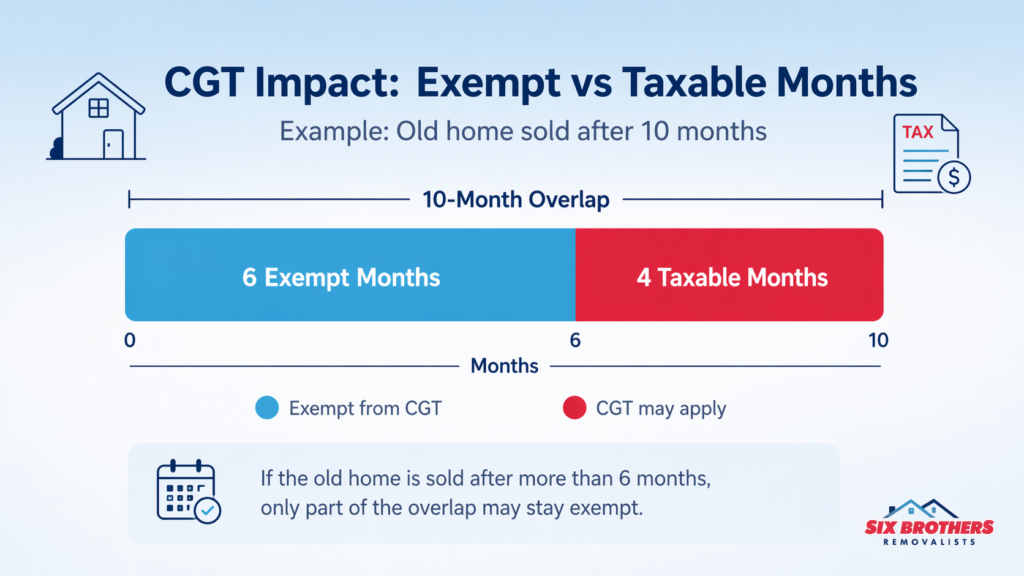
If your move takes longer than six months, the ATO still gives you a window. Only the last six months before you dispose of the old home stay exempt for both. If it takes longer than 6 months to dispose of your old home, the main residence exemption applies to both homes only for the last 6 months before you dispose of your old home.
Before that? You have to pick one home as your main residence. The other pays CGT for that period.
CGT Implications
Let’s say you held both homes for 10 months before selling the old one. The first 4 months? One home cops CGT.
The gain gets worked out on a pro-rata basis. Days held as non-main-residence divided by total days owned. Then that slice of the profit is taxable.
You also get the 50% CGT discount if you’ve owned the property over 12 months. That softens the blow. Still, the tax can bite. A $200,000 gain on a Sydney unit can mean tens of thousands in CGT if you cross the line.
What to Check Before You Sell Property
Selling’s not just about the price tag. It’s about timing, paperwork, and knowing what you’re giving up.
Here’s a quick checklist.
- Settlement dates. Line up your new home purchase and old home sale as tight as you can.
- Income history. Check if you rented out the old home in the last year. That can kill your exemption.
- Occupancy proof. Utility bills, Medicare address, electoral roll. Keep them all.
- Tax residency. Foreign residents can’t claim the main residence exemption after 1 July 2020. Check your status.
- Land tax vs CGT. These are separate. Both have six-month rules. Both matter.
- Get advice. Talk to a tax accountant before signing contracts. Cheap fix, big savings.
And one more thing. Get your move sorted early. A smooth physical move can keep your timing on track. A messy one can push your old home sale past the six-month mark. That’s real money.
Planning Your Move Around the 6 Month Rule
Here’s where the tax stuff meets the real world. If you’re moving in Sydney and chasing the six-month window, your mover matters. A slow truck, a lost box, a delayed handover, any of it can throw your timeline off.
Pick a team that actually shows up on time. Six Brothers Removalists has been doing Sydney moves for years. House, unit, office, the lot.
Call us on 1300 764 372, shoot an email to info@sixbrothersremovalist.com.au, or swing by the office at Suite 1 level 5/58/60 Macquarie St, Parramatta NSW 2150.
We handle the boxes. You handle the tax office. Deal?
Final Word
The 6 month rule for property isn’t fancy. It’s practical. It gives honest movers a buffer so the tax office doesn’t punish normal timing.
Know the rules. Watch the clock. Keep the income off the old place. Move in properly to the new one. Sell the old one within six months. Do those five things, and both homes stay exempt from CGT during the overlap. Miss one, and you’re looking at a tax bill that could’ve been avoided.
Work smart. Move smart. And when in doubt, ring a tax accountant before you sign anything.
Frequently Asked Questions
How long is the 6 month rule exactly?
Six months from when you buy the new home to when you sell the old one. Both can be treated as your main residence during that window.
Can I rent out my old home during the six months?
No. Any rental income breaks the exemption. Keep the old home off the rental market.
What if my old home takes 9 months to sell?
Only the last six months before sale get the full exemption. The first three months go against one home for CGT.
Does this apply in every state?
The CGT rule is federal (ATO). The land tax side varies by state. NSW has its own six-month land tax concession.
Can I use both the 6 month rule and 6 year rule?
Not for the same period. They cover different situations. Pick one based on your plan.